
Tales of elearning at work Evaluating the development
- Slides: 10
Tales of e-learning at work. Evaluating the development of web-based learning environments in Norwegian industrial companies. Lahn, Leif Chr. Institute for educational research/Inter. Media University of Oslo • E-learning in working life. • The NEMLIG-project and its institutional context. • Design of the project • Outcomes: The learning arena prototype and methods for participative design of learning environments. • Experiences of users • Conclusions about work-integrated online learning. ECER 2003 Hamburg
E-learning in working life. Studies of e-learning at the work place • Learning management systems • Course ware marketed as ”work based learning” • Knowledge sharing ECER 2003, Hamburg
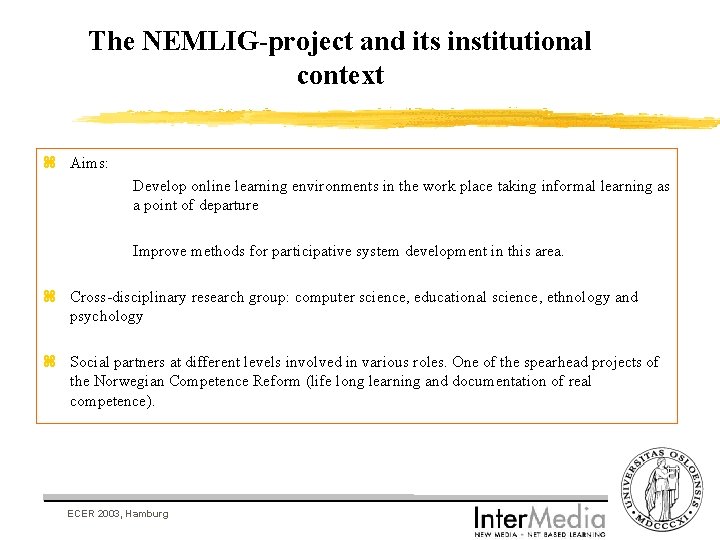
The NEMLIG-project and its institutional context z Aims: Develop online learning environments in the work place taking informal learning as a point of departure Improve methods for participative system development in this area. z Cross-disciplinary research group: computer science, educational science, ethnology and psychology z Social partners at different levels involved in various roles. One of the spearhead projects of the Norwegian Competence Reform (life long learning and documentation of real competence). ECER 2003, Hamburg
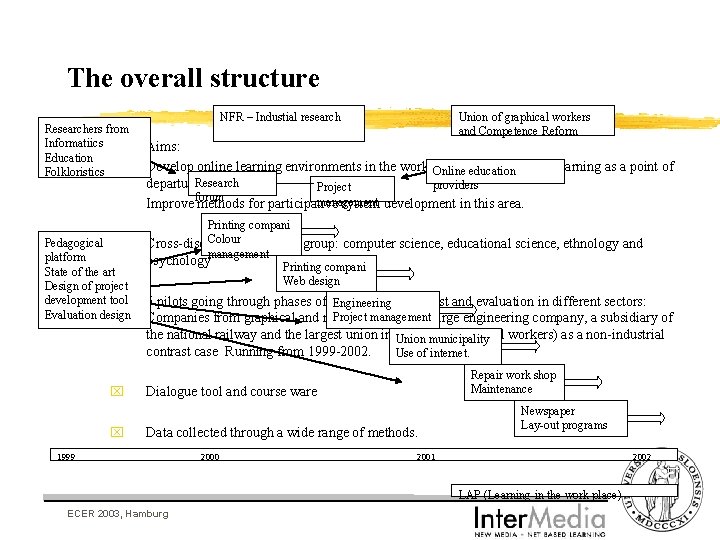
The overall structure Researchers from Informatiics x Education Folkloristics Pedagogical x platform State of the art Design of project development tool x Evaluation design x x NFR – Industial research Union of graphical workers and Competence Reform Aims: Develop online learning environments in the work place informal learning as a point of Onlinetaking education departure. Research providers Project forum management Improve methods for participative system development in this area. Printing compani Colour research group: computer science, educational science, ethnology and Cross-disciplinary management psychology Printing compani Web design 6 pilots going through phases of mapping, Engineeringdesign, test and evaluation in different sectors: Project management Companies from graphical and media industries, a large engineering company, a subsidiary of the national railway and the largest union in Norway (municipal workers) as a non-industrial Union municipality contrast case Running from 1999 -2002. Use of internet. Repair work shop Maintenance Dialogue tool and course ware Data collected through a wide range of methods. 1999 2000 Newspaper Lay-out programs 2001 2002 LAP (Learning in the work place) ECER 2003, Hamburg
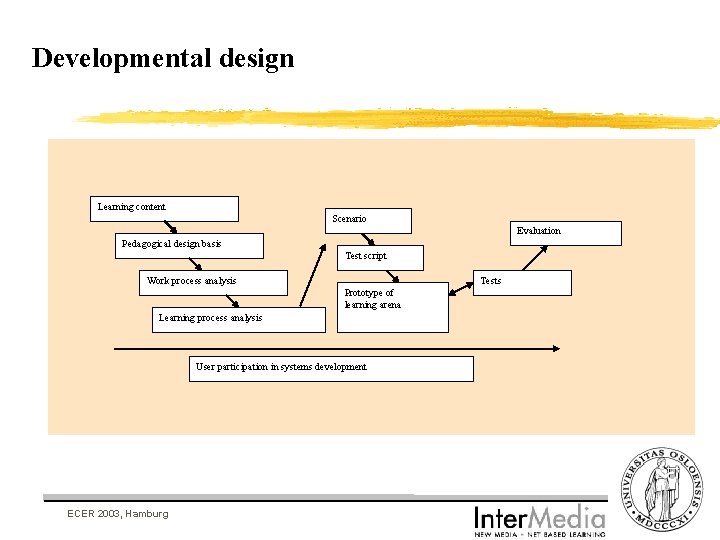
Developmental design Learning content Scenario Evaluation Pedagogical design basis Test script Work process analysis Tests Prototype of learning arena Learning process analysis User participation in systems development ECER 2003, Hamburg
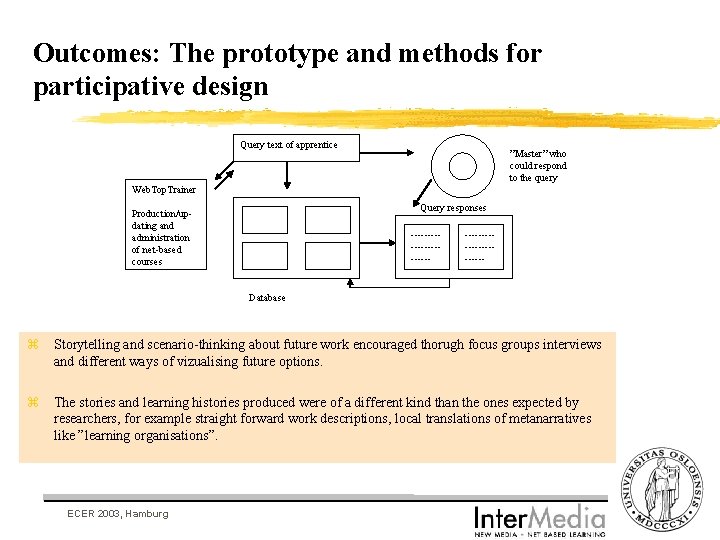
Outcomes: The prototype and methods for participative design Query text of apprentice ”Master” who could respond to the query Web. Top. Trainer Query responses Production/updating and administration of net-based courses ---------------------- Database z Storytelling and scenario-thinking about future work encouraged thorugh focus groups interviews and different ways of vizualising future options. z The stories and learning histories produced were of a different kind than the ones expected by researchers, for example straight forward work descriptions, local translations of metanarratives like ”learning organisations”. ECER 2003, Hamburg
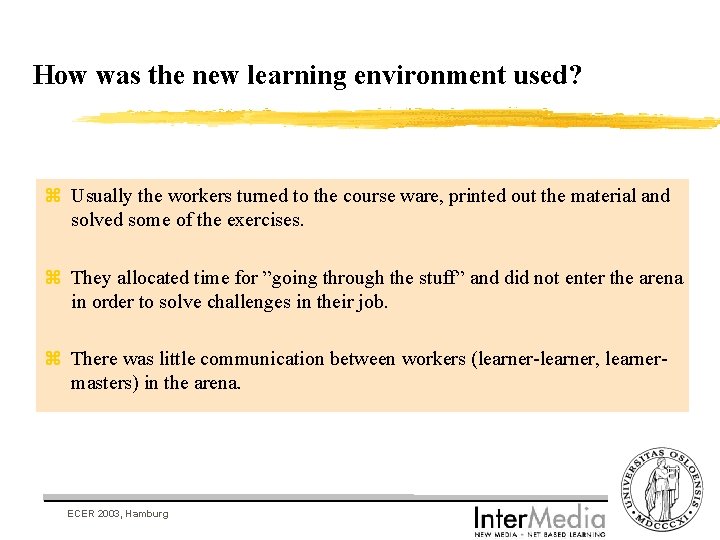
How was the new learning environment used? z Usually the workers turned to the course ware, printed out the material and solved some of the exercises. z They allocated time for ”going through the stuff” and did not enter the arena in order to solve challenges in their job. z There was little communication between workers (learner-learner, learnermasters) in the arena. ECER 2003, Hamburg
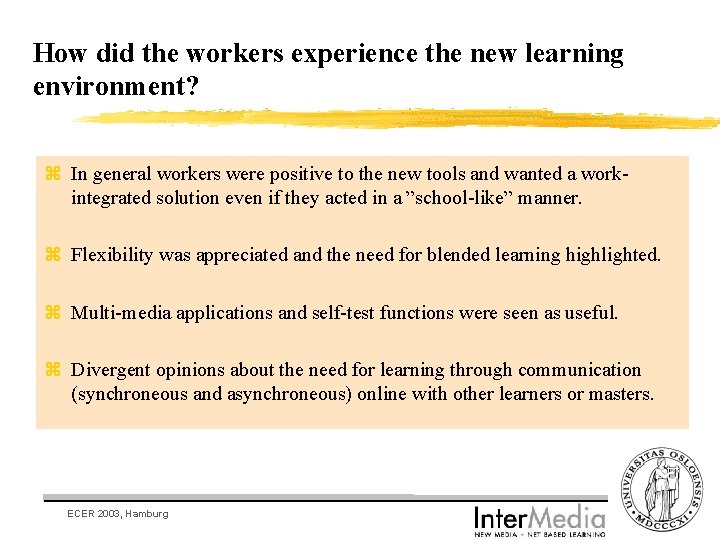
How did the workers experience the new learning environment? z In general workers were positive to the new tools and wanted a workintegrated solution even if they acted in a ”school-like” manner. z Flexibility was appreciated and the need for blended learning highlighted. z Multi-media applications and self-test functions were seen as useful. z Divergent opinions about the need for learning through communication (synchroneous and asynchroneous) online with other learners or masters. ECER 2003, Hamburg
Why did they choose the ”school-like” alternatives? z Dilemmas in work organisation. Specialisation of tasks and expert domains E-learning in the turmoil of business innovations Trust and interorganisational communication. z Dilemmas in user-friendly design. On-line communication and visual problem solving. Learning tools need to be robust and transparent. Little tolerance for trial and error. Particpative construction of the learning content dependent on ”critical mass” z Dilemmas in participative design methodology. Linear models and bottom-up processes Participative methods as imposed narratives ECER 2003, Hamburg
Participative design for work-based (e)-learning z Parallel learning z Anchoring z Dilemmas and ways out z Implementation and development as continuous activities z Integrated evaluation ECER 2003, Hamburg