
Talent Management Talent Acquisition and Recruitment Process Classification
- Slides: 37
Talent Management
• Talent Acquisition and Recruitment Process • Classification and Compensation • Workforce Analytics • FLSA Changes • Employment of Relatives • Dual Career Network
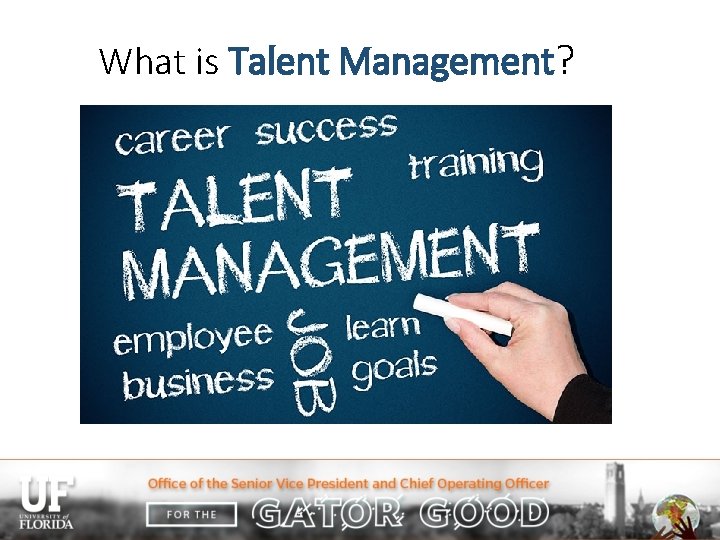
What is Talent Management?
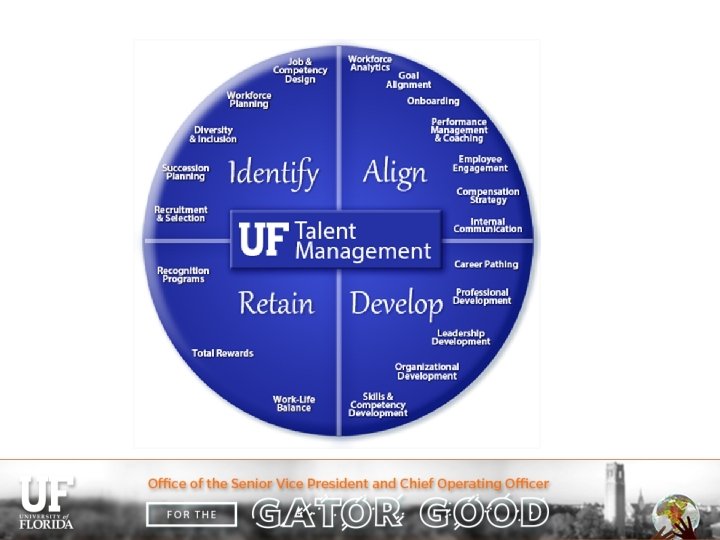
What is Talent Management? Talent Management is a set of integrated organizational HR processes designed to attract, develop, motivate, and retain productive, engaged employees. The goal of talent management is to create a high-performance, sustainable organization that meets its strategic and operational goals and objectives.
The University of Florida is a federal contractor and an equal opportunity employer. We are required to perform competitive positions for all vacancies Search Committee’s are required as a part of shared governance for director level and above. Faculty Search Committee Tutorial is available on my. Training and companion toolkit is available.
Classification and Compensation
UF as an Employer • On any given payday, approximately 29, 000 employees will receive a “paycheck” • Includes student assistants and temporary employees • UF’s average biweekly payroll is $49, 507, 000 • FY 13 payroll (salary only) was $1. 3 billion
UF Employment Groups Staff Appointments: • TEAMS (~8, 000) • Technical, Executive, Administrative, and Managerial Support • USPS (~769) • University Support Personnel System • No new USPS after 1/7/03 • OPS • Other Personnel Services/Temporary
Classification System § Provides a framework for HR objectives and activities while ensuring the university’s employment practices comply with federal and state laws § Helps ensure staff positions that perform similar duties and responsibilities are grouped together through a series of job titles § Facilitates other HR functions such as recruitment and staffing, pay administration, training and development, and performance management by grouping positions
Why Is It Important? • Helps us maintain an “equal pay for equal work” policy—thus avoiding inequitable treatment of employees • Aids in recruitment by establishing meaningful qualification requirements and salaries • Aids in clarifying and improving organizational structure • Facilitates better employee-management relations by ensuring clarity about the expected job
UF “On Target” Classification Project • Designed to identify job titles for TEAMS employees that more accurately reflect what they do • When implemented: o More meaningful job titles o Clearer career paths because similar jobs can be more easily grouped to show potential promotional opportunities o Training and development plans aligned with job classifications to help employees get the training they need o More meaningful performance evaluations tied to the jobs being performed o Will help recruit great candidates when jobs are vacant because qualified applicants will more readily understand what our job titles mean
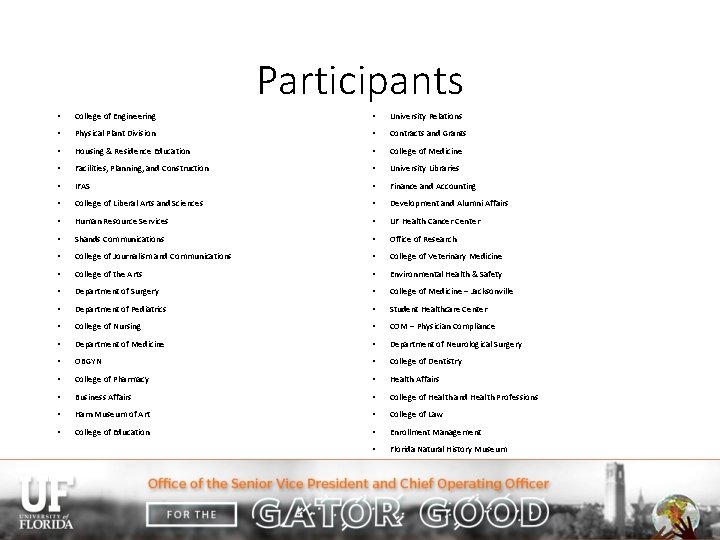
Participants • College of Engineering • University Relations • Physical Plant Division • Contracts and Grants • Housing & Residence Education • College of Medicine • Facilities, Planning, and Construction • University Libraries • IFAS • Finance and Accounting • College of Liberal Arts and Sciences • Development and Alumni Affairs • Human Resource Services • UF Health Cancer Center • Shands Communications • Office of Research • College of Journalism and Communications • College of Veterinary Medicine • College of the Arts • Environmental Health & Safety • Department of Surgery • College of Medicine – Jacksonville • Department of Pediatrics • Student Healthcare Center • College of Nursing • COM – Physician Compliance • Department of Medicine • Department of Neurological Surgery • OBGYN • College of Dentistry • College of Pharmacy • Health Affairs • Business Affairs • College of Health and Health Professions • Harn Museum of Art • College of Law • College of Education • Enrollment Management • Florida Natural History Museum
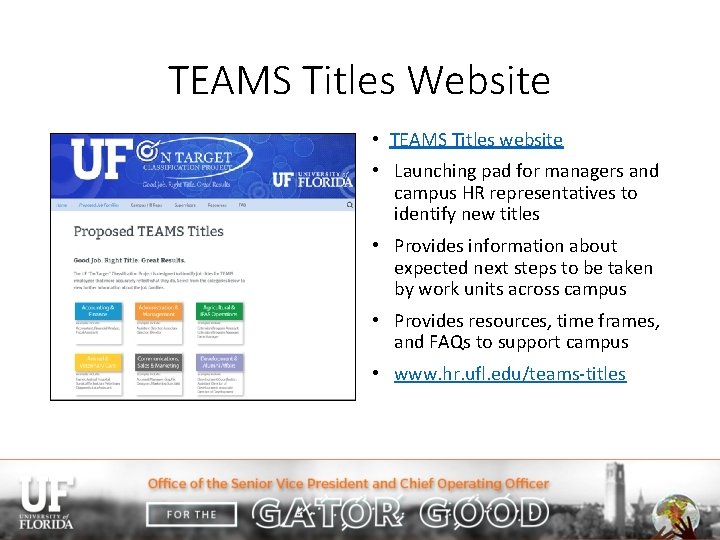
TEAMS Titles Website • TEAMS Titles website • Launching pad for managers and campus HR representatives to identify new titles • Provides information about expected next steps to be taken by work units across campus • Provides resources, time frames, and FAQs to support campus • www. hr. ufl. edu/teams-titles
Pay Mechanisms • HRS administers various compensation mechanisms • • • Reclassifications Special pay increases On-call pay Callbacks Shift differential • We’ll also review UF’s flextime policy
Reclassifications • When there is a significant change in the duties assigned to a position, a reclassification should be requested • Focus on duties and responsibilities assigned to a position, rather than the individual occupying the position • The employee should already be performing the work for a minimum of 6 months
Special Pay Increases (SPIs) • Departments may request Special Pay Increases, or SPIs, for the following circumstances: • Counter offers • An employee has received an offer from another organization • Market equity • Can be internal or external • Increased job responsibility
Special Pay Increases (SPIs) • In all cases, an SPI form must be completed and requires approval from the respective vice president of each budgetary unit as well as the VP for Human Resource Services • Using the Special Pay Increase Request • www. hr. ufl. edu/class_comp/forms/spi. pdf • Any special circumstances should be noted on the form • Effective date=the date the VP for HR approves the SPI
HR Analytics • HRS can provide information related to: • What’s the average pay on campus for a particular classification? • What’s an appropriate range to use when advertising a vacancy that takes into account appropriate market data? • What’s an appropriate amount for a Special Pay Increase, or SPI – market, counter-offer, additional duties (temporary or permanent)? • University headcount, demographic, and retirement data. • www. analytics. erp. ufl. edu
Fair Labor Standards Act • Non-exempt - (hourly) • Not exempt from the FLSA • Must be compensated for hours worked over 40/workweek with overtime (1. 5) • UF’s workweek: Friday–Thursday • NOT calculated on biweekly period • “Exempt” • Exempt from, or not covered by, the provisions of the FLSA
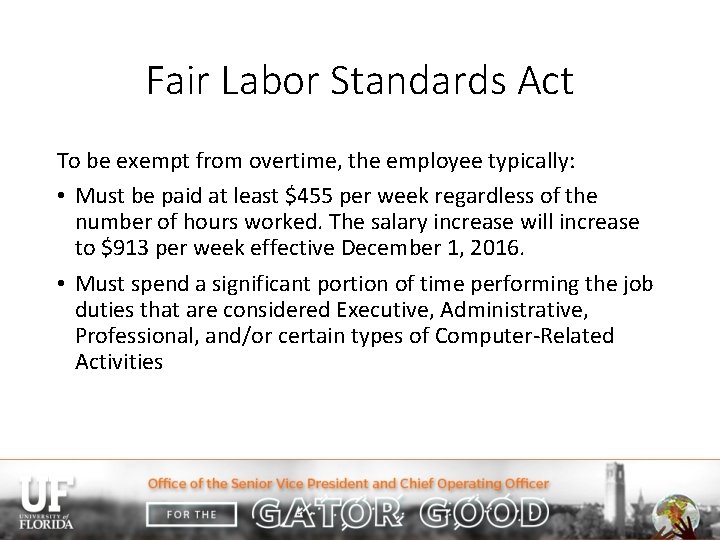
Fair Labor Standards Act To be exempt from overtime, the employee typically: • Must be paid at least $455 per week regardless of the number of hours worked. The salary increase will increase to $913 per week effective December 1, 2016. • Must spend a significant portion of time performing the job duties that are considered Executive, Administrative, Professional, and/or certain types of Computer-Related Activities
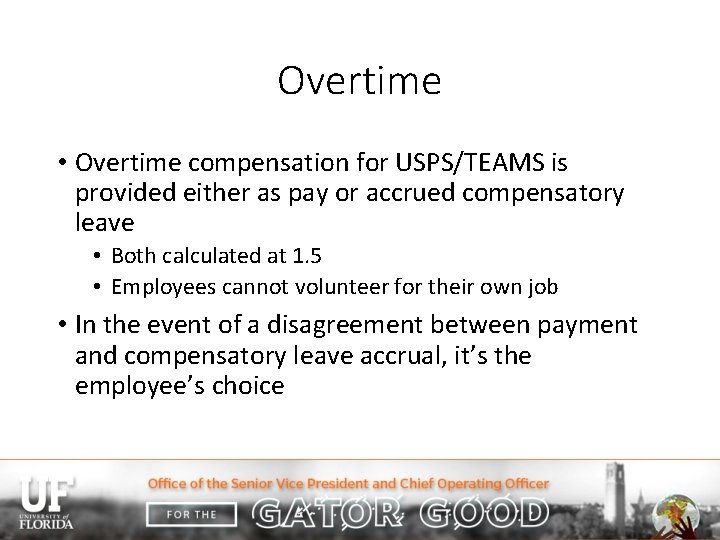
Overtime • Overtime compensation for USPS/TEAMS is provided either as pay or accrued compensatory leave • Both calculated at 1. 5 • Employees cannot volunteer for their own job • In the event of a disagreement between payment and compensatory leave accrual, it’s the employee’s choice
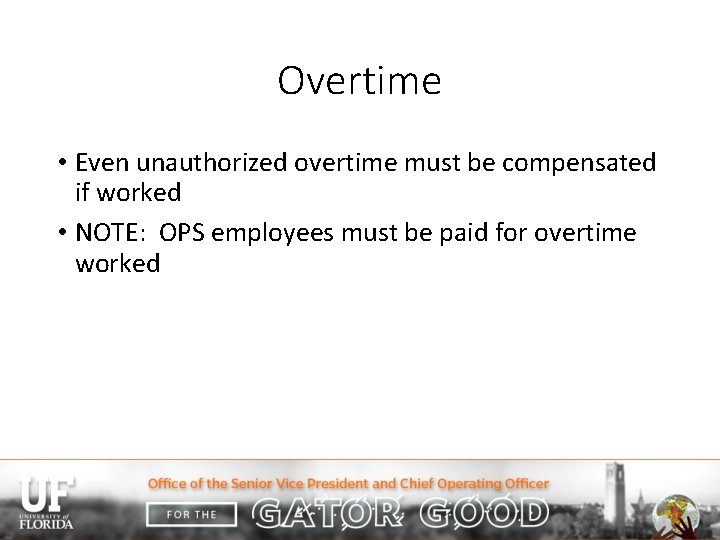
Overtime • Even unauthorized overtime must be compensated if worked • NOTE: OPS employees must be paid for overtime worked
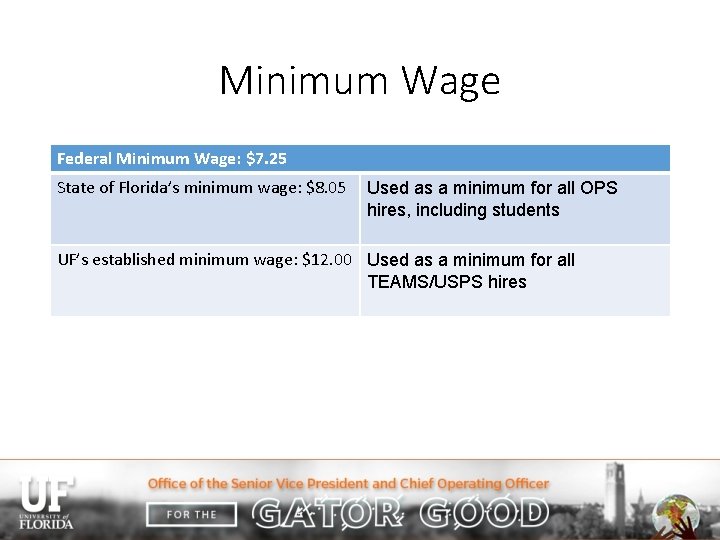
Minimum Wage Federal Minimum Wage: $7. 25 State of Florida’s minimum wage: $8. 05 Used as a minimum for all OPS hires, including students UF’s established minimum wage: $12. 00 Used as a minimum for all TEAMS/USPS hires
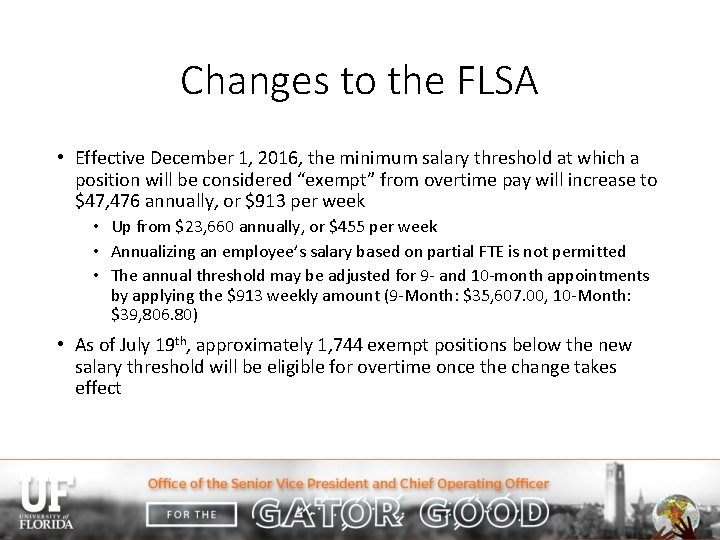
Changes to the FLSA • Effective December 1, 2016, the minimum salary threshold at which a position will be considered “exempt” from overtime pay will increase to $47, 476 annually, or $913 per week • Up from $23, 660 annually, or $455 per week • Annualizing an employee’s salary based on partial FTE is not permitted • The annual threshold may be adjusted for 9 - and 10 -month appointments by applying the $913 weekly amount (9 -Month: $35, 607. 00, 10 -Month: $39, 806. 80) • As of July 19 th, approximately 1, 744 exempt positions below the new salary threshold will be eligible for overtime once the change takes effect
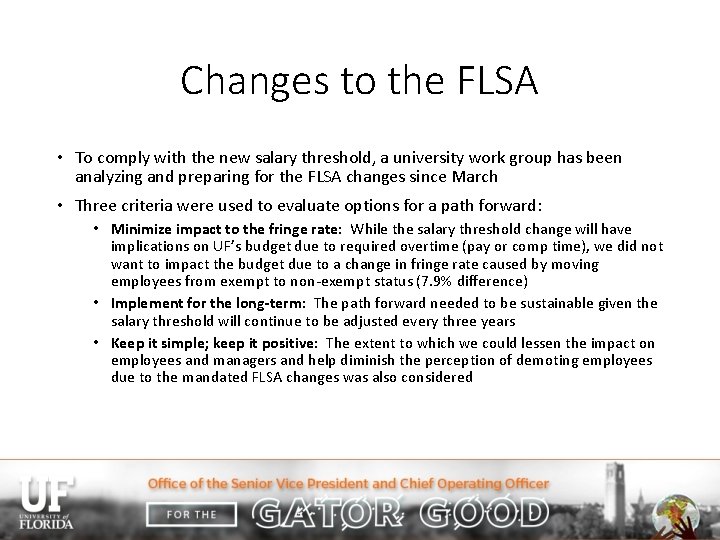
Changes to the FLSA • To comply with the new salary threshold, a university work group has been analyzing and preparing for the FLSA changes since March • Three criteria were used to evaluate options for a path forward: • Minimize impact to the fringe rate: While the salary threshold change will have implications on UF’s budget due to required overtime (pay or comp time), we did not want to impact the budget due to a change in fringe rate caused by moving employees from exempt to non-exempt status (7. 9% difference) • Implement for the long-term: The path forward needed to be sustainable given the salary threshold will continue to be adjusted every three years • Keep it simple; keep it positive: The extent to which we could lessen the impact on employees and managers and help diminish the perception of demoting employees due to the mandated FLSA changes was also considered
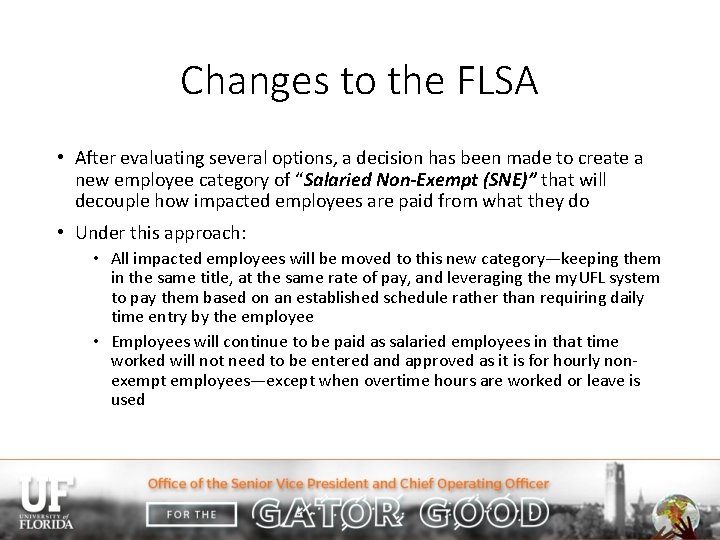
Changes to the FLSA • After evaluating several options, a decision has been made to create a new employee category of “Salaried Non-Exempt (SNE)” that will decouple how impacted employees are paid from what they do • Under this approach: • All impacted employees will be moved to this new category—keeping them in the same title, at the same rate of pay, and leveraging the my. UFL system to pay them based on an established schedule rather than requiring daily time entry by the employee • Employees will continue to be paid as salaried employees in that time worked will not need to be entered and approved as it is for hourly nonexempt employees—except when overtime hours are worked or leave is used
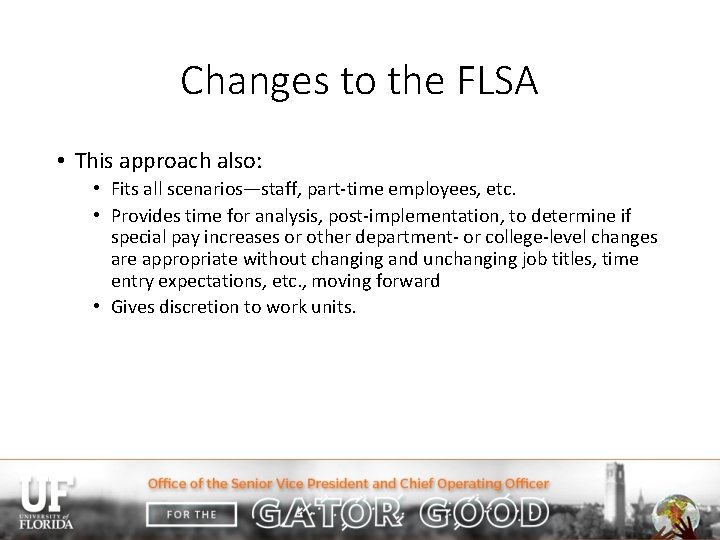
Changes to the FLSA • This approach also: • Fits all scenarios—staff, part-time employees, etc. • Provides time for analysis, post-implementation, to determine if special pay increases or other department- or college-level changes are appropriate without changing and unchanging job titles, time entry expectations, etc. , moving forward • Gives discretion to work units.
Changes to the FLSA • As with all proposals of this nature, there are some consequences: • In certain cases, some employees in the same job title will be eligible for overtime, while other coworkers will not • This approach could encourage underreporting of hours worked because employees in the SNE category will not be required to enter hours worked, unless they work extra hours (or use accrued leave) • Must be addressed through communication and training of the employees and their supervisors to ensure institutional compliance • Employees and supervisors are responsible for ensuring that all time is entered accurately and reflect all hours worked.
Changes to the FLSA • As with all proposals of this nature, there are some consequences: • In certain cases, some employees in the same job title will be eligible for overtime, while other coworkers will not • This approach could encourage underreporting of hours worked because employees in the SNE category will not be required to enter hours worked, unless they work extra hours (or use accrued leave) • Must be addressed through communication and training of the employees and their supervisors to ensure institutional compliance • Employees and supervisors are responsible for ensuring that all time is entered accurately and reflect all hours worked.
Employment of Relatives • The University of Florida is committed to a policy of employment and advancement on qualifications and merit and does not discriminate in favor of or in opposition to the employment of relatives. • UF Regulation 1. 009 specifically prohibits the appointment of relatives or persons living in the same household to any position where a direct or indirect supervisory relationship would exist between relatives or would create a perceived or actual conflict of interest. This includes, but is not limited to appointment, compensation, assignment of work, evaluation, grants administration and sponsored research projects, and financial authority or transactions.
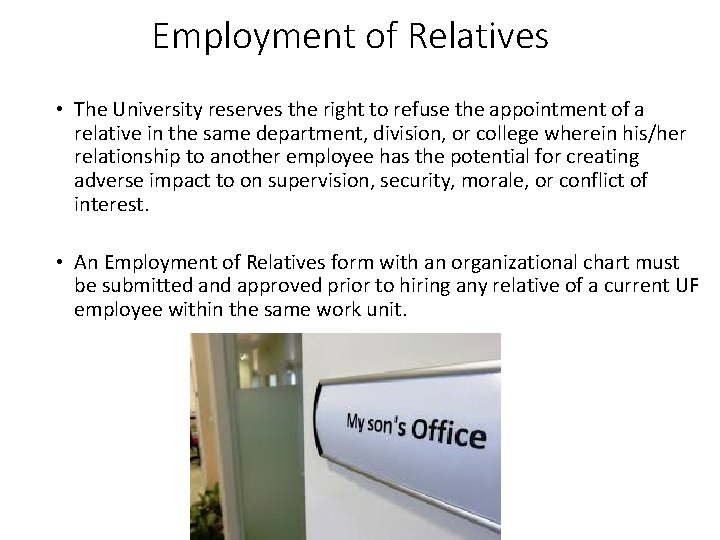
Employment of Relatives • The University reserves the right to refuse the appointment of a relative in the same department, division, or college wherein his/her relationship to another employee has the potential for creating adverse impact to on supervision, security, morale, or conflict of interest. • An Employment of Relatives form with an organizational chart must be submitted and approved prior to hiring any relative of a current UF employee within the same work unit.
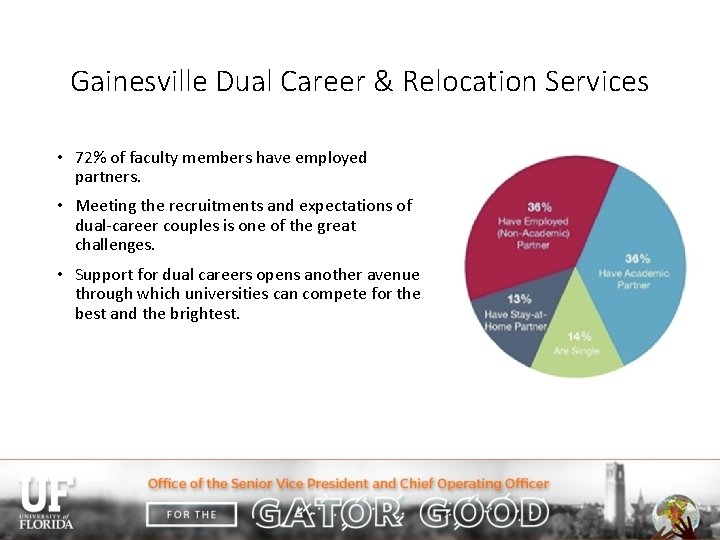
Gainesville Dual Career & Relocation Services • 72% of faculty members have employed partners. • Meeting the recruitments and expectations of dual-career couples is one of the great challenges. • Support for dual careers opens another avenue through which universities can compete for the best and the brightest.
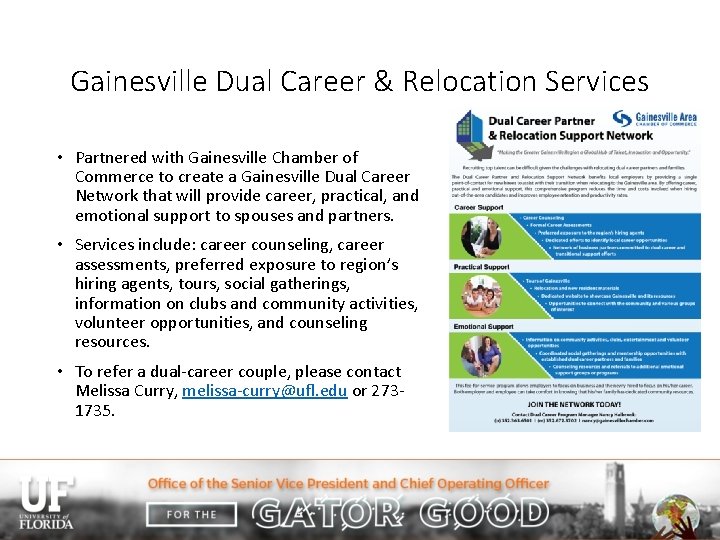
Gainesville Dual Career & Relocation Services • Partnered with Gainesville Chamber of Commerce to create a Gainesville Dual Career Network that will provide career, practical, and emotional support to spouses and partners. • Services include: career counseling, career assessments, preferred exposure to region’s hiring agents, tours, social gatherings, information on clubs and community activities, volunteer opportunities, and counseling resources. • To refer a dual-career couple, please contact Melissa Curry, melissa-curry@ufl. edu or 2731735.
• Participated to launch of a relocation guide for the Gainesville area. • Collaborated with Advantage Publishing, Gainesville, Chamber of Commerce, Santa Fe College, and local companies to create guide. • www. guidetogreatergainesville. com
Questions? melissa-curry@ufl. edu Compensation@ufl. edu (352) 392 -2477