
Talent Management for a New Generation Peter Cappelli
- Slides: 44
Talent Management for a New Generation Peter Cappelli Professor and Director Center for Human Resources The Wharton School
Why should we care about managing talent? n. Labor is about 65% costs of typical business n. Performance differences are huge n. Employees and how they’re managed is source of most competencies
Why should we “manage” talent? Why not just hire what we need when we need it?
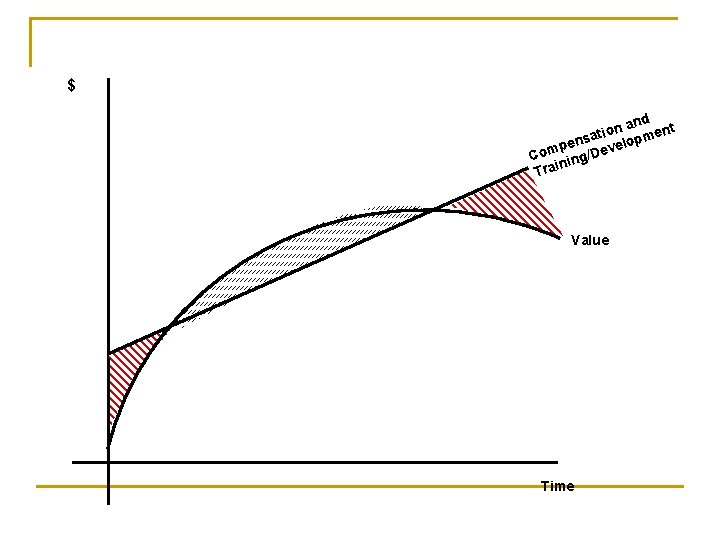
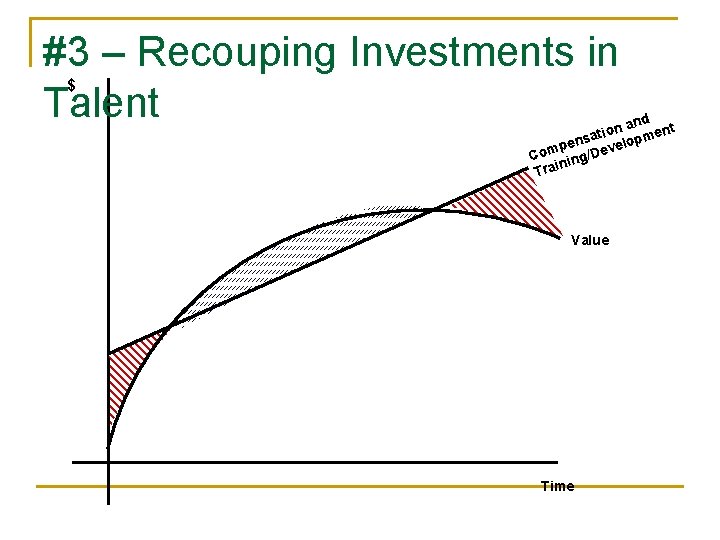
The Finances of Managing Talent and Internal Development n In the traditional model, supply meant internal development q q q n Up-front investment in candidates, recouped over time through improved performance Can make money this way Can also lose money if lose the investment Outside hiring, pay as you go q Can’t earn a return or be a source of advantage
$ d n an ent o i t a ens evelopm p m Co ing/D n Trai Value Time
The rise of the great corporate career Different practices made sense at different times n Open markets in the early years n n 1950 s-’ 60 s average Fortune 500 exec had been with their company 24 years The typical career path… q q q 12 -18 mo training 18 -21 month job rotation “Hi potential” program – accelerated promotions 75% execs had > 5 yrs on corporate staff 40% execs began in marketing/sales Detailed workforce and succession plans – 15 years out
Which is the Kindergarten Report Card Which is the Performance Appraisal? System A Rank candidates on a scale of…Very Satisfactory – Unsatisfactory • Dependability • Stability • Imagination • Originality • Self-expression • Health and Vitality • Ability to plan and control • Cooperation System B Rank candidates on a scale of…Satisfactory – Improving – Needs Improvement • Can be depended upon • Contributes to the good work of others • Accepts and uses criticism • Thinks critically • Shows initiative • Plans work well • Physical resistance • Self-expression • Creative ability
What Is Different Now? The lifetime model breaking up The notion of a secure, long-term career is harder to imagine. President/CEO tenure was: 10 yrs in 1950 s; 5 years in 1960 s; <3 yrs now CEO turnover (and exec team) up 53% since ’ 95 q q q Rising 2 x as fast in UK and Europe as in US Firing for performance biggest cause, 2 x as retirement 54% VP vacancies and above have an outside search Restructuring is non-stop q q q AMA survey – 49% have downsizings even during the “boom” years Fortune 500 now employ ½ as many as 20 years ago 63 percent cutting in one division and expanding in another Cuts happened faster in this downturn than any time before Employee Tenure: Down with employer/ Up with occupation
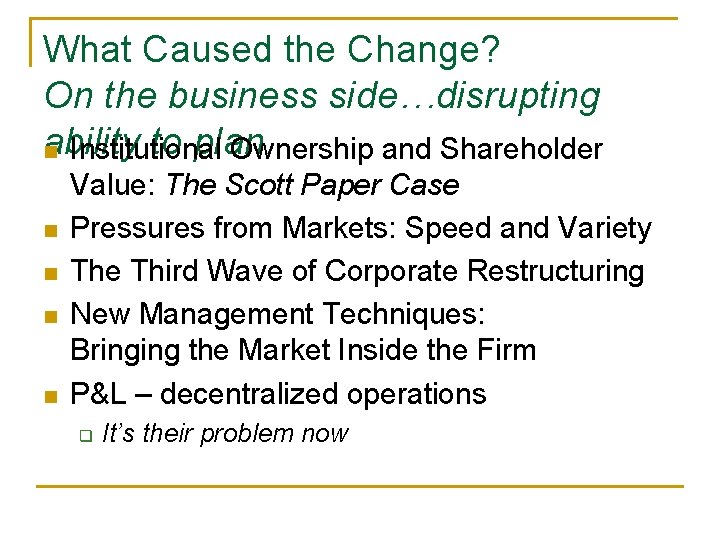
What Caused the Change? On the business side…disrupting ability to plan. n Institutional Ownership and Shareholder n n Value: The Scott Paper Case Pressures from Markets: Speed and Variety The Third Wave of Corporate Restructuring New Management Techniques: Bringing the Market Inside the Firm P&L – decentralized operations q It’s their problem now
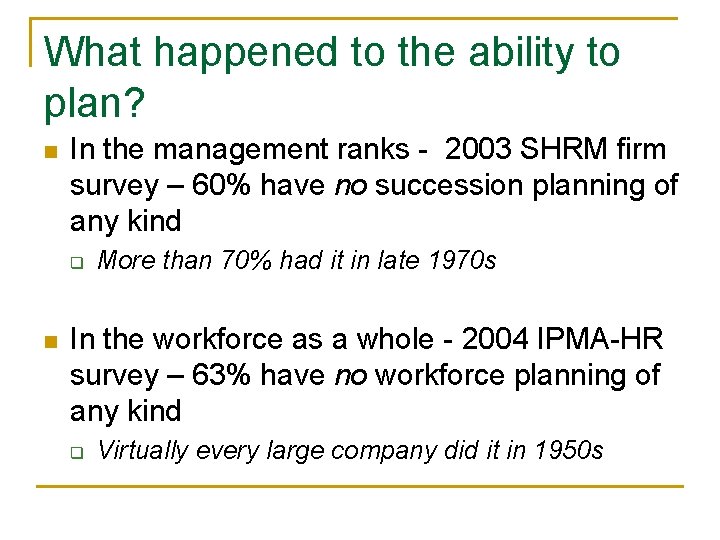
What happened to the ability to plan? n In the management ranks - 2003 SHRM firm survey – 60% have no succession planning of any kind q n More than 70% had it in late 1970 s In the workforce as a whole - 2004 IPMA-HR survey – 63% have no workforce planning of any kind q Virtually every large company did it in 1950 s
What changed on the employee side? How did they respond to end of lifetime employment?
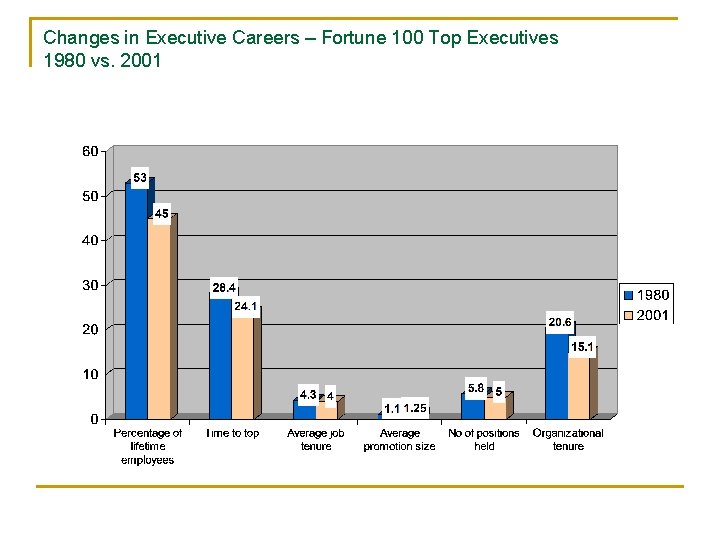
Changes in Executive Careers – Fortune 100 Top Executives 1980 vs. 2001
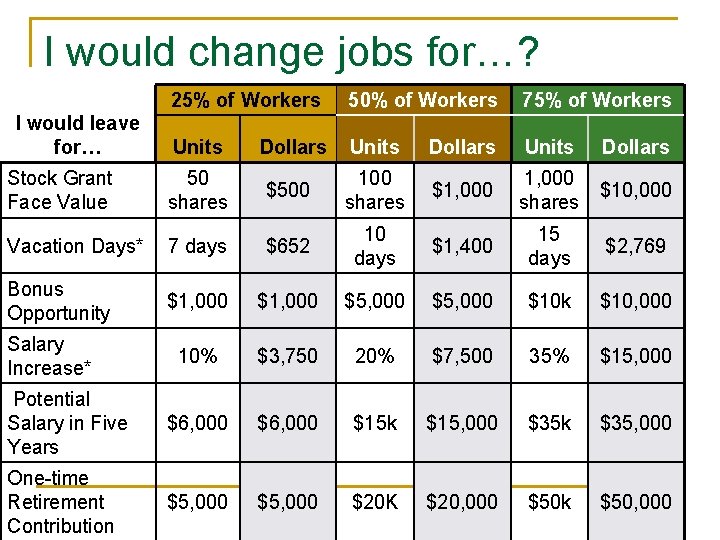
I would change jobs for…? 25% of Workers 50% of Workers 75% of Workers Units Dollars Stock Grant Face Value 50 shares $500 100 shares $1, 000 shares $10, 000 Vacation Days* 7 days $652 10 days $1, 400 15 days $2, 769 Bonus Opportunity $1, 000 $5, 000 $10 k $10, 000 10% $3, 750 20% $7, 500 35% $15, 000 Potential Salary in Five Years $6, 000 $15 k $15, 000 $35 k $35, 000 One-time Retirement Contribution $5, 000 $20 K $20, 000 $50 k $50, 000 I would leave for… Salary Increase*
Does the Next Generation Really Have Different Attitudes Toward What do they expect from jobs? Employers? How should we manage them?
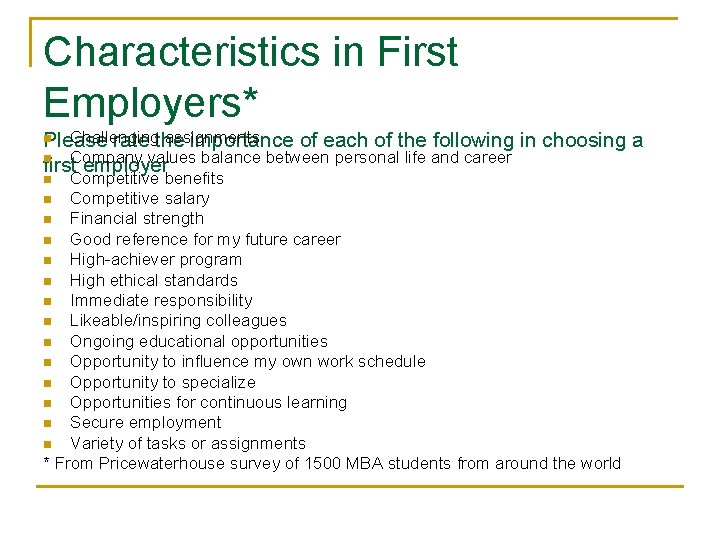
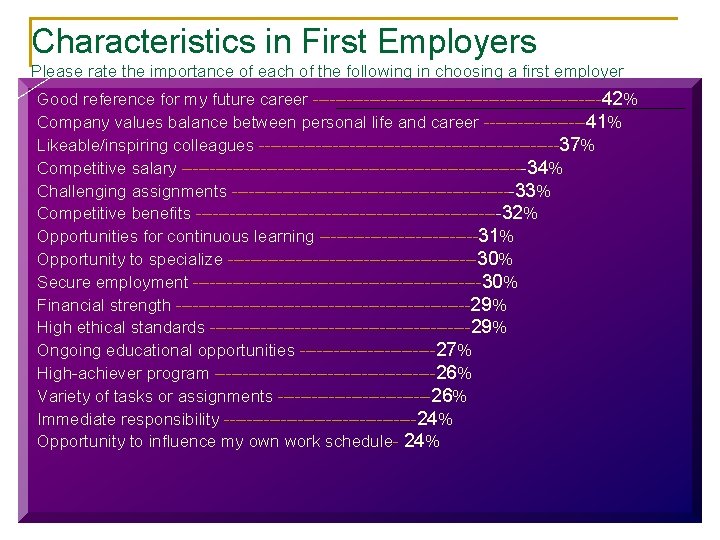
Characteristics in First Employers* Challenging assignments Please rate the importance of each of the following in choosing a n values balance between personal life and career first. Company employer n Competitive benefits n Competitive salary n Financial strength n Good reference for my future career n High-achiever program n High ethical standards n Immediate responsibility n Likeable/inspiring colleagues n Ongoing educational opportunities n Opportunity to influence my own work schedule n Opportunity to specialize n Opportunities for continuous learning n Secure employment n Variety of tasks or assignments * From Pricewaterhouse survey of 1500 MBA students from around the world n
Characteristics in First Employers Please rate the importance of each of the following in choosing a first employer Good reference for my future career --------------------------42% Company values balance between personal life and career ---------41% Likeable/inspiring colleagues ---------------------------37% Competitive salary -------------------------------34% Challenging assignments -------------------------33% Competitive benefits ---------------------------32% Opportunities for continuous learning --------------31% Opportunity to specialize ----------------------30% Secure employment --------------------------30% Financial strength --------------------------29% High ethical standards -----------------------29% Ongoing educational opportunities ------------27% High-achiever program --------------------26% Variety of tasks or assignments --------------26% Immediate responsibility -----------------24% Opportunity to influence my own work schedule- 24%
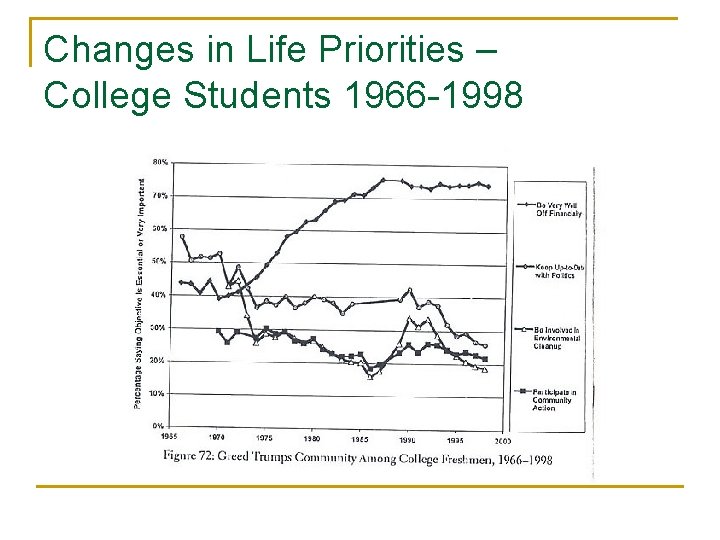
Changes in Life Priorities – College Students 1966 -1998
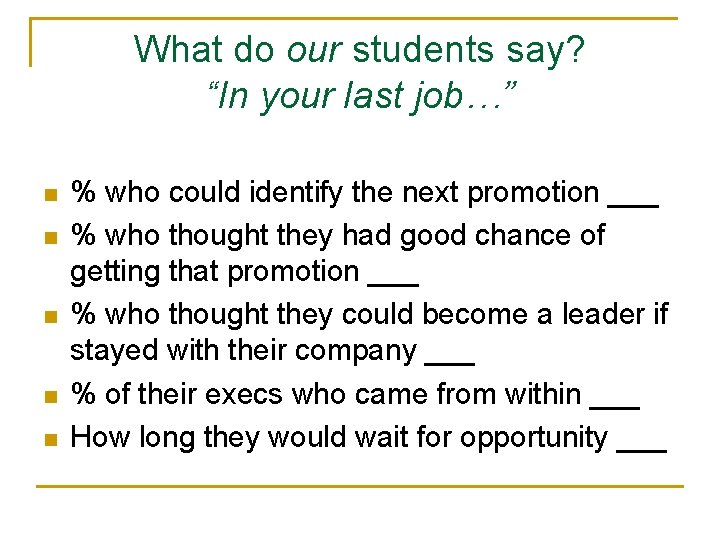
What do our students say? “In your last job…” n n n % who could identify the next promotion ___ % who thought they had good chance of getting that promotion ___ % who thought they could become a leader if stayed with their company ___ % of their execs who came from within ___ How long they would wait for opportunity ___
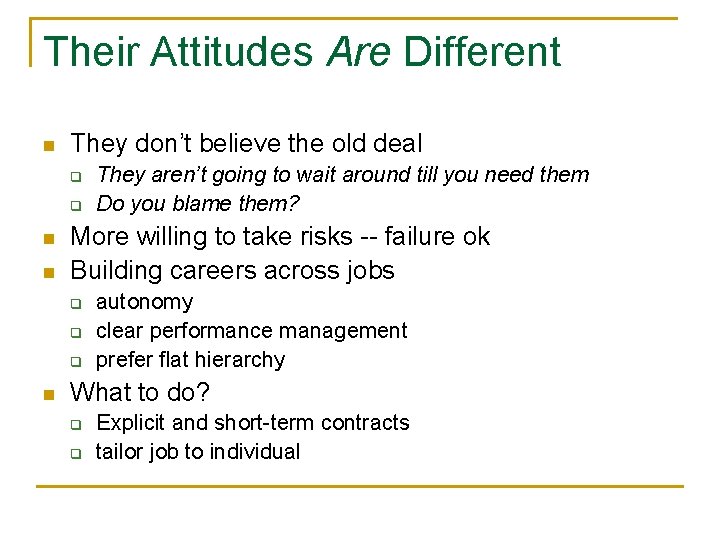
Their Attitudes Are Different n They don’t believe the old deal q q n n More willing to take risks -- failure ok Building careers across jobs q q q n They aren’t going to wait around till you need them Do you blame them? autonomy clear performance management prefer flat hierarchy What to do? q q Explicit and short-term contracts tailor job to individual
How about “Work-Life” Balance? n How new is this concern? q q n How much is about “flexibility? ” Is better performance management the answer? Should employers pull back on their demands on employees? q q If so, which demands? How about employees who do not want to pull back?
So…what’s the new social contract with employees? What should employers and employees expect from each other?
Focus on the “Buy” Decision – Recruiting and Retaining Talent:
What is Your “Employee Value Proposition? ” Suppose you had to sell your job to applicants who have choices…. could you hire the people you want?
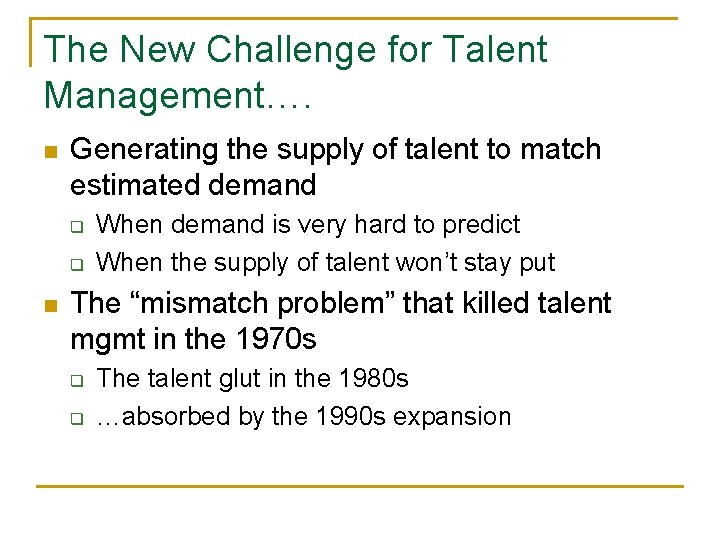
The New Challenge for Talent Management…. n Generating the supply of talent to match estimated demand q q n When demand is very hard to predict When the supply of talent won’t stay put The “mismatch problem” that killed talent mgmt in the 1970 s q q The talent glut in the 1980 s …absorbed by the 1990 s expansion
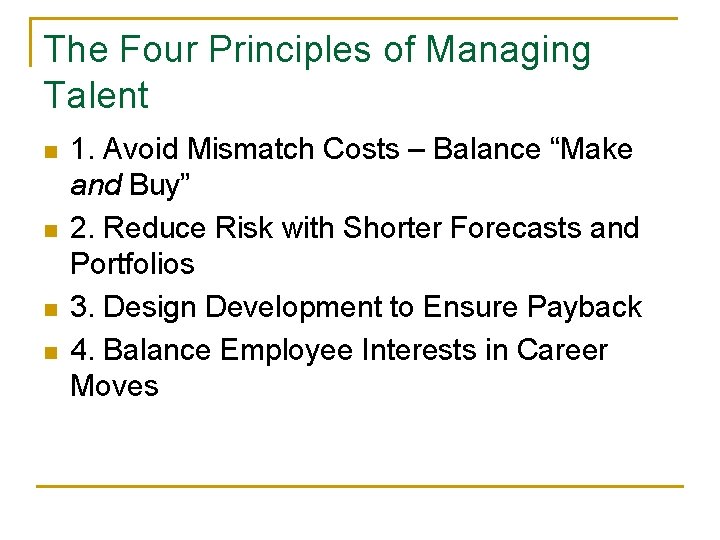
The Four Principles of Managing Talent n n 1. Avoid Mismatch Costs – Balance “Make and Buy” 2. Reduce Risk with Shorter Forecasts and Portfolios 3. Design Development to Ensure Payback 4. Balance Employee Interests in Career Moves
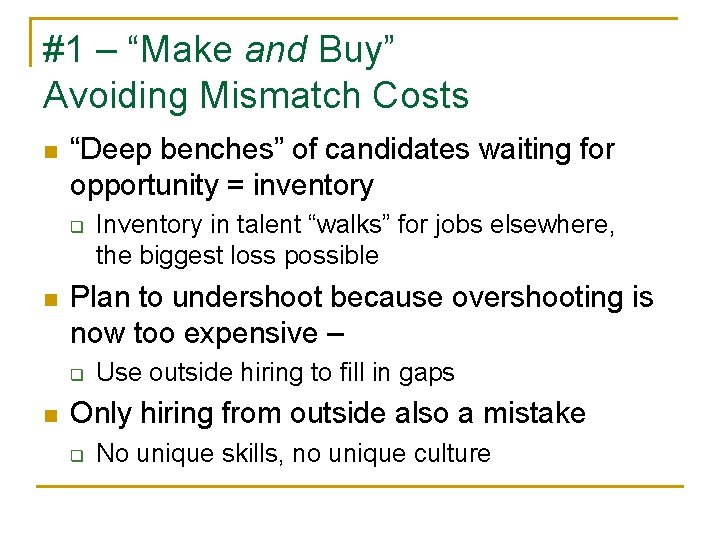
#1 – “Make and Buy” Avoiding Mismatch Costs n “Deep benches” of candidates waiting for opportunity = inventory q n Plan to undershoot because overshooting is now too expensive – q n Inventory in talent “walks” for jobs elsewhere, the biggest loss possible Use outside hiring to fill in gaps Only hiring from outside also a mistake q No unique skills, no unique culture
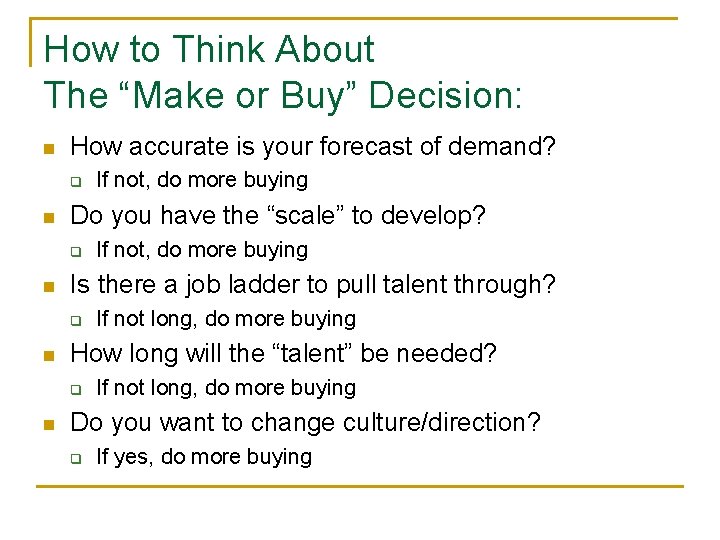
How to Think About The “Make or Buy” Decision: n How accurate is your forecast of demand? q n Do you have the “scale” to develop? q n If not long, do more buying How long will the “talent” be needed? q n If not, do more buying Is there a job ladder to pull talent through? q n If not, do more buying If not long, do more buying Do you want to change culture/direction? q If yes, do more buying
Acquiring Groups, Teams, Companies…. n What’s the long-term goal? n Lessons from Cisco q Screening candidates to integration
#2 – Reducing Risk of Being Wrong n Much harder to forecast business and talent demands into future q n If we only have a two year business plan, how credible is a 10 year career plan? Don’t own the talent, they leave unpredictably q Long-term development and succession plans are not credible unless retention is nearly perfect
Rethink Internal Development… n n Poor quality of long-term forecasts is issue so…. The logic of portfolios for managing uncertainty q Centralize all development programs – n q “Talent pools” – match basic development to basic demand n q Balance out mismatches Just-in-time development to fit General development first, delay specific development until have shorter forecasts n n E. g. , no “ 5 yr mgmt manufacturing program” Instead, “ 3 yr mgmt development” & “ 2 yr special manufacturing program”
#3 – Recouping Investments in Talent $ d n an ent o i t a ens evelopm p m Co ing/D n Trai Value Time
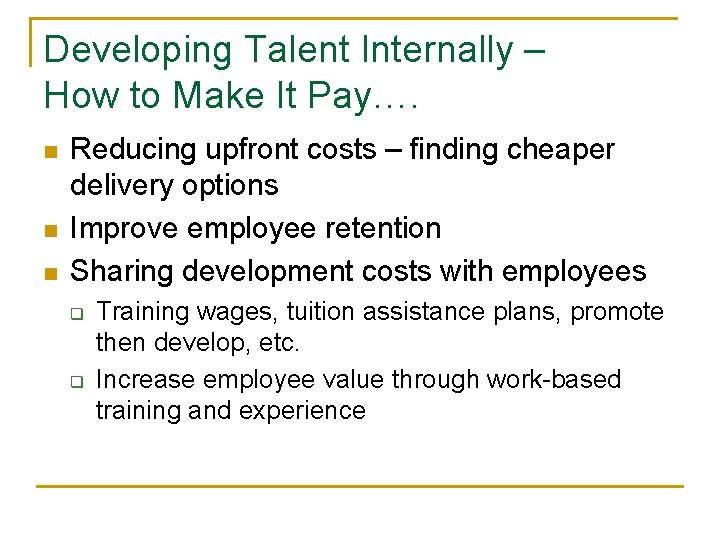
Developing Talent Internally – How to Make It Pay…. n n n Reducing upfront costs – finding cheaper delivery options Improve employee retention Sharing development costs with employees q q Training wages, tuition assistance plans, promote then develop, etc. Increase employee value through work-based training and experience
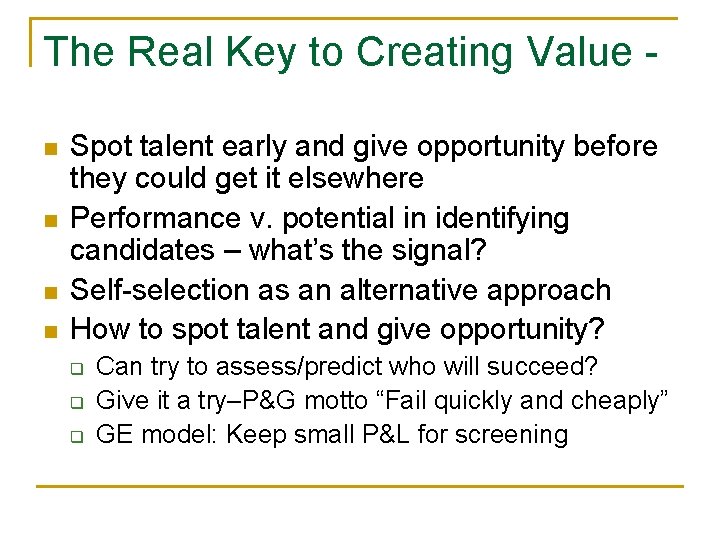
The Real Key to Creating Value n n Spot talent early and give opportunity before they could get it elsewhere Performance v. potential in identifying candidates – what’s the signal? Self-selection as an alternative approach How to spot talent and give opportunity? q q q Can try to assess/predict who will succeed? Give it a try–P&G motto “Fail quickly and cheaply” GE model: Keep small P&L for screening
What was your best developmental experience?
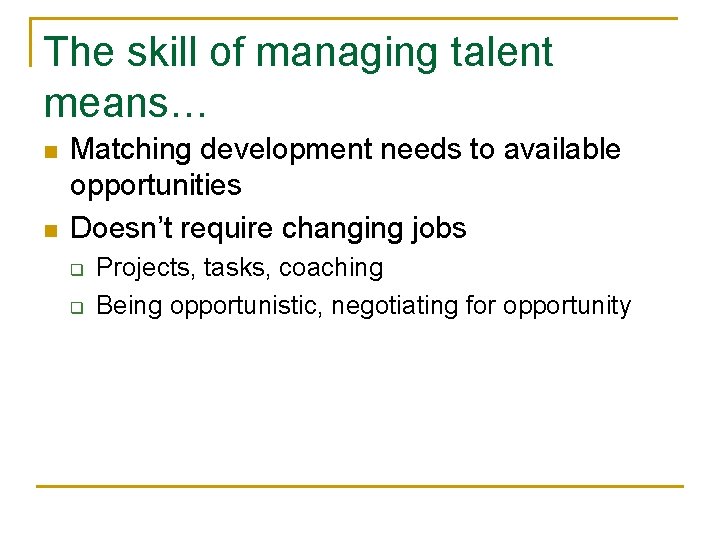
The skill of managing talent means… n n Matching development needs to available opportunities Doesn’t require changing jobs q q Projects, tasks, coaching Being opportunistic, negotiating for opportunity
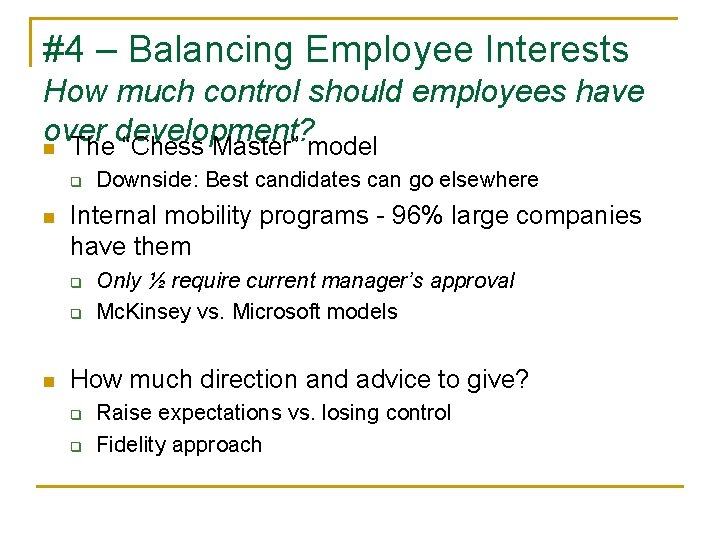
#4 – Balancing Employee Interests How much control should employees have over development? n The “Chess Master” model q n Internal mobility programs - 96% large companies have them q q n Downside: Best candidates can go elsewhere Only ½ require current manager’s approval Mc. Kinsey vs. Microsoft models How much direction and advice to give? q q Raise expectations vs. losing control Fidelity approach
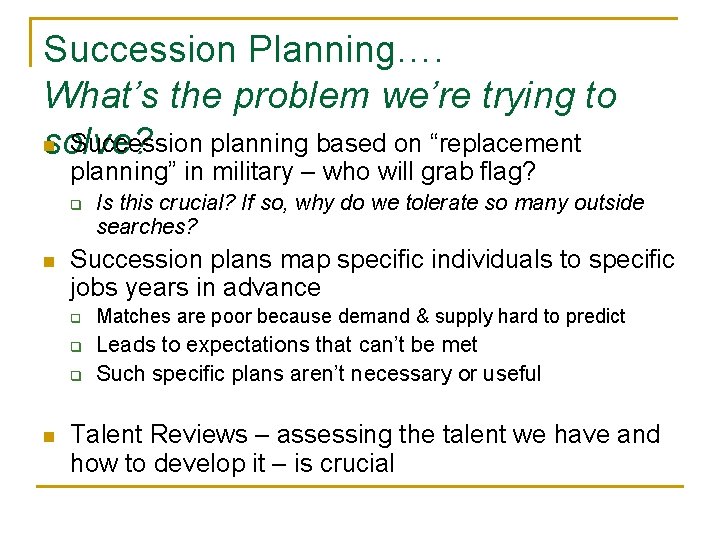
Succession Planning…. What’s the problem we’re trying to n Succession planning based on “replacement solve? planning” in military – who will grab flag? q n Succession plans map specific individuals to specific jobs years in advance q q q n Is this crucial? If so, why do we tolerate so many outside searches? Matches are poor because demand & supply hard to predict Leads to expectations that can’t be met Such specific plans aren’t necessary or useful Talent Reviews – assessing the talent we have and how to develop it – is crucial
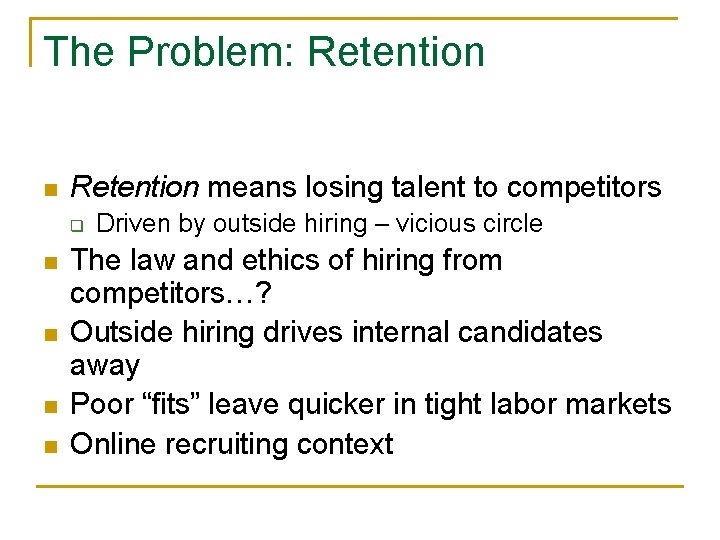
The Problem: Retention n Retention means losing talent to competitors q n n Driven by outside hiring – vicious circle The law and ethics of hiring from competitors…? Outside hiring drives internal candidates away Poor “fits” leave quicker in tight labor markets Online recruiting context
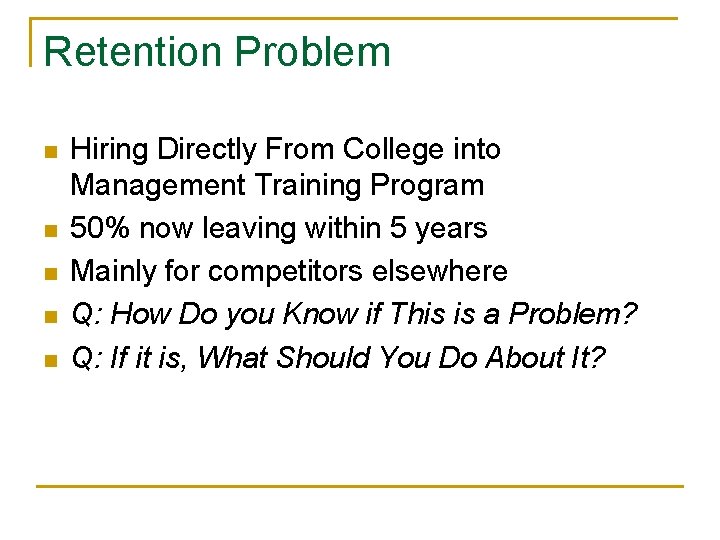
Retention Problem n n n Hiring Directly From College into Management Training Program 50% now leaving within 5 years Mainly for competitors elsewhere Q: How Do you Know if This is a Problem? Q: If it is, What Should You Do About It?
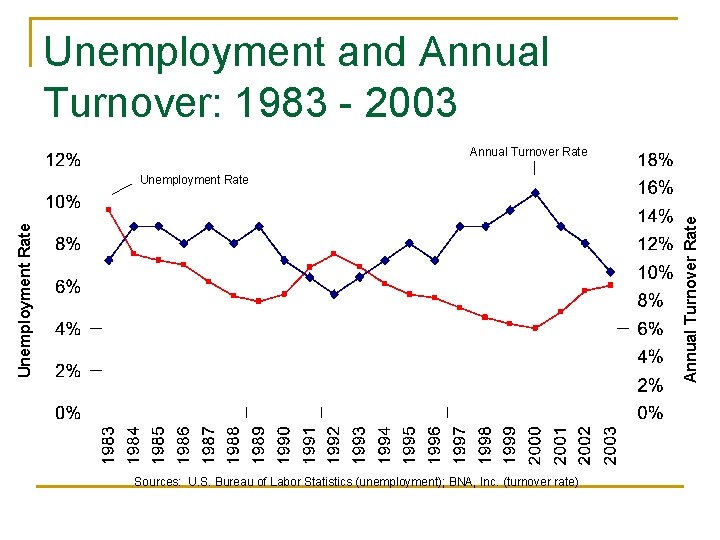
Unemployment and Annual Turnover: 1983 - 2003 Annual Turnover Rate Unemployment Rate Sources: U. S. Bureau of Labor Statistics (unemployment); BNA, Inc. (turnover rate)
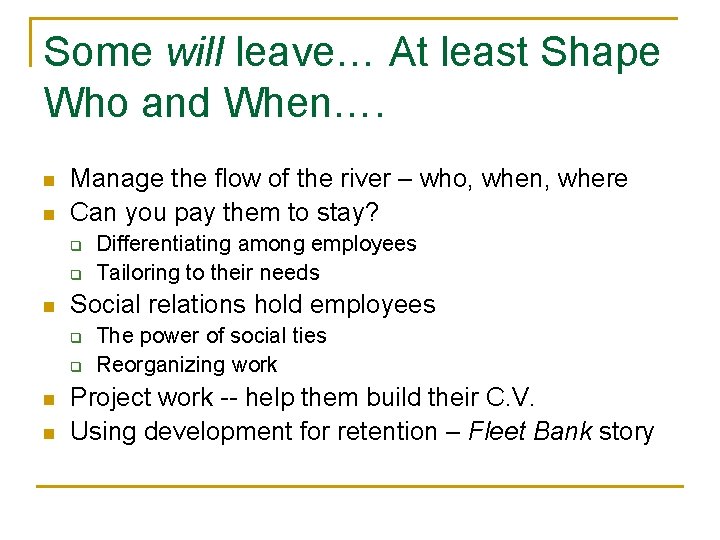
Some will leave… At least Shape Who and When…. n n Manage the flow of the river – who, when, where Can you pay them to stay? q q n Social relations hold employees q q n n Differentiating among employees Tailoring to their needs The power of social ties Reorganizing work Project work -- help them build their C. V. Using development for retention – Fleet Bank story
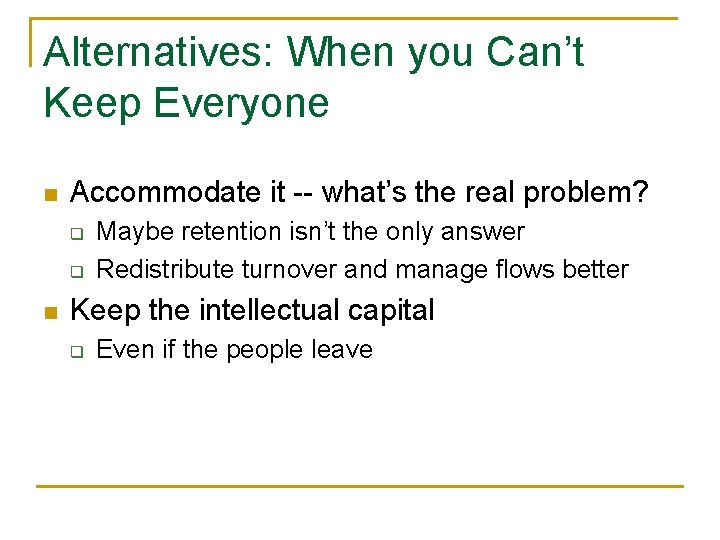
Alternatives: When you Can’t Keep Everyone n Accommodate it -- what’s the real problem? q q n Maybe retention isn’t the only answer Redistribute turnover and manage flows better Keep the intellectual capital q Even if the people leave
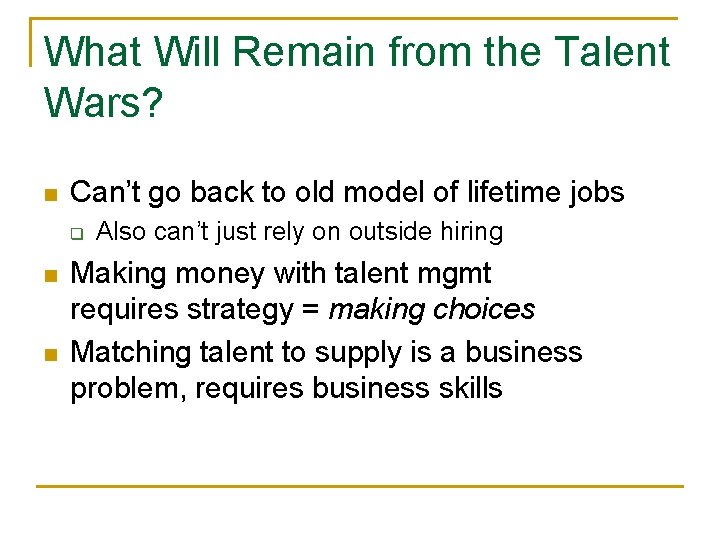
What Will Remain from the Talent Wars? n Can’t go back to old model of lifetime jobs q n n Also can’t just rely on outside hiring Making money with talent mgmt requires strategy = making choices Matching talent to supply is a business problem, requires business skills