
TALENT DEVELOPMENT IN EDUCATION AN INCLUSIVE OR EXCLUSIVE
- Slides: 11
TALENT DEVELOPMENT IN EDUCATION: AN INCLUSIVE OR EXCLUSIVE EDUCATION POLICY? ANNETTE RASMUSSEN & CHRISTIAN YDESEN ASA ANNUAL MEETING 2017 SATURDAY, AUGUST 12, 4: 30 -5: 30 PM TABLE 25 THE ROLES OF TEACHERS: BEYOND TEACHING TO THE TEST
Talent development policies We cannot afford that young people with the will and talent to make a special effort lack challenges in our educational system and perhaps lose interest in getting an education. Denmark’s competitiveness in the global knowledge society depends on our ability to develop talents. We therefore have to give the most gifted room to perform so that they can exploit their potential to the benefit of society and their own future. Danish Ministry of Education, 2008
Outline of the presentation • Brief introduction to the Danish education system • The teacher as one among many stakeholders • The role of teachers in talent development • Selection criteria • A sociological gaze at the Nordic welfare state setting • Concluding remarks
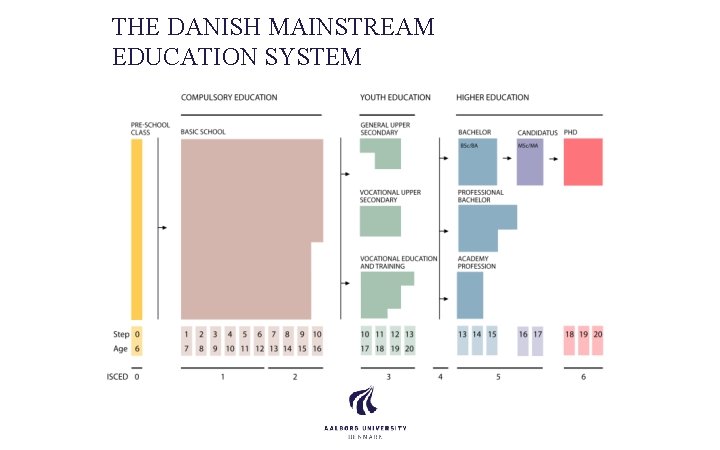
The Danish Education System • • • 1814: A national system of compulsory education was established. 1855: The first Danish school for so-called ‘idiotic, imbecile and epileptic children’ was founded focus on the streaming of problem children into special education. During the 20 th century, the Danish primary school gradually developed into an undivided comprehensive school. 1993 Education Act: teaching must “be varied to correspond to the individual student’s needs and abilities” and thus “contain challenges to all students”. 2006 Education Act: reintroduced the option of streaming, although only for limited periods differentiation based on gender or academic level is possible. In the 21 st century, the Danish primary school shifted from a focus on Bildung to a focus on knowledge and skills
THE DANISH MAINSTREAM EDUCATION SYSTEM
The teacher as one among many stakeholders • • Government authorities (the executive) The local councils (municipalities) School management The teachers The parents The children International organisations
The role of teachers in talent development • • To identify potential talents To communicate to a certain group of students that they are talented To advise them to participate in talent class activities To upward differentiate their teaching
Selection criteria • • • They have to be above average in the subjects of English, Danish, and Mathematics They have to be motivated and prepared to invest time in taking on new challenges in school and personally They have to be extrovert They have to be prepared to take on exceptional challenges They have to be able to set targets for their achievements personally and as a group They have to be independent and reflexive
A sociological gaze at the Nordic welfare state setting • The state as a collective illusion the state is constantly reproduced (real effects) – it is a bureaucratic field • The origins of the modern state: • Genetic: invention of the “public”: from dynastic to bureaucratic mode of reproduction • Structural: claims to the “universal” - “central bank of symbolic power” • Functional: protect and discipline - “Left hand, Right hand”
The concept of state-crafting • • • The professionals’ boundary work shapes: Ø the professions, since it becomes constitutive of their jurisdiction, technologies, and positions. Ø the deviant, because it defines a social taxonomy of deviant characteristics and traits. Ø the state dictating the configuration of the public good and how the state operates in practice. State-crafting is the dialectical and symbiotic connections between professionals’ actions and interventions and their boundary work constructing the boundaries of unacceptable otherness, and ultimately statist capital as the configuration of the public good understood as a justifying referent for governing. The concept collapses the usual dichotomies of state versus professions.
Concluding remarks • • • From a ‘welfare state’ to a ‘competition state’ The rationale behind the talent initiatives is primarily economic motives based on optimal development of each individual’s resources (rather than the group’s) as a prerequisite for national economic growth However, a more democratic rationale can be identified at the local level where the fellowship of the class – the rub-off effect on the other students – is used as an argument for the talent class Power struggles within the bureaucratic field of the state (economic vs. pedagogical rationales) … a shift in the way education is enacted the very workings of the welfare state have changed and the societal values are being reconfigured