
Taking your Evaluation Plan to the Next Level


- Slides: 37
Taking your Evaluation Plan to the Next Level: Developing Evaluation Analysis Plans to Inform Data Collection Processes and Measurement Taletha Derrington, Da. Sy & NCSI Debbie Cate, ECTA Tony Ruggiero, Da. Sy Improving Data, Improving Outcomes New Orleans, LA August 2016
Session Objectives • Identify essential elements of an analysis plan • Summarize types of data and analysis considerations • Apply essential elements and guiding questions to begin developing an analysis plan 2
Session Outline • • • 3 Essentials of data analysis plans Evaluation plan components and data analysis Types of data and analytic methods Developing analysis plans – two examples Small group practice Work on your own plans!
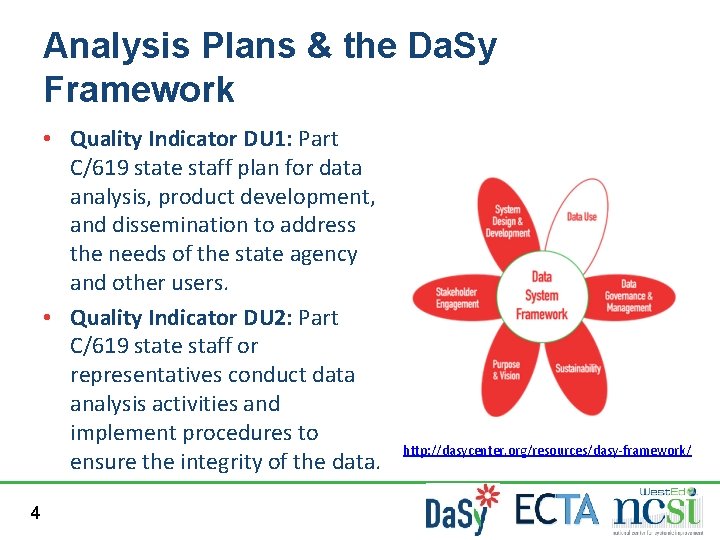
Analysis Plans & the Da. Sy Framework • Quality Indicator DU 1: Part C/619 state staff plan for data analysis, product development, and dissemination to address the needs of the state agency and other users. • Quality Indicator DU 2: Part C/619 state staff or representatives conduct data analysis activities and implement procedures to ensure the integrity of the data. 4 http: //dasycenter. org/resources/dasy-framework/
Essential Elements of a Data Analysis Plan • Purpose of the analysis • Description of the general topic of analysis • Details for the analysis that specify: – What – topic to be analyzed – Why – hypotheses or rationale – How – specific variables, types and order of analyses • Documentation of decisions and findings Da. Sy & ECTA, 2015 5
Essential Elements of a Data Analysis Plan • Details for the analysis that specify: – What – topic to be analyzed – Why – hypotheses or rationale – How – specific variables, types and order of analyses Da. Sy & ECTA, 2015 6
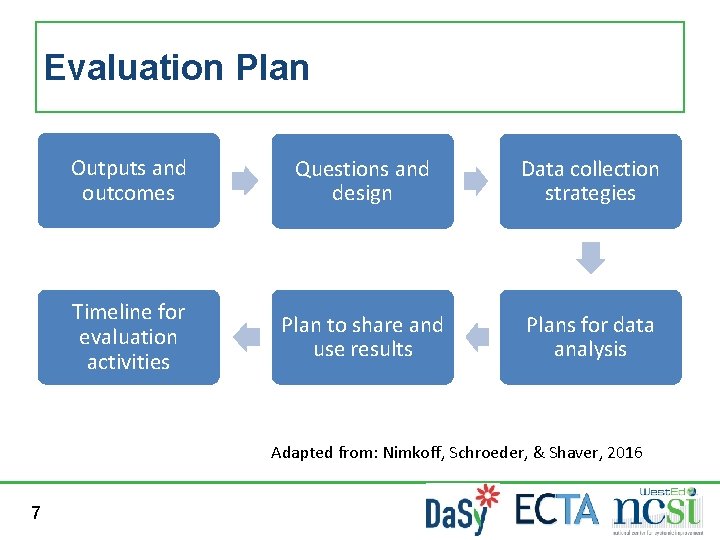
Evaluation Plan Outputs and outcomes Questions and design Data collection strategies Timeline for evaluation activities Plan to share and use results Plans for data analysis Adapted from: Nimkoff, Schroeder, & Shaver, 2016 7
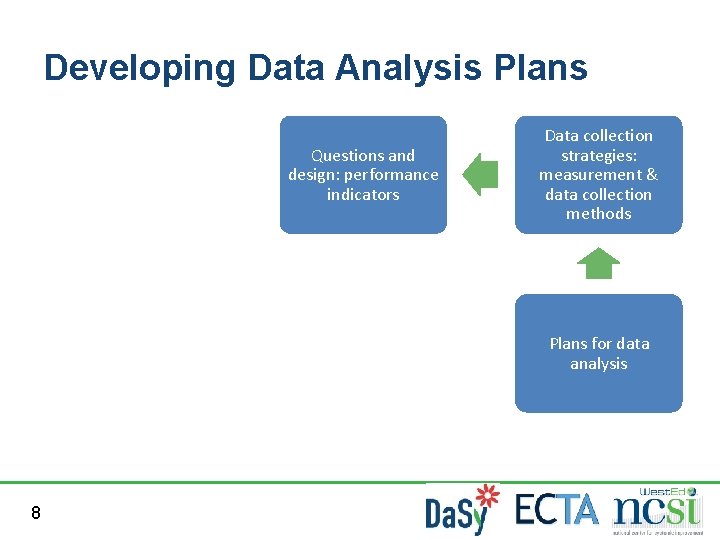
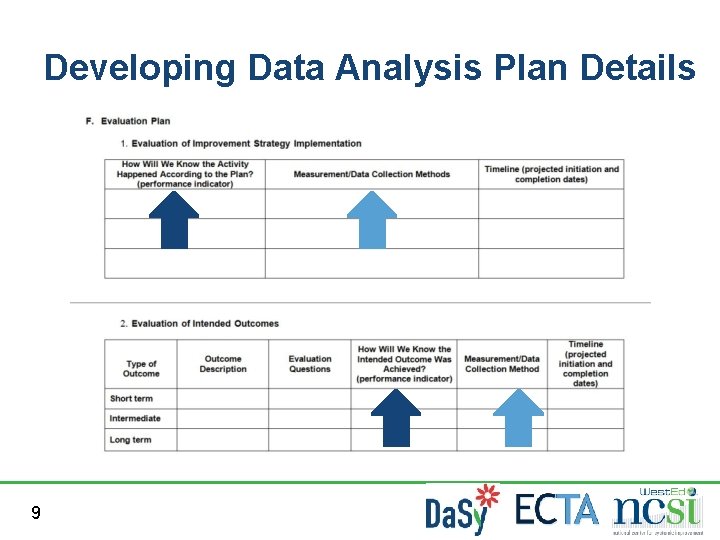
Developing Data Analysis Plans Questions and design: performance indicators Data collection strategies: measurement & data collection methods Plans for data analysis 8
Developing Data Analysis Plan Details 9
Data Analysis Plan Details: What are you analyzing? • Performance indicators – Piece of information that measures (indicates) whether outcomes are being achieved, i. e. performance. – Evidence that will allow the SSIP Team to track change or progress. • Other factors that might influence performance – Time – When implementation occurred – Child, family, program, and/or community characteristics 10
What is a “good” performance indicator? A few criteria: 1. The indicator is clearly related to the outcome and is a measurement of the outcome. 2. Usually contains a statistic, a number (e. g. , a percentage, an average, a total) to track to see whether it goes up or down. 3. State whether you want to see an increase or decrease. 4. The wording of an indicator should suggest how you are going to measure the outcome. 5. Feasible for you to collect the data. 11
Well-written Performance Indicators • An increase (direction) in the average score (number) on the Proficiency Test given at the end of training (method of measurement) • An increase (direction) in the average score (number) on the Provider Skills Checklist (method of measurement) 12
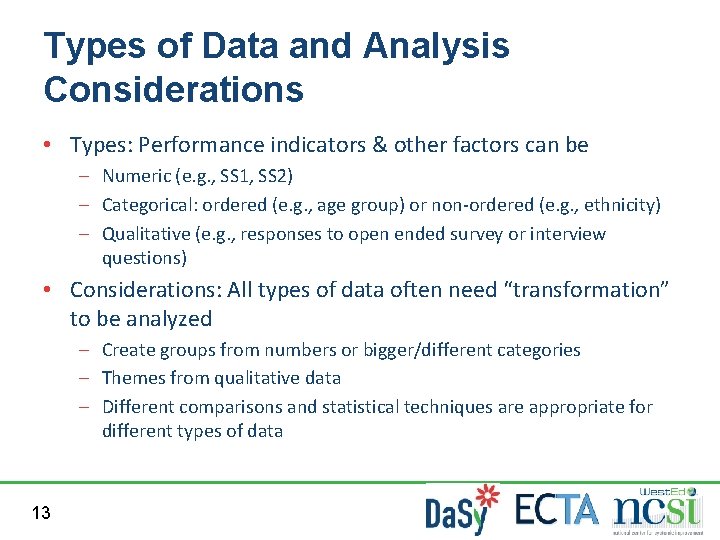
Types of Data and Analysis Considerations • Types: Performance indicators & other factors can be – Numeric (e. g. , SS 1, SS 2) – Categorical: ordered (e. g. , age group) or non-ordered (e. g. , ethnicity) – Qualitative (e. g. , responses to open ended survey or interview questions) • Considerations: All types of data often need “transformation” to be analyzed – Create groups from numbers or bigger/different categories – Themes from qualitative data – Different comparisons and statistical techniques are appropriate for different types of data 13
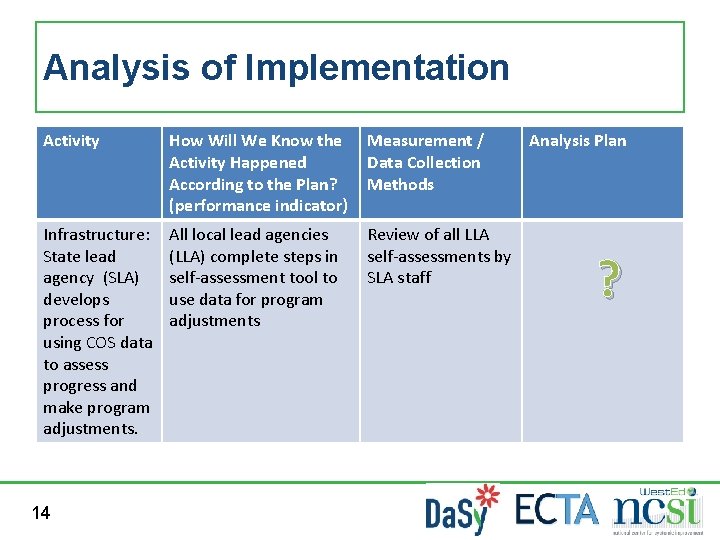
Analysis of Implementation Activity How Will We Know the Activity Happened According to the Plan? (performance indicator) Measurement / Data Collection Methods Infrastructure: State lead agency (SLA) develops process for using COS data to assess progress and make program adjustments. All local lead agencies (LLA) complete steps in self-assessment tool to use data for program adjustments Review of all LLA self-assessments by SLA staff 14 Analysis Plan ?
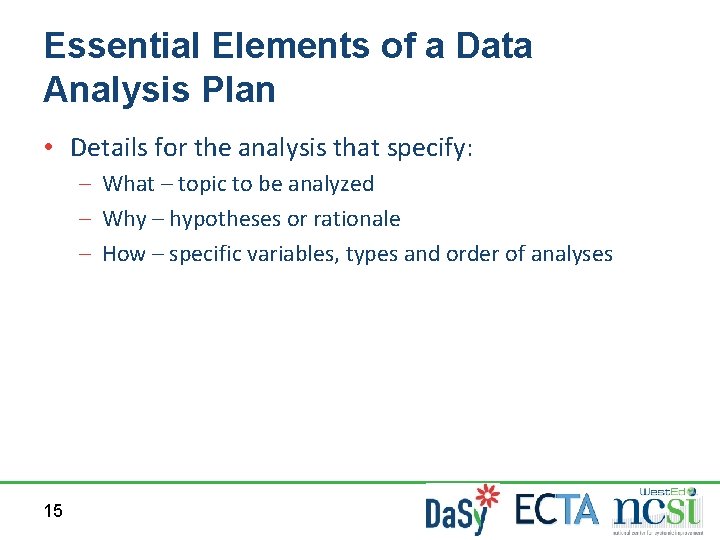
Essential Elements of a Data Analysis Plan • Details for the analysis that specify: – What – topic to be analyzed – Why – hypotheses or rationale – How – specific variables, types and order of analyses 15
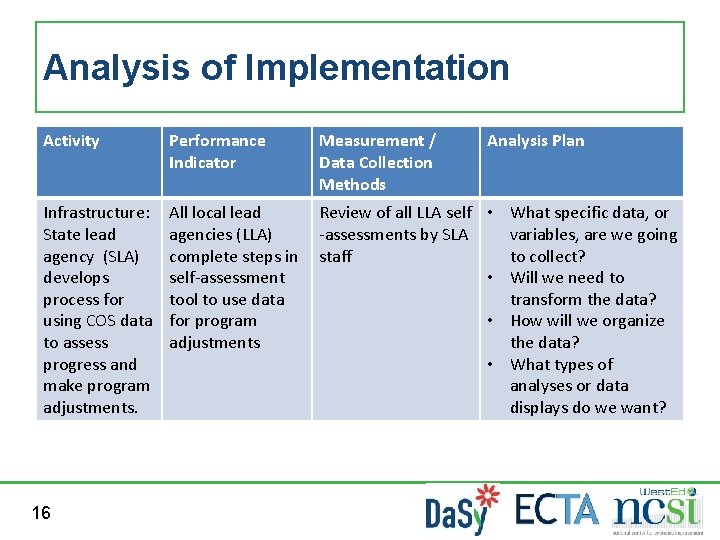
Analysis of Implementation Activity Performance Indicator Measurement / Data Collection Methods Infrastructure: State lead agency (SLA) develops process for using COS data to assess progress and make program adjustments. All local lead agencies (LLA) complete steps in self-assessment tool to use data for program adjustments Review of all LLA self • What specific data, or -assessments by SLA variables, are we going staff to collect? • Will we need to transform the data? • How will we organize the data? • What types of analyses or data displays do we want? 16 Analysis Plan
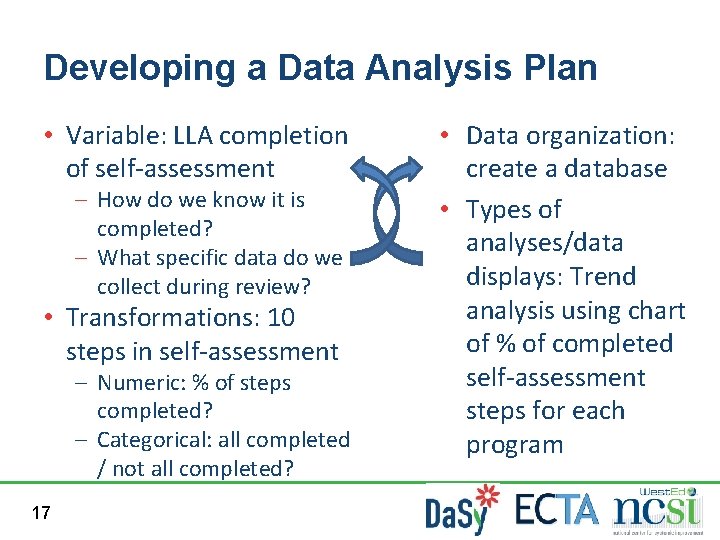
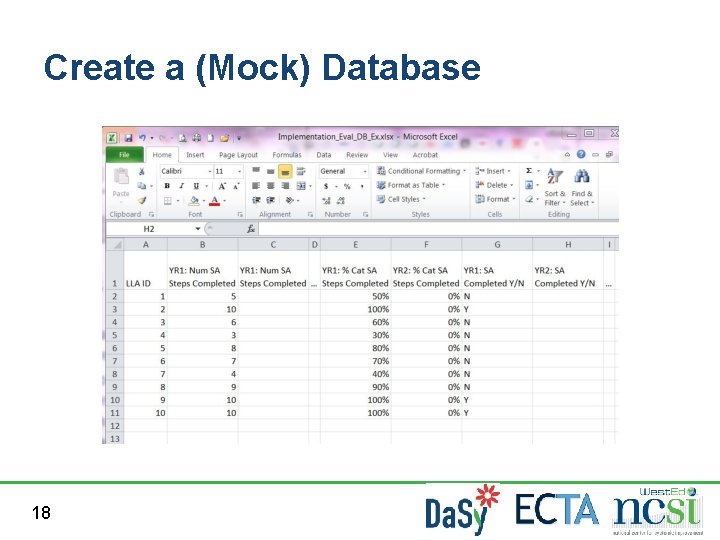
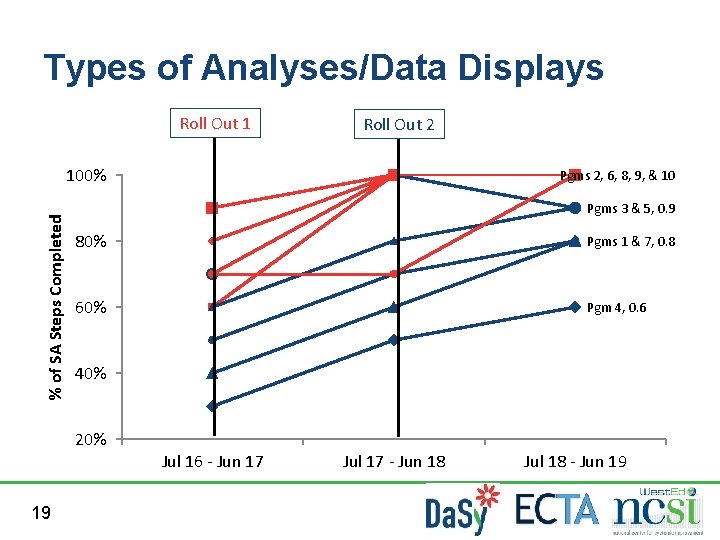
Developing a Data Analysis Plan • Variable: LLA completion of self-assessment – How do we know it is completed? – What specific data do we collect during review? • Transformations: 10 steps in self-assessment – Numeric: % of steps completed? – Categorical: all completed / not all completed? 17 • Data organization: create a database • Types of analyses/data displays: Trend analysis using chart of % of completed self-assessment steps for each program
Create a (Mock) Database 18
Types of Analyses/Data Displays Roll Out 1 Roll Out 2 % of SA Steps Completed 100% Pgms 3 & 5, 0. 9 80% Pgms 1 & 7, 0. 8 60% Pgm 4, 0. 6 40% 20% 19 Pgms 2, 6, 8, 9, & 10 Jul 16 - Jun 17 Jul 17 - Jun 18 Jul 18 - Jun 19
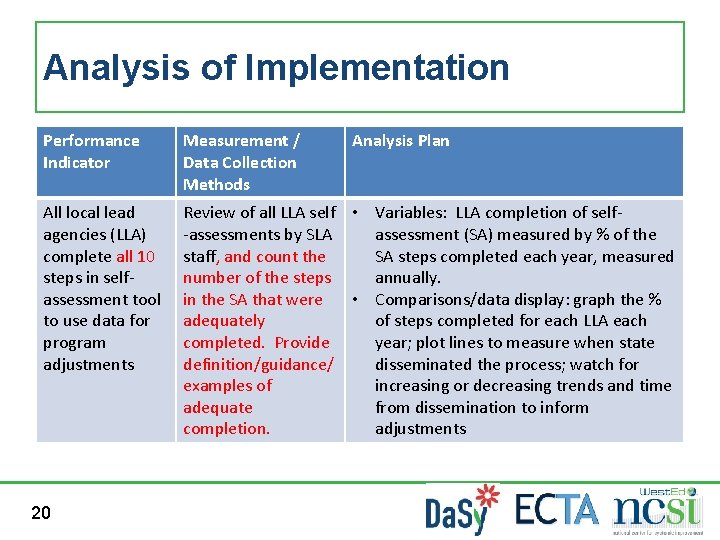
Analysis of Implementation Performance Indicator Measurement / Data Collection Methods All local lead agencies (LLA) complete all 10 steps in selfassessment tool to use data for program adjustments Review of all LLA self • Variables: LLA completion of self-assessments by SLA assessment (SA) measured by % of the staff, and count the SA steps completed each year, measured number of the steps annually. in the SA that were • Comparisons/data display: graph the % adequately of steps completed for each LLA each completed. Provide year; plot lines to measure when state definition/guidance/ disseminated the process; watch for examples of increasing or decreasing trends and time adequate from dissemination to inform completion. adjustments 20 Analysis Plan
Questions? 21
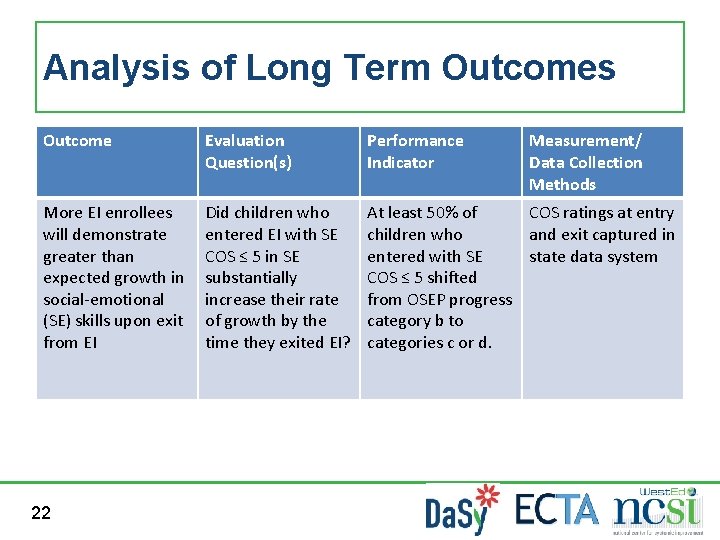
Analysis of Long Term Outcomes Outcome Evaluation Question(s) Performance Indicator More EI enrollees will demonstrate greater than expected growth in social-emotional (SE) skills upon exit from EI Did children who entered EI with SE COS ≤ 5 in SE substantially increase their rate of growth by the time they exited EI? At least 50% of COS ratings at entry children who and exit captured in entered with SE state data system COS ≤ 5 shifted from OSEP progress category b to categories c or d. 22 Measurement/ Data Collection Methods
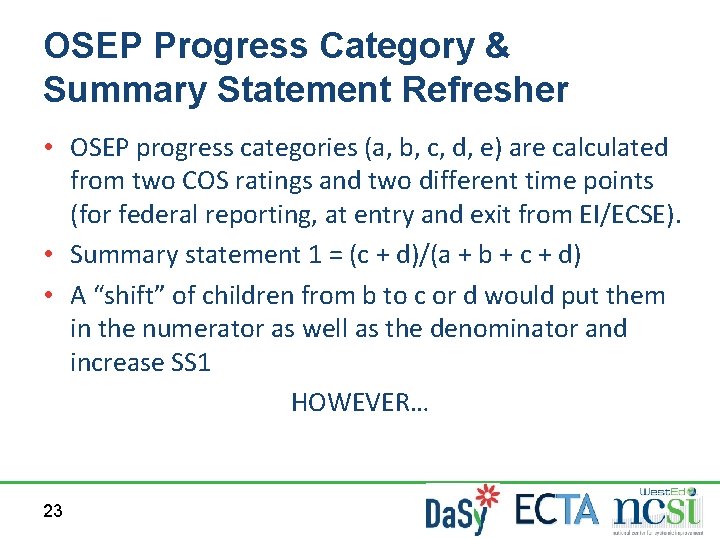
OSEP Progress Category & Summary Statement Refresher • OSEP progress categories (a, b, c, d, e) are calculated from two COS ratings and two different time points (for federal reporting, at entry and exit from EI/ECSE). • Summary statement 1 = (c + d)/(a + b + c + d) • A “shift” of children from b to c or d would put them in the numerator as well as the denominator and increase SS 1 HOWEVER… 23
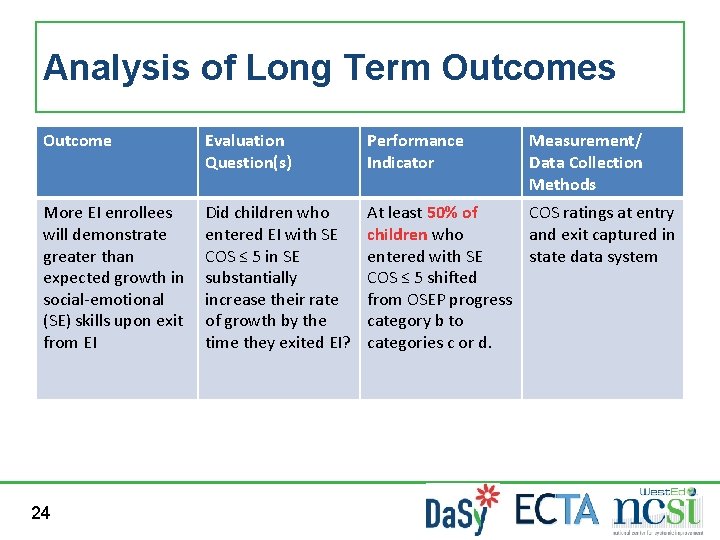
Analysis of Long Term Outcomes Outcome Evaluation Question(s) Performance Indicator More EI enrollees will demonstrate greater than expected growth in social-emotional (SE) skills upon exit from EI Did children who entered EI with SE COS ≤ 5 in SE substantially increase their rate of growth by the time they exited EI? At least 50% of COS ratings at entry children who and exit captured in entered with SE state data system COS ≤ 5 shifted from OSEP progress category b to categories c or d. 24 Measurement/ Data Collection Methods
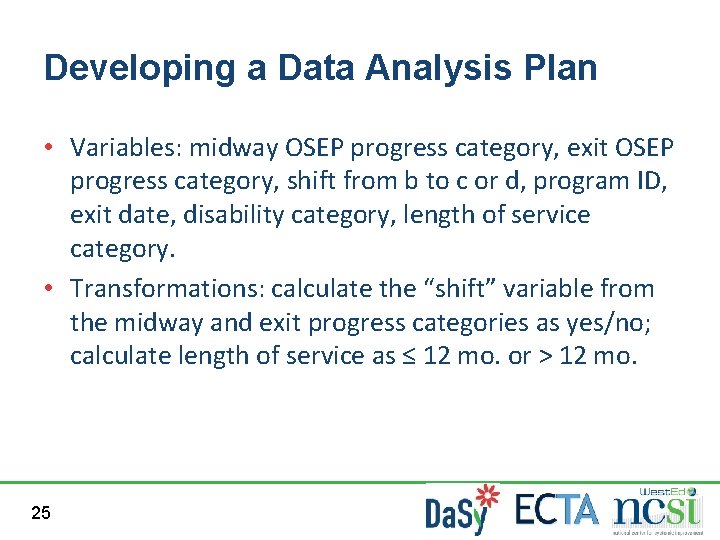
Developing a Data Analysis Plan • Variables: midway OSEP progress category, exit OSEP progress category, shift from b to c or d, program ID, exit date, disability category, length of service category. • Transformations: calculate the “shift” variable from the midway and exit progress categories as yes/no; calculate length of service as ≤ 12 mo. or > 12 mo. 25
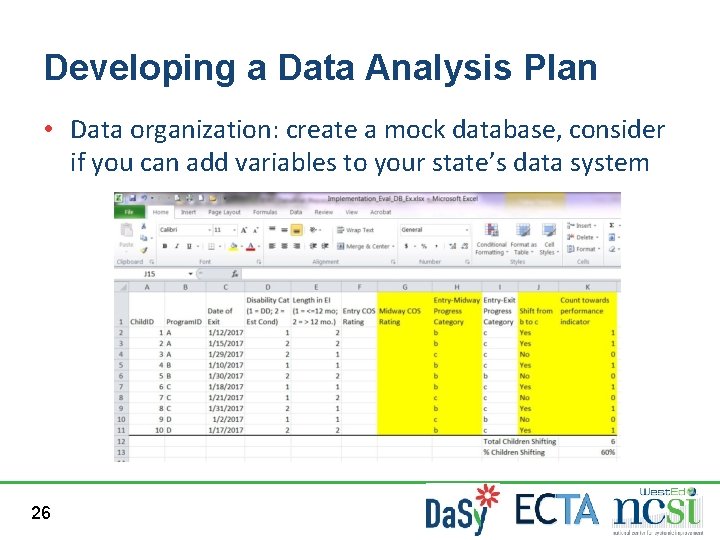
Developing a Data Analysis Plan • Data organization: create a mock database, consider if you can add variables to your state’s data system 26
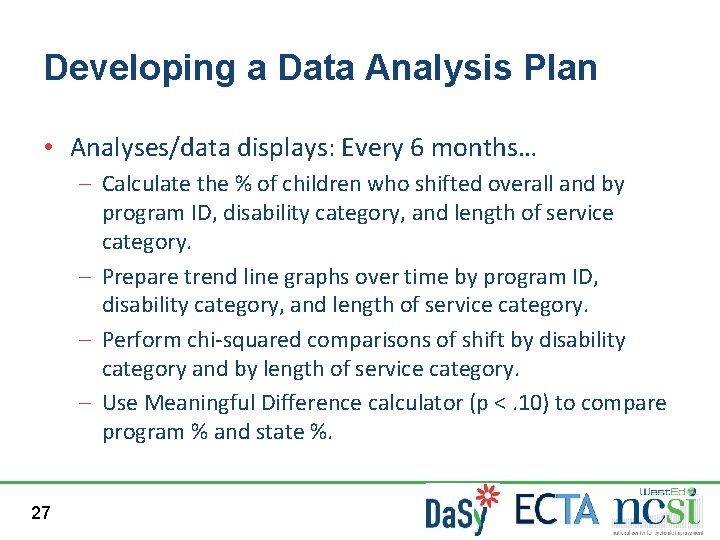
Developing a Data Analysis Plan • Analyses/data displays: Every 6 months… – Calculate the % of children who shifted overall and by program ID, disability category, and length of service category. – Prepare trend line graphs over time by program ID, disability category, and length of service category. – Perform chi-squared comparisons of shift by disability category and by length of service category. – Use Meaningful Difference calculator (p <. 10) to compare program % and state %. 27
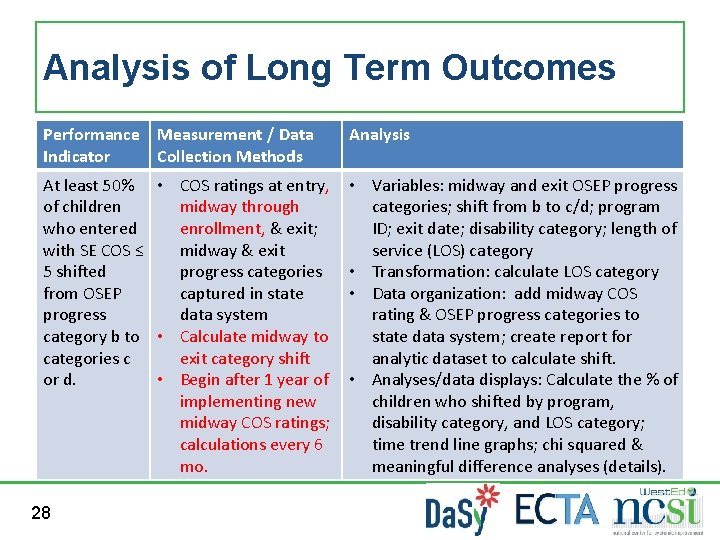
Analysis of Long Term Outcomes Performance Measurement / Data Indicator Collection Methods Analysis At least 50% • COS ratings at entry, of children midway through who entered enrollment, & exit; with SE COS ≤ midway & exit 5 shifted progress categories from OSEP captured in state progress data system category b to • Calculate midway to categories c exit category shift or d. • Begin after 1 year of implementing new midway COS ratings; calculations every 6 mo. • Variables: midway and exit OSEP progress categories; shift from b to c/d; program ID; exit date; disability category; length of service (LOS) category • Transformation: calculate LOS category • Data organization: add midway COS rating & OSEP progress categories to state data system; create report for analytic dataset to calculate shift. • Analyses/data displays: Calculate the % of children who shifted by program, disability category, and LOS category; time trend line graphs; chi squared & meaningful difference analyses (details). 28
Small Group Practice 29
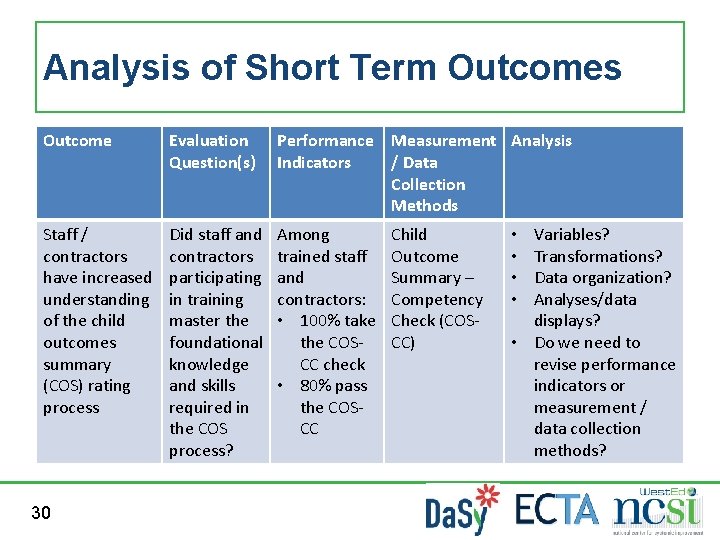
Analysis of Short Term Outcomes Outcome Evaluation Question(s) Performance Measurement Analysis Indicators / Data Collection Methods Staff / contractors have increased understanding of the child outcomes summary (COS) rating process Did staff and contractors participating in training master the foundational knowledge and skills required in the COS process? Among trained staff and contractors: • 100% take the COSCC check • 80% pass the COSCC 30 Child Outcome Summary – Competency Check (COSCC) Variables? Transformations? Data organization? Analyses/data displays? • Do we need to revise performance indicators or measurement / data collection methods? • •
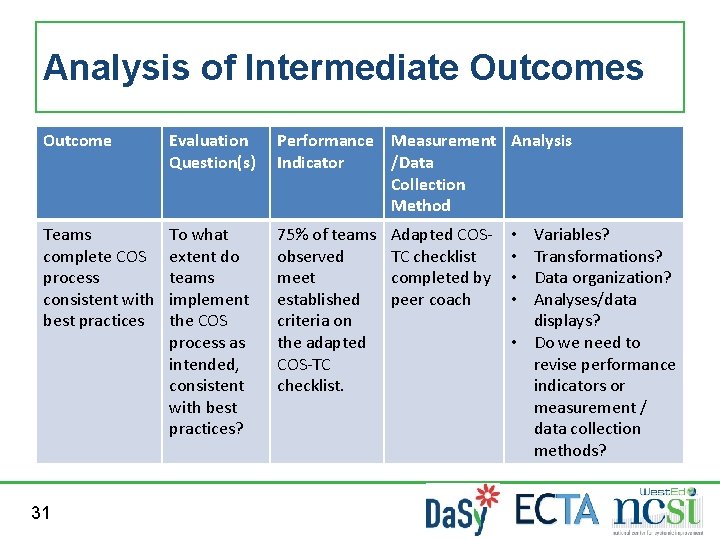
Analysis of Intermediate Outcomes Outcome Evaluation Question(s) Performance Measurement Analysis Indicator /Data Collection Method Teams complete COS process consistent with best practices To what extent do teams implement the COS process as intended, consistent with best practices? 75% of teams observed meet established criteria on the adapted COS-TC checklist. 31 Adapted COSTC checklist completed by peer coach Variables? Transformations? Data organization? Analyses/data displays? • Do we need to revise performance indicators or measurement / data collection methods? • •
Share Out & Questions 32
Work on your own plans! 33
Share Out & Questions 34
Resources • • 35 Da. Sy & ECTA. (2015). Planning, conducting, and documenting data analysis for program improvement. http: //dasycenter. sri. com/downloads/Da. Sy_papers/Da. Sy_SSIP_Data. Analysis. Planning_20150323_FINAL_A cc. pdf Derrington, T. , Vinh, M. , Winer, A. , & Hebbeler, K. (April-May, 2015). The Data Are in the Details: Translating Evaluation Questions Into Detailed Analytical Questions. IDC Interactive Institutes, https: //ideadata. org/resource-library/55 bbb 08 f 140 ba 074738 b 456 c/. Derrington, T. , Winer, A. , Campbell, S. , Thompson, V. , Mazza, B. , Rush, M. , Hankey, C. (April-May, 2015). Maximize the Return on Your Data Investment: Planning and Documentation for Data Collection and Analysis. IDC Interactive Institutes, https: //ideadata. org/resource-library/55 c 24511140 ba 0477 f 8 b 457 d/. Early Childhood Outcomes Center, ECTA. (2009). Summary Statements for Target Setting –Child Outcomes Indicators C 3 and B 7. http: //ectacenter. org/~pdfs/eco/Summary. Statement. Definitions. pdf Early Childhood Outcomes Center, ECTA. (2012). Developmental Trajectories: Getting to Progress Categories from COS Ratings training resources webinar. http: //ectacenter. org/eco/pages/selflearning. asp. ECTA, Da. Sy, NCSI, & IDC. (2015). Sample SSIP Action Plan Template. http: //ectacenter. org/~docs/topics/ssip_improvement_plan_template. doc. Nimkoff, Schroeder, & Shaver. (May/June, 2016). SSIP Phase III: Operationalizing Your Evaluation Plan. IDC Interactive Institutes, Kansas City, MO & Savannah, GA.
Thanks! • Taletha Derrington, taletha. derrington@sri. com • Debbie Cate, debbie. cate@unc. edu • Tony Ruggiero, tony. ruggiero@aemcorp. com Da. Sy NCSI • http: //dasycenter. org/ • http: //ncsi. wested. org/ • Twitter @Da. Sy. Center • Twitter @The. NCSI • Facebook https: //www. facebook. com/dasycenter 36 ECTA • http: //ectacenter. org/ • Twitter @ECTACenter • Facebook https: //www. facebook. c om/ecta-center 304774389667984/
The contents of this presentation were developed under grants from the U. S. Department of Education, # H 373 Z 120002, #H 326 P 120002, and #H 326 R 140006. However, those contents do not necessarily represent the policy of the U. S. Department of Education, and you should not assume endorsement by the Federal Government. Project Officers: Meredith Miceli, Richelle Davis, Julia Martin Eile, Perry Williams, and Shedeh Hajghassemali. 37