
taking the English II EOC STAAR TEST TIPS

- Slides: 34
taking the English II EOC/ STAAR TEST TIPS & REMINDERS. .
In what order should I take the test? • It does NOT MATTER in what order you take the test. Just because the testing people put the essay on the last page does NOT mean you have to do the test in that order. • Suggestion: DO THE ESSAY FIRST – Remember, the essay is the most important part of the test. If you knock the essay out of the park, you most likely pass. IF YOU GET A 4—it is very likely you will get commended!!
Order…Continued… • Next, do the READING SECTION! Why, you ask? The NEXT section that requires A LOT of concentration is the reading – sometimes those sections get tedious. You have to have the brain power to get through it. RE-READ if your attention starts to drift! • Make NOTES [annotate the passage] as you read, and look up [you have the ability to use a dictionary throughout the test] any words that you need.
Order…continued…still…. • Last, do the editing section. This is an important section (hey, it’s ALL important) but it requires the LEAST amount of focus/concentration, so do this LAST. • Be sure to read the section carefully. If something “sounds” wrong, it probably is.
Multiple choice test taking strategies – Reading Section: • Approach each reading section as though you will be taking a test over it. ANNOTATE and underline key words/phrases. If something seems important, make a mark next to it. • When you finish reading the selection, move on to the questions. Here is a hint: The STAAR test writers usually give you 4 options. YOU CAN ALMOST ALWAYS ELIMINATE ONE right off the bat b/c it’s off the wall or just sounds wrong. Now you’re down to three. There is usually one that is SORT OF right, but something about it is wrong. Now you’re down to 2.
Multiple choice test taking strategies – Reading Section: • Approach each reading section as though you will be taking a test over it. ANNOTATE and underline key words/phrases. If something seems important, make a mark next to it. • Once you’ve narrowed down to 2, go back to the reading section and try to “prove” both answers. • Nearly ALL questions have a throwaway answer, a “sort of” correct but not completely, and a “throw you off” answer. You have to narrow to the “right” answer and “throw you off” if you can. It ups your odds of getting the question correct. • DICTIONARIES – USE them if you need them. If you don’t understand what a question is asking, you can’t answer it correctly!
THE ESSAY – The Keys to the Process • Remember HOOK= gracefully ease your reader into your topic. You can start with a GENERAL statement about whatever you are writing about. This should get your reader’s attention but does not have to be a SCREAMING HEADLINE. • Transition sentence = should guide you reader from your hook to your thesis. • THESIS = MOST IMPORTANT SENTENCE you will write. Restate the prompt, add your POSITION, and then reason 1 & 2. Keep these BRIEF. You will elaborate your reasons in your body paragraph.
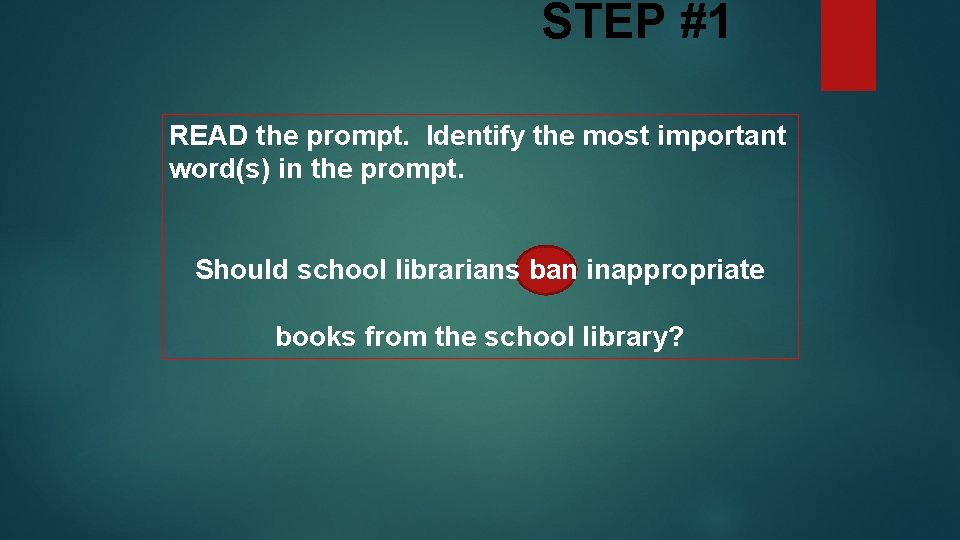
STEP #1 READ the prompt. Identify the most important word(s) in the prompt. Should school librarians ban inappropriate books from the school library?
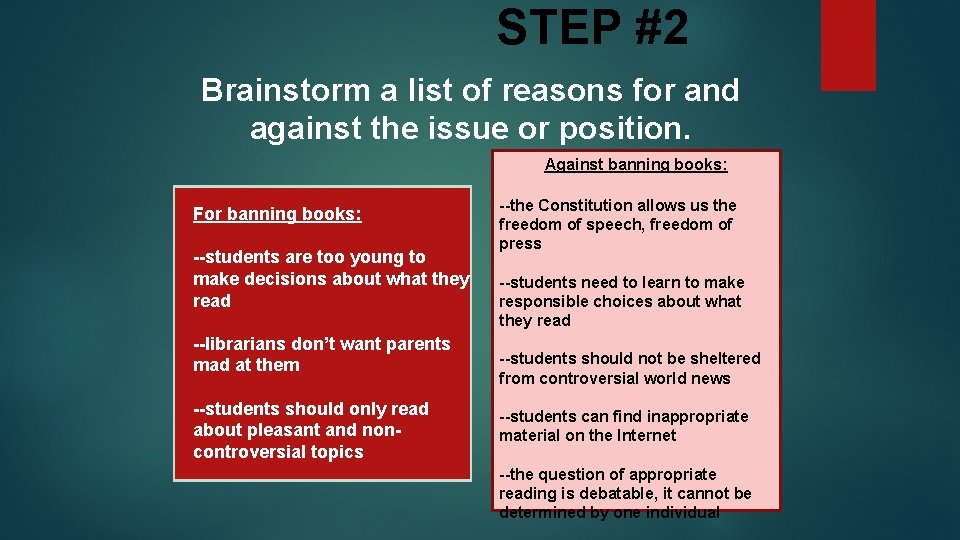
STEP #2 Brainstorm a list of reasons for and against the issue or position. Against banning books: For banning books: --students are too young to make decisions about what they read --librarians don’t want parents mad at them --students should only read about pleasant and noncontroversial topics --the Constitution allows us the freedom of speech, freedom of press --students need to learn to make responsible choices about what they read --students should not be sheltered from controversial world news --students can find inappropriate material on the Internet --the question of appropriate reading is debatable, it cannot be determined by one individual
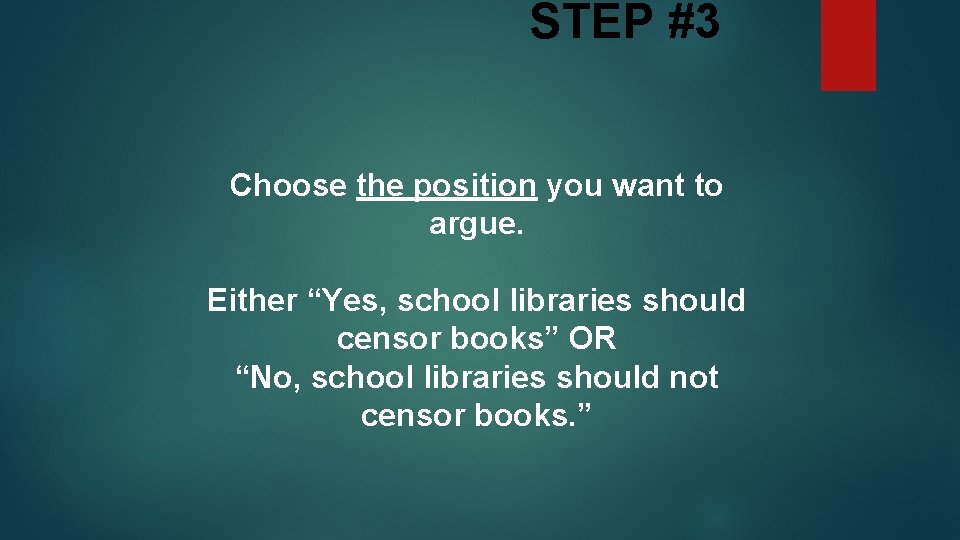
STEP #3 Choose the position you want to argue. Either “Yes, school libraries should censor books” OR “No, school libraries should not censor books. ”
STEP #4 Choose the two “reasons” for which you can write the best argument. --One “reason” for each body paragraph
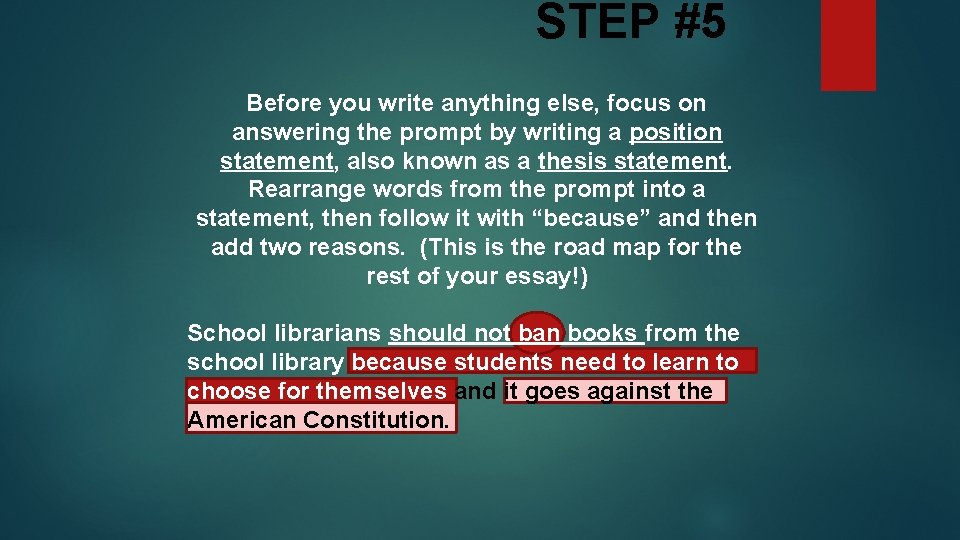
STEP #5 Before you write anything else, focus on answering the prompt by writing a position statement, also known as a thesis statement. Rearrange words from the prompt into a statement, then follow it with “because” and then add two reasons. (This is the road map for the rest of your essay!) School librarians should not ban books from the school library because students need to learn to choose for themselves and it goes against the American Constitution.
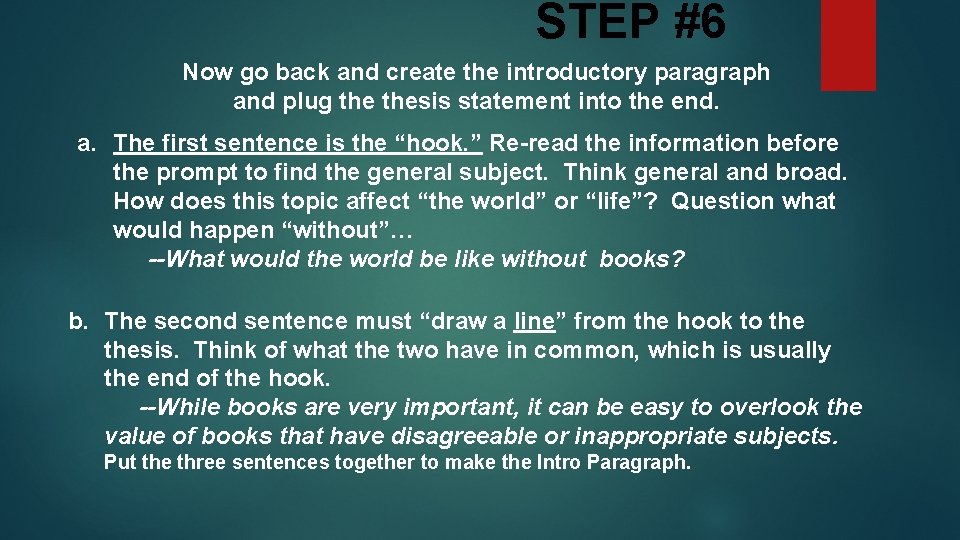
STEP #6 Now go back and create the introductory paragraph and plug thesis statement into the end. a. The first sentence is the “hook. ” Re-read the information before the prompt to find the general subject. Think general and broad. How does this topic affect “the world” or “life”? Question what would happen “without”… --What would the world be like without books? b. The second sentence must “draw a line” from the hook to thesis. Think of what the two have in common, which is usually the end of the hook. --While books are very important, it can be easy to overlook the value of books that have disagreeable or inappropriate subjects. Put the three sentences together to make the Intro Paragraph.
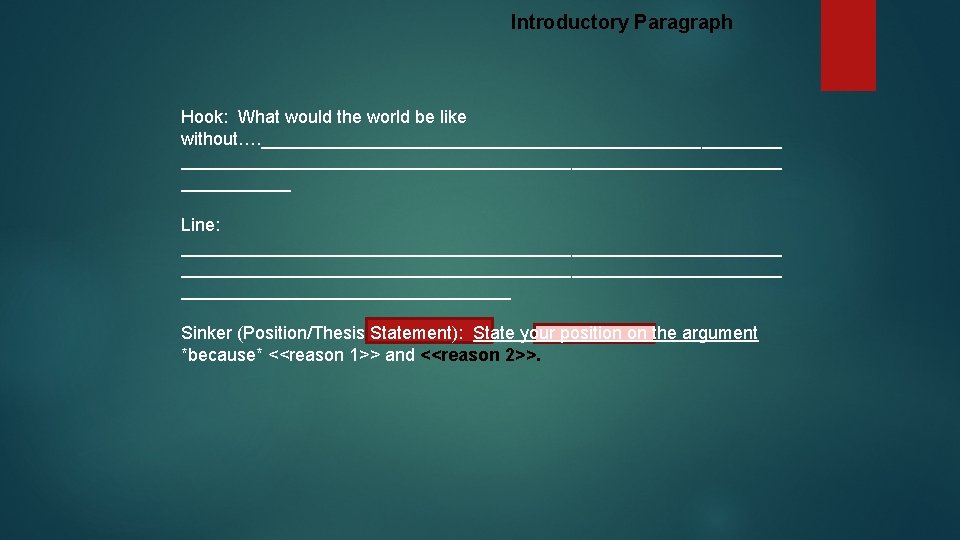
Introductory Paragraph Hook: What would the world be like without…. ________________________________________________________ Line: ____________________________________________________________ Sinker (Position/Thesis Statement): State your position on the argument *because* <<reason 1>> and <<reason 2>>.
THE ESSAY – The Keys to the Process • Reason 1 = Body paragraph #1: • Remember to give an example!! Think of an example from the “inner circle” – your experiences, books you’ve read, your school, church, sports team, etc. (1 st person is OK though, IF it’s the BEST example!) • Think of an “outer circle” example – general knowledge such as politics, history, pop culture, etc. • Be sure your example PROVES YOUR POINT. Use those persuasive transition words!
THE ESSAY – The Keys to the Process • Reason 2 = Body paragraph #2: • If you used “inner circle” as your first example in body paragraph 1, try to think of an “outer circle” for body paragraph 2. • YOU MUST INCLUDE AN EXAMPLE for each body paragraph – the more detailed you can be, the better your essay. YOU DON’T have much room though, so make sure you know what you want to say before writing it in that box!
THE ESSAY – The Keys to the Process. • Conclusion: • Find a new way to state that thesis!!!! • Leave your reader with a “final thought. ” Think full circle…you brought them into the topic with your hook, now you’re bringing them OUT of your essay the same way. • This is a GREAT time to use a rhetorical strategy…call to action, rhetorical question, repetition, parallelism, emotional appeal, etc!
THE ESSAY – The Keys to the Process • A word about Prewriting: • YOU HAD BETTER DO IT! Remember to list your pros/cons or for/against. This is a useful activity even if you KNOW what your position will be. WHY?
THE ESSAY – The Keys to the Process • OTHER WRITING TIPS: • Remember your grader!! (the old lady who taught high school in 1985). • NO SLANG, No text writing, etc. • Handwriting: Try to write as NEATLY AS POSSIBLE. Yes, I know it should not matter, but it sort of does. If they can’t read your essay, that’s going to be a problem! • PARAGRAPHS – this should go without saying, but it should be very clear when you are transitioning to another paragraph.
The Essay, Continued…. GRADER A GRADER B The old lady with cats, birds, The unemployed millennial and a collection of jigsaw who is getting his second puzzles. She’s a retired master’s degree in English teacher who taught in the 80 s. literature. (His first one is in She doesn’t know your slang. philosophy. ) He knows your Her hobbies include playing slang, but is super pretentious canasta and diagramming sentences for fun. She has to and will critique your grammar get her grandkids to help her and writing within an inch of understand how to get to the his life. His hobbies include internet on her computer, and iced caramel lattes and she only just got an i. Phone brunch. He is almost NEVER last year. impressed.
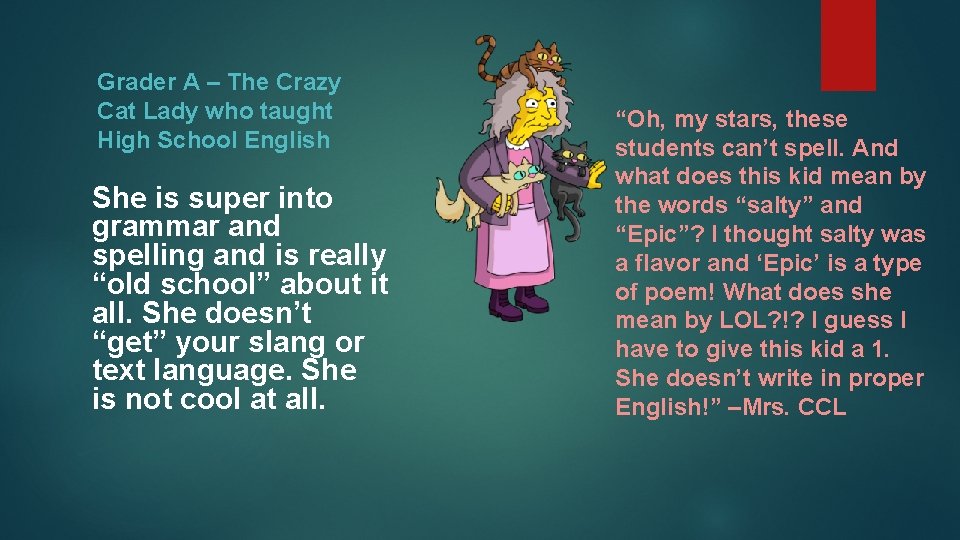
Grader A – The Crazy Cat Lady who taught High School English She is super into grammar and spelling and is really “old school” about it all. She doesn’t “get” your slang or text language. She is not cool at all. “Oh, my stars, these students can’t spell. And what does this kid mean by the words “salty” and “Epic”? I thought salty was a flavor and ‘Epic’ is a type of poem! What does she mean by LOL? !? I guess I have to give this kid a 1. She doesn’t write in proper English!” –Mrs. CCL
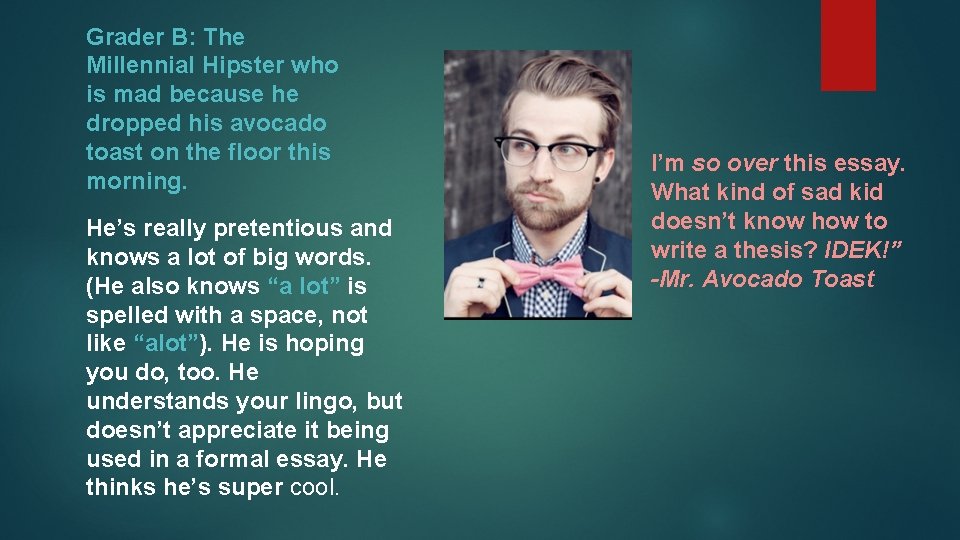
Grader B: The Millennial Hipster who is mad because he dropped his avocado toast on the floor this morning. He’s really pretentious and knows a lot of big words. (He also knows “a lot” is spelled with a space, not like “alot”). He is hoping you do, too. He understands your lingo, but doesn’t appreciate it being used in a formal essay. He thinks he’s super cool. I’m so over this essay. What kind of sad kid doesn’t know how to write a thesis? IDEK!” -Mr. Avocado Toast
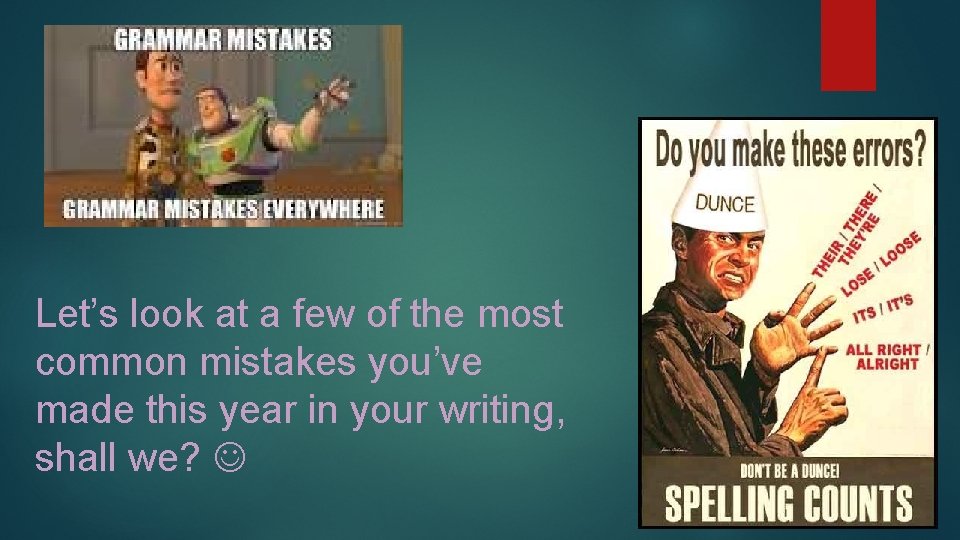
Let’s look at a few of the most common mistakes you’ve made this year in your writing, shall we?
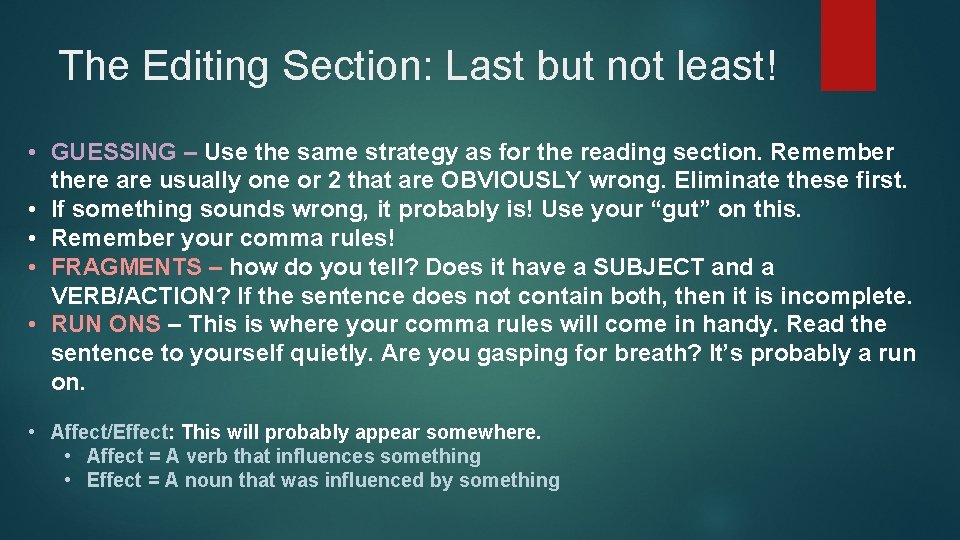
The Editing Section: Last but not least! • GUESSING – Use the same strategy as for the reading section. Remember there are usually one or 2 that are OBVIOUSLY wrong. Eliminate these first. • If something sounds wrong, it probably is! Use your “gut” on this. • Remember your comma rules! • FRAGMENTS – how do you tell? Does it have a SUBJECT and a VERB/ACTION? If the sentence does not contain both, then it is incomplete. • RUN ONS – This is where your comma rules will come in handy. Read the sentence to yourself quietly. Are you gasping for breath? It’s probably a run on. • Affect/Effect: This will probably appear somewhere. • Affect = A verb that influences something • Effect = A noun that was influenced by something
Final Tips: The night before/ morning of the test: • Get a good night’s sleep. You don’t have to go to bed at 9, but don’t go to bed at 2 am either. This is a 5 hour test, which requires focus and test taking stamina. • Wake up a little earlier than usual, but not TOO early. Let yourself ease into the day. • EAT BREAKFAST. Have some protein. Don’t eat a HUGE breakfast, but be sure you have something in your stomach so it isn’t growling by 10 am. A breakfast taco is perfect. Get one with some bacon. ; ) • Bring a sweater, a book, and a bottle of water for the test. Have an extra pencil & eraser just in case. Bring a highlighter.
Final tips: During the test • Remember – Essay first (don’t forget prewriting), then reading multiple choice, then editing section. • If you need to take a break or stand up, DO IT. Go to the bathroom. Get a drink. Then get your focus back. • You can close your book, stretch, and take a “brain break” without getting up as well. Do this if you need to. • If you find your mind wandering, take a few deep breaths. Get some oxygen to your brain. Stretch. Then get your focus back and resume the test. • Much of this test is just the ability to sustain focus for the time it takes to get through it. • Trust your gut – you’ve learned a lot this year! USE YOUR brain! It’s a good one!! YOU’VE GOT THIS!!
TAKE YOUR TIME – YOU HAVE A LOT OF IT! ***USE the dictionary! What separates pass/fail, and pass/commended is often ONE OR 2 questions. Don’t rush through the test. You have plenty of time to sit & be bored, trust me!
Good Luck! You are going to do GREAT!
Practice 1: Write an essay stating your position on whether you believe that we live in an information age or an interruption age.
Practice 2: Write an essay stating your position on whether learning always has a positive effect on a person’s life.
Practice 3: Write an essay on which is more important: what a person thinks or what a person does.
Practice 4: Write an essay stating your position on whether people are forced to do things because of social pressures.