
Taking Notes The Art of Summarization Are your


- Slides: 12
Taking Notes The Art of Summarization Are your pencils sharpened? Powerpoint adapted from G. Anderson Original – DMS GCPS ‘ 06
What is summarizing? • Restating the main idea(s) into your own words – include only the main point(s) (significant evidence/details) – considerably shorter than the original and take a – expansive synopsis of the original source 2
Why Summarize? • • Takes less room Faster Helps you understand the information Helps avoid plagiarism 3
What is Plagiarism? • Taking someone else’s words, or even their ideas and research and using them as if they are your own. – stealing words/ideas 4
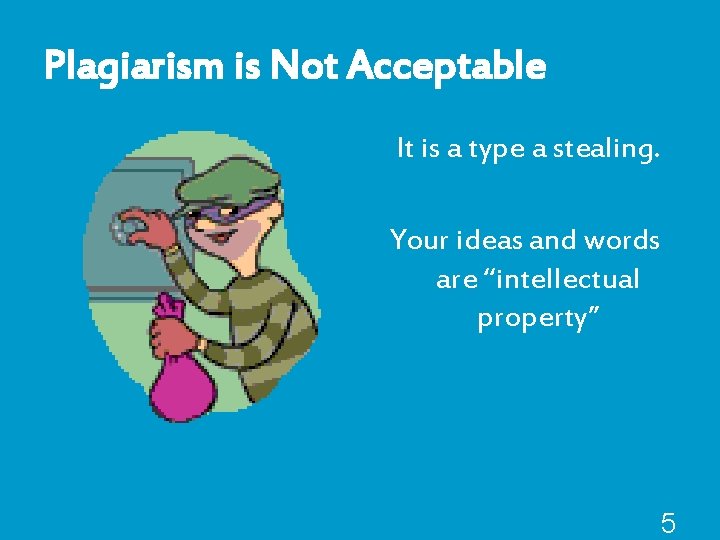
Plagiarism is Not Acceptable It is a type a stealing. Your ideas and words are “intellectual property” 5
Summarizing Steps 1. Skim the material to be summarized. ** Make sure you always refer back to the original source within the text or by MLA citation. 6
2. Identify key words and phrases you think are important or that are needed. Then, paraphrase—put into your own words. • What is paraphrasing? • rewriting a passage into your own words • usually shorter than the original 7
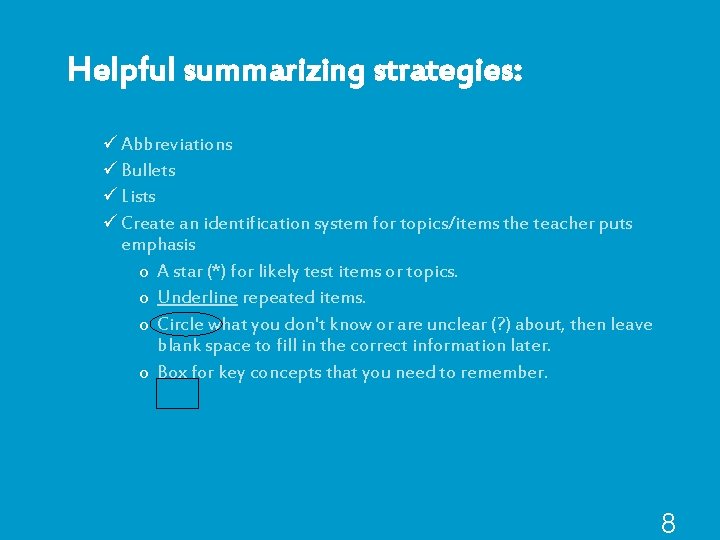
Helpful summarizing strategies: ü Abbreviations ü Bullets ü Lists ü Create an identification system for topics/items the teacher puts emphasis o A star (*) for likely test items or topics. o Underline repeated items. o Circle what you don't know or are unclear (? ) about, then leave blank space to fill in the correct information later. o Box for key concepts that you need to remember. 8
3. Put quotation marks around phrases or sentences that will make a strong impression on your readers. However, use quotations sparingly. 9
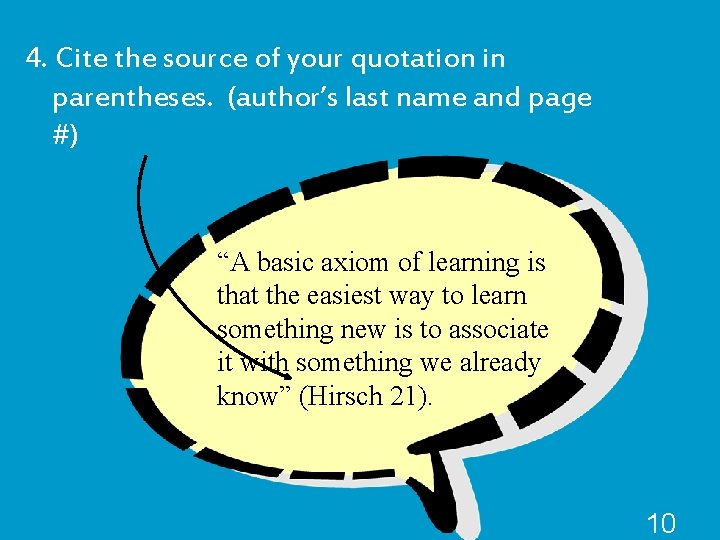
4. Cite the source of your quotation in parentheses. (author’s last name and page #) “A basic axiom of learning is that the easiest way to learn something new is to associate it with something we already know” (Hirsch 21). 10
Practice your note taking • use television or radio programs, summarize and/or short-periods of time, increasing over time. • compare with classmates to see if everyone wrote the same main points. 11
Works Cited Hirsch, D. “The Theory Behind the Dictionary”. Dictionary of Cultural Literacy. Boston: Houghton Mifflin, 2002. “Information Skill of the Month: Strategies in the Bag. ” School Library Media Activities Monthly. September 2005, 22: 1. Accessed 15 October 2005. <http: //www. slmam. com>. 12