
Taking Notes Highlight or underline important facts and
- Slides: 10
Taking Notes
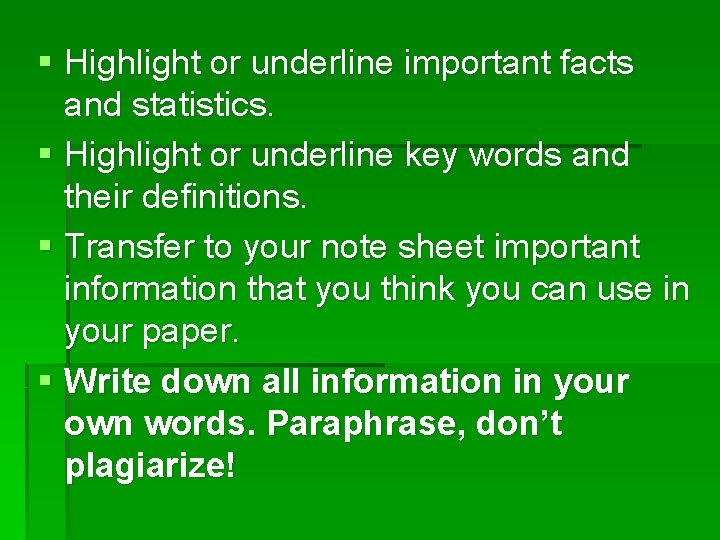
§ Highlight or underline important facts and statistics. § Highlight or underline key words and their definitions. § Transfer to your note sheet important information that you think you can use in your paper. § Write down all information in your own words. Paraphrase, don’t plagiarize!
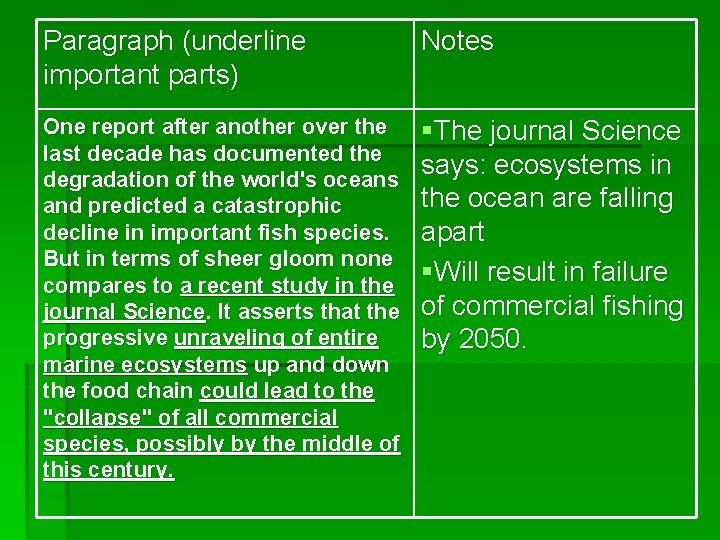
Paragraph (underline important parts) Notes One report after another over the last decade has documented the degradation of the world's oceans and predicted a catastrophic decline in important fish species. But in terms of sheer gloom none compares to a recent study in the journal Science. It asserts that the progressive unraveling of entire marine ecosystems up and down the food chain could lead to the ''collapse'' of all commercial species, possibly by the middle of this century. §The journal Science says: ecosystems in the ocean are falling apart §Will result in failure of commercial fishing by 2050.
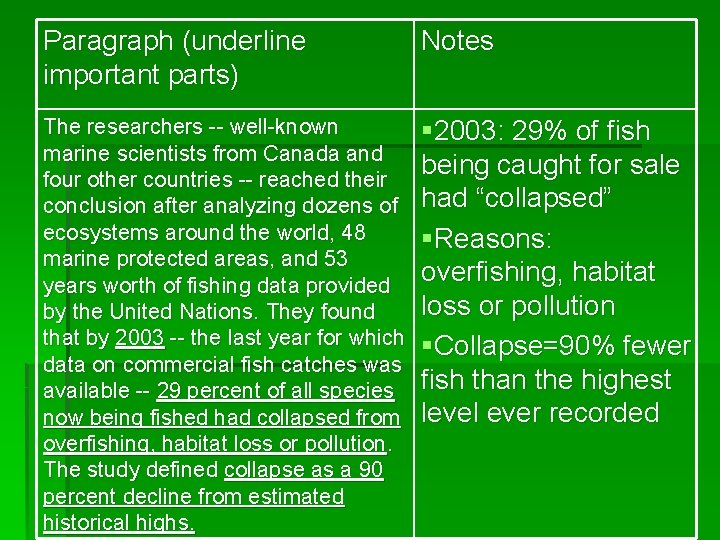
Paragraph (underline important parts) Notes The researchers -- well-known marine scientists from Canada and four other countries -- reached their conclusion after analyzing dozens of ecosystems around the world, 48 marine protected areas, and 53 years worth of fishing data provided by the United Nations. They found that by 2003 -- the last year for which data on commercial fish catches was available -- 29 percent of all species now being fished had collapsed from overfishing, habitat loss or pollution. The study defined collapse as a 90 percent decline from estimated historical highs. § 2003: 29% of fish being caught for sale had “collapsed” §Reasons: overfishing, habitat loss or pollution §Collapse=90% fewer fish than the highest level ever recorded
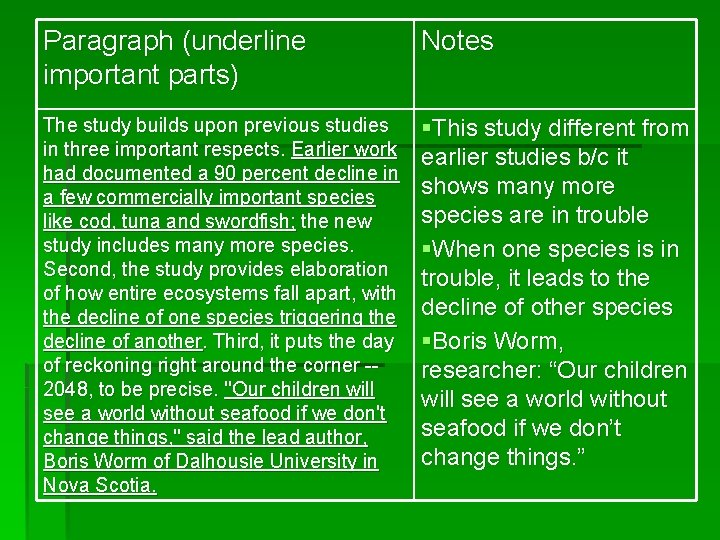
Paragraph (underline important parts) Notes The study builds upon previous studies in three important respects. Earlier work had documented a 90 percent decline in a few commercially important species like cod, tuna and swordfish; the new study includes many more species. Second, the study provides elaboration of how entire ecosystems fall apart, with the decline of one species triggering the decline of another. Third, it puts the day of reckoning right around the corner -2048, to be precise. ''Our children will see a world without seafood if we don't change things, '' said the lead author, Boris Worm of Dalhousie University in Nova Scotia. §This study different from earlier studies b/c it shows many more species are in trouble §When one species is in trouble, it leads to the decline of other species §Boris Worm, researcher: “Our children will see a world without seafood if we don’t change things. ”
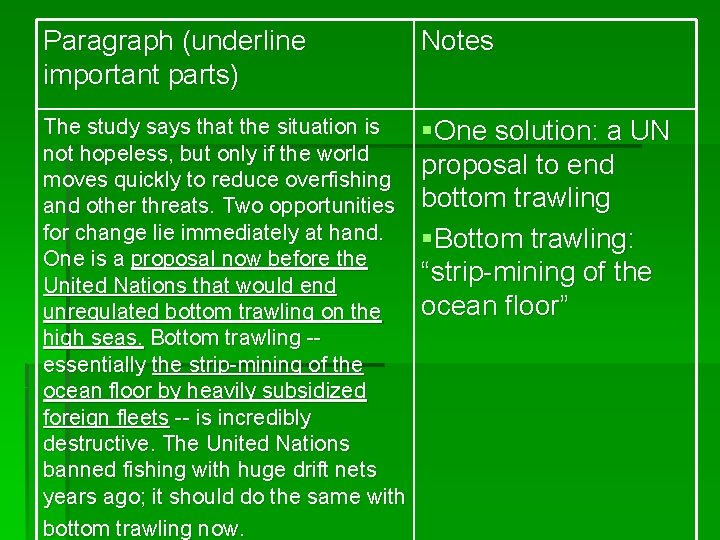
Paragraph (underline important parts) Notes The study says that the situation is not hopeless, but only if the world moves quickly to reduce overfishing and other threats. Two opportunities for change lie immediately at hand. One is a proposal now before the United Nations that would end unregulated bottom trawling on the high seas. Bottom trawling -essentially the strip-mining of the ocean floor by heavily subsidized foreign fleets -- is incredibly destructive. The United Nations banned fishing with huge drift nets years ago; it should do the same with bottom trawling now. §One solution: a UN proposal to end bottom trawling §Bottom trawling: “strip-mining of the ocean floor”
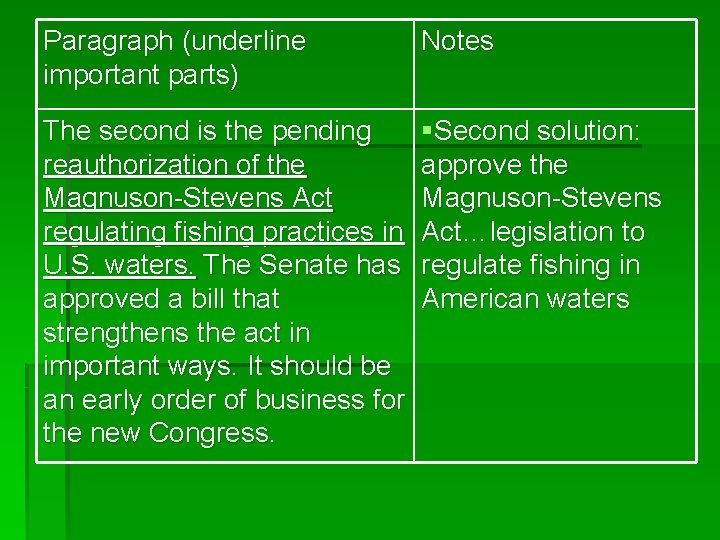
Paragraph (underline important parts) Notes The second is the pending reauthorization of the Magnuson-Stevens Act regulating fishing practices in U. S. waters. The Senate has approved a bill that strengthens the act in important ways. It should be an early order of business for the new Congress. §Second solution: approve the Magnuson-Stevens Act…legislation to regulate fishing in American waters
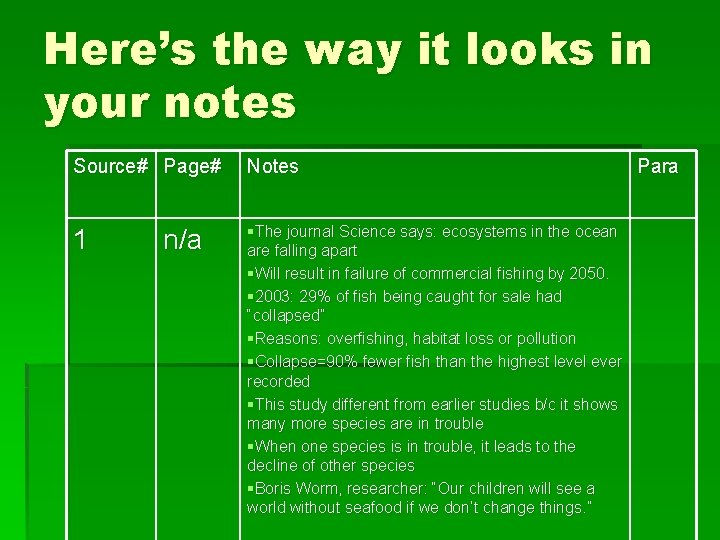
Here’s the way it looks in your notes Source# Page# Notes 1 §The journal Science says: ecosystems in the ocean are falling apart §Will result in failure of commercial fishing by 2050. § 2003: 29% of fish being caught for sale had “collapsed” §Reasons: overfishing, habitat loss or pollution §Collapse=90% fewer fish than the highest level ever recorded §This study different from earlier studies b/c it shows many more species are in trouble §When one species is in trouble, it leads to the decline of other species §Boris Worm, researcher: “Our children will see a world without seafood if we don’t change things. ” n/a Para
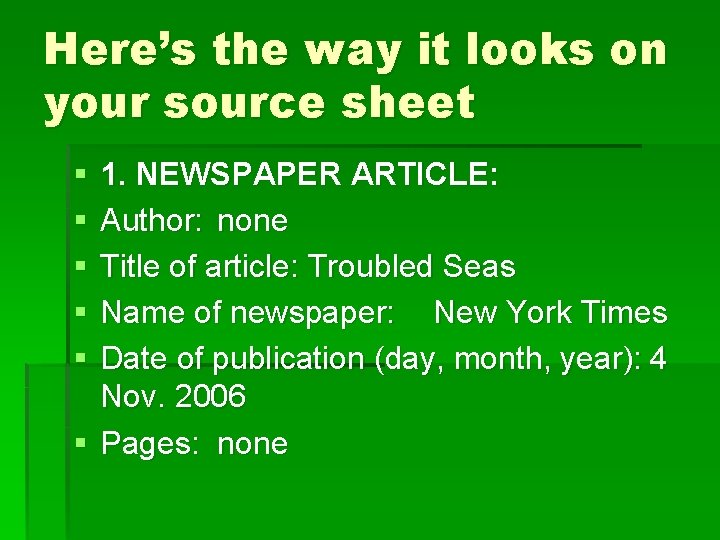
Here’s the way it looks on your source sheet § § § 1. NEWSPAPER ARTICLE: Author: none Title of article: Troubled Seas Name of newspaper: New York Times Date of publication (day, month, year): 4 Nov. 2006 § Pages: none
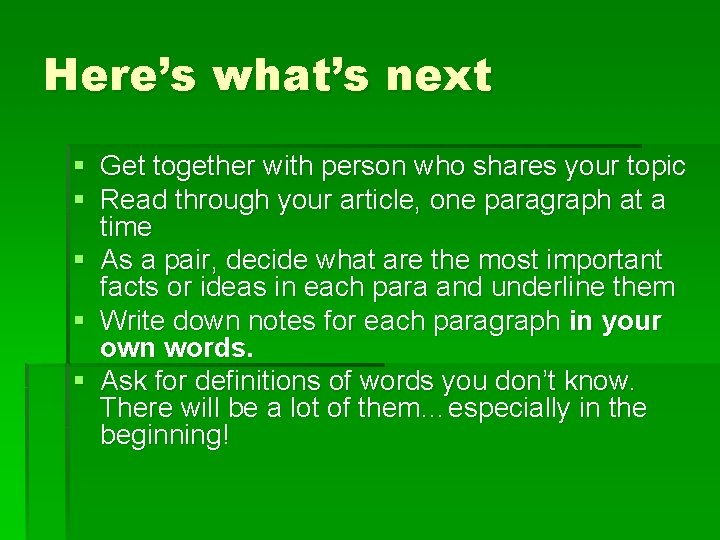
Here’s what’s next § Get together with person who shares your topic § Read through your article, one paragraph at a time § As a pair, decide what are the most important facts or ideas in each para and underline them § Write down notes for each paragraph in your own words. § Ask for definitions of words you don’t know. There will be a lot of them…especially in the beginning!