
Taking Good Conservation Assistance Notes Conservation Planning Part











- Slides: 22
Taking Good Conservation Assistance Notes Conservation Planning, Part 2 July, 2017 Connecticut Abbie Cadman, Resource Conservationist
Why Should Adequate Documentation Be Important To You? • • • Reduce chances for errors, customer service, prepare for appeals. NRCS documents are used for NAD (National Appeals Division) appeals with internal/external customers Provides for continuity in service in the case of a change in planner Is used to record client decisions Improves communication with the client Provides a timeline of events for potential complaints and appeals NRCS is changing the way we do business • • • Internal compliance/O&E teams – state and national Appeals/Mediation Equitable Relief Equal Access to Justice Act (EAJA) Litigation It is Required in many places in the National Procedures Planning Handbook (NPPH) and in the CPM 512
Who is Responsible? • Everyone! • Everyone who works with a participant or on a project is responsible to make sure the complete story is told. • No single person is responsible for completing the Con 6 notes – District Conservationist, Farm Bill Specialist, planners, technicians, engineers (they may keep their own job diary), Conservation District staff
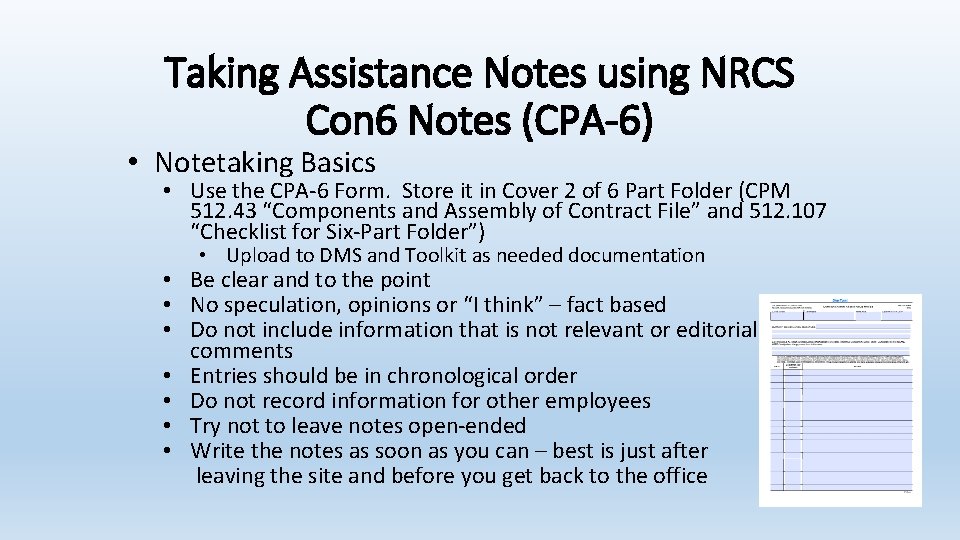
Taking Assistance Notes using NRCS Con 6 Notes (CPA-6) • Notetaking Basics • Use the CPA-6 Form. Store it in Cover 2 of 6 Part Folder (CPM 512. 43 “Components and Assembly of Contract File” and 512. 107 “Checklist for Six-Part Folder”) • Upload to DMS and Toolkit as needed documentation • Be clear and to the point • No speculation, opinions or “I think” – fact based • Do not include information that is not relevant or editorial comments • Entries should be in chronological order • Do not record information for other employees • Try not to leave notes open-ended • Write the notes as soon as you can – best is just after leaving the site and before you get back to the office
Common Shortfalls • Documenting resource concerns • Describe in assistance notes, on an aerial map, CPA-52 • Include location and extent of concerns • Attach photos – provide a scale and/or reference point • Summarize information exchanged between you and the participant • • • Results of the field visit or telephone conversation Areas of agreement/disagreement Next steps for implementing contract Record participant decisions as they are made Print and attach emails, reference “see email” in notes
Example 1 Insufficient Information
Example 2 NOT LEGIBLE
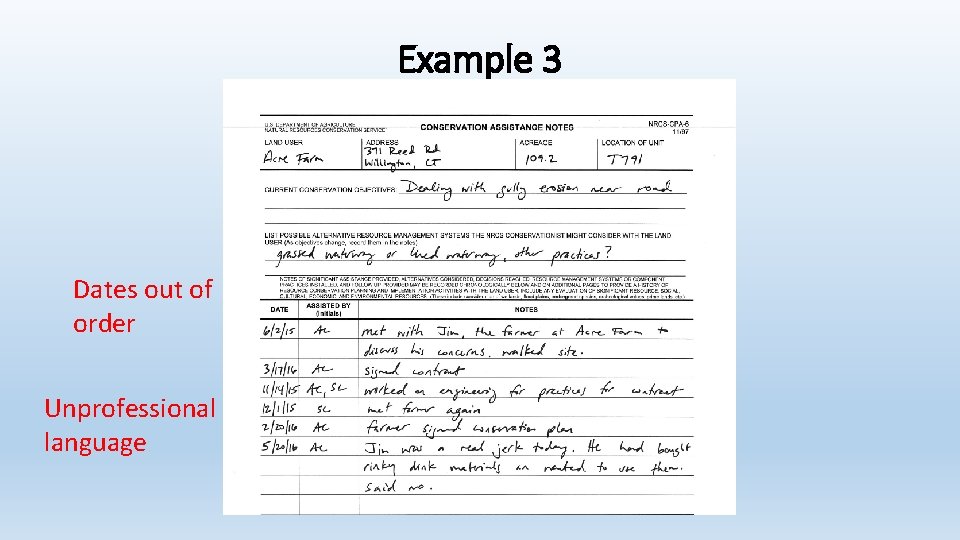
Example 3 Dates out of order Unprofessional language
Example 4 BAD.
Example 5 Ok. May not stand up if litigation involved – can be edited. Likely not completed directly after interaction. Not associated with planning folder. May be appropriate in some cases.
Example 6 Good, but I am sure I missed some things. Information all filled out, chronological dates, background info, references to other documents for more information, DMS, decisions, discussions… Include everything relevant to the conservation planning process. *Tell the whole story*
Please keep in mind… • Documenting applied practices • Required as a part of the planning process (NPPH 600. 28. 1) • Includes practices installed with Conservation Technical Assistance (CTA) • Can be recorded in assistance notes, on the conservation plan, on job sheets, maps • Necessary to ensure future applications are not duplicating practices • Document everyone involved in practice certification – producer, planner, engineer, etc. • Examples of notes/documentation include: • Field visits/phone calls/emails with participant • Dates for implementation of practices • Communication with Third party landowners/other interested parties when plans are implemented • Photos
Notes for NFSAM Appeals • Notes are crucial during reconsideration with a field visit and are also part of the administrative record if there is a formal appeal (NAD). • Assistance notes provided to Appellant, FSA, and/or NAD depending upon level of appeal • Will be scrutinized during a NAD appeal. • Basis must be clear why a tract has the wetland label assigned by the agency • All approvals/denials must be documented • Preliminary or Final Technical Determination
Wetland Con 6 Notes • Need to ensure NFSAM procedures were followed: reconsideration with a field visit or mediation; appeal to FSA or to NAD • Notes are especially important during informal appeals/mediation process, appeal to FSA, and as part of the administrative record if there is a formal appeal (NAD) • Will be scrutinized during a NAD appeal. • Must document why agency took action: wetland label/approval/denial
Wetland CPA-6 Notes • Who completed the determination? • New certified determination, prior certified determination, or maintenance ? • Historical imagery review completed? • Field or office determination? • Was owner/operator contacted before site visit? • Who was present if there was a field visit?
Examples of Items to Document for Contracting NOTE – Do not keep separate notes for Planning, Contracting and Implementation • All discussions, decisions, meetings with applicant • All eligibility documentation – statuses, what is needed • Include evaluation of publicly owned land potential for duplication of practices • When documents received or sent to applicant • Which document or form • When documents uploaded to DMS • Which document or form • Status of eligibility paperwork with FSA
Examples of Items to Document with Implementation • Pre-construction meeting details • Description of work being done (equipment, materials, progress made) • Problems encountered any required corrective actions • Conversations with contractor and participant • Decisions made by participant • Site conditions • Details on any work and/or materials that will not meet NRCS standards and specifications
Engineering Job Diary OR Con 6 Notes? Notes on job investigation and resource concerns Con 6 Notes References to permits applied for or received Con 6 Notes Details of pre-construction meeting Engineering Job Diary Details of pipe delivered: ASTM, diameter, length Engineering Job Diary “On June 1, 2016, construction commenced, see job diary for details” A list of equipment on site Construction issues/problems requiring a contract modification Con 6 Notes Engineering Job Diary BOTH
What Should Be In Con 6 Notes By Policy 512. 43 Components and Assembly of contract file B Filing Contract Documents (2) (v) Conservation assistance notes, which should be concise, factual statements that document information relating to significant activities and situations such as (but not limited to) — • Planning and application materials delivered (participant’s copy of contract, job sheets, and engineering data) • Documentation of site visits • Annual contract reviews • Potential noncompliance with contract provisions and actions taken by participant/NRCS • Scheduling arrangements • Correspondence and agreements reached with the participant that are not documented in other parts of the contract and may be useful in follow-up.
Additional Documentation • E-mail correspondence (be very careful before hitting “send button”) or should correspondence with participant be on agency letterhead? • Not just documenting interactions with producers, document relevant activities within NRCS and Partners • Approvals to add funds/modifications • Approvals to waive cost recovery for cancellations or terminations • Any interpretation of policy directly related to the contract Anyone working with the contract file should be able to follow progress of the contract through the 6 -notes. Document, Document…
Summary • Good 6 -notes will tell the history of land conditions, contract, practice implementation, etc. and allow for anyone in the office or other official to be able to pick up the file and to know what was done and why. • It should include ALL interactions and be written in an unbiased manner that is free from opinions. • The wording should be professional and written in a manner that is understandable and to the point that will help the agency in possible appeals, equitable relief cases, mediation, EAJA, litigation
THANK YOU! Abbie Cadman Resource Conservationist Tolland, CT Abbie. Cadman@ct. usda. gov 860 -871 -4017 National Contact (and original author of much of this presentation): Ed Nilson National Appeals and Equitable Relief Coordinator USDA-NRCS National Headquarters (202) 538 -9537 USDA IS AN EQUAL OPPORTUNITY PROVIDER, EMPLOYER AND LENDER