
Taking Depositions The Top of the Funnel J
- Slides: 14
Taking Depositions “The Top of the Funnel” J. Richard Ratcliffe, Esq. 1
Goals of the Program Demystify and simplify the process of taking or defending a deposition ¡ Give you an opportunity to experiment, try techniques, make mistakes ¡ Realistic experience in a testing laboratory where you control the experiment and get immediate feedback ¡ The NITA Privilege ¡ 2
Why take a deposition? ¡ Discovery / To build your case • To learn new information • To confirm facts you already know • To test your theories ¡ To educate your client ¡ To “see, hear, and smell” the witness 3
How Do You Use A Deposition? ü As affirmative evidence for motions or trial ü To refresh recollection of a testifying witness ü To impeach a testifying witness 5
LONG BEFORE THE DEPOSITION BEGINS… 6
Preparing Yourself ¡ REVIEW/CONSULT: l l l ¡ Documents produced Other deposition transcripts Motion papers Your client, expert Independent research MAKE NOTES: l l Outline vs. script Keyed to documents 7
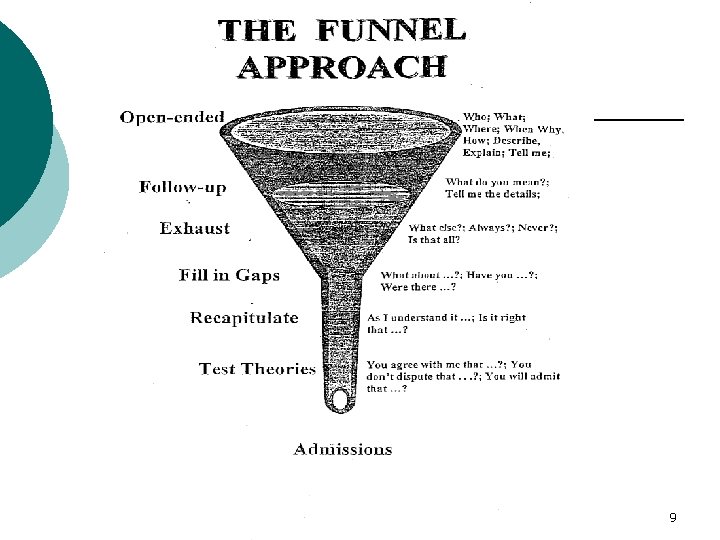
TECHNIQUE: THE FUNNEL APPROACH Get the coverage or breadth of the topic first ¡ Start your questioning in broad areas to avoid unintended gaps ¡ Use open-ended questions - HOW, WHAT, WHO, WHEN, WHERE, WHY, DESCRIBE, EXPLAIN, TELL ME ¡ 8
9
The Funnel Approach (cont’d) ¡ ¡ Gradually narrow your areas as you gain confidence as to what is relevant and useful Ask narrow and pointed questions as you fill in details and seek admissions Insure completeness by always asking “anything else? ” Recapitulate and summarize where useful, being careful of how you paraphrase 10
The Funnel Approach (cont’d) Listen to the answers and follow up when necessary and appropriate, then or later ¡ Exhaust each topic before moving on to a new topic ¡ Questions should be short and clear; try to use 10 words or less ¡ 11
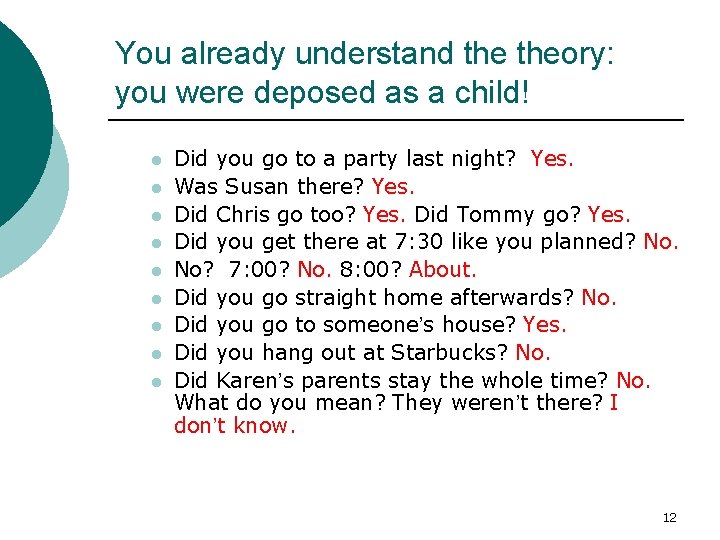
You already understand theory: you were deposed as a child! l l l l l Did you go to a party last night? Yes. Was Susan there? Yes. Did Chris go too? Yes. Did Tommy go? Yes. Did you get there at 7: 30 like you planned? No. No? 7: 00? No. 8: 00? About. Did you go straight home afterwards? No. Did you go to someone’s house? Yes. Did you hang out at Starbucks? No. Did Karen’s parents stay the whole time? No. What do you mean? They weren’t there? I don’t know. 12
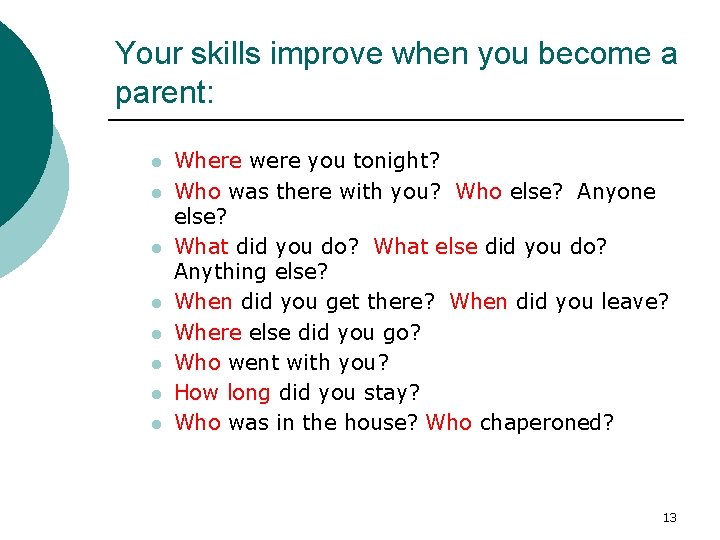
Your skills improve when you become a parent: l l l l Where were you tonight? Who was there with you? Who else? Anyone else? What did you do? What else did you do? Anything else? When did you get there? When did you leave? Where else did you go? Who went with you? How long did you stay? Who was in the house? Who chaperoned? 13
Consider: ¡ ¡ ¡ Which method was easier as the questioner? Which got you more information? Which got the person talking? Which gives you more confidence that you learned all the information there was to learn? But, as the one being interrogated, which do you prefer (especially if you have something to hide)? 14
Demonstration ¡ Closed vs Open Ended Questions at the Top of the Funnel 15