
Taking Charge of your Career Andrea Danyluk Professor
- Slides: 26
Taking Charge of your Career Andrea Danyluk Professor of Computer Science Williams College Carol Shilepsky Professor of Mathematics and Computer Science Wells College
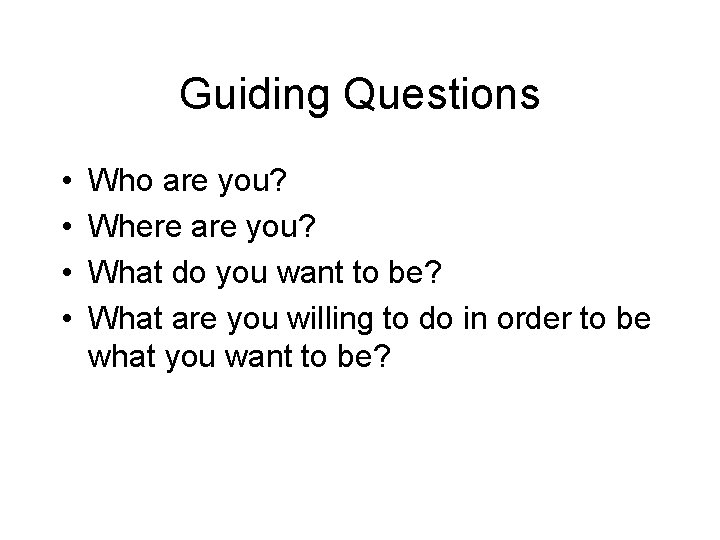
Guiding Questions • • Who are you? Where are you? What do you want to be? What are you willing to do in order to be what you want to be?
Who am I? • 1990 -1994 NYNEX S&T • 1994 - Williams College – – Department Chair of Committee on Educational Policy Chair of Faculty Steering Committee on Appointments and Promotions
Where are you? Probably obvious… • Working toward goals happens in context • Watch and listen – Read your environment to learn what you need to do to achieve your goals – Hear what others are trying to communicate to you
What you can learn For promotion to full professor: • External letters of support needed? • Relative value of research in CS vs CS education? • Importance of leadership ability? • Sustained excellence in teaching?
What do you want to be? • Administrator? – What kind? • Researcher? – In industry? – At a more research-oriented institution?
The administrative track • Pursue committee assignments related to your area of interest – Will help you decide whether you’re really interested – Will support your claim of interest – Will put you in touch with those currently holding those positions • Demonstrate that you’re organized • Let someone know you’re interested in administrative opportunities
Example 1: Dean of Students • Committees – Academic Standing, Undergraduate Life, Honor and Discipline… • Demonstrate interest in student activities and concerns
2: Dean of Faculty • Committees – Educational Policy, Faculty Steering, Appointments and Promotions • Show leadership in your department
3: Provost • Committees – Appointments and Promotions, Priorities and Resources • More generally: – What does X do? – What are her/his areas of responsibility?
The CS education track Do you want to be a Dean of CS Education? • CS Ed. Publications • New curricular initiatives • Textbook publication • Presentations at SIGCSE • Service to the CS Ed. community
The research track • Establish collaborations with researchers at other institutions – Will keep you “on your toes” – Can provide you with access to good minds, good resources, etc. • Grants – Volunteer for review panels • Be willing to travel – Make the most of sabbaticals, summers, conference opportunities
Volunteerism • Provides opportunities to meet people – Name recognition – People to go to for advice • Offers a glimpse of the workings of a school/organization/conference… • But be careful: can be too much of a good thing
What are you willing to do… … to be what you want to be? • Delayed gratification – How much are you willing to give up and for how long? • Have to pay your dues • Is there something that makes you happy on your way to your goal?
“yes” or “no” • It’s ok to say “no” – No one will hate you; they might even respect you more – Many (most? ) opportunities will present themselves again • How to decide? – Will this opportunity arise again? – Might I regret my decision?
The move to X and back* again • X = Administration – Students can be scary – Relationships with colleagues and/or students may have changed • X = Industry – Potentially invigorating in the short term – Potentially impossible in the long term * to teaching
Pick a goal • Even seemingly spontaneous opportunities probably aren’t so spontaneous • Your history/experience will affect the opportunities that become available to you • Will help inform your decisions when opportunities present themselves • Remember that your career goals and your personal goals need to coexist
But avoid putting on blinders • Be open to some opportunities that are off your track • Mixing things up is interesting • There are many good ways to live a life • Goals are a guide -- not an absolute
Carol Shilepsky Professor of Mathematics and Computer Science Wells College
Brief Bio • 1965: BA in Mathematics, Connecticut College for Women • 1971: Ph. D. in Mathematics, University of Wisconsin, Madison • 1974: Assistant Professor at Wells College shared with husband Sandy • 1978: Assistant Professor • 1981: Associate Professor • 1989: Professor • Various visiting appointments at Cornell, including NSF VPW
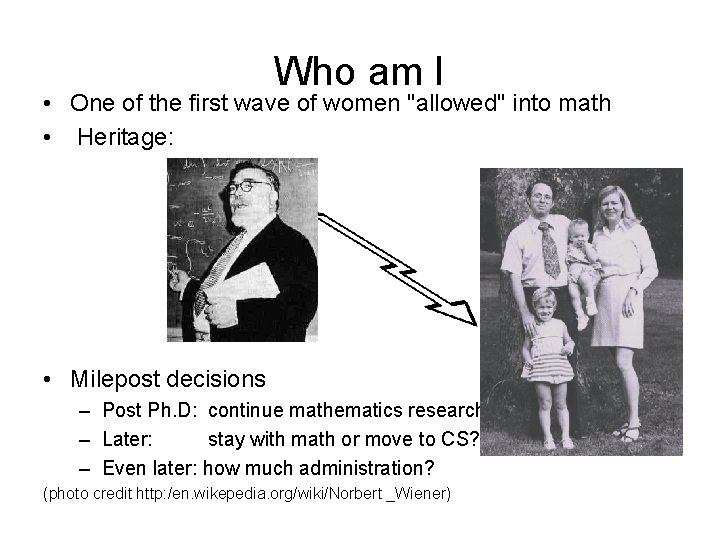
Who am I • One of the first wave of women "allowed" into math • Heritage: • Milepost decisions – Post Ph. D: continue mathematics research? – Later: stay with math or move to CS? – Even later: how much administration? (photo credit http: /en. wikepedia. org/wiki/Norbert _Wiener)
Where am I: Wells College • Liberal arts, ~600 students, single-sex until 2005, Aurora, NY • Criteria for promotion – Excellence in teaching – Excellence in research or community service – Satisfactory in the other • The facts of life, first year at Wells – Invited to speak at the AMS national meeting ($300 towards expenses) – Invited to speak at an international meeting in Finland (declined) – Received desk copy of Hillier and Lieberman's Operations Research
Consequences • Collaboration with Cornell School of OR and IE (1978 -82) – Work with Jack Muckstadt and Dave Heath in Inventory Theory, primarily for USAF – NSF Visiting Professorship for Women 1990 -91 • Consulting for Digicomp Research, Ithaca, NY (1982 -present) – Stumbled into it because they needed a mathematician to analyze program verification environments (thanks to Anil Nerode) – Software I helped build is on helicopters in Iraq – Systems I helped build monitor airspace at a number of AF bases – Safety analysis I directed helps ensure a cruise missile targeted for Baghdad doesn't hit Tel Aviv • Developing Computer Science at Wells (1982 -present) – Resources: experience at Digicomp, Cornell colloquia and classes, Wells' willingness to let me develop courses
Administration • • Wells model: shared governance per a strong Faculty Manual Junior faculty involved in major committees Implications: a lot of work, a lot of responsibility Along the way – – Presidential Search Committee third year at Wells All major committees Advisory Committee often Currently Chair of Mathematical and Physical Sciences • Good preparation if one wants to move to administration • Can distract from teaching and research • Corporate administration (Digicomp Research) – Proposal writing and administration – Personnel management – Currently on Board of Directors
How To Reconcile Who and Where • Institutional goals usually take precedence over individuals • The least successful/happy new faculty don't get it – Great teaching at Cornell is not enough – Great research at Wells is not enough • Evolution works better than revolution – I wasn't going to get enough travel $$ or time to remain a research mathematician – I could find opportunities that fit better with Wells • A career is a long time • There are more opportunities than you have time for • Tenure is a nice base
Discussion • Where and who are you? • Where do you want to be? • What choices do you need to make now for benefits later? • What opportunities do you have? • What obstacles? • Who can help?