
TAKING AN INTEGRATED APPROACH TO DISASTER RISK REDUCTION

- Slides: 15
TAKING AN INTEGRATED APPROACH TO DISASTER RISK REDUCTION Presentation to JSC-WCRP Antalya, Turkey Feb 2010 International Social Sciences Council Gordon A. Mc. Bean, CM, Ph. D, FRSC Chair, Science Committee – Integrated Research on Disaster Risk - IRDR Institute for Catastrophic Loss Reduction University of Western Ontario, Canada
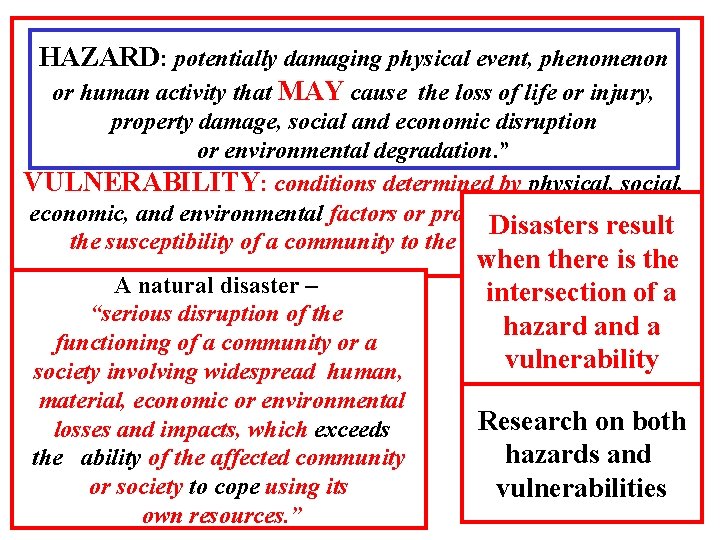
HAZARD: potentially damaging physical event, phenomenon or human activity that MAY cause the loss of life or injury, property damage, social and economic disruption or environmental degradation. ” VULNERABILITY: conditions determined by physical, social, economic, and environmental factors or processes, which increase Disasters result the susceptibility of a community to the impact of hazards. A natural disaster – “serious disruption of the functioning of a community or a society involving widespread human, material, economic or environmental losses and impacts, which exceeds the ability of the affected community or society to cope using its own resources. ” when there is the intersection of a hazard and a vulnerability Research on both hazards and vulnerabilities
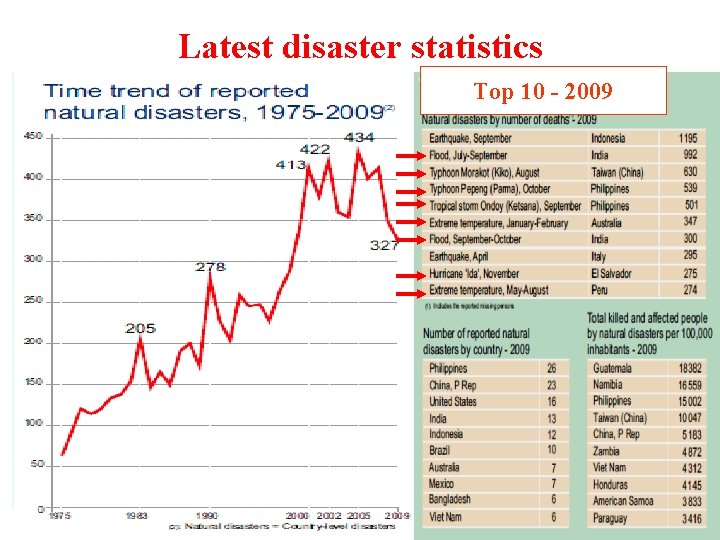
Latest disaster statistics Top 10 - 2009
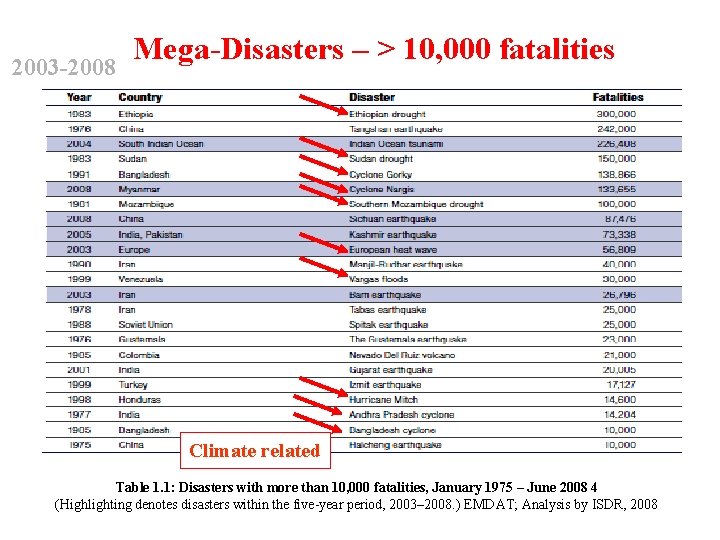
2003 -2008 Mega-Disasters – > 10, 000 fatalities Climate related Table 1. 1: Disasters with more than 10, 000 fatalities, January 1975 – June 2008 4 (Highlighting denotes disasters within the five-year period, 2003– 2008. ) EMDAT; Analysis by ISDR, 2008
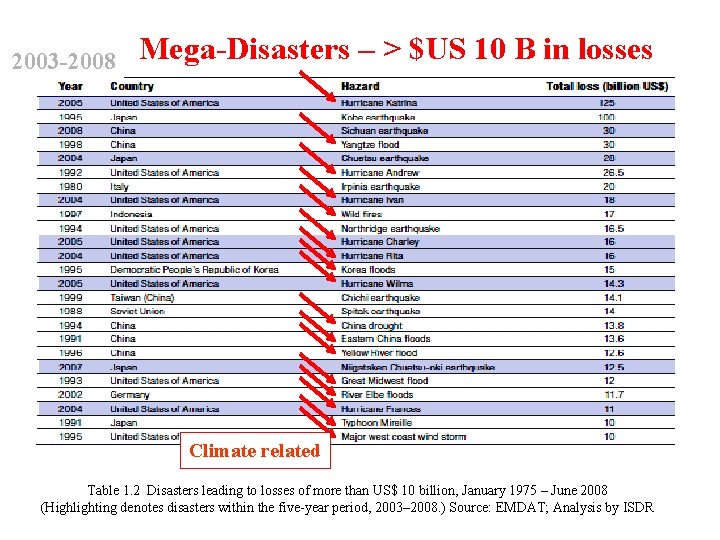
2003 -2008 Mega-Disasters – > $US 10 B in losses Climate related Table 1. 2 Disasters leading to losses of more than US$ 10 billion, January 1975 – June 2008 (Highlighting denotes disasters within the five-year period, 2003– 2008. ) Source: EMDAT; Analysis by ISDR
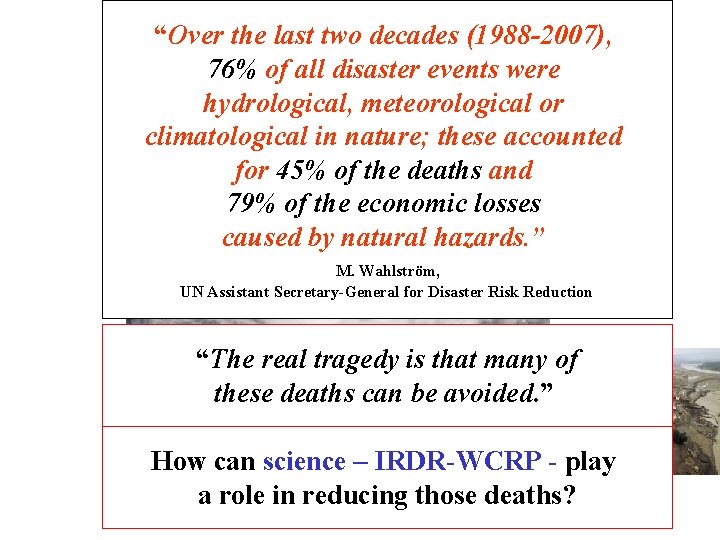
“Over the last two decades (1988 -2007), 76% of all disaster events were Typhoon Morakot – August 2009 hydrological, meteorological or climatological in nature; these accounted for 45% of the deaths and 79% of the economic losses caused by natural hazards. ” M. Wahlström, UN Assistant Secretary-General for Disaster Risk Reduction “The real tragedy is that many of these deaths can be avoided. ” How can science – IRDR-WCRP - play a role in reducing those deaths?
Integrated Research on Disaster Risk Addressing the challenge of natural and humaninduced environmental hazards (IRDR) An integrated approach to research on disaster risk through: an international, multidisciplinary (natural, health, engineering and social sciences, including socioeconomic analysis) collaborative research programme. - Sept/2008
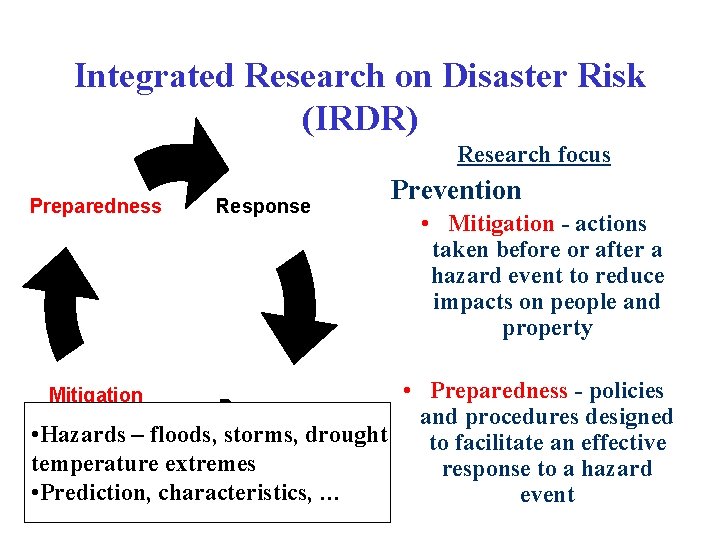
Integrated Research on Disaster Risk (IRDR) Research focus Preparedness Response Prevention • Mitigation - actions taken before or after a hazard event to reduce impacts on people and property • Preparedness - policies Recovery and procedures designed • Hazards – floods, storms, drought to facilitate an effective temperature extremes response to a hazard • Prediction, characteristics, … event Mitigation
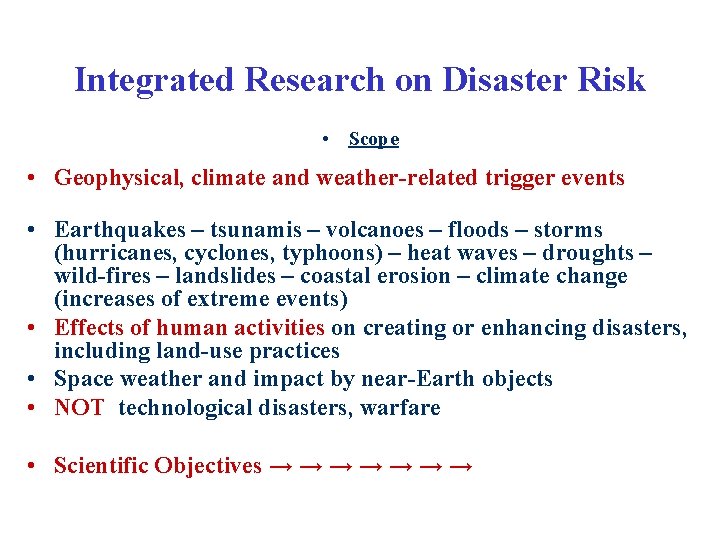
Integrated Research on Disaster Risk • Scope • Geophysical, climate and weather-related trigger events • Earthquakes – tsunamis – volcanoes – floods – storms (hurricanes, cyclones, typhoons) – heat waves – droughts – wild-fires – landslides – coastal erosion – climate change (increases of extreme events) • Effects of human activities on creating or enhancing disasters, including land-use practices • Space weather and impact by near-Earth objects • NOT technological disasters, warfare • Scientific Objectives → → → →
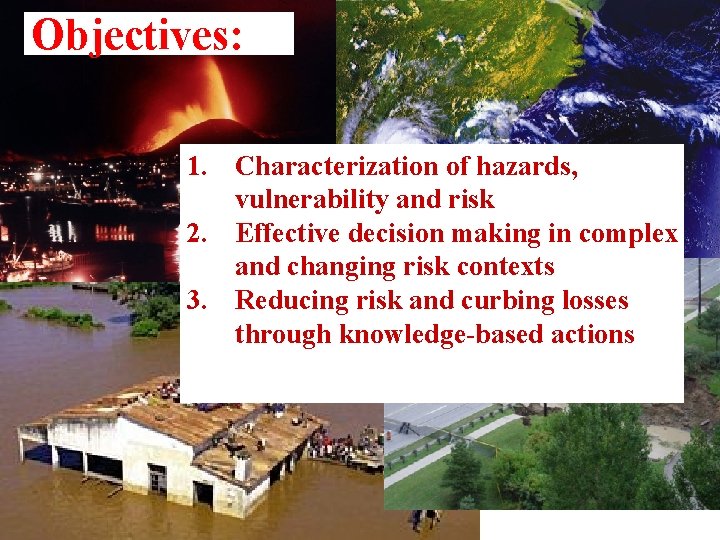
Objectives: 1. Characterization of hazards, vulnerability and risk 2. Effective decision making in complex and changing risk contexts 3. Reducing risk and curbing losses through knowledge-based actions
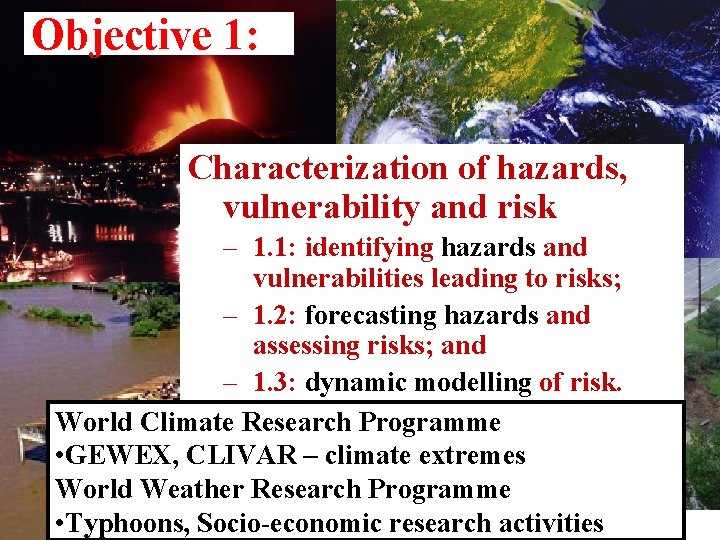
Objective 1: Characterization of hazards, vulnerability and risk – 1. 1: identifying hazards and vulnerabilities leading to risks; – 1. 2: forecasting hazards and assessing risks; and – 1. 3: dynamic modelling of risk. World Climate Research Programme • GEWEX, CLIVAR – climate extremes World Weather Research Programme • Typhoons, Socio-economic research activities
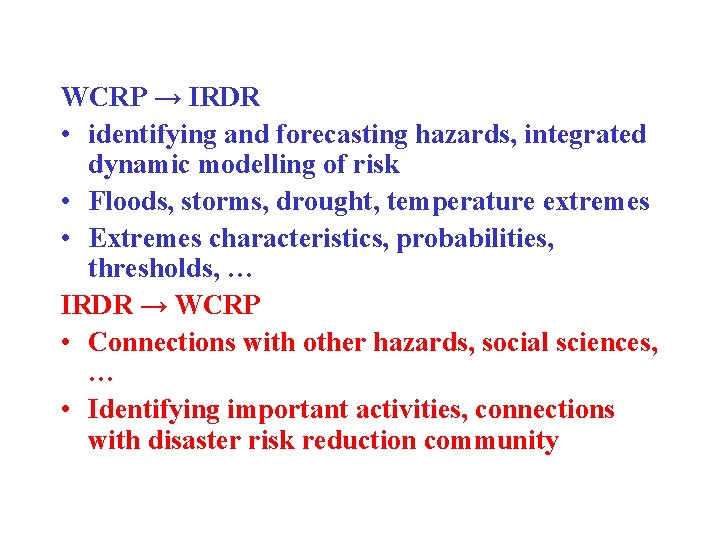
WCRP → IRDR • identifying and forecasting hazards, integrated dynamic modelling of risk • Floods, storms, drought, temperature extremes • Extremes characteristics, probabilities, thresholds, … IRDR → WCRP • Connections with other hazards, social sciences, … • Identifying important activities, connections with disaster risk reduction community
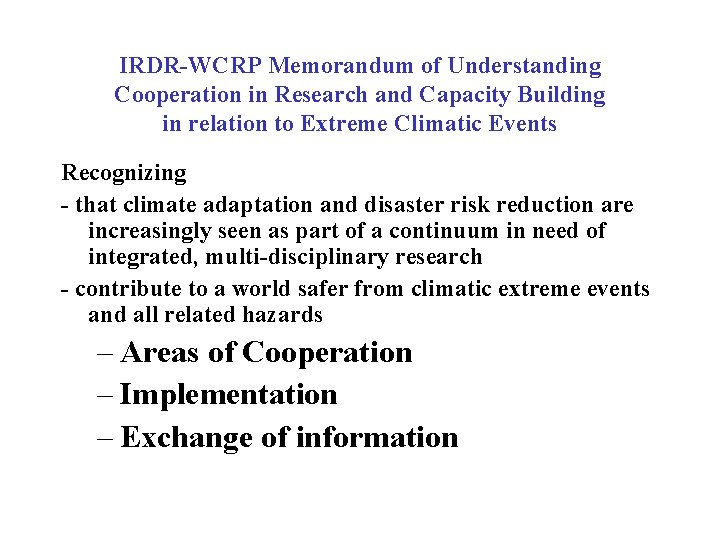
IRDR-WCRP Memorandum of Understanding Cooperation in Research and Capacity Building in relation to Extreme Climatic Events Recognizing - that climate adaptation and disaster risk reduction are increasingly seen as part of a continuum in need of integrated, multi-disciplinary research - contribute to a world safer from climatic extreme events and all related hazards – Areas of Cooperation – Implementation – Exchange of information
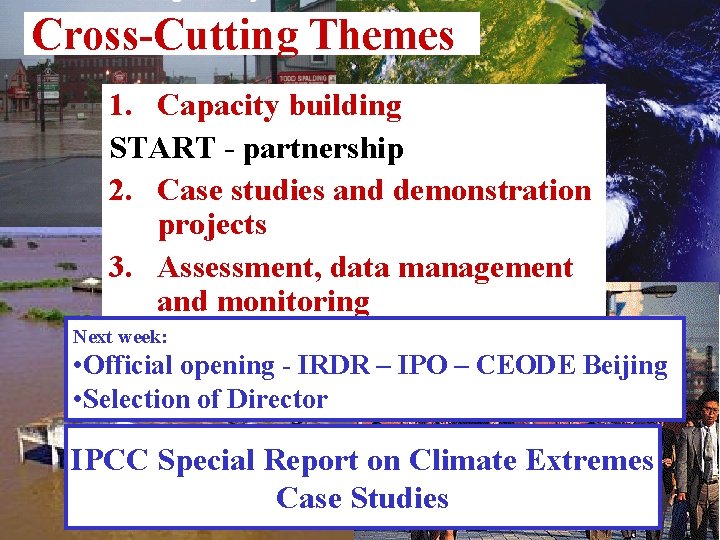
Cross-Cutting Themes 1. Capacity building START - partnership 2. Case studies and demonstration projects 3. Assessment, data management and monitoring Next week: • Official opening - IRDR – IPO – CEODE Beijing • Selection of Director IPCC Special Report on Climate Extremes Case Studies
Integrated Research on Disaster Risk - IRDR Addressing the challenge of natural and human-induced environmental hazards International Social Sciences Council Thank you for your attention