
Taking a test reading your textbook and writing
Taking a test, reading your textbook, and writing an essay.
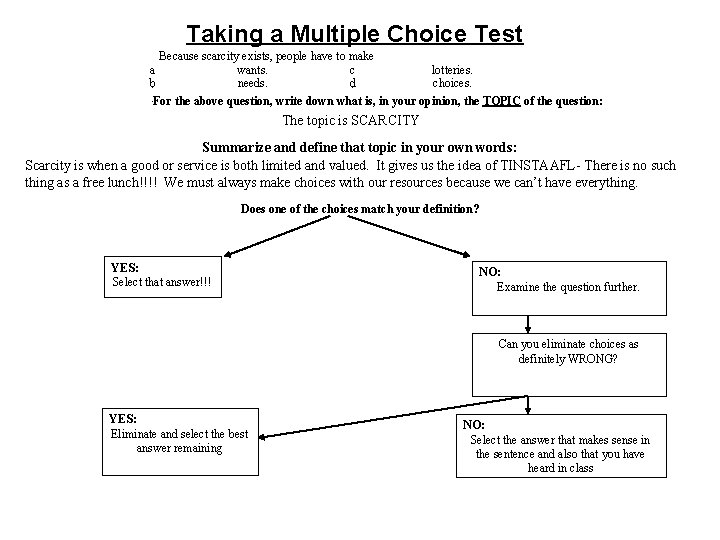
Taking a Multiple Choice Test Because scarcity exists, people have to make a wants. c lotteries. b. needs. d. choices. . For the above question, write down what. is, in your opinion, the TOPIC of the question: The topic is SCARCITY Summarize and define that topic in your own words: Scarcity is when a good or service is both limited and valued. It gives us the idea of TINSTAAFL- There is no such thing as a free lunch!!!! We must always make choices with our resources because we can’t have everything. Does one of the choices match your definition? YES: Select that answer!!! NO: Examine the question further. Can you eliminate choices as definitely WRONG? YES: Eliminate and select the best answer remaining NO: Select the answer that makes sense in the sentence and also that you have heard in class
Getting to know your textbook. • First – examine the table of contents. – The table of contents out lines the content of the book. It also shows you how the chapters of the book will be laid out. • Second – explore the index. – The index is organized alphabetically. It lists the specific topics of the textbook and the page that the topic can be found. • Third – check out the glossary. – The glossary is a miniature dictionary. It won’t give you as much information as the index, but it is faster for finding the definition of a word.
How to read a textbook. • Follow these steps to familiarize yourself with the chapter: 1. Read the chapter title. 2. Read the introductory paragraph. 1. Many chapters will offer a paragraph that explains in a general way the contents of that chapter. 3. Read the subchapter headings. 1. The textbook will employ different fonts or boldface so that you can easily identify these. 4. Look quickly at he charts, pictures, graphs, tables, cartoons, and the like. 1. Read the captions under each. 5. Read the concluding paragraph or summary. 6. Read the questions at the end of the chapter.

How to read a textbook. • Now read the chapter. • You are now faced with two questions: – Do you have to read everything, or do you just need to read enough to answer the questions about the reading? • To what extent are you responsible for all of the material in the reading? • Will your teacher give you a quiz the following day to make sure you’ve read it all? • Will your teacher go over all the material the following day, or will you be expected to learn and retain it on your own?
How to read a textbook. – How does your short-range goal of saving time stack up against your long-range goal of becoming a better student? • In other words, are you interested merely in submitting acceptable homework, or are you genuinely interested in learning the material? • Will the information you have read mean as much to you if you don’t have a fuller idea of the content? • Are you content with acquiring the necessary information in class when the teacher reviews the material, or do you wish to become a leader in the next day’s discussion?
How to read a textbook. • Should you take notes over the reading? – If this helps you to retain the information, it would be a good idea for you take notes over the reading. – This will also help you when you wish to study for a test. It helps you locate information quickly and reduces the amount of rereading you may be required to do.
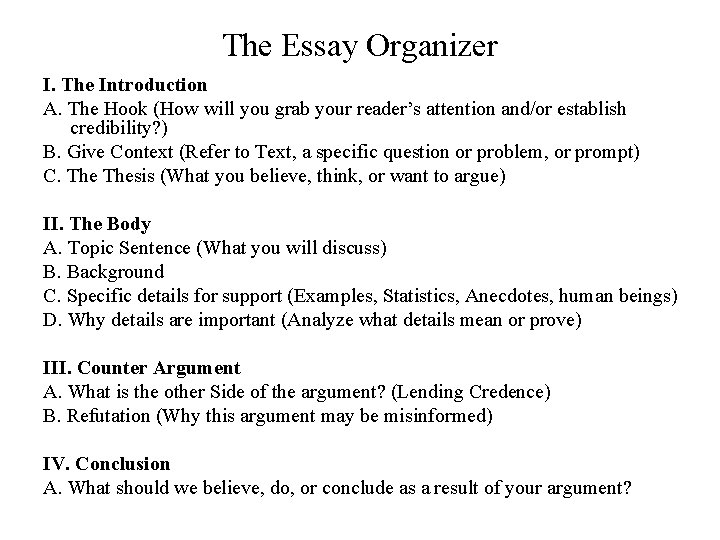
The Essay Organizer I. The Introduction A. The Hook (How will you grab your reader’s attention and/or establish credibility? ) B. Give Context (Refer to Text, a specific question or problem, or prompt) C. Thesis (What you believe, think, or want to argue) II. The Body A. Topic Sentence (What you will discuss) B. Background C. Specific details for support (Examples, Statistics, Anecdotes, human beings) D. Why details are important (Analyze what details mean or prove) III. Counter Argument A. What is the other Side of the argument? (Lending Credence) B. Refutation (Why this argument may be misinformed) IV. Conclusion A. What should we believe, do, or conclude as a result of your argument?
2 nd Day Essay The Watershed • A watershed, literally, discusses which way water will flow as it falls to the Earth • In history it means a change in time that is a major separation • I would like you to write an essay today about a “watershed” moment in your life • Please try to follow the format outlined by Mr. Rathke.
- Slides: 9