
Taking a Look at SelfRegulated Strategy Development for


- Slides: 31
Taking a Look at Self-Regulated Strategy Development for Writing
Agenda • Comprehensive, Integrated, Three-Tiered (Ci 3 T) Models of Prevention • A Look at Self-Regulated Strategy Development (SRSD) for Writing – What is SRSD for Writing? – Why is SRSD for Writing effective? – What does the supporting research for SRSD for Writing say? – What are the benefits and challenges? – How do I implement SRSD for Writing in my classroom? Implementation Checklist – How well is it working? Examining the Effects
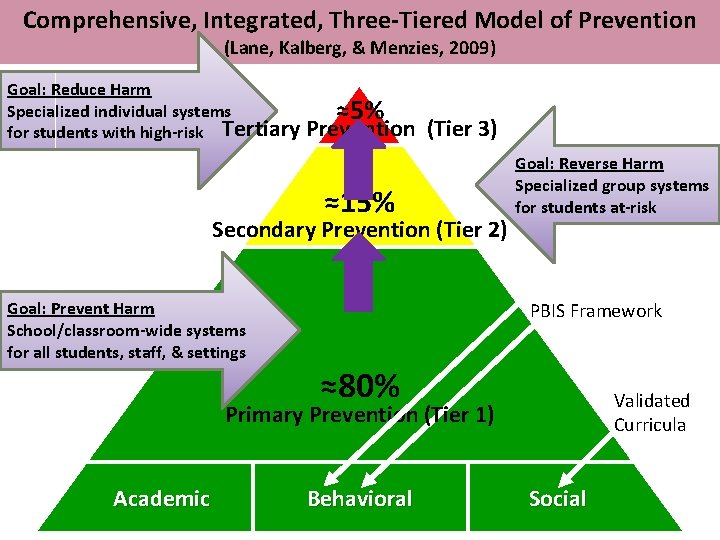
Comprehensive, Integrated, Three-Tiered Model of Prevention (Lane, Kalberg, & Menzies, 2009) Goal: Reduce Harm Specialized individual systems for students with high-risk Tertiary ≈5% Prevention (Tier 3) ≈15% Secondary Prevention (Tier 2) Goal: Prevent Harm School/classroom-wide systems for all students, staff, & settings Goal: Reverse Harm Specialized group systems for students at-risk PBIS Framework ≈80% Validated Curricula Primary Prevention (Tier 1) Academic Behavioral Social
A Look at: Self-Regulated Strategy Development (SRSD)
What is Self-Regulated Strategy Development (SRSD)? • Individualized instruction tailored to the needs of the students: – Explicit Instruction, – Academic Instruction, – Social Strategies, – Flexible to allow for the intensity of instruction to be adjusted to meet the individual needs of a student. (Harris, Graham, Mason, & Friedlander, 2007)
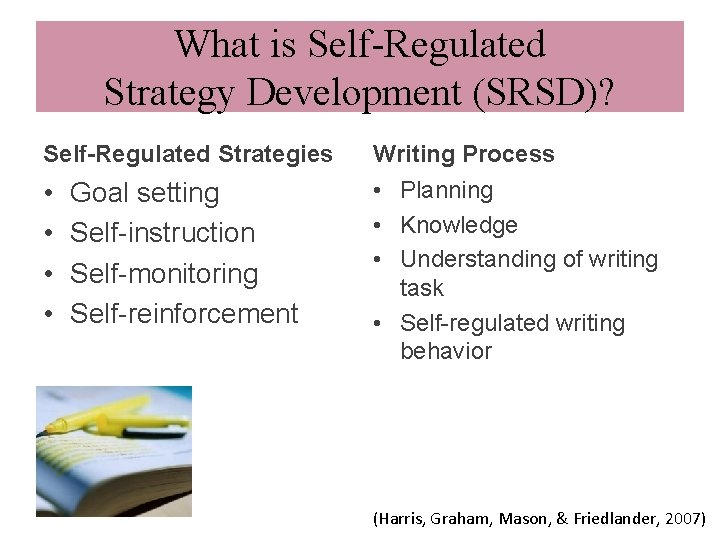
What is Self-Regulated Strategy Development (SRSD)? Self-Regulated Strategies Writing Process • • • Planning • Knowledge • Understanding of writing task • Self-regulated writing behavior Goal setting Self-instruction Self-monitoring Self-reinforcement (Harris, Graham, Mason, & Friedlander, 2007)
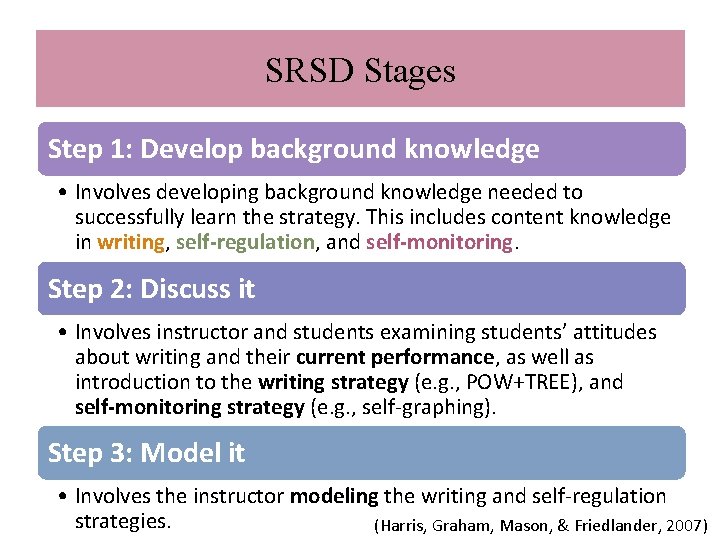
SRSD Stages Step 1: Develop background knowledge • Involves developing background knowledge needed to successfully learn the strategy. This includes content knowledge in writing, self-regulation, and self-monitoring. Step 2: Discuss it • Involves instructor and students examining students’ attitudes about writing and their current performance, as well as introduction to the writing strategy (e. g. , POW+TREE), and self-monitoring strategy (e. g. , self-graphing). Step 3: Model it • Involves the instructor modeling the writing and self-regulation strategies. (Harris, Graham, Mason, & Friedlander, 2007)
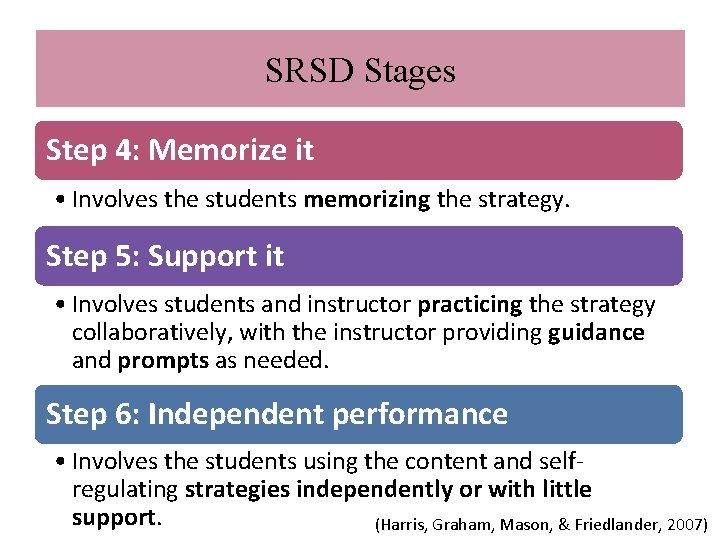
SRSD Stages Step 4: Memorize it • Involves the students memorizing the strategy. Step 5: Support it • Involves students and instructor practicing the strategy collaboratively, with the instructor providing guidance and prompts as needed. Step 6: Independent performance • Involves the students using the content and selfregulating strategies independently or with little support. (Harris, Graham, Mason, & Friedlander, 2007)
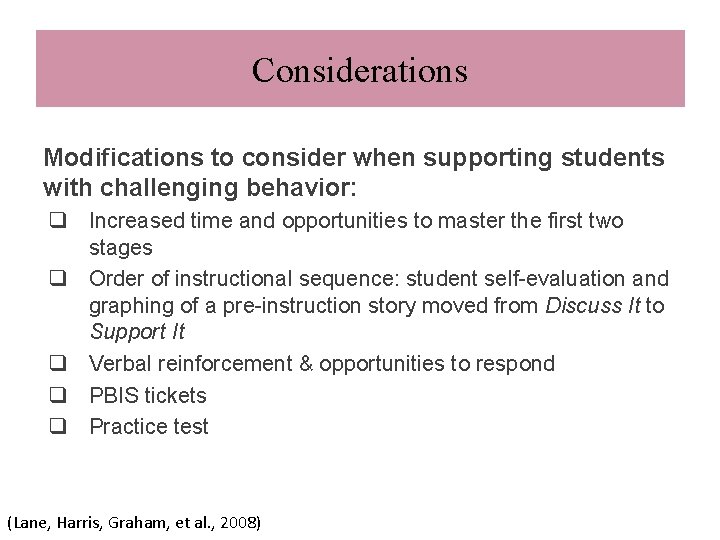
Considerations Modifications to consider when supporting students with challenging behavior: q Increased time and opportunities to master the first two stages q Order of instructional sequence: student self-evaluation and graphing of a pre-instruction story moved from Discuss It to Support It q Verbal reinforcement & opportunities to respond q PBIS tickets q Practice test (Lane, Harris, Graham, et al. , 2008)
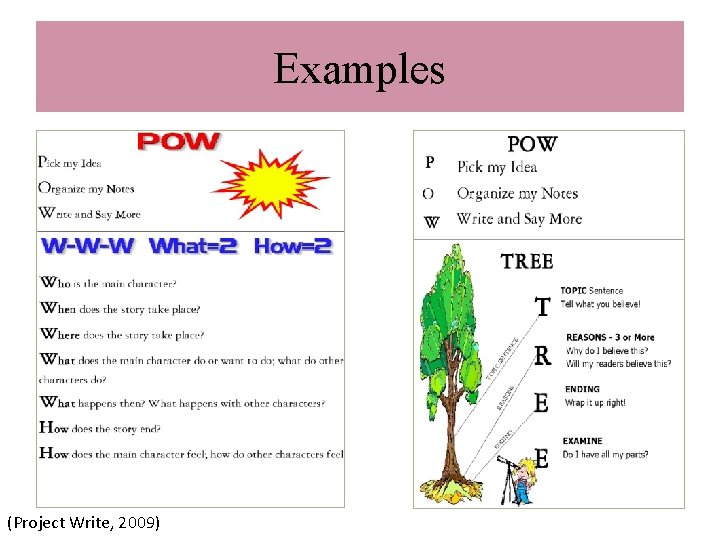
Examples (Project Write, 2009)
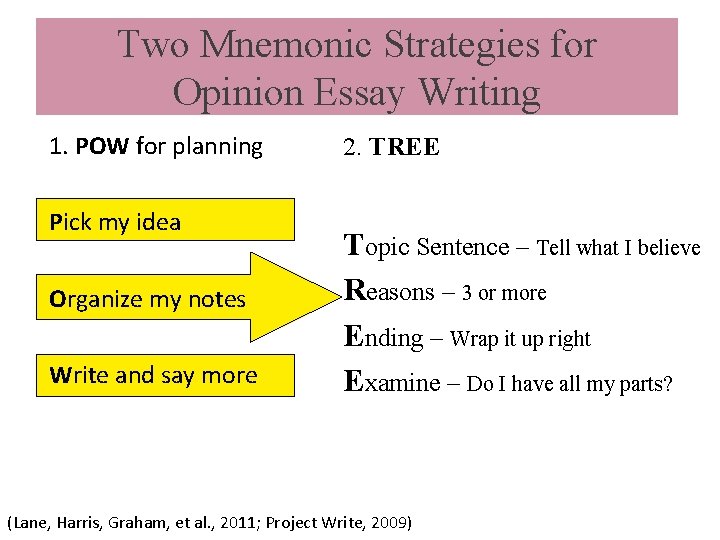
Two Mnemonic Strategies for Opinion Essay Writing 1. POW for planning Pick my idea Organize my notes Write and say more 2. TREE Topic Sentence – Tell what I believe Reasons – 3 or more Ending – Wrap it up right Examine – Do I have all my parts? (Lane, Harris, Graham, et al. , 2011; Project Write, 2009)
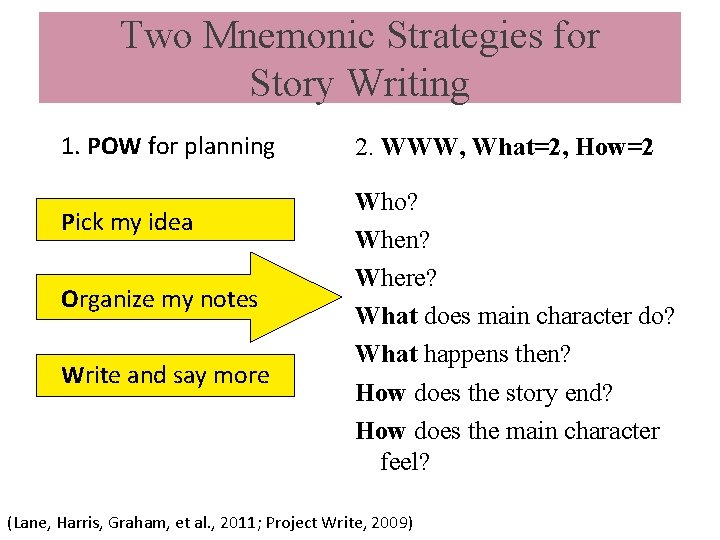
Two Mnemonic Strategies for Story Writing 1. POW for planning Pick my idea Organize my notes Write and say more 2. WWW, What=2, How=2 Who? When? Where? What does main character do? What happens then? How does the story end? How does the main character feel? (Lane, Harris, Graham, et al. , 2011; Project Write, 2009)
Why is SRSD effective? • SRSD instruction assists students in understanding the writing process: – Planning, – Composition, – Editing/Revising. • Recursive and flexible format of six instructional stages for scaffolding student learning. • Allows for individualization through low-intensity, teacher deliverable supports. (Lane, Harris, et al. , 2008; Mason, Kubina, & Hoover, 2013)
What does the supporting research for SRSD say? • SRSD has been implemented across a variety of settings (e. g. , general education, special education, alternative educational settings) across the elementary and secondary continuum (e. g. , Ennis, Harris, Lane, & Mason, 2014; Harris, Graham, & Adkins, 2015; Mason, Jubina, & Hoover, 2013). • SRSD is an evidence-based practice for students with learning disabilities (Baker, Chard, Ketterlin-Geller, Apichatabutra, & Doaber, 2009) and students with and at risk for emotional or behavioral disorders (Sreckovic, Common, Knowles, & Lane, 2014). • SRSD have large effect on student essay elements, quality, and word count (Losinski, Cuenca-Carlino, & Zablocki, 2014).
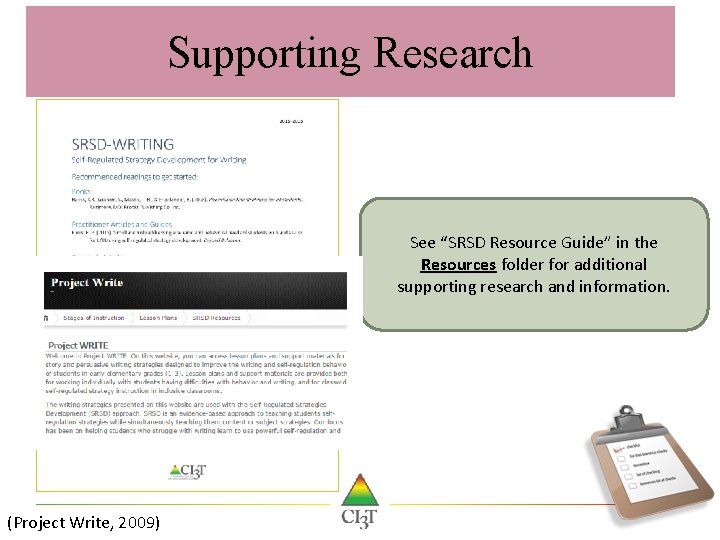
Supporting Research See “SRSD Resource Guide” in the Resources folder for additional supporting research and information. (Project Write, 2009)
What are the benefits & challenges? Benefits Challenges • Easy to link to school-wide plan for behavior, and address issues of motivation, engagement, attention, and problem behavior • Teaches students to selfregulate their own behavior to facilitate learning • Facilitates self-determination skills such as goal-setting, selfawareness, and decision and choice making • Modifying 1: 1 or small group lessons to large group (wholeclass instruction) (Cuenca-Sanchez, Mastropieri, Scruggs, & Kidd, 2012; Mc. Keown, Fitz. Patrick, & Sandmel, 2014)
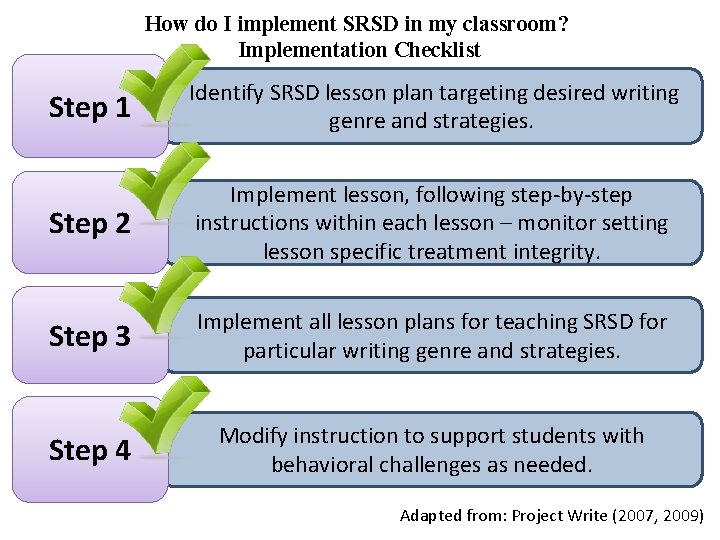
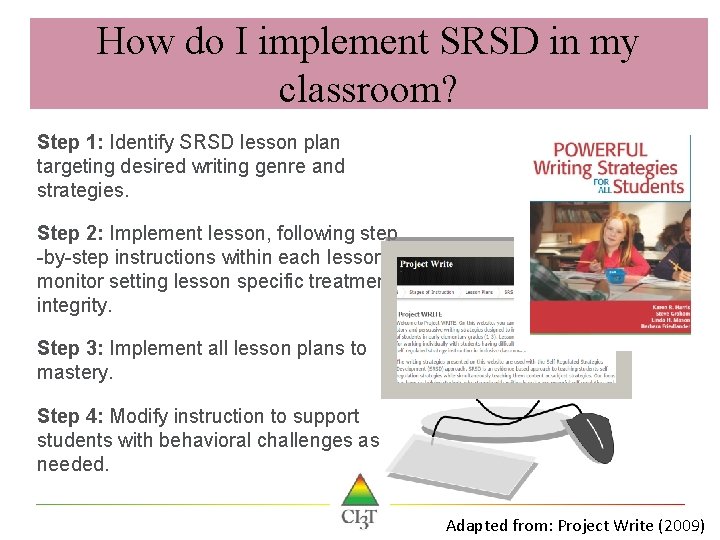
How do I implement SRSD in my classroom? Implementation Checklist Step 1 ! Identify SRSD lesson plan targeting desired writing genre and strategies. Step 2 Implement lesson, following step-by-step instructions within each lesson – monitor setting lesson specific treatment integrity. Step 3 Implement all lesson plans for teaching SRSD for particular writing genre and strategies. Step 4 Modify instruction to support students with behavioral challenges as needed. Adapted from: Project Write (2007, 2009)
How do I implement SRSD in my classroom? Step 1: Identify SRSD lesson plan targeting desired writing genre and strategies. Step 2: Implement lesson, following step -by-step instructions within each lesson – monitor setting lesson specific treatment integrity. Step 3: Implement all lesson plans to mastery. Step 4: Modify instruction to support students with behavioral challenges as needed. Adapted from: Project Write (2009)
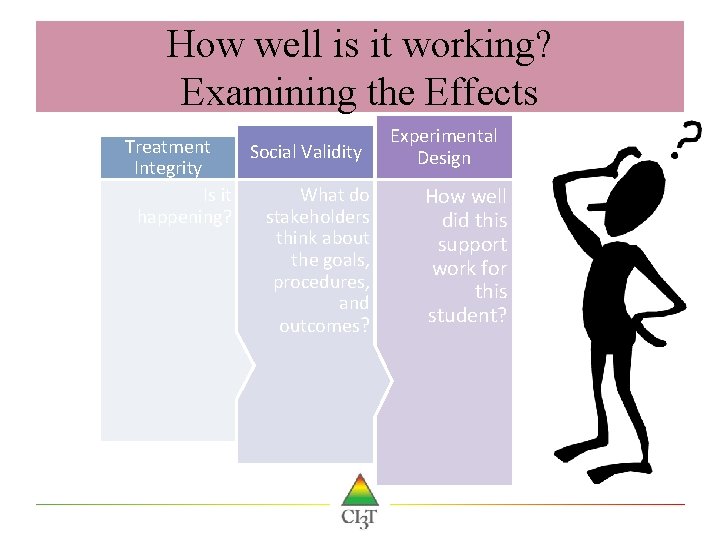
How well is it working? Examining the Effects Treatment Social Validity Integrity Is it What do happening? stakeholders think about the goals, procedures, and outcomes? Experimental Design How well did this support work for this student?
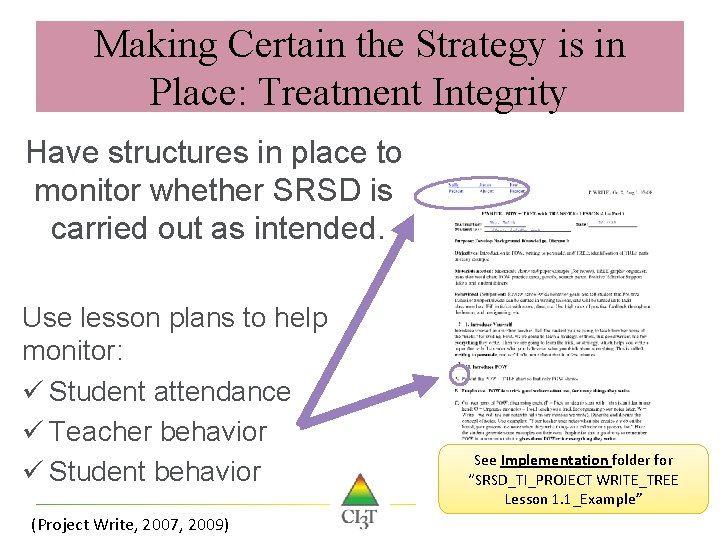
Making Certain the Strategy is in Place: Treatment Integrity Have structures in place to monitor whether SRSD is carried out as intended. Use lesson plans to help monitor: ü Student attendance ü Teacher behavior ü Student behavior (Project Write, 2007, 2009) See Implementation folder for “SRSD_TI_PROJECT WRITE_TREE Lesson 1. 1_Example”
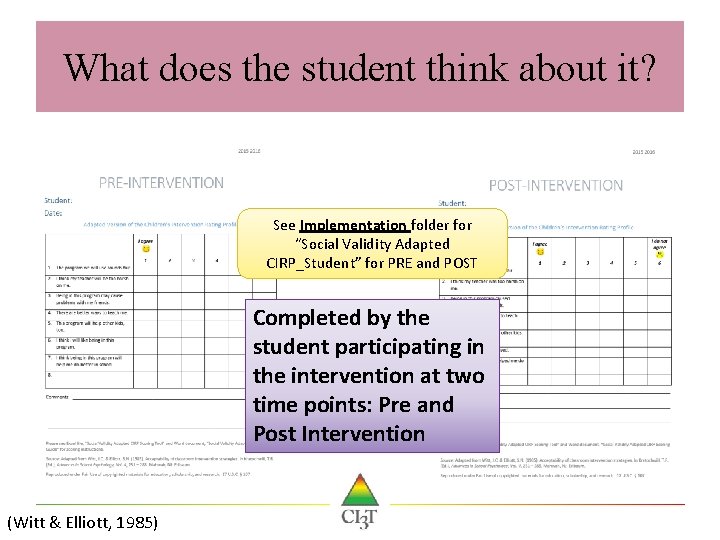
What does the student think about it? See Implementation folder for “Social Validity Adapted CIRP_Student” for PRE and POST Completed by the student participating in the intervention at two time points: Pre and Post Intervention (Witt & Elliott, 1985)
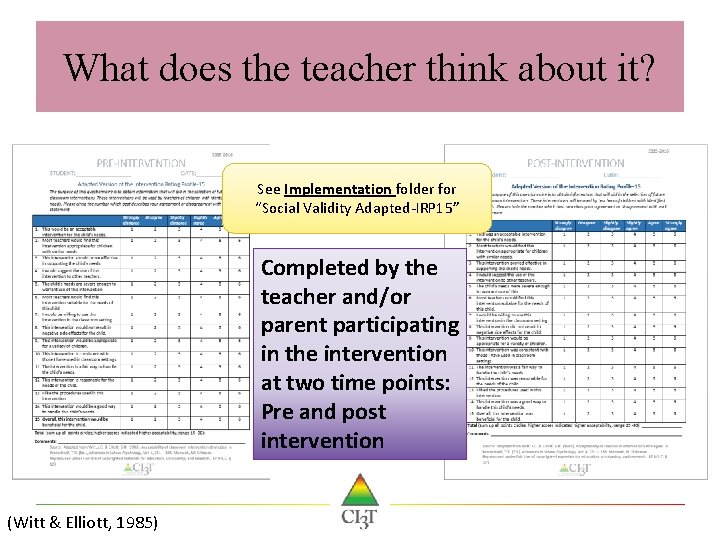
What does the teacher think about it? See Implementation folder for “Social Validity Adapted-IRP 15” Completed by the teacher and/or parent participating in the intervention at two time points: Pre and post intervention (Witt & Elliott, 1985)
Assessment § Writing probes § Types: § Story Prompt § Opinion Essay Prompt § Assessor § Research Assistant § Teacher § Academic engaged time § Treatment integrity § Social validity § Descriptive measures
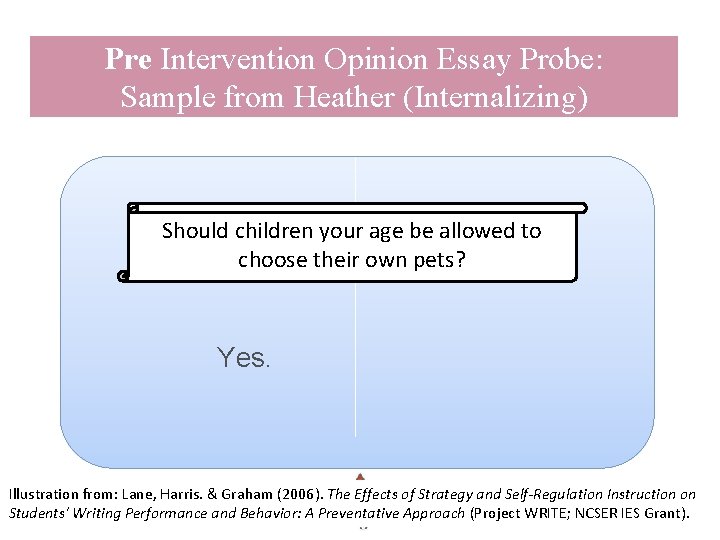
Pre Intervention Opinion Essay Probe: Sample from Heather (Internalizing) Should children your age be allowed to choose their own pets? Yes. Illustration from: Lane, Harris. & Graham (2006). The Effects of Strategy and Self-Regulation Instruction on Students' Writing Performance and Behavior: A Preventative Approach (Project WRITE; NCSER IES Grant).
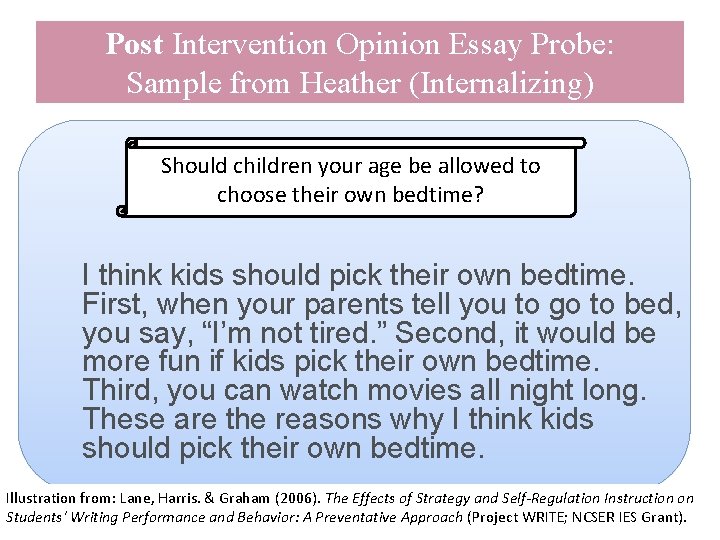
Post Intervention Opinion Essay Probe: Sample from Heather (Internalizing) Should children your age be allowed to choose their own bedtime? I think kids should pick their own bedtime. First, when your parents tell you to go to bed, you say, “I’m not tired. ” Second, it would be more fun if kids pick their own bedtime. Third, you can watch movies all night long. These are the reasons why I think kids should pick their own bedtime. Illustration from: Lane, Harris. & Graham (2006). The Effects of Strategy and Self-Regulation Instruction on Students' Writing Performance and Behavior: A Preventative Approach (Project WRITE; NCSER IES Grant).
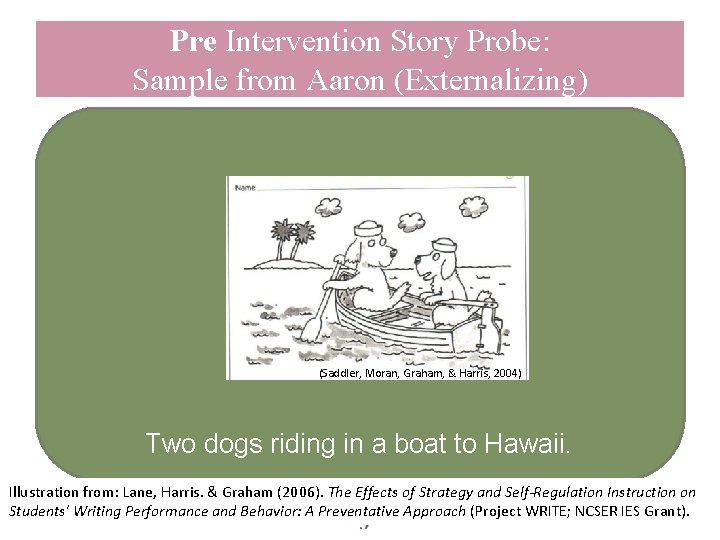
Pre Intervention Story Probe: Sample from Aaron (Externalizing) (Saddler, Moran, Graham, & Harris, 2004) Two dogs riding in a boat to Hawaii. Illustration from: Lane, Harris. & Graham (2006). The Effects of Strategy and Self-Regulation Instruction on Students' Writing Performance and Behavior: A Preventative Approach (Project WRITE; NCSER IES Grant).
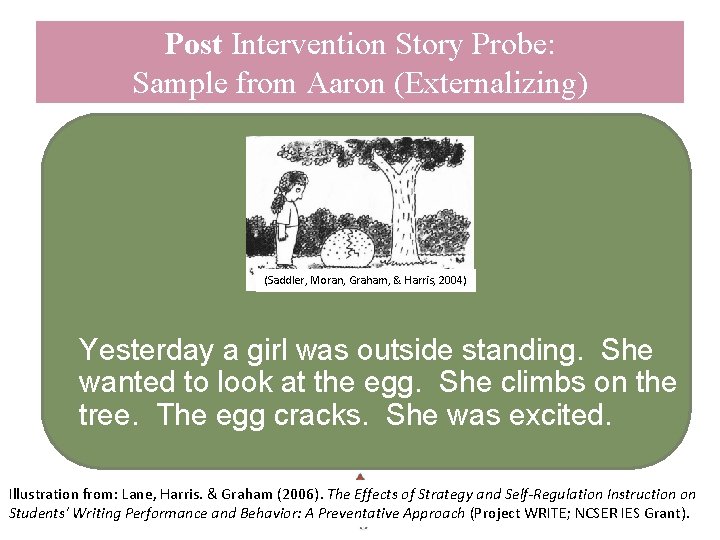
Post Intervention Story Probe: Sample from Aaron (Externalizing) (Saddler, Moran, Graham, & Harris, 2004) Yesterday a girl was outside standing. She wanted to look at the egg. She climbs on the tree. The egg cracks. She was excited. Illustration from: Lane, Harris. & Graham (2006). The Effects of Strategy and Self-Regulation Instruction on Students' Writing Performance and Behavior: A Preventative Approach (Project WRITE; NCSER IES Grant).
. 2 2. 016 17. 2 2. 016 19. 2 2. 016 21. 2 2. 016 23. 2 2. 016 25. 2 2. 016 27. 2 2. 016 29. 2 0 3. 16 2. 20 3. 16 4. 20 3. 16 6. 20 3. 16 8. 2 3. 016 10. 2 3. 016 12. 2 3. 016 14. 2 3. 016 16. 2 3. 016 18. 2 3. 016 20. 2 01 6 2. 15 Percentage AET 100 Baseline (A 1) 90 80 70 60 50 40 30 20 10 0 Date Words Written 2 Percentage AET 40 35 30 25 20 15 10 5 0 Student Outcomes Illustration: Hypothetical Data Intervention (B 1) Words Written Percentage Academic Engaged Time (AET) & Words Written
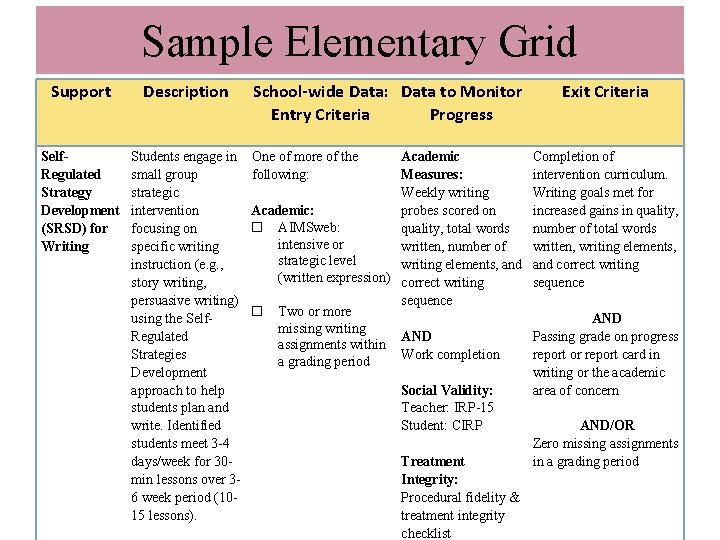
Sample Elementary Grid Support Description Self. Regulated Strategy Development (SRSD) for Writing Students engage in small group strategic intervention focusing on specific writing instruction (e. g. , story writing, persuasive writing) using the Self. Regulated Strategies Development approach to help students plan and write. Identified students meet 3 -4 days/week for 30 min lessons over 36 week period (1015 lessons). School-wide Data: Data to Monitor Entry Criteria Progress One of more of the following: Academic Measures: Weekly writing Academic: probes scored on AIMSweb: quality, total words intensive or written, number of strategic level writing elements, and (written expression) correct writing sequence Two or more missing writing AND assignments within Work completion a grading period Social Validity: Teacher: IRP-15 Student: CIRP Treatment Integrity: Procedural fidelity & treatment integrity checklist Exit Criteria Completion of intervention curriculum. Writing goals met for increased gains in quality, number of total words written, writing elements, and correct writing sequence AND Passing grade on progress report or report card in writing or the academic area of concern AND/OR Zero missing assignments in a grading period
Will you please. . . Discuss: 1. What are your “take aways” from this session? 2. How might you use SRSD with your students? Let’s talk … And make plans!
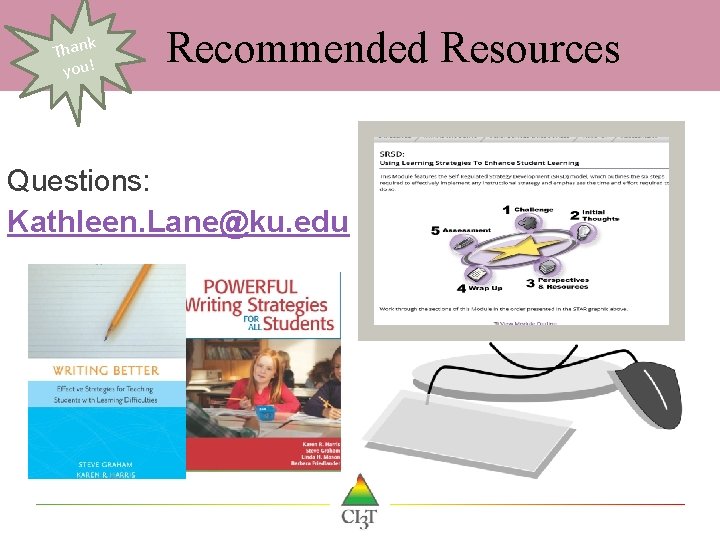
Thank you! Recommended Resources Questions: Kathleen. Lane@ku. edu