
Taking a Long Look at QUIC An Approach

- Slides: 14
Taking a Long Look at QUIC: An Approach for Rigorous Evaluation of Rapidly Evolving Transport Protocols Arash Molavi Kakhki 1, Samuel Jero 2, David Choffnes 1, Cristina Nita-Rotaru 1, and Alan Mislove 1 1 Northeastern University 2 Purdue University IMC 2017
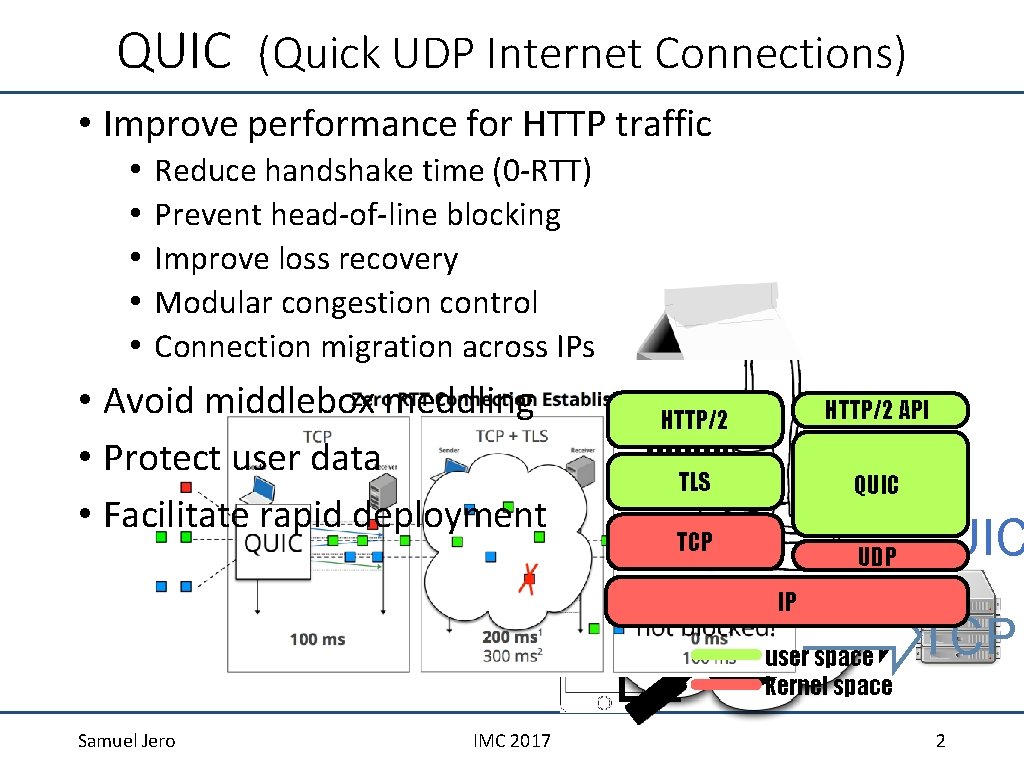
QUIC (Quick UDP Internet Connections) • Improve performance for HTTP traffic • • • Reduce handshake time (0 -RTT) Prevent head-of-line blocking Improve loss recovery Modular congestion control Connection migration across IPs • Avoid middlebox meddling • Protect user data • Facilitate rapid deployment HTTP/2 Cubic TLS HTTP/2 API BBRQUIC 1. 2. 3. 4 TCP UDP ✤ No ACK ambiguity ✤ Better RTT/BW estimation 0111 IP 5. 6. 7. 8 Samuel Jero IMC 2017 0101 user space TCP kernel space 2
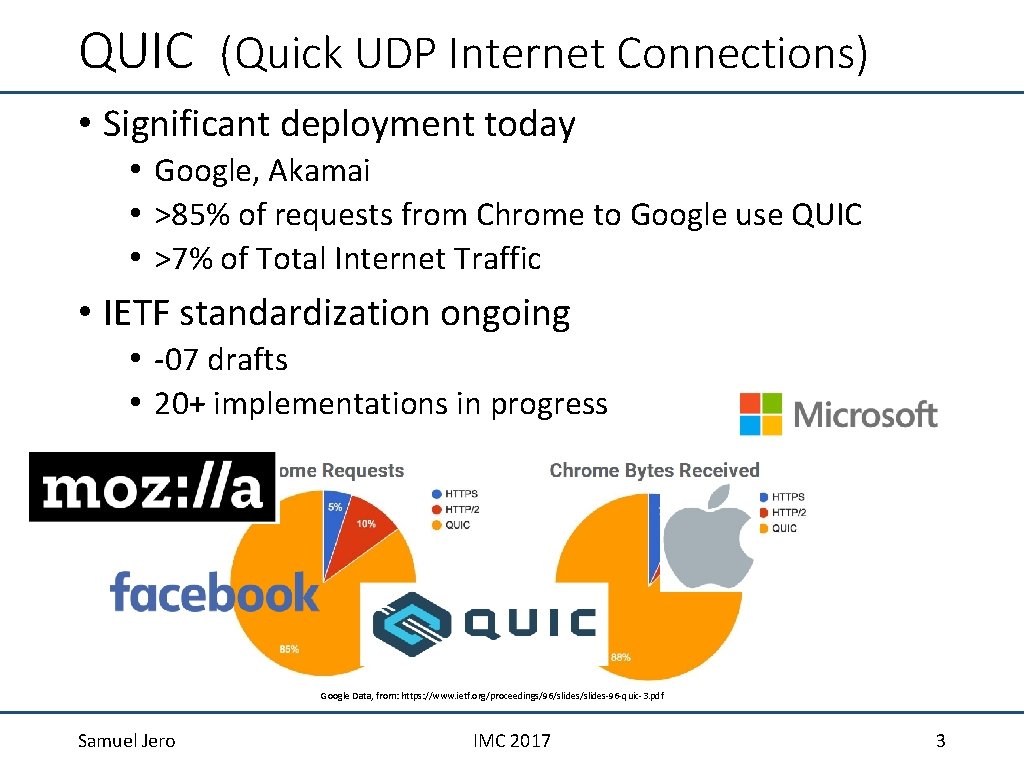
QUIC (Quick UDP Internet Connections) • Significant deployment today • Google, Akamai • >85% of requests from Chrome to Google use QUIC • >7% of Total Internet Traffic • IETF standardization ongoing • -07 drafts • 20+ implementations in progress Google Data, from: https: //www. ietf. org/proceedings/96/slides-96 -quic-3. pdf Samuel Jero IMC 2017 3
Existing Evaluations of QUIC Google’s evaluation • 3% page load time improvement searchstatistics • on All. Google aggregated • 8% latency reduction on Google • search Limited controlled tests Not reproducible • 18% reduction in buffer time on • You. Tube Other QUIC evaluations • • • Limited environments/networks Limited tests Old versions of QUIC Untuned implementations Results not statically sound No root cause analysis Samuel Jero IMC 2017 4
Our Work Goal: Provide a rigorous evaluation of QUIC’s performance compared to TCP • Extensive calibration to ensure fair comparisons between QUIC and TCP • Methodology for automatic head-to-head comparisons, including root-cause-analysis • Statistical analysis of results • Evaluation of QUIC’s performance compared to TCP • Variety of emulated network conditions (loss, delay, jitter, …) • Variety of network types (fixed-line, wireless, cellular, …) • Variety of environments (desktop, mobile, …) • Root cause analysis Samuel Jero IMC 2017 5
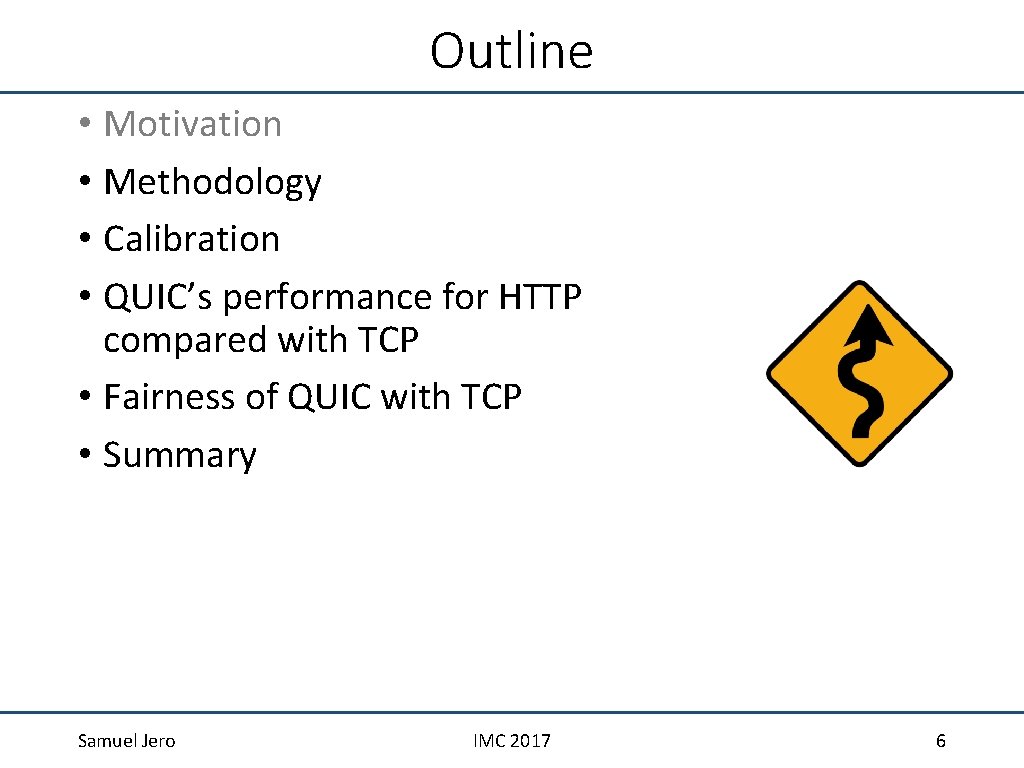
Outline • Motivation • Methodology • Calibration • QUIC’s performance for HTTP compared with TCP • Fairness of QUIC with TCP • Summary Samuel Jero IMC 2017 6
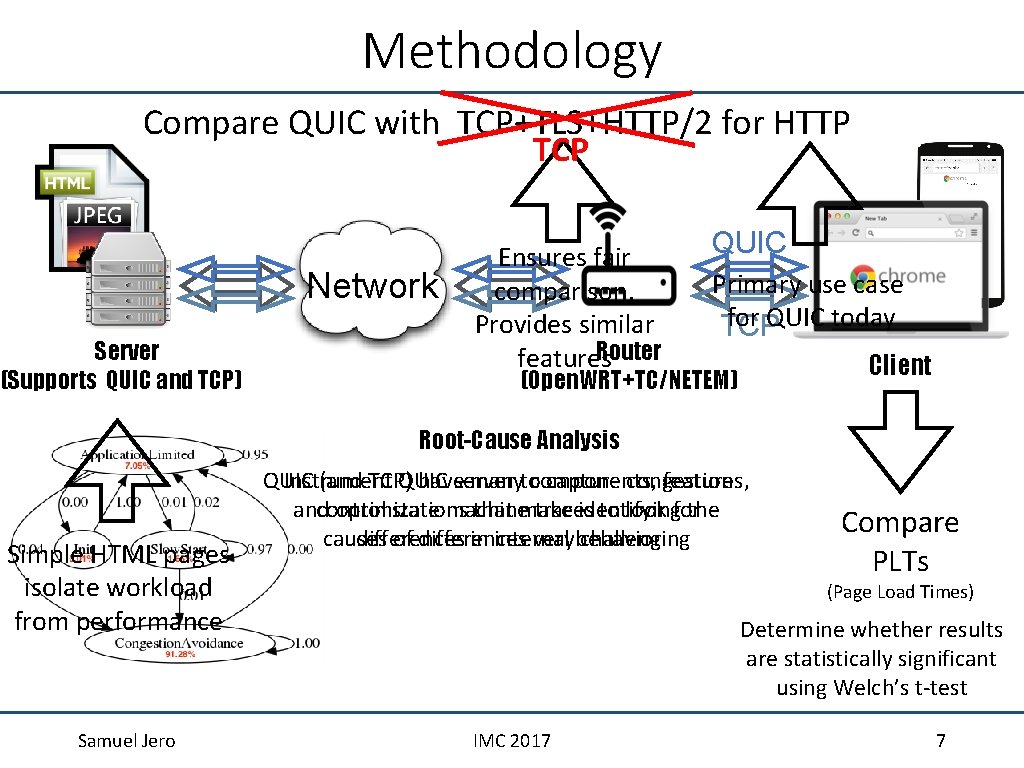
Methodology Compare QUIC with TCP+TLS+HTTP/2 for HTTP TCP Network Server (Supports QUIC and TCP) Ensures fair comparison, Provides similar Router features QUIC Primary use case for QUIC today TCP Client (Open. WRT+TC/NETEM) Root-Cause Analysis Simple HTML pages isolate workload from performance Samuel Jero Instrument QUIC capture congestion QUIC (and TCP) haveserver manytocomponents, features, control state machine traces to look for and optimizations that make identifying the differences in internal causes of differences verybehavior challenging Compare PLTs (Page Load Times) Determine whether results are statistically significant using Welch’s t-test IMC 2017 7
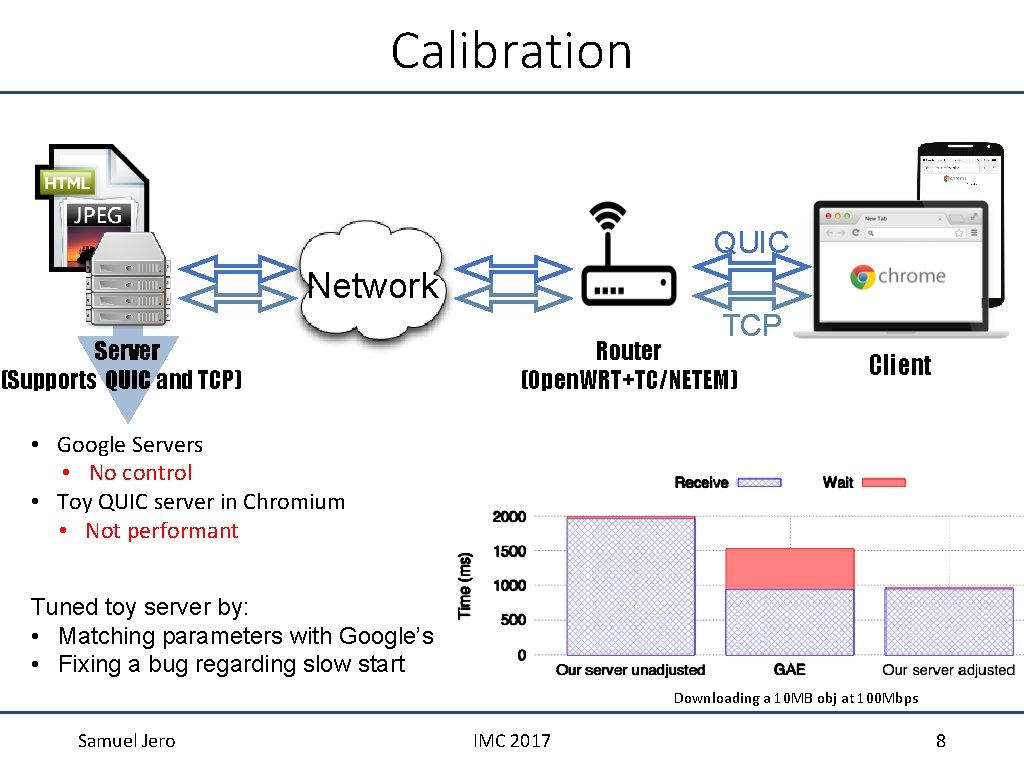
Calibration QUIC Network Server (Supports QUIC and TCP) TCP Router (Open. WRT+TC/NETEM) Client • Google Servers • No control • Toy QUIC server in Chromium • Not performant Tuned toy server by: • Matching parameters with Google’s • Fixing a bug regarding slow start Downloading a 10 MB obj at 100 Mbps Samuel Jero IMC 2017 8
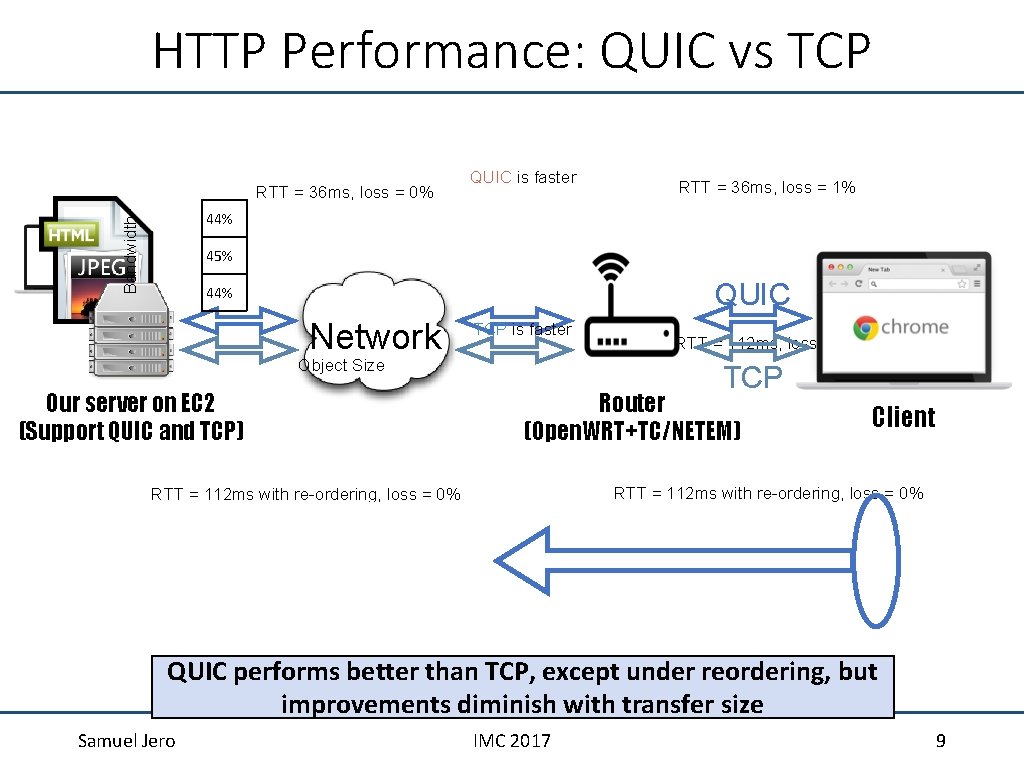
HTTP Performance: QUIC vs TCP RTT = 36 ms, loss = 0% QUIC is faster RTT = 36 ms, loss = 1% Bandwidth 44% 45% QUIC 44% Network TCP is faster Object Size Our server on EC 2 (Support QUIC and TCP) RTT = 112 ms, loss = 0% TCP Router (Open. WRT+TC/NETEM) Client RTT = 112 ms with re-ordering, loss = 0% QUIC performs better than TCP, except under reordering, but improvements diminish with transfer size Samuel Jero IMC 2017 9
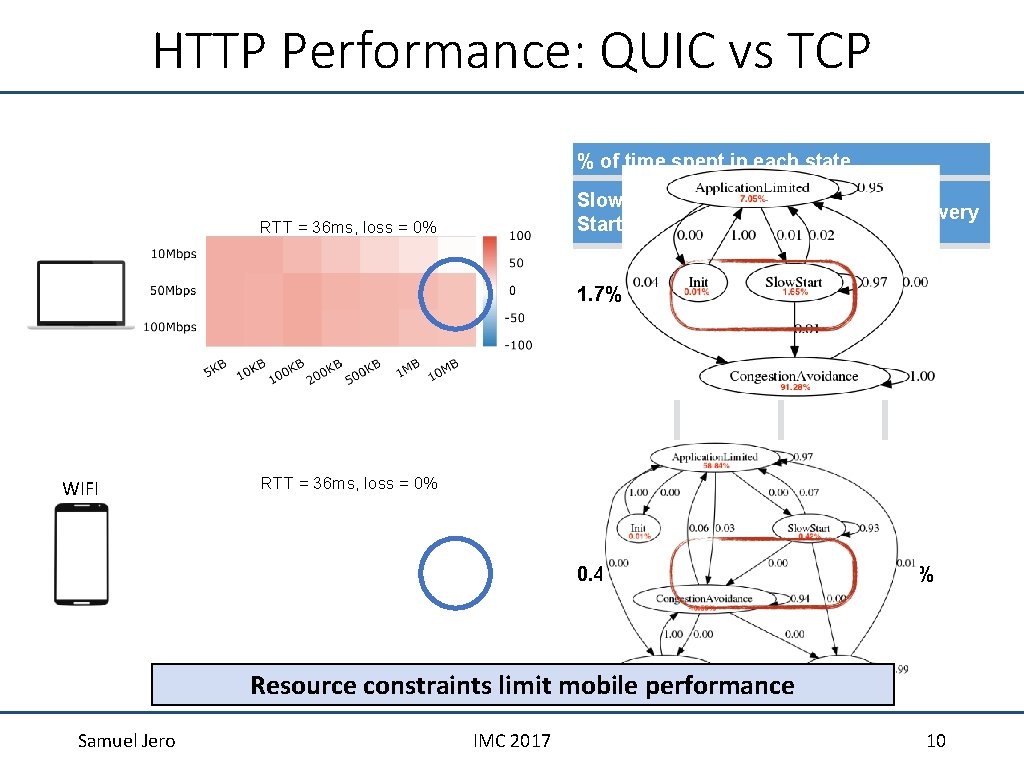
HTTP Performance: QUIC vs TCP % of time spent in each state RTT = 36 ms, loss = 0% WIFI Slow Start Cong. Avoid. App. Limit. Recovery 1. 7% 91. 5% 7. 1% 0% 0. 42% 40. 6% 58. 8% 0. 2% RTT = 36 ms, loss = 0% Resource constraints limit mobile performance Samuel Jero IMC 2017 10
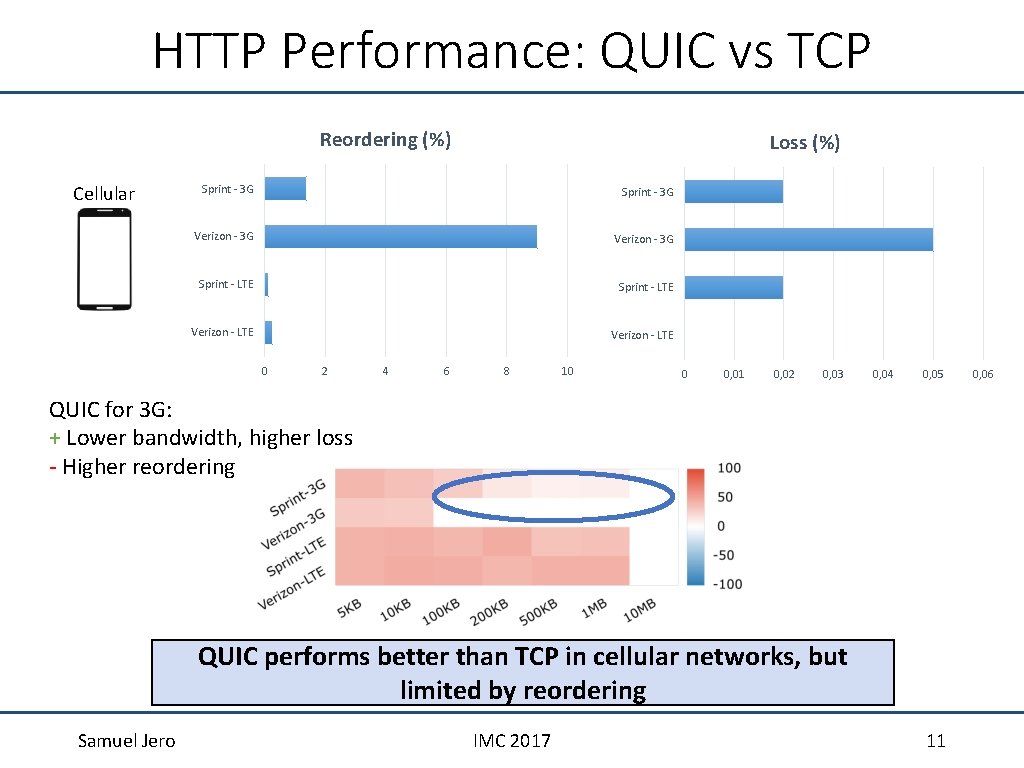
HTTP Performance: QUIC vs TCP Reordering (%) Cellular Loss (%) Sprint - 3 G Verizon - 3 G Sprint - LTE Verizon - LTE 0 2 4 6 8 10 0 0, 01 0, 02 0, 03 0, 04 0, 05 QUIC for 3 G: + Lower bandwidth, higher loss - Higher reordering QUIC performs better than TCP in cellular networks, but limited by reordering Samuel Jero IMC 2017 11 0, 06
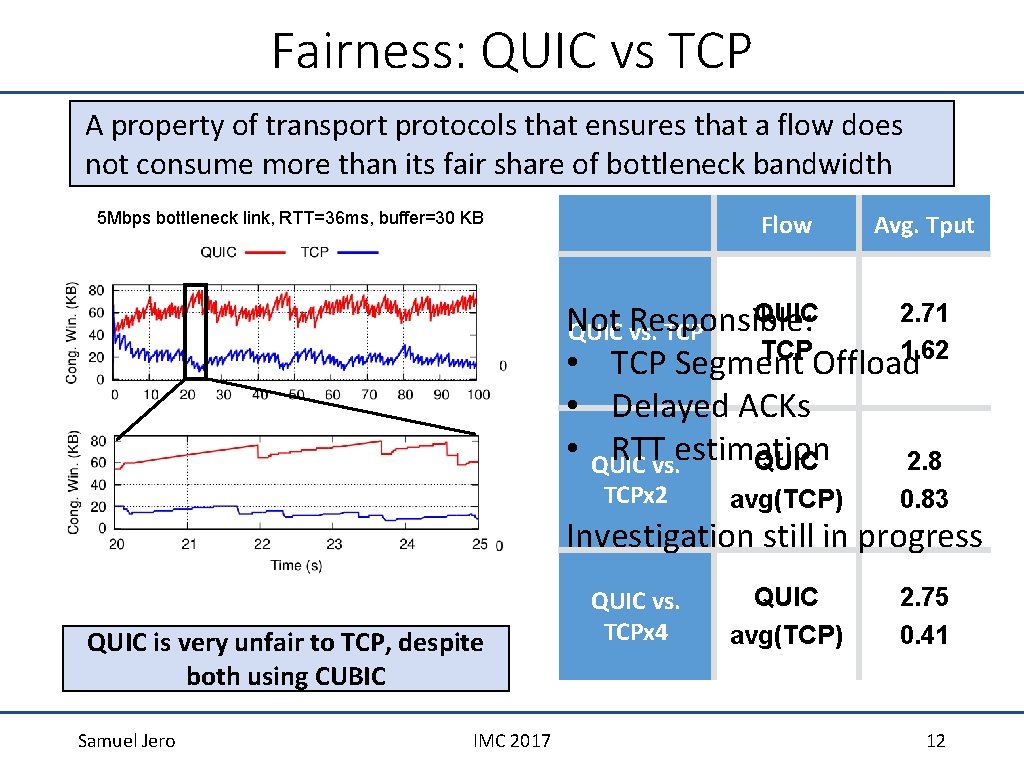
Fairness: QUIC vs TCP A property of transport protocols that ensures that a flow does not consume more than its fair share of bottleneck bandwidth 5 Mbps bottleneck link, RTT=36 ms, buffer=30 KB Flow Avg. Tput QUIC 2. 71 Not Responsible: QUIC vs. TCP 1. 62 • TCP Segment Offload • Delayed ACKs • QUIC RTTvs. estimation QUIC 2. 8 TCPx 2 avg(TCP) 0. 83 QUIC avg(TCP) 2. 75 0. 41 Investigation still in progress QUIC is very unfair to TCP, despite both using CUBIC Samuel Jero IMC 2017 QUIC vs. TCPx 4 12
Summary • Evaluated the performance of QUIC, an application-layer transport protocol that is rapidly evolving and deployed at scale • Focus on the performance and fairness of QUIC for HTTP in comparison to TCP+TLS+HTTP/2 • • Under a variety of network conditions In desktop, mobile, and cellular environments With careful calibration Ensuring statistical significance • Root-cause analysis to understand our findings by instrumenting the QUIC implementation • Approach can be applied to future versions and protocols Samuel Jero IMC 2017 13
Questions? Samuel Jero sjero@sjero. net Check out the code! http: //quic. ccs. neu. edu Samuel Jero IMC 2017 14