
Taking a few steps back Paper 2 Q
Taking a few steps back. . . Paper 2 Q 3 'Language Discourses' What does this mean?
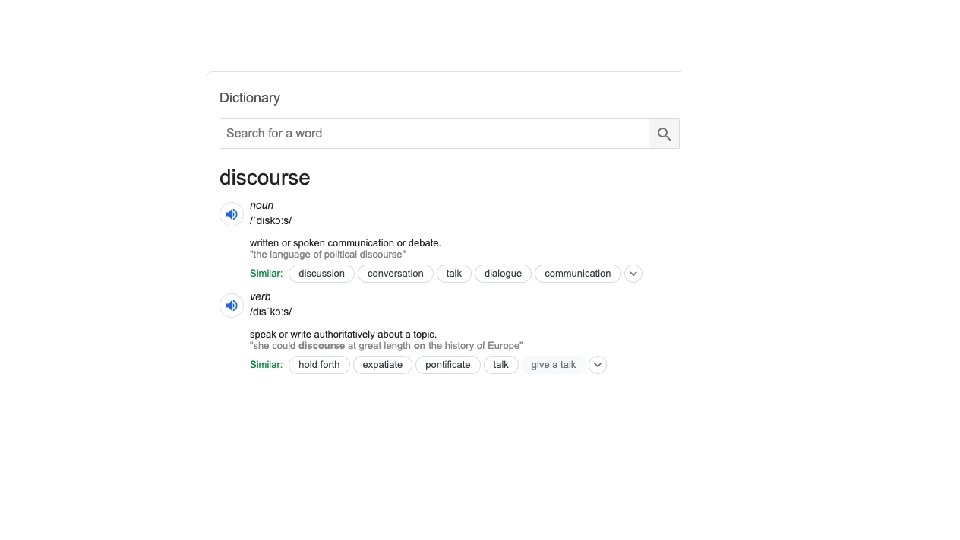

Modes of Discourse The four traditional modes of discourse are narration, description, exposition, and argument In composition studies, the term modes of discourse refers to the four traditional categories of written texts: narration, description, exposition, and argument. Also known as the rhetorical modes and forms of discourse. Argument: A form of communication meant to convince an audience that the writer or speaker is correct, using evidence and reason. Transactional: Transactional discourse is used to propel something into action, such as advertising motivating a customer to buy, or showing a customer how to use a product via a manual. This type of discourse generally does not rely so much on literary devices. Expressive: Expressive discourse comprises those acts of literary writing that is creative, yet non-fiction. This could include memoirs, letters, or online blogs. Exposition: Exposition is used to inform the audience of something with relatively neutral language, i. e. , it’s not meant to persuade or evoke emotion Poetic: Poetic discourse comprises creative, fictional writing. Poetic discourse includes novels, poems, and drama. These types of work often prioritize emotion, imagery, theme, and character development, as well as the use of literary devices like metaphor and symbolism.
• WHAT is the subject/idea being represented? HOW is it being represented? • WHAT and WHOSE viewpoint is being represented? This is key as there maybe multiple perspectives. Are other 'voices' being used? • Are there references to language users or other participants and their actions? WHO is being represented in the text and HOW are they being constructed? • Does the writer use their own voice? HOW are they constructing an identity? HOW are they aligned with the subject matter? • HOW is the writer positioning the audience?
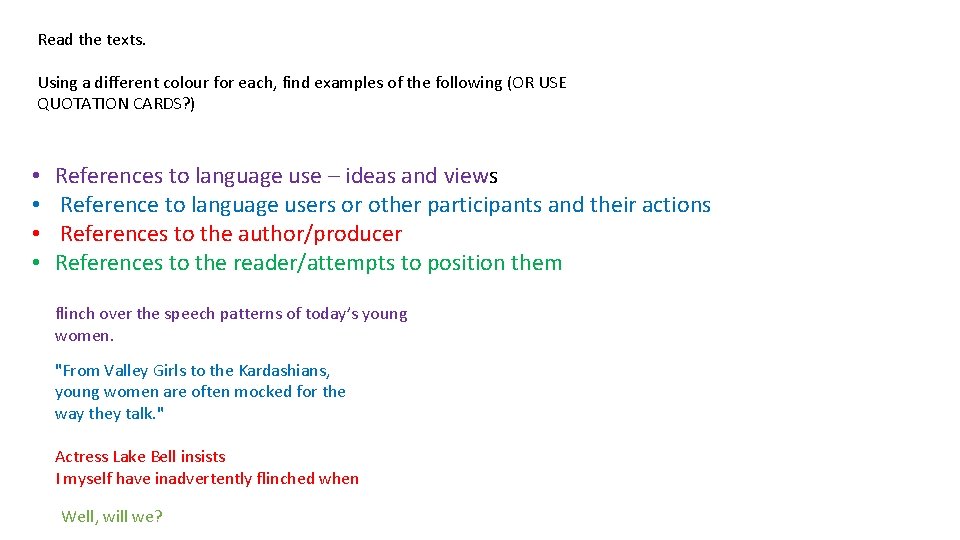
Read the texts. Using a different colour for each, find examples of the following (OR USE QUOTATION CARDS? ) • • References to language use – ideas and views Reference to language users or other participants and their actions References to the author/producer References to the reader/attempts to position them flinch over the speech patterns of today’s young women. "From Valley Girls to the Kardashians, young women are often mocked for the way they talk. " Actress Lake Bell insists I myself have inadvertently flinched when Well, will we?
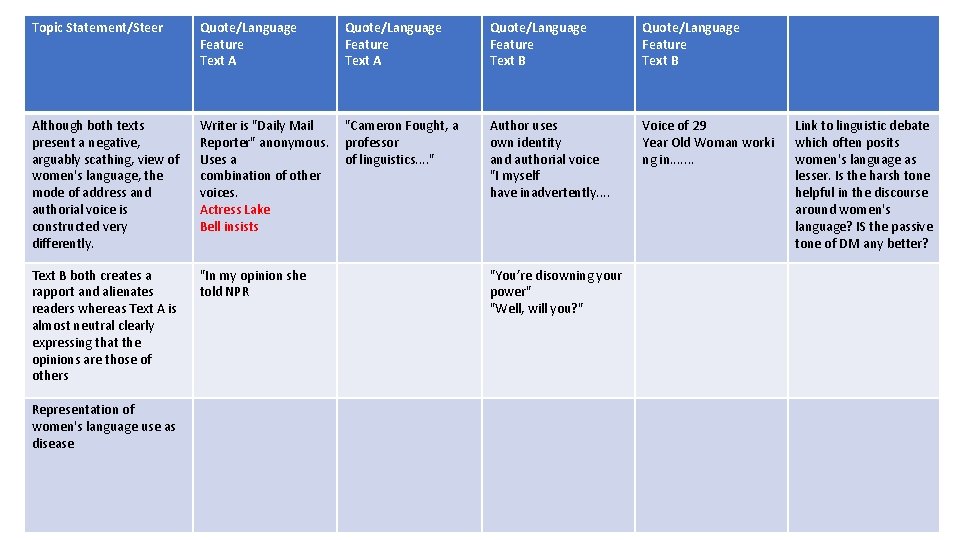
Topic Statement/Steer Quote/Language Feature Text A Quote/Language Feature Text B Although both texts present a negative, arguably scathing, view of women's language, the mode of address and authorial voice is constructed very differently. Writer is "Daily Mail Reporter" anonymous. Uses a combination of other voices. Actress Lake Bell insists "Cameron Fought, a professor of linguistics. . " Author uses own identity and authorial voice "I myself have inadvertently. . Voice of 29 Year Old Woman worki ng in. . . . Text B both creates a rapport and alienates readers whereas Text A is almost neutral clearly expressing that the opinions are those of others "In my opinion she told NPR Representation of women's language use as disease "You’re disowning your power" "Well, will you? " Link to linguistic debate which often posits women's language as lesser. Is the harsh tone helpful in the discourse around women's language? IS the passive tone of DM any better?
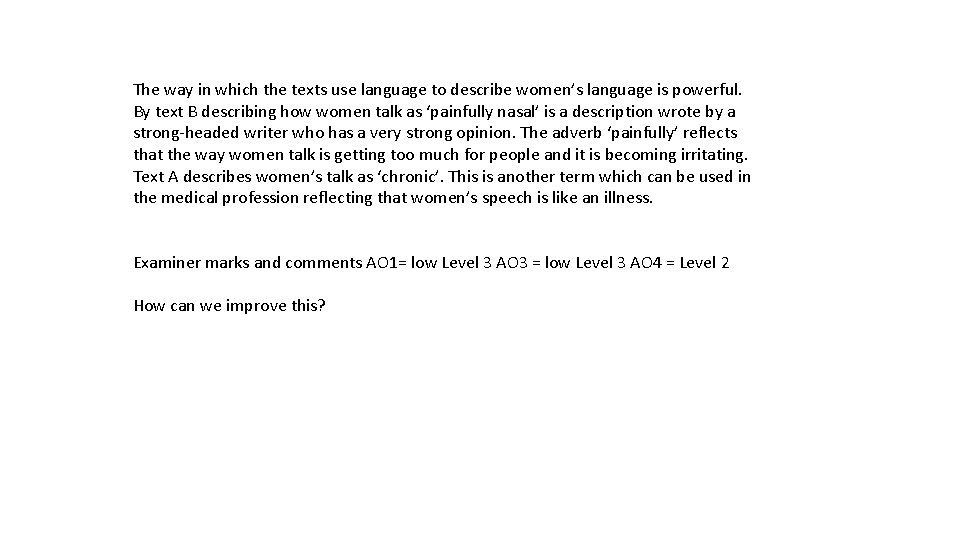
The way in which the texts use language to describe women’s language is powerful. By text B describing how women talk as ‘painfully nasal’ is a description wrote by a strong-headed writer who has a very strong opinion. The adverb ‘painfully’ reflects that the way women talk is getting too much for people and it is becoming irritating. Text A describes women’s talk as ‘chronic’. This is another term which can be used in the medical profession reflecting that women’s speech is like an illness. Examiner marks and comments AO 1= low Level 3 AO 3 = low Level 3 AO 4 = Level 2 How can we improve this?
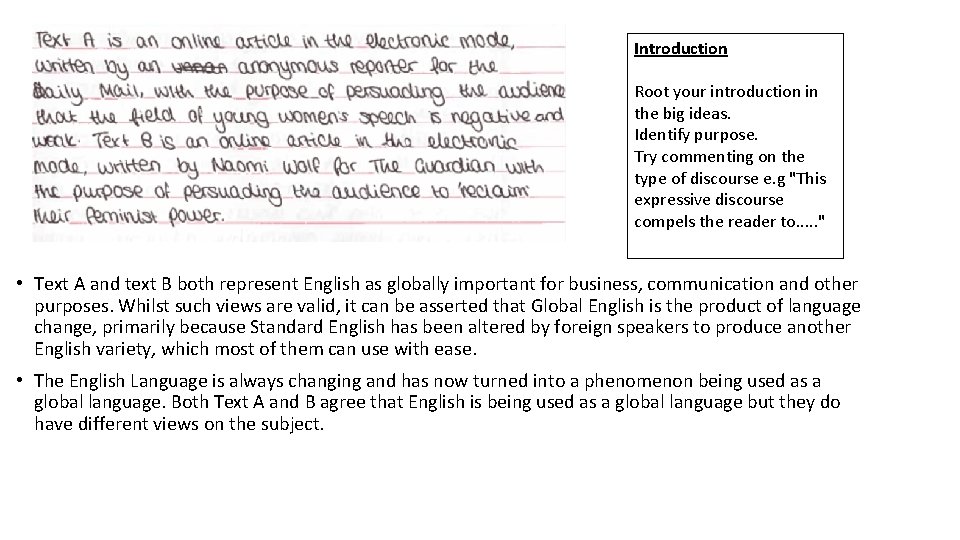
Introduction Root your introduction in the big ideas. Identify purpose. Try commenting on the type of discourse e. g "This expressive discourse compels the reader to. . . " • Text A and text B both represent English as globally important for business, communication and other purposes. Whilst such views are valid, it can be asserted that Global English is the product of language change, primarily because Standard English has been altered by foreign speakers to produce another English variety, which most of them can use with ease. • The English Language is always changing and has now turned into a phenomenon being used as a global language. Both Text A and B agree that English is being used as a global language but they do have different views on the subject.
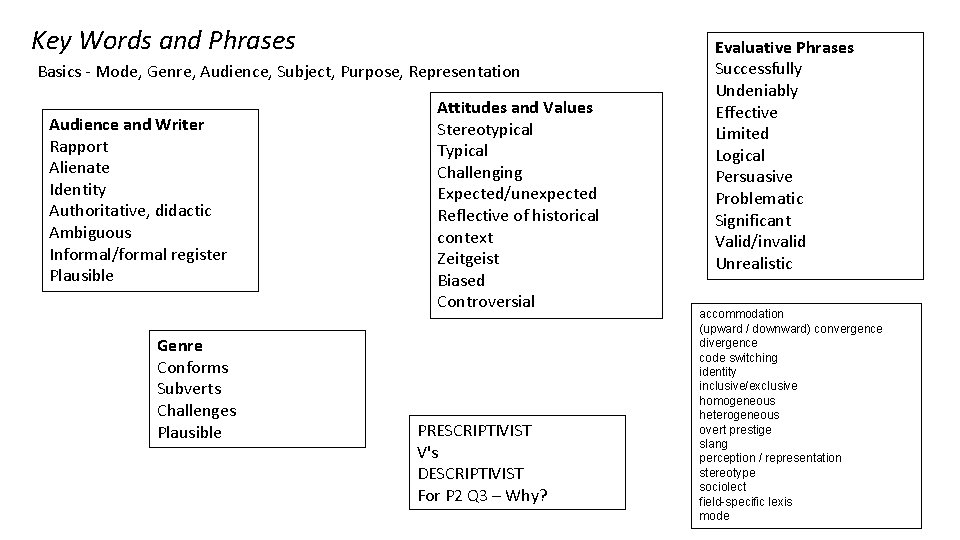
Key Words and Phrases Basics - Mode, Genre, Audience, Subject, Purpose, Representation Audience and Writer Rapport Alienate Identity Authoritative, didactic Ambiguous Informal/formal register Plausible Genre Conforms Subverts Challenges Plausible Attitudes and Values Stereotypical Typical Challenging Expected/unexpected Reflective of historical context Zeitgeist Biased Controversial PRESCRIPTIVIST V's DESCRIPTIVIST For P 2 Q 3 – Why? Evaluative Phrases Successfully Undeniably Effective Limited Logical Persuasive Problematic Significant Valid/invalid Unrealistic accommodation (upward / downward) convergence divergence code switching identity inclusive/exclusive homogeneous heterogeneous overt prestige slang perception / representation stereotype sociolect field-specific lexis mode
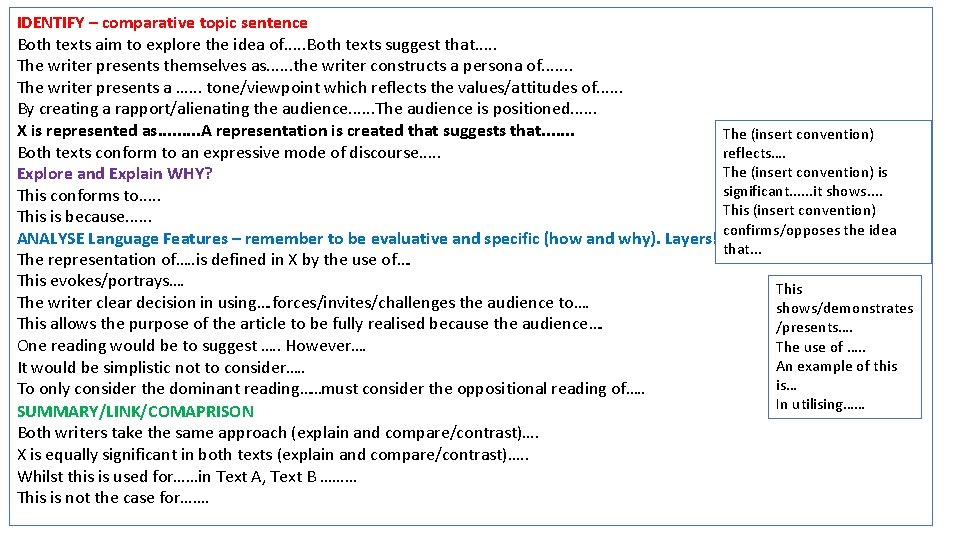
IDENTIFY – comparative topic sentence Both texts aim to explore the idea of. . . Both texts suggest that. . . The writer presents themselves as. . . the writer constructs a persona of. . . . The writer presents a …. . . tone/viewpoint which reflects the values/attitudes of. . . By creating a rapport/alienating the audience. . . The audience is positioned. . . X is represented as. . A representation is created that suggests that. . . . The (insert convention) Both texts conform to an expressive mode of discourse. . . reflects…. The (insert convention) is Explore and Explain WHY? significant. . . it shows. . This conforms to. . . This (insert convention) This is because. . . confirms/opposes the idea ANALYSE Language Features – remember to be evaluative and specific (how and why). Layers! that. . . The representation of…. . is defined in X by the use of…. This evokes/portrays…. This The writer clear decision in using…. forces/invites/challenges the audience to…. shows/demonstrates This allows the purpose of the article to be fully realised because the audience…. /presents…. One reading would be to suggest …. . However…. The use of …. . An example of this It would be simplistic not to consider…. . is… To only consider the dominant reading……must consider the oppositional reading of…. . In utilising…… SUMMARY/LINK/COMAPRISON Both writers take the same approach (explain and compare/contrast)…. X is equally significant in both texts (explain and compare/contrast)…. . Whilst this is used for……in Text A, Text B ……… This is not the case for…….
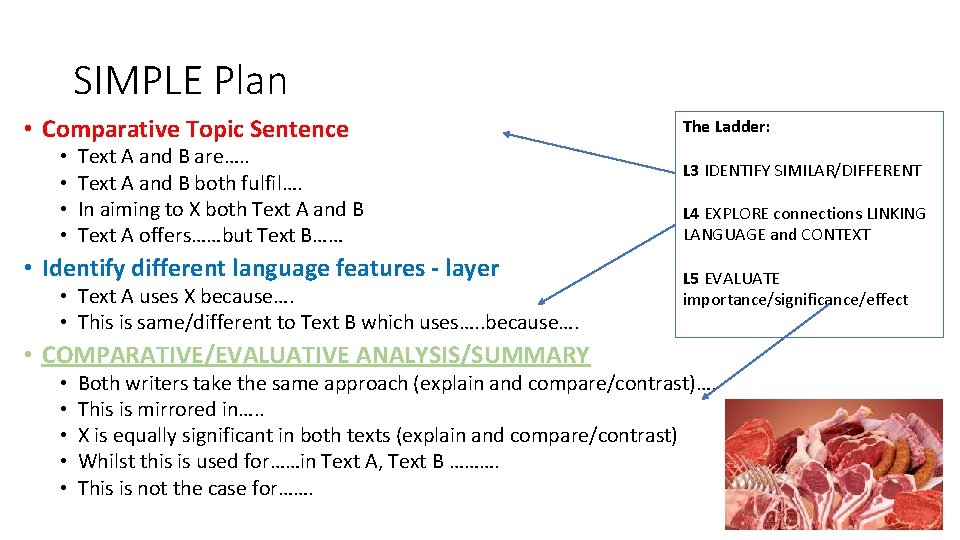
SIMPLE Plan • Comparative Topic Sentence • • Text A and B are…. . Text A and B both fulfil…. In aiming to X both Text A and B Text A offers……but Text B…… • Identify different language features - layer • Text A uses X because…. • This is same/different to Text B which uses…. . because…. • COMPARATIVE/EVALUATIVE ANALYSIS/SUMMARY • • • The Ladder: L 3 IDENTIFY SIMILAR/DIFFERENT L 4 EXPLORE connections LINKING LANGUAGE and CONTEXT L 5 EVALUATE importance/significance/effect Both writers take the same approach (explain and compare/contrast)…. This is mirrored in…. . X is equally significant in both texts (explain and compare/contrast) Whilst this is used for……in Text A, Text B ………. This is not the case for…….
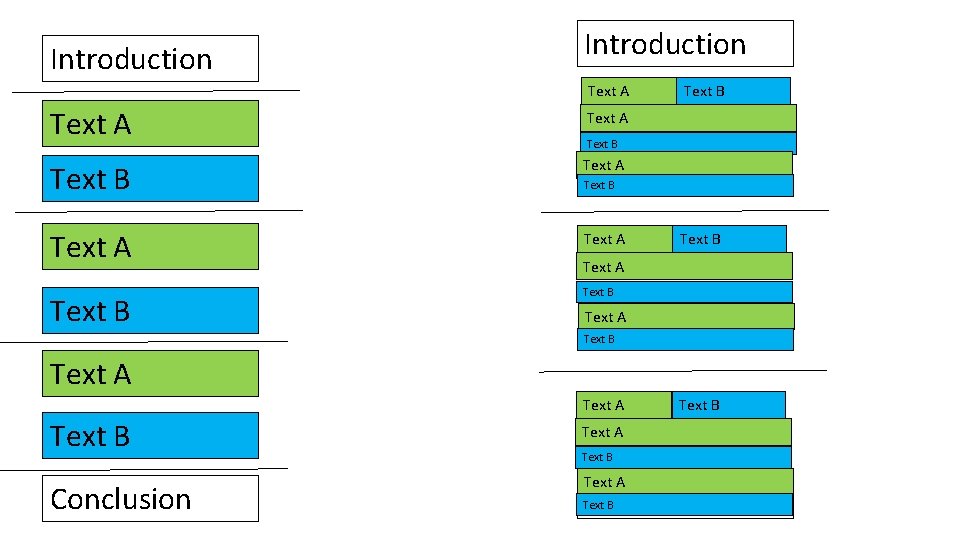
Introduction Text A Text A Text B Text B Text A Text B Conclusion Text B Text A Conclusion Text B
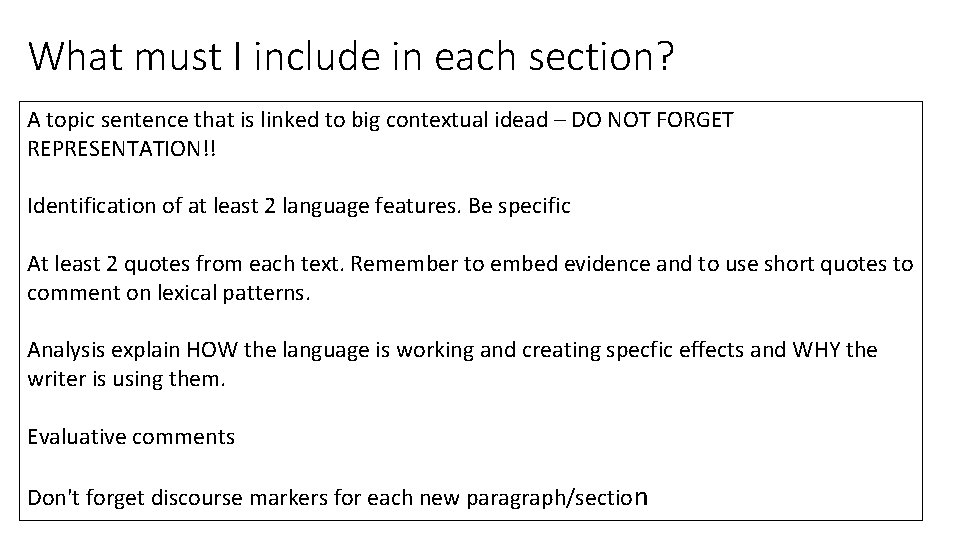
What must I include in each section? A topic sentence that is linked to big contextual idead – DO NOT FORGET REPRESENTATION!! Identification of at least 2 language features. Be specific At least 2 quotes from each text. Remember to embed evidence and to use short quotes to comment on lexical patterns. Analysis explain HOW the language is working and creating specfic effects and WHY the writer is using them. Evaluative comments Don't forget discourse markers for each new paragraph/section
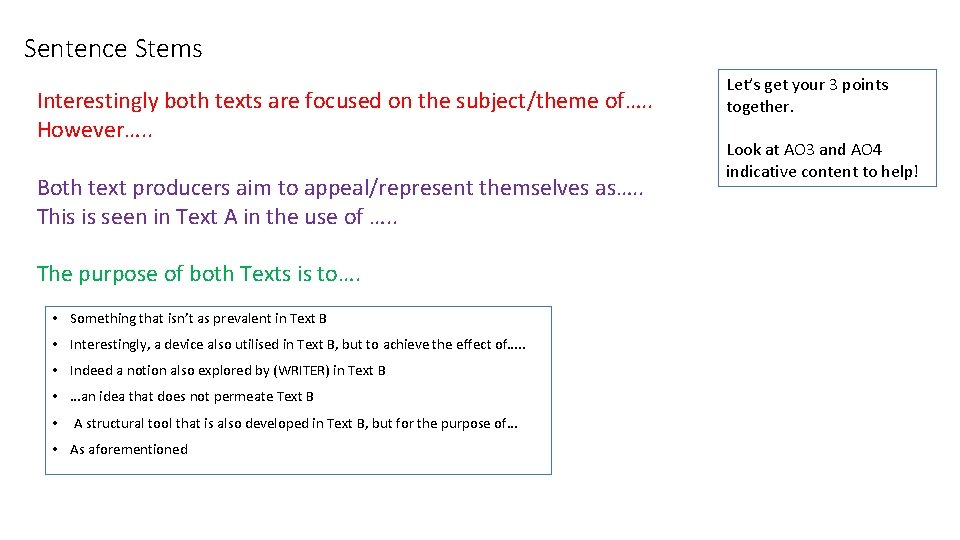
Sentence Stems Interestingly both texts are focused on the subject/theme of…. . However…. . Both text producers aim to appeal/represent themselves as…. . This is seen in Text A in the use of …. . The purpose of both Texts is to…. • Something that isn’t as prevalent in Text B • Interestingly, a device also utilised in Text B, but to achieve the effect of…. . • Indeed a notion also explored by (WRITER) in Text B • …an idea that does not permeate Text B • A structural tool that is also developed in Text B, but for the purpose of… • As aforementioned Let’s get your 3 points together. Look at AO 3 and AO 4 indicative content to help!
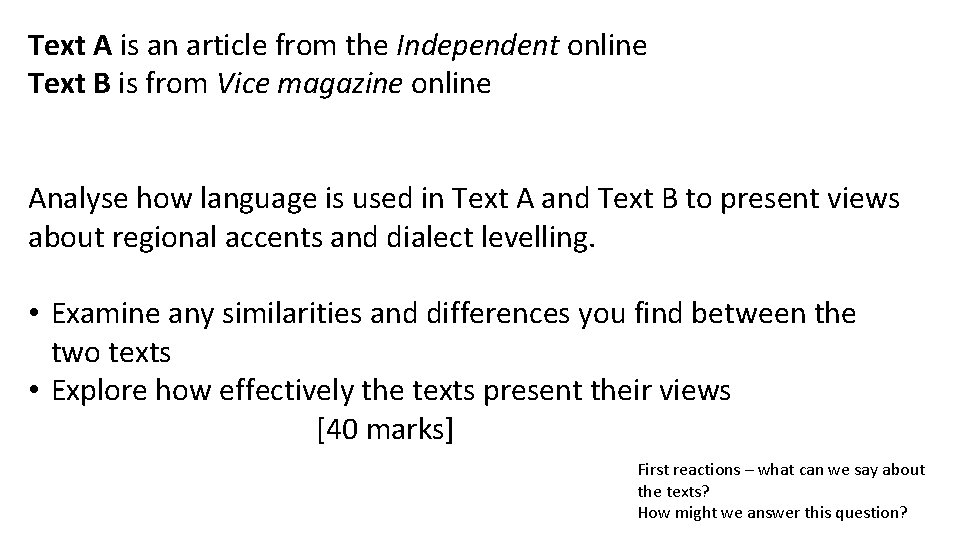
Text A is an article from the Independent online Text B is from Vice magazine online Analyse how language is used in Text A and Text B to present views about regional accents and dialect levelling. • Examine any similarities and differences you find between the two texts • Explore how effectively the texts present their views [40 marks] First reactions – what can we say about the texts? How might we answer this question?
• WHAT is the subject/idea being represented? HOW is it being represented? • Are there references to language users or other participants and their actions? WHO is being represented in the text and HOW are they being constructed? • WHAT and WHOSE viewpoint is being represented? This is key as there maybe multiple perspectives. Are other 'voices' being used? - Does the writer use their own voice? HOW are they constructing an identity? HOW are they aligned with the subject matter? • HOW is the writer positioning the audience?
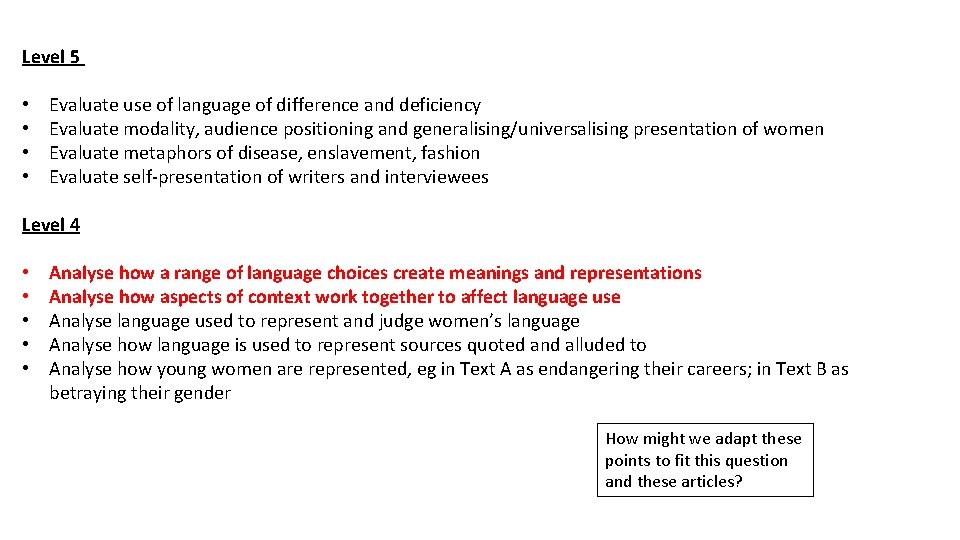
Level 5 • • Evaluate use of language of difference and deficiency Evaluate modality, audience positioning and generalising/universalising presentation of women Evaluate metaphors of disease, enslavement, fashion Evaluate self-presentation of writers and interviewees Level 4 • • • Analyse how a range of language choices create meanings and representations Analyse how aspects of context work together to affect language use Analyse language used to represent and judge women’s language Analyse how language is used to represent sources quoted and alluded to Analyse how young women are represented, eg in Text A as endangering their careers; in Text B as betraying their gender How might we adapt these points to fit this question and these articles?
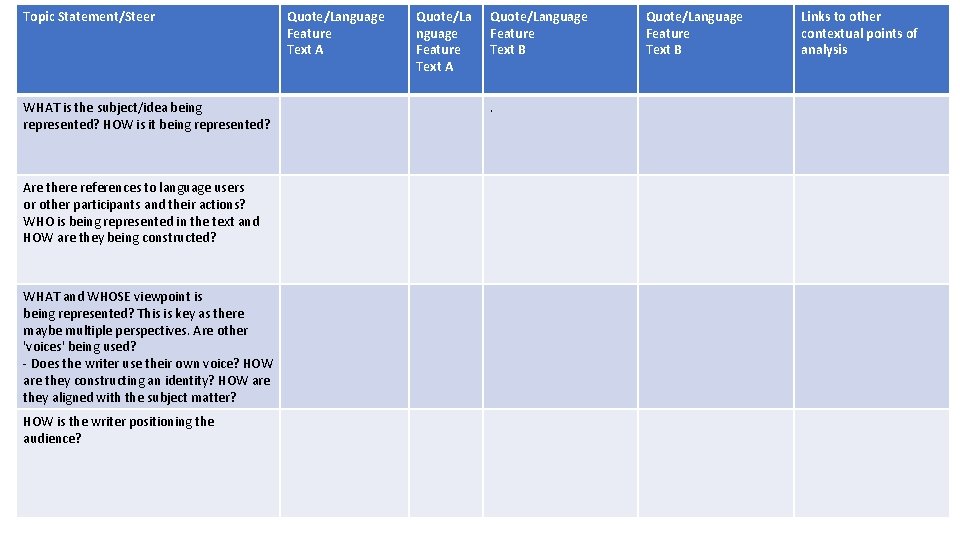
Topic Statement/Steer WHAT is the subject/idea being represented? HOW is it being represented? Are there references to language users or other participants and their actions? WHO is being represented in the text and HOW are they being constructed? WHAT and WHOSE viewpoint is being represented? This is key as there maybe multiple perspectives. Are other 'voices' being used? - Does the writer use their own voice? HOW are they constructing an identity? HOW are they aligned with the subject matter? HOW is the writer positioning the audience? Quote/Language Feature Text A Quote/Language Feature Text B Links to other contextual points of analysis
- Slides: 18