
Taking a Case to Court Law and EconomicsCharles
- Slides: 27
Taking a Case to Court Law and Economics-Charles W. Upton
Taking a Case Through Court • A dispute between Sam and Richard would normally go to the State District Court. Taking a Case to Court
Taking a Case Through Court • A dispute between Sam and Richard would normally go to the State District Court. – The court, with or without a jury, would determine the facts and the law, and then issue a decision. – In general, the losing party has the right to appeal that decision to the Appellate Court. Taking a Case to Court
Taking a Case Through Court • A dispute between Sam and Richard would normally go to the State District Court. • The Appellate court would then review that decision, asking two questions: – Was the law properly stated? – Did the judge properly let the jury decide the facts (or, if he decided it himself, did he have a basis for deciding the facts)? Note that this is not the same as a new review of the facts. Taking a Case to Court
Taking a Case Through Court • The losing party may then appeal to the Supreme Court, who has no obligation to hear the case. • It will generally hear it only if it believes it is important to clarify the law. (Death Penalty cases are an common exception). Taking a Case to Court
Federal Court • When can you go to a Federal Court? – Federal Issues. – The US is a party. – Diversity Cases Taking a Case to Court
Butterfield v. Forrester. (1809, tried at Old Bailey) • Forrester has been making repairs on his house and had blocked the road, but noting detours. • Butterfield, riding a horse along the highway, is somewhat intoxicated and riding hard, runs into the construction at 8: 00 PM on an August Evening and is thrown from his Horse. Taking a Case to Court
Butterfield v. Forrester. (1809, tried at Old Bailey) • Forrester has been making repairs on his house and had blocked the road, but noting detours. He sues under the usual • Butterfield, riding issue. a horse along the negligence highway, is somewhat intoxicated and riding hard, runs into the construction at 8: 00 PM on an August Evening and is thrown from his Horse. Taking a Case to Court
Butterfield v. Forrester. (1809, tried at Old Bailey) • Forrester has been making repairs on his house and had blocked the road, but noting detours. He sues under the usual • Butterfield, riding issue. a horse along the negligence highway, is somewhat intoxicated A personand is liable riding hard, runs into the construction at for any damages 8: 00 PM on an August Evening is own caused and by his thrown from his Horse. negligence. Taking a Case to Court
Butterfield v. Forrester. (1809, tried at Old Bailey) • The judge instructs the jury that, if a person acting with reasonable and ordinary care could have avoided the accident, then they should find for the defendant. Taking a Case to Court
Butterfield v. Forrester. (1809, tried at Old Bailey) • The judge instructs the jury that, if a person acting with reasonable and ordinary care could have avoided the accident, then they should find for the defendant. • That is, even if Forrester is negligent, Butterfield cannot collect if he is also negligent. Taking a Case to Court
Butterfield v. Forrester. (1809, tried at Old Bailey) • The judge instructs the jury that, if a person acting with reasonable and ordinary care could have avoided thefinds accident, then they The jury Butterfield is should find fornegligent the defendant. for riding while no damages. • That is, eveninebriated. if Forrester. Thus is negligent, Butterfield cannot collect if he is also negligent. Taking a Case to Court
Butterfield v. Forrester. (1809, tried at Old Bailey) • Butterfield appeals and loses. • The court holds that Forrester’s negligence is compounded by Butterfield’s contributory negligence. Taking a Case to Court
Butterfield v. Forrester. (1809, tried at Old Bailey) • Butterfield appeals and loses. • The court holds that Forrester’s negligence is compounded by Butterfield’s contributory negligence. • This sets new law. Negligence is cancelled by contributory negligence. Taking a Case to Court
Division of Labor • The judge finds the law (contributory negligence is a defense to negligence). • The jury finds the fact: riding while inebriated is not ordinary and reasonable care (the reasonable man standard). Taking a Case to Court
Davies v. Mann (1842) • Mr. Davies has an ass whose forelegs have been fettered grazing on a public highway. Taking a Case to Court
Davies v. Mann (1842) • Mr. Davies has an ass whose forelegs have been fettered grazing on a public highway. • Mr. Mann's wagon, coming at a “smartish” pace, runs into the ass and kills it. Taking a Case to Court
Davies v. Mann (1842) • Mr. Davies has an ass whose forelegs have been fettered grazing on a public highway. • Mr. Mann's wagon, coming at a “smartish” pace, runs into the ass and kills it. • Davies sues. Taking a Case to Court
Davies v. Mann (1842) • Mr. Davies has an ass whose forelegs have been fettered grazing on a public highway. • Mr. Mann's wagon, coming at a “smartish” pace, runs into the ass and kills it. • Davies sues. Note that Mann is negligent, but Davies is also guilty of contributory negligence. Taking a Case to Court
Davies v. Mann (1842) • The judge orders the jury to decide for Davies if they thought Mann could have avoided the accident by exercising ordinary care. • The jury finds for Davies. Taking a Case to Court
Davies v. Mann (1842) • The judge orders the jury to decide for Davies if they thought Mann could have avoided the accident by exercising ordinary This is inconsistent with care. Butterfield v. Forrester • The jury finds for Davies. Taking a Case to Court
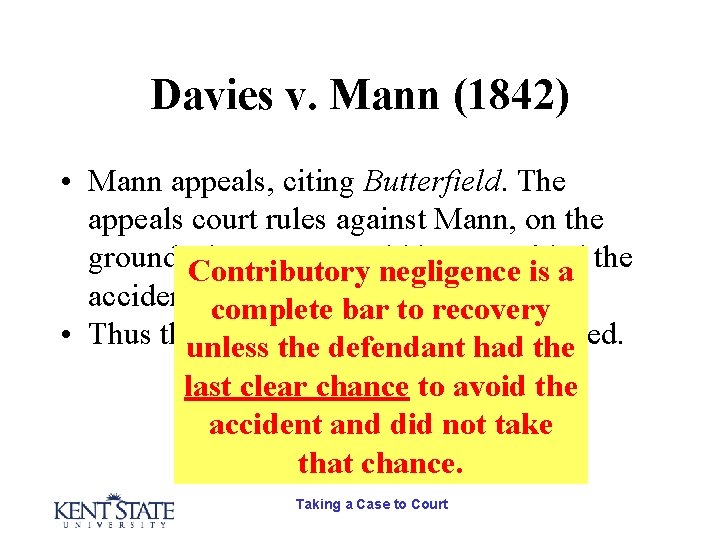
Davies v. Mann (1842) • Mann appeals, citing Butterfield. The appeals court rules against Mann, on the grounds that Mann could have avoided the accident. • Thus the law of negligence gets modified. Taking a Case to Court
Davies v. Mann (1842) • Mann appeals, citing Butterfield. The appeals court rules against Mann, on the grounds. Contributory that Mann could have avoided the negligence is a accident. complete bar to recovery • Thus theunless law ofthe negligence gets modified. defendant had the last clear chance to avoid the accident and did not take that chance. Taking a Case to Court
Is this economic efficiency? • Butterfield vs. Forrester – Forrester had illegally blocked a public road. – Had Butterfield seen the accident, damages could have been avoided by going around the block. – The cost of Butterfield going around the block would have been less than the cost of the accident to Butterfield. Taking a Case to Court
A Similar Example • You are driving down a one way street, at reasonable speed. I turn into the street, driving the wrong way. • I am clearly at fault, but if you become headstrong and insist on running into me, you cannot sue. Taking a Case to Court
A Similar Example • You are driving down a one way street, at You have the last clear chance reasonable speed. I turn into the street, to avoid the accident, and driving the wrong way. economic efficiency requires • I am clearly at fault, but if you become you take it. The “last clear headstrong and insist on running into me, chance” rule gives you an you cannot sue. incentive to avoid the accident. Taking a Case to Court
End © 2004 Charles W. Upton Taking a Case to Court