
Taking a Bite Out of Nonfiction Text A
Taking a Bite Out of Nonfiction Text A tasty guide to the forms and function of nonfiction text. Created by Mary Maycock And Roxanne Wheeler
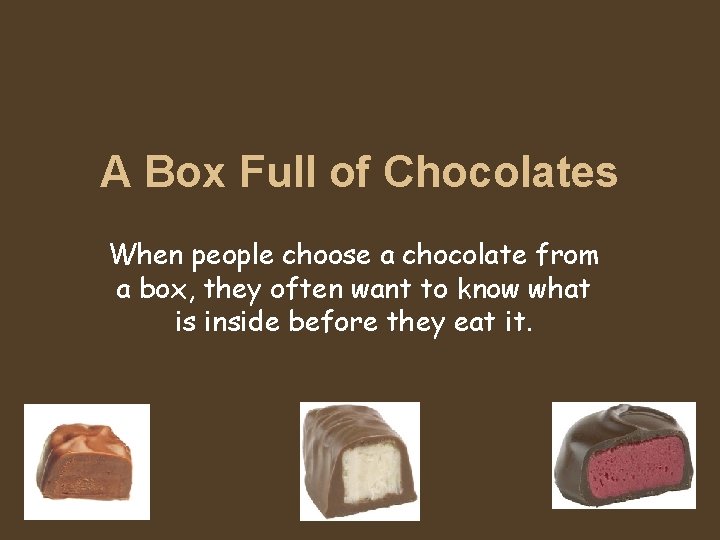
A Box Full of Chocolates When people choose a chocolate from a box, they often want to know what is inside before they eat it.
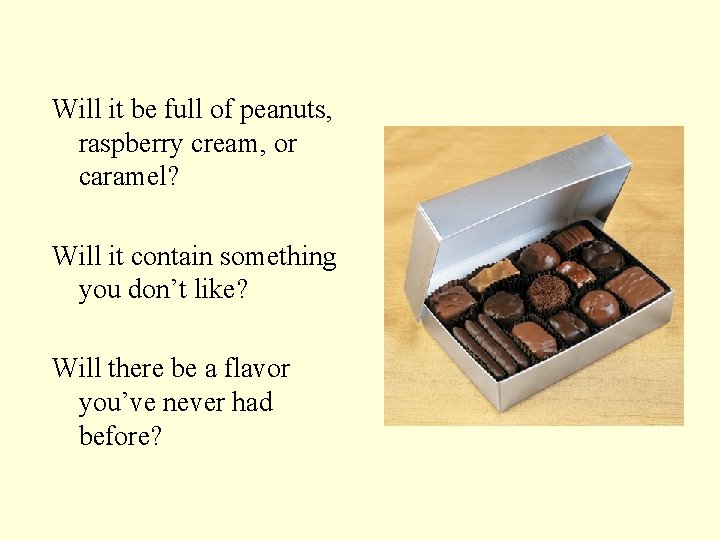
Will it be full of peanuts, raspberry cream, or caramel? Will it contain something you don’t like? Will there be a flavor you’ve never had before?
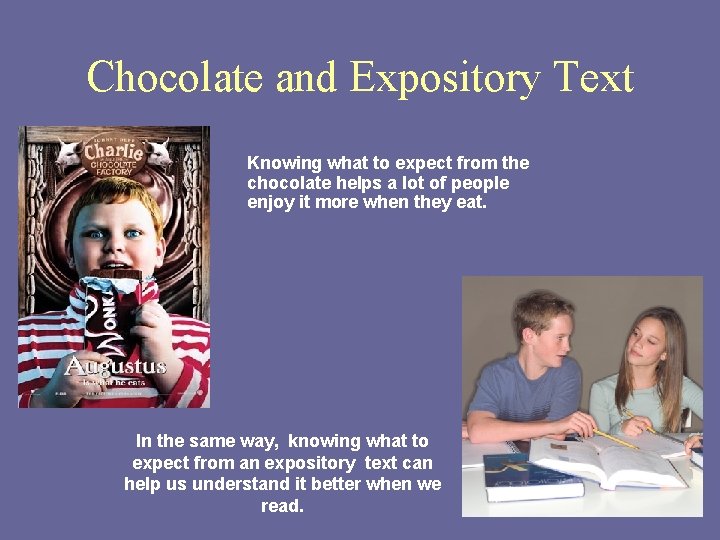
Chocolate and Expository Text Knowing what to expect from the chocolate helps a lot of people enjoy it more when they eat. In the same way, knowing what to expect from an expository text can help us understand it better when we read.
There are hundreds of types of fillings for chocolate, but just 5 basic patterns for expository text structures. Description Sequence Comparison-Contrast Cause-Effect Problem-Solution
Expository Text Types In the next few slides you’ll find a description and example of each of the 5 text types. After that, there will be a quiz game where you can test yourself on how well you recognize the 5 types.
Type 1: Description A description gives the characteristics of an object, person, place or idea. It often has a lot of details.
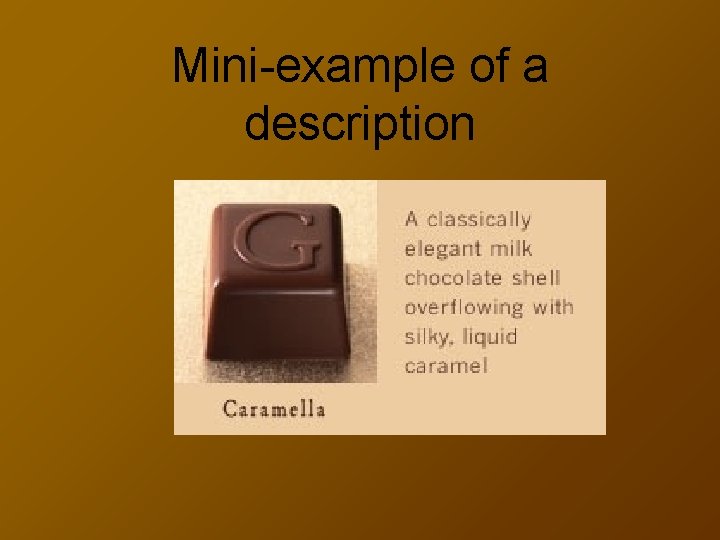
Mini-example of a description
Type 2: Sequence A sequence text type tells events in the order that they happen. Signal words: First, second, next, after that, before, finally
Mini-example of a sequence Up until the 1800’s, people drank all their chocolate. Then in 1847 the first chocolate candy was developed by a British company. Milk chocolate, actually made by adding mild products to the chocolate, was developed by two Swiss men, Daniel Peter and Henri Nestle, in 1875.
Type 3: Comparison-Contrast A comparison-contrast text type gives similarities and differences between two or more things. Signal words: different, same, but, yet, by contrast, whereas, while, in comparison
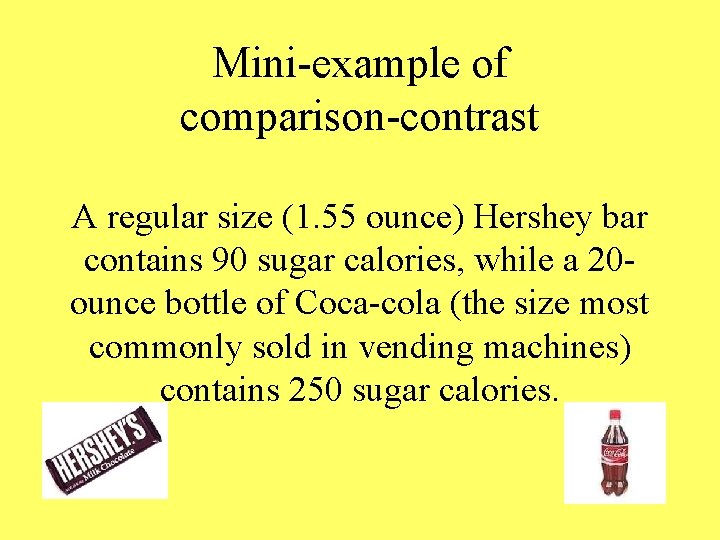
Mini-example of comparison-contrast A regular size (1. 55 ounce) Hershey bar contains 90 sugar calories, while a 20 ounce bottle of Coca-cola (the size most commonly sold in vending machines) contains 250 sugar calories.
Type 4: Cause-Effect A cause-effect text type gives the reasons why something happens. Signal words: Why, if, so, because of, since, as a result, since, in order to
Mini-example of cause-effect Researchers at the Harvard School of Public Health recently discovered that people who eat chocolate one to three times a month live almost a year longer than those who don’t eat any chocolate. Why? Compounds in chocolate called phenols reduce the risk of getting heart disease.
Type 5: Problem-Solution Just like its name says, this text type gives a problem and then tells how to deal with it. Signal words: Because, since, as a result, so that
Mini-example of problem-solution Chocolate can cause indigestion. It can also cause heartburn, a backup of stomach acids into the esophagus. People who suffer from heartburn are advised to cut down on chocolate.
Can you identify all 5 text structures? Test yourself with the Text Structure Quiz Game. Read each text and decide whether it is description, sequence, comparison-contrast, cause-effect or problem-solution. When you decide, click on the chocolate to see if you are correct. Every Correct answer will get you a chocolate in your chocolate box. Get ready to play!
Text 1 It was at the 1893 World’s Columbian Exposition in Chicago that Hershey first became fascinated with the art of chocolate making. While there, he purchased some German machinery, had it shipped to Lancaster and began producing chocolate coatings for his caramels. But aware of the growing demand for chocolate itself, he soon started the Hershey Chocolate Company. cause-effect descriptive problem-solution Comparisoncontrast sequence
Text 2 The temperature at which cocoa butter, one of the main ingredients in chocolate, melts is just the average human body temperature of 98. 6 degrees Fahrenheit. This is why chocolate literally melts in your mouth! cause-effect descriptive problem-solution Comparisoncontrast sequence
Text 3 Soldiers were becoming increasingly fed up that chocolate sent to the Gulf by their families was melting before they could enjoy it. The 14 and 15 -year-old pupils from Afon Taf High School in Troedyrhiw, Merthyr, Tydfil, spent more than a year cooking up the recipe for chocolate that can survive desert heat. . . Louise Treen, 15 said: “We had to keep trying and trying to get the quantities used in the chocolate just right. Our chocolate takes about an hour to cook and its secret ingredient is glycerine. cause-effect descriptive problem-solution Comparisoncontrast sequence
Text 4 There is almost no caffeine in chocolate. A chocolate bar has about the same amount as a cup of decaffeinated coffee. Here’s a comparison of some products: A cup of hot cocoa contains 5 milligrams of caffeine, a 1. 5 -ounce milk-chocolate bar contains 10 milligrams of caffeine, and an 8 -ounce cup of regular coffee has 130 milligrams of caffeine. cause-effect descriptive problem-solution Comparisoncontrast sequence
Text 5 Chocolate liquor is pure, unsweetened chocolate. Eaten in this state, it’s pretty nasty because it is bitter, but it’s possible to acquire a taste for it. You can do two different things with chocolate liquor. You can pour it into a mold and let it cool and solidify. This is unsweetened chocolate. Or you can press it in a hydraulic press to squeeze out the fat. When you do that, what you are left with is a dry cake of the ground cocoa bean solids and cocoa butter (useful in everything from tanning products to white chocolate). cause-effect descriptive problem-solution Comparisoncontrast sequence
Text sources: Type 1: “Platinum Collection Pieces”. Godiva Chocolatier. 2006. http: //www. godiva. com Type 2, Text 1: “Writing Process Model 10”. “Type 3, 4 and 5, Text 2 and 4: Zanecosky, Althea. “Sweet News”. Scholastic Choices. April/May 2006, 21 - 23. Text 3: de Bruxelle, Simon. “And for Deserts? Heatproff Chocolate”. The Times. February 25, 2004. http: //web. ebscohost. com Text 5 Brain, Marshall. “How Chocolate Works”. How Stuff Works. http: //www. howstuffworks. com Image sources: www. amazon. com www. billybear 4 kids. com www. english-shop. net http: //www. flickr. com/explore/interesting/2005/07/26/page 44/ http: //www. godiva. com/ www. romanicoschocolate. com http: //www. sees. com/ www. youngstarnews. com/ysn/movies/catcf. htm
- Slides: 23