
Takeoff Performance Jet Aircraft Performance Lecture 11 Chapter

- Slides: 18
Takeoff Performance Jet Aircraft Performance Lecture 11 Chapter 5
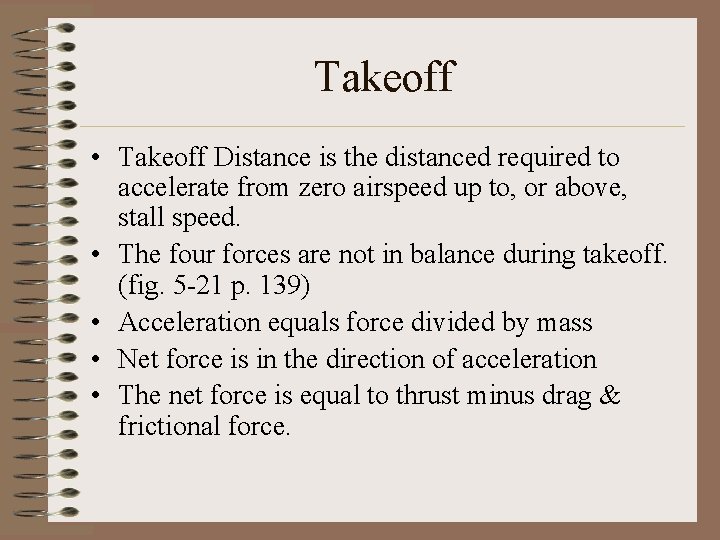
Takeoff • Takeoff Distance is the distanced required to accelerate from zero airspeed up to, or above, stall speed. • The four forces are not in balance during takeoff. (fig. 5 -21 p. 139) • Acceleration equals force divided by mass • Net force is in the direction of acceleration • The net force is equal to thrust minus drag & frictional force.
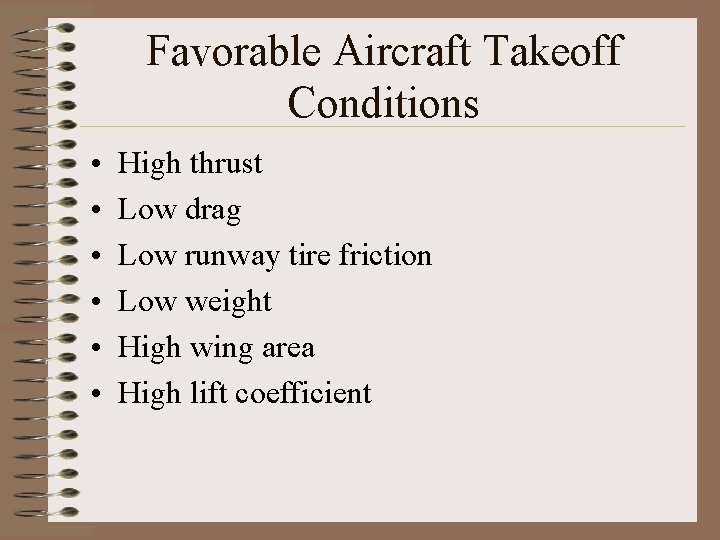
Favorable Aircraft Takeoff Conditions • • • High thrust Low drag Low runway tire friction Low weight High wing area High lift coefficient
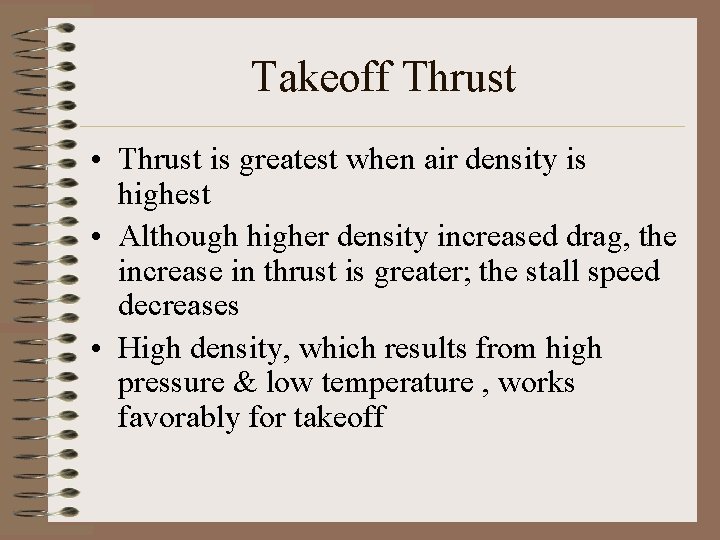
Takeoff Thrust • Thrust is greatest when air density is highest • Although higher density increased drag, the increase in thrust is greater; the stall speed decreases • High density, which results from high pressure & low temperature , works favorably for takeoff
Favorable Environmental Takeoff Conditions • • • Smooth runway surface Level or downhill slope High pressure Low temperature High headwind
Balance Field Length Critical engine failure speed-V 1 definite criterion for decision Slower than V 1 the pilot aborts the takeoff to stop in the event of an engine failure If an engine fails faster than V 1 the pilot must continue the takeoff on remaining engines
Balanced Field • V 2 is the distance required to stop is exactly the same as that required to reach takeoff speed • Balanced field length is the overall runway distance up to the point of stopping • Figure 5 -22 p. 143
Landing • Landing in two parts- landing distance & roll distance from touchdown to stop • Touchdown at 15% above stall is appropriate for modern aircraft. • Deceleration is negative acceleration • Most effective braking only reduced roll 10% than with no braking
Landing Conditions • • • Runway surface L/D ratio Wind Runway slope Altitude (pressure & temperature) Weight
Jet Aircraft Performance • Jet-propelled aircraft produce thrust directly from the engine. • Figure 5 -23 p. 146 – Plot of thrust available and thrust required – The maximum velocity occurs at the intersection of these curves (like power curve)
Range & Endurance • Because fuel consumption is proportional is to thrust, the minimum fuel consumption would occur at the minimum thrust required • Best endurance occurs at the minimum point on the thrust required (drag) curve • Figure 5 -24 p. 147
L/D Ratio • Maximum L/D ratio gives the maximum performance in the following: – Endurance – Power-off Glide Ratio – Angle of Climb
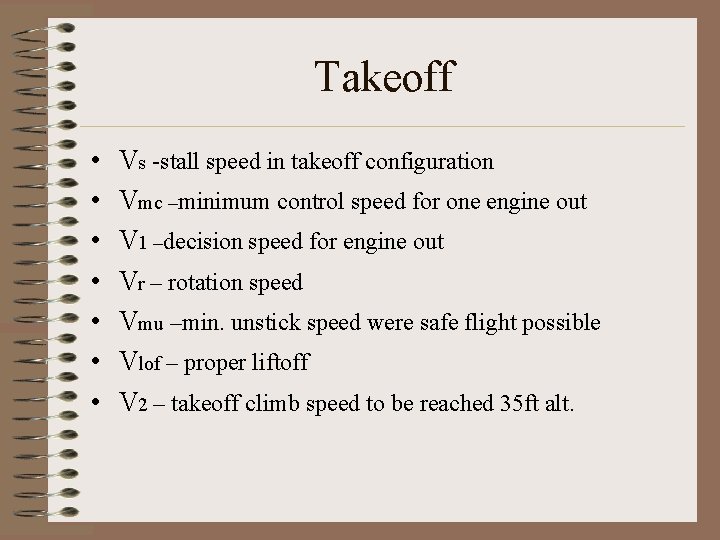
Takeoff • • Vs -stall speed in takeoff configuration Vmc –minimum control speed for one engine out V 1 –decision speed for engine out Vr – rotation speed Vmu –min. unstick speed were safe flight possible Vlof – proper liftoff V 2 – takeoff climb speed to be reached 35 ft alt.
Maneuvering Load factors limits established by the FAA A load factor is the maneuver force in a particular direction divided by the weight of the aircraft The load factor is the lift divided by the weight in the vertical direction
V-n Diagram • V-n diagram is the aircraft operational envelope that ensures design loads are not exceeded • The diagram is simply a plot of velocity for various load factors • Figure 5 -27 p. 151
Accelerated Climb • Rate of climb-excess power divided by weight (Specific excess power) • “Specific” denotes some quantity per unit • Figure 5 -28 p. 153 • Figure 5 -29 p. 154 • Figure 5 -30 p. 155
Quiz on Chapter 5 Please take out a sheet of paper Include today’s date & your name
Quiz on chapter 5 • Explain balance of field. • What is a load factor? • What is the purpose of the V-n diagram?