
Take a Stand to Prevent Falls Prevention Presentation
- Slides: 34
Take a Stand to Prevent Falls Prevention Presentation Developed by AOTA and AGPT, a component of APTA Photo © William Provost Photo courtesy of Ambro at freedigitalphotos. net Copyright © 2015 by the American Occupational Therapy Association and the Academy of Geriatric Physical Therapy, APTA. To republish this information, please contact copyright@aota. org or geriatrics@geriatrics. org
Are falls preventable? Image courtesy of anarres at openclipart. org Copyright © 2015 by the American Occupational Therapy Association and the Academy of Geriatric Physical Therapy, APTA. To republish this information, please contact copyright@aota. org or geriatrics@geriatrics. org
YES! Falls are largely preventable! Come learn how. Copyright © 2015 by the American Occupational Therapy Association and the Academy of Geriatric Physical Therapy, APTA. To republish this information, please contact copyright@aota. org or geriatrics@geriatrics. org
Today’s Discussion �Definition of a fall �Fear of falling �Risk factors for falling �Action steps to reduce YOUR fall risk Image courtesy of Stuart Miles at freedigitalphotos. net Copyright © 2015 by the American Occupational Therapy Association and the Academy of Geriatric Physical Therapy, APTA. To republish this information, please contact copyright@aota. org or geriatrics@geriatrics. org
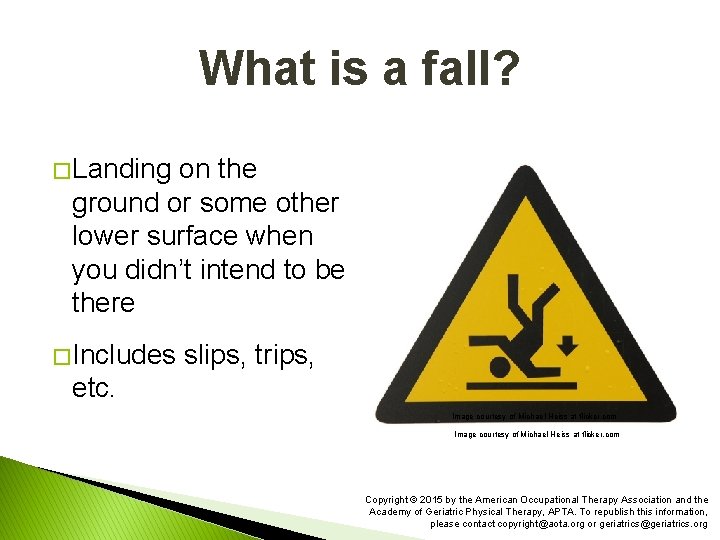
What is a fall? � Landing on the ground or some other lower surface when you didn’t intend to be there � Includes slips, trips, etc. Image courtesy of Michael Heiss at flicker. com Copyright © 2015 by the American Occupational Therapy Association and the Academy of Geriatric Physical Therapy, APTA. To republish this information, please contact copyright@aota. org or geriatrics@geriatrics. org
Have you had a fall? � Have you had a fall in the past year? � Were you hurt? � Do you worry about falling? � Do you feel unsteady when standing or walking? Copyright © 2015 by the American Occupational Therapy Association and the Academy of Geriatric Physical Therapy, APTA. To republish this information, please contact copyright@aota. org or geriatrics@geriatrics. org
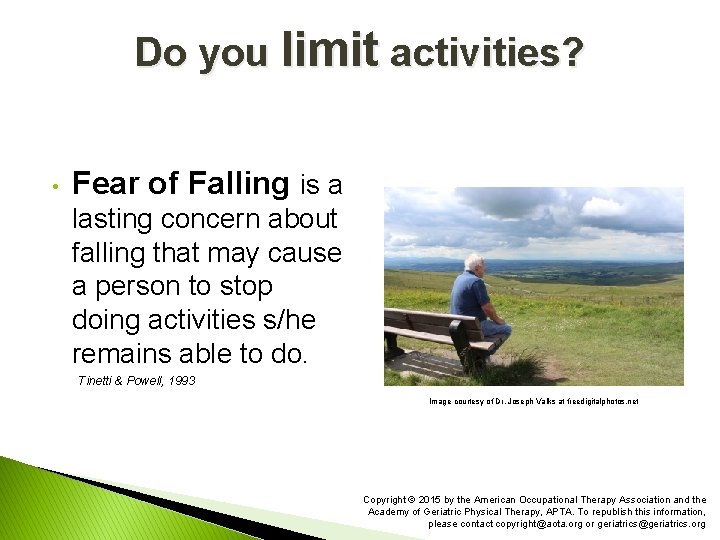
Do you limit activities? • Fear of Falling is a lasting concern about falling that may cause a person to stop doing activities s/he remains able to do. Tinetti & Powell, 1993 Image courtesy of Dr. Joseph Valks at freedigitalphotos. net Copyright © 2015 by the American Occupational Therapy Association and the Academy of Geriatric Physical Therapy, APTA. To republish this information, please contact copyright@aota. org or geriatrics@geriatrics. org
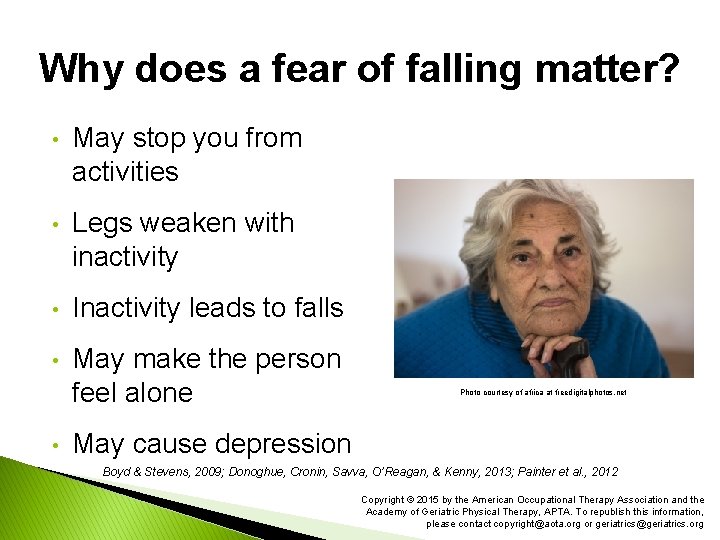
Why does a fear of falling matter? • May stop you from activities • Legs weaken with inactivity • Inactivity leads to falls • May make the person feel alone • www. ncoa. org Photo courtesy of africa at freedigitalphotos. net May cause depression Boyd & Stevens, 2009; Donoghue, Cronin, Savva, O’Reagan, & Kenny, 2013; Painter et al. , 2012 Copyright © 2015 by the American Occupational Therapy Association and the Academy of Geriatric Physical Therapy, APTA. To republish this information, please contact copyright@aota. org or geriatrics@geriatrics. org
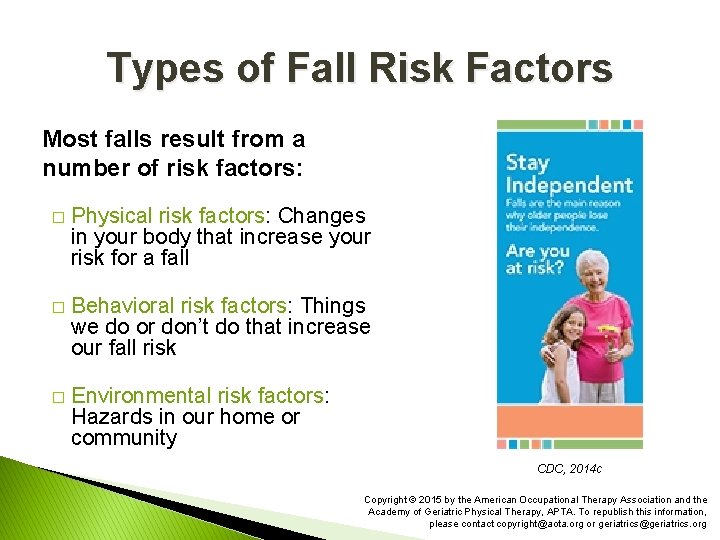
Types of Fall Risk Factors Most falls result from a number of risk factors: � Physical risk factors: Changes in your body that increase your risk for a fall � Behavioral risk factors: Things we do or don’t do that increase our fall risk � Environmental risk factors: Hazards in our home or community CDC, 2014 c Copyright © 2015 by the American Occupational Therapy Association and the Academy of Geriatric Physical Therapy, APTA. To republish this information, please contact copyright@aota. org or geriatrics@geriatrics. org
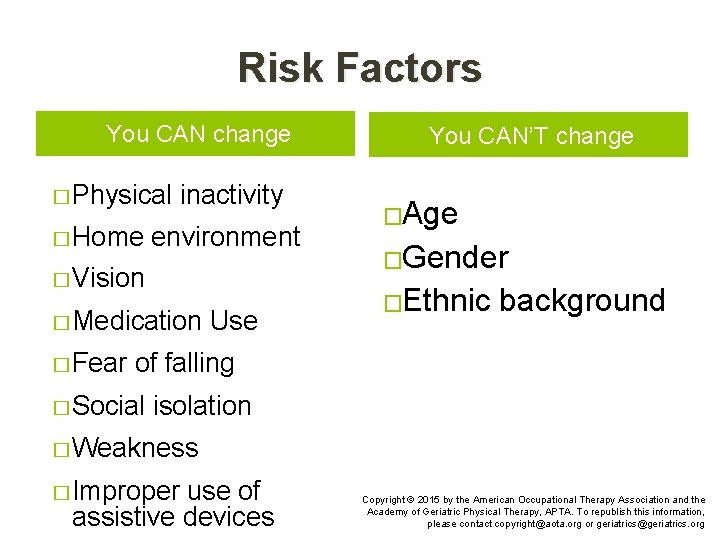
Risk Factors You CAN change � Physical � Home inactivity environment � Vision � Medication � Fear Use You CAN’T change �Age �Gender �Ethnic background of falling � Social isolation � Weakness � Improper use of assistive devices Copyright © 2015 by the American Occupational Therapy Association and the Academy of Geriatric Physical Therapy, APTA. To republish this information, please contact copyright@aota. org or geriatrics@geriatrics. org
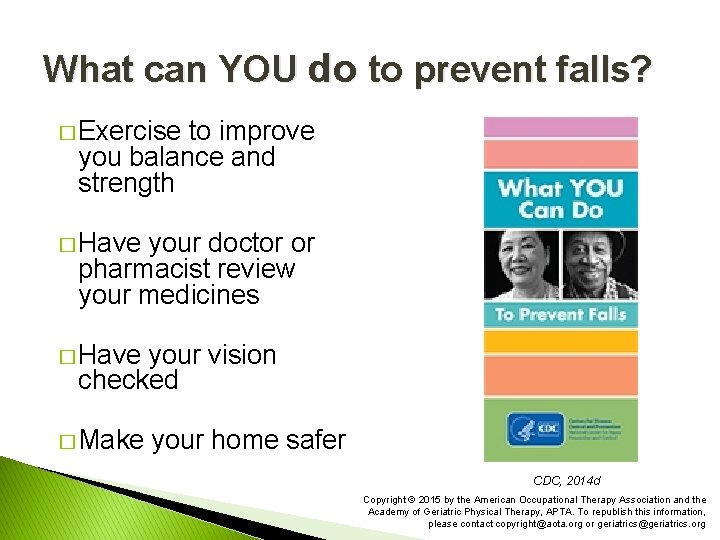
What can YOU do to prevent falls? � Exercise to improve you balance and strength � Have your doctor or pharmacist review your medicines � Have your vision checked � Make your home safer CDC, 2014 d Copyright © 2015 by the American Occupational Therapy Association and the Academy of Geriatric Physical Therapy, APTA. To republish this information, please contact copyright@aota. org or geriatrics@geriatrics. org
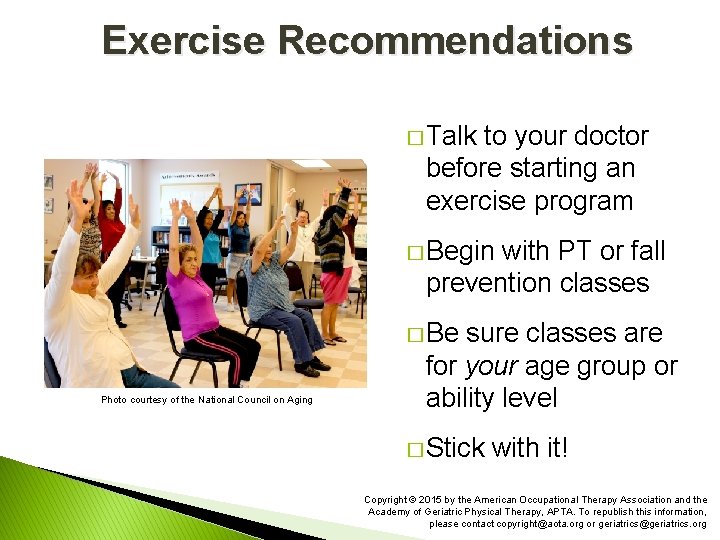
Exercise Recommendations � Talk to your doctor before starting an exercise program � Begin with PT or fall prevention classes � Be Photo courtesy of the National Council on Aging sure classes are for your age group or ability level � Stick with it! Copyright © 2015 by the American Occupational Therapy Association and the Academy of Geriatric Physical Therapy, APTA. To republish this information, please contact copyright@aota. org or geriatrics@geriatrics. org
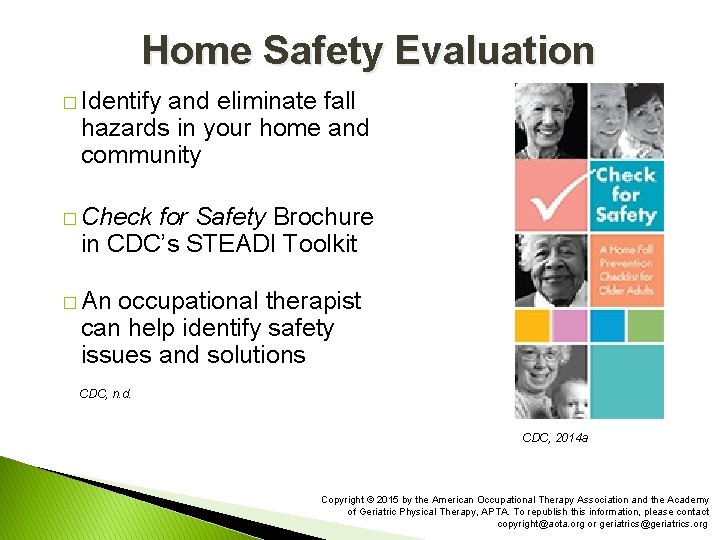
Home Safety Evaluation � Identify and eliminate fall hazards in your home and community � Check for Safety Brochure in CDC’s STEADI Toolkit � An occupational therapist can help identify safety issues and solutions CDC, n. d. CDC, 2014 a Copyright © 2015 by the American Occupational Therapy Association and the Academy of Geriatric Physical Therapy, APTA. To republish this information, please contact copyright@aota. org or geriatrics@geriatrics. org
Medications and Falls Risk ◦ Side effects may make you dizzy ◦ Medication changes can increase fall risk ◦ Use one pharmacy ◦ Review your medications each year ◦ Be sure you can read your labels Image courtesy of Victor Habbick at freedigitalphotos. net Copyright © 2015 by the American Occupational Therapy Association and the Academy of Geriatric Physical Therapy, APTA. To republish this information, please contact copyright@aota. org or geriatrics@geriatrics. org
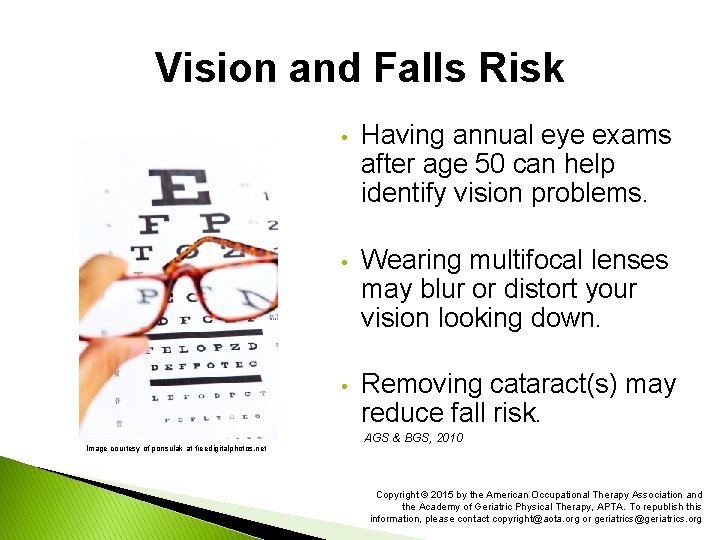
Vision and Falls Risk Image courtesy of ponsulak at freedigitalphotos. net • Having annual eye exams after age 50 can help identify vision problems. • Wearing multifocal lenses may blur or distort your vision looking down. • Removing cataract(s) may reduce fall risk. AGS & BGS, 2010 Copyright © 2015 by the American Occupational Therapy Association and the Academy of Geriatric Physical Therapy, APTA. To republish this information, please contact copyright@aota. org or geriatrics@geriatrics. org
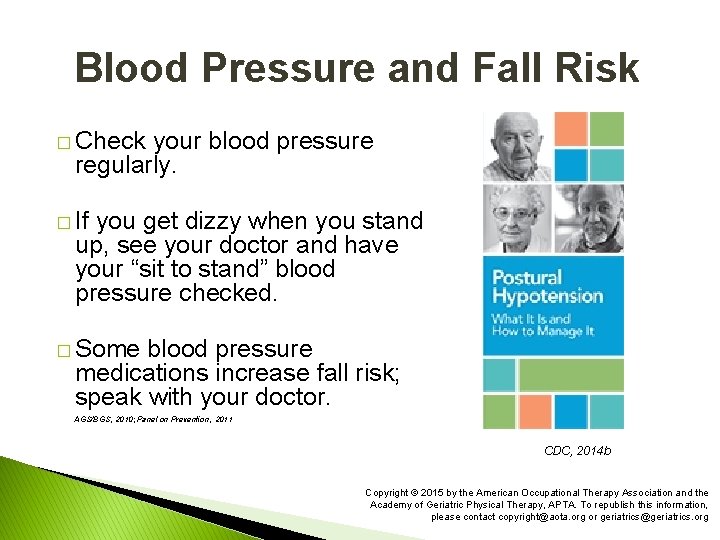
Blood Pressure and Fall Risk � Check your blood pressure regularly. � If you get dizzy when you stand up, see your doctor and have your “sit to stand” blood pressure checked. � Some blood pressure medications increase fall risk; speak with your doctor. AGS/BGS, 2010; Panel on Prevention, 2011 CDC, 2014 b Copyright © 2015 by the American Occupational Therapy Association and the Academy of Geriatric Physical Therapy, APTA. To republish this information, please contact copyright@aota. org or geriatrics@geriatrics. org
Chronic Conditions May Contribute to Your Fall Risk �Diabetes �Arthritis �Stroke �Multiple Sclerosis (MS) �Parkinson’s Disease �Chronic Pain �Depression �Chronic Obstructive Pulmonary Disease (COPD) AGS & BGS, 2010; Panel on Prevention, 2011 Copyright © 2015 by the American Occupational Therapy Association and the Academy of Geriatric Physical Therapy, APTA. To republish this information, please contact copyright@aota. org or geriatrics@geriatrics. org
Risk of Falling May Increase Ø Change in your medications Ø Illness or infection Ø Pain Ø Lack of sleep Ø Being sad or worried Ø Reduced activity level Ø Move to new home � Change in use of cane or walker Photo © Aprescindere Image courtesy of Stuart Miles at freedigitalphotos. net Copyright © 2015 by the American Occupational Therapy Association and the Academy of Geriatric Physical Therapy, APTA. To republish this information, please contact copyright@aota. org or geriatrics@geriatrics. org
Start Small Choose one risk factor to address • Pharmacist & Doctor — review medications for side effects that may cause you to fall • Occupational Therapist — home assessment and recommendations to make your home safer • Physical Therapist — help with physical activity, balance, strength, and moving safely Copyright © 2015 by the American Occupational Therapy Association and the Academy of Geriatric Physical Therapy, APTA. To republish this information, please contact copyright@aota. org or geriatrics@geriatrics. org
After a Fall Occurs … � Check for injury. � Call for help, if needed. � Seek medical attention right away if you might have hit your head. � Call your doctor. � Check for safety hazards. � Learn how to get up safely. Photo courtesy of Ventrilock at freedigitalphotos. net Copyright © 2015 by the American Occupational Therapy Association and the Academy of Geriatric Physical Therapy, APTA. To republish this information, please contact copyright@aota. org or geriatrics@geriatrics. org
Evidence-Based Fall Prevention Programs Copyright © 2015 by the American Occupational Therapy Association and the Academy of Geriatric Physical Therapy, APTA. To republish this information, please contact copyright@aota. org or geriatrics@geriatrics. org
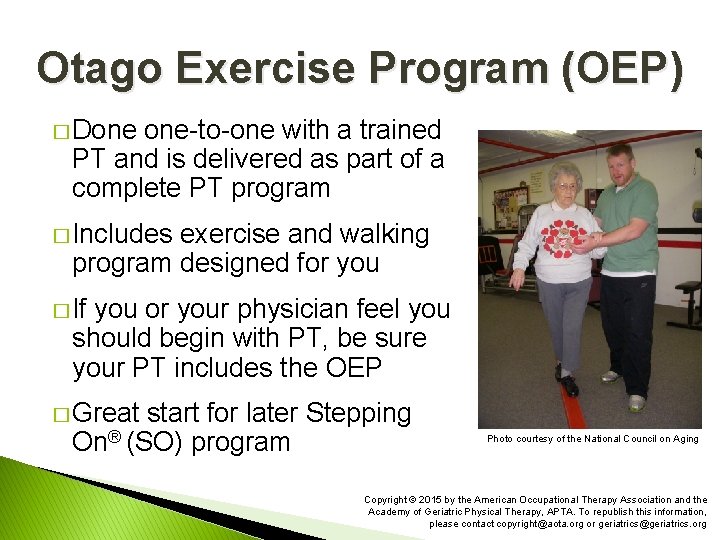
Otago Exercise Program (OEP) � Done one-to-one with a trained PT and is delivered as part of a complete PT program � Includes exercise and walking program designed for you � If you or your physician feel you should begin with PT, be sure your PT includes the OEP � Great start for later Stepping On® (SO) program Photo courtesy of the National Council on Aging Copyright © 2015 by the American Occupational Therapy Association and the Academy of Geriatric Physical Therapy, APTA. To republish this information, please contact copyright@aota. org or geriatrics@geriatrics. org
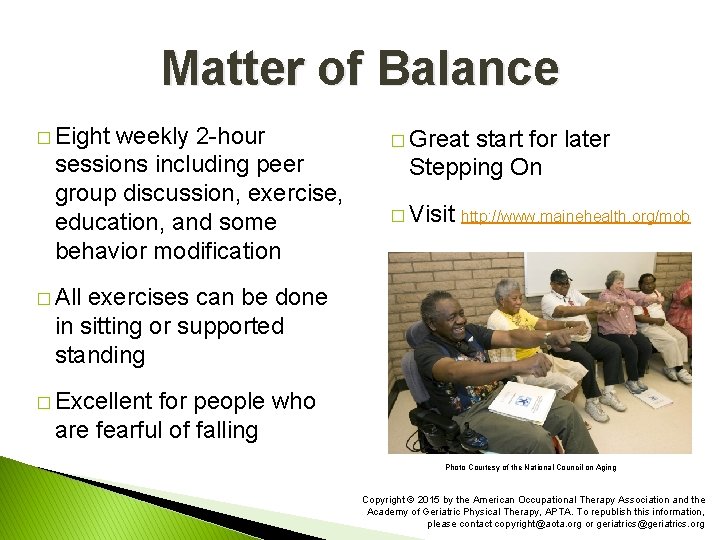
Matter of Balance � Eight weekly 2 -hour sessions including peer group discussion, exercise, education, and some behavior modification � Great start for later Stepping On � Visit http: //www. mainehealth. org/mob � All exercises can be done in sitting or supported standing � Excellent for people who are fearful of falling Photo Courtesy of the National Council on Aging Copyright © 2015 by the American Occupational Therapy Association and the Academy of Geriatric Physical Therapy, APTA. To republish this information, please contact copyright@aota. org or geriatrics@geriatrics. org
Stepping ® On (SO) � Seven weekly 2 -hour classes including peer discussion, exercise, expert lectures � Great follow-up to Otago (OEP) � SO classes include standing exercises that are done by a chair independently � You should feel safe standing and walking independently before you begin SO � Visit https: //wihealthyaging. org/stepping-on Copyright © 2015 by the American Occupational Therapy Association and the Academy of Geriatric Physical Therapy, APTA. To republish this information, please contact copyright@aota. org or geriatrics@geriatrics. org
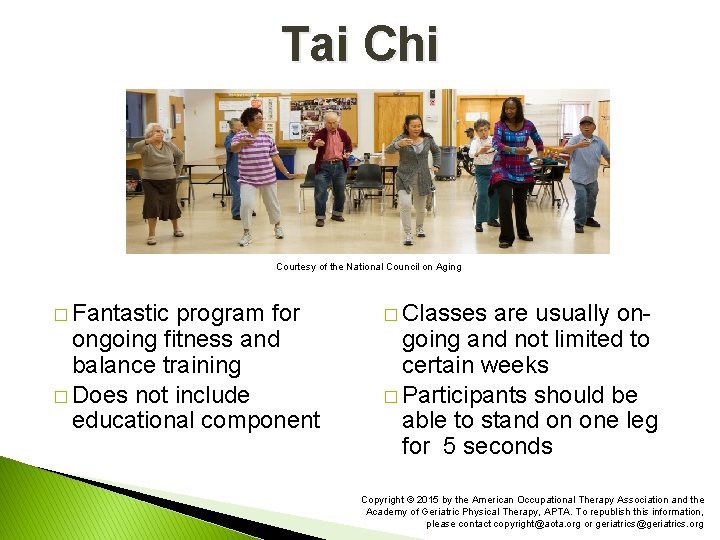
Tai Chi Courtesy of the National Council on Aging � Fantastic program for ongoing fitness and balance training � Does not include educational component � Classes are usually ongoing and not limited to certain weeks � Participants should be able to stand on one leg for 5 seconds Copyright © 2015 by the American Occupational Therapy Association and the Academy of Geriatric Physical Therapy, APTA. To republish this information, please contact copyright@aota. org or geriatrics@geriatrics. org
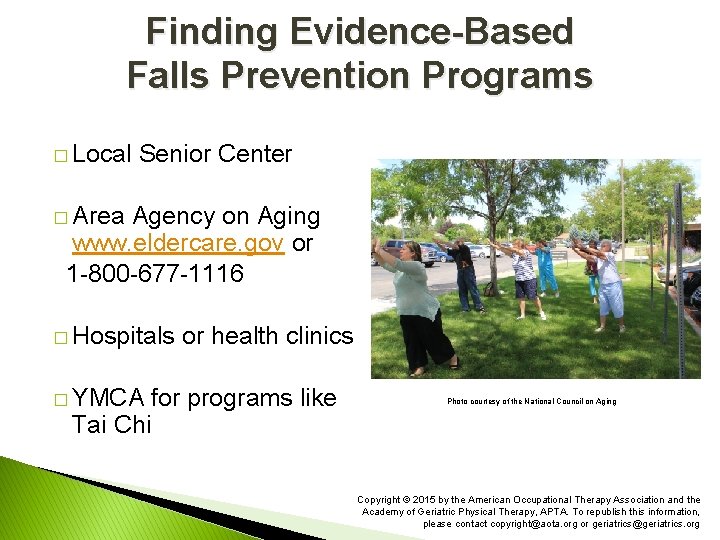
Finding Evidence-Based Falls Prevention Programs � Local Senior Center � Area Agency on Aging www. eldercare. gov or 1 -800 -677 -1116 � Hospitals � YMCA or health clinics for programs like Tai Chi Photo courtesy of the National Council on Aging Copyright © 2015 by the American Occupational Therapy Association and the Academy of Geriatric Physical Therapy, APTA. To republish this information, please contact copyright@aota. org or geriatrics@geriatrics. org
REMEMBER Move More! Copyright © 2015 by the American Occupational Therapy Association and the Academy of Geriatric Physical Therapy, APTA. To republish this information, please contact copyright@aota. org or geriatrics@geriatrics. org
Copyright © 2015 by the American Occupational Therapy Association and the Academy of Geriatric Physical Therapy, APTA. To republish this information, please contact copyright@aota. org or geriatrics@geriatrics. org
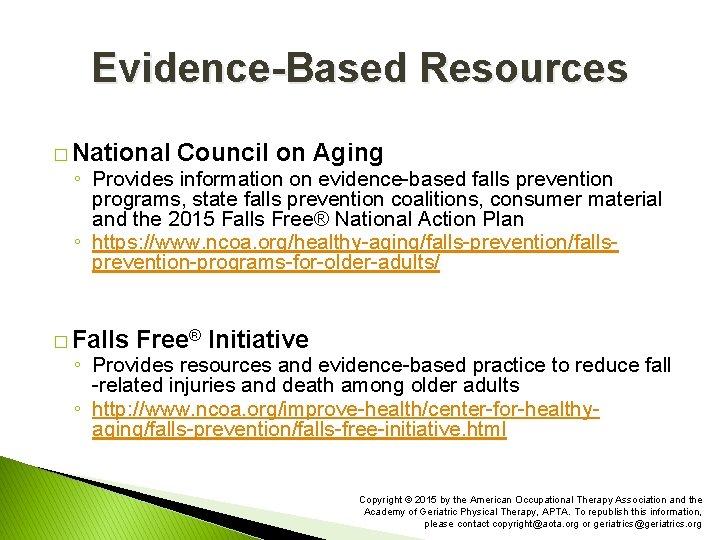
Evidence-Based Resources � National Council on Aging ◦ Provides information on evidence-based falls prevention programs, state falls prevention coalitions, consumer material and the 2015 Falls Free® National Action Plan ◦ https: //www. ncoa. org/healthy-aging/falls-prevention/fallsprevention-programs-for-older-adults/ � Falls Free® Initiative ◦ Provides resources and evidence-based practice to reduce fall -related injuries and death among older adults ◦ http: //www. ncoa. org/improve-health/center-for-healthyaging/falls-prevention/falls-free-initiative. html Copyright © 2015 by the American Occupational Therapy Association and the Academy of Geriatric Physical Therapy, APTA. To republish this information, please contact copyright@aota. org or geriatrics@geriatrics. org
Thank You for Coming! This Power. Point presentation was developed by Jane Painter-Patton, Ed. D, OTR/L, FAOTA, Professor, East Carolina University and Mindy Oxman Renfro, PT, Ph. D, DPT, University of Montana, with assistance from AOTA staff Karen Smith, OT/L, CAPS. Copyright © 2015 by the American Occupational Therapy Association and the Academy of Geriatric Physical Therapy, APTA. To republish this information, please contact copyright@aota. org or geriatrics@geriatrics. org
References American Geriatrics Society & British Geriatrics Society (AGS & BGS). (2010). Clinical practice guideline: Prevention of falls in older persons. New York: American Geriatrics Society. Boyd, R. , & Stevens, J. A. (2009). Falls and fear of falling: Burden, beliefs and behaviours. Age and Ageing, 38, 423– 428. Retrieved from http: //dx. doi. org/10. 1093/ageing/afp 053 Centers for Disease Control and Prevention (CDC). (n. d. ). Fall prevention patient referral form. Retrieved from http: //www. cdc. gov/steadi/pdf/fall_prevention_patient_referral_form-a. pdf Centers for Disease Control and Prevention (CDC). (2014 a). Check for safety (brochure). Retrieved from http: //www. cdc. gov/steadi/pdf/check_for_safety_brochure-a. pdf Centers for Disease Control and Prevention (CDC). (2014 b). Postural hypotension: What it is and how to manage it (brochure). Retrieved from http: //www. cdc. gov/homeandrecreationalsafety/pdf/steadi-2015. 04/Postural_Hypotensiona. pdf Centers for Disease Control and Prevention (CDC). (2014 c). Stay independent (brochure). Retrieved from http: //www. cdc. gov/homeandrecreationalsafety/pdf/steadi 2015. 04/Stay_Independent_brochure-a. pdf Copyright © 2015 by the American Occupational Therapy Association and the Academy of Geriatric Physical Therapy, APTA. To republish this information, please contact copyright@aota. org or geriatrics@geriatrics. org
References Centers for Disease Control and Prevention (CDC). (2014 d). What you can do to prevent falls (brochure). Retrieved from http: //www. cdc. gov/Homeand. Recreational. Safety/pubs/English/brochure_Eng_desktop-a. pdf Donoghue, O. A. , Cronin, H. , Savva, G. M. , O’Reagan, C. , & Kenny, R. A. (2013). Effects of fear of falling and activity restriction on normal and dual task walking in community dwelling older adults. Gain & Posture, 38, 120 -124. Painter, J. A. , Allison, L. , Dhingra, P. , Daughtery, J. , Cogdill, K. , & Trujillo, L. G. (2012). Fear of falling and its relationship with anxiety depression, and activity engagement among community -dwelling older adults. American Journal of Occupational Therapy, 66, 169 -176. Panel on Prevention. (2011). Summary of the updated AGS/BGS clinical practice guideline for prevention of falls in older persons. Journal of the American Geriatrics Society, 59, 148 -157. Tinetti, M. E. , & Powell L. (1993). Fear of falling and low self-efficacy: A case of dependence in elderly persons. Journal of Gerontology, 48, 35 -38. Copyright © 2015 by the American Occupational Therapy Association and the Academy of Geriatric Physical Therapy, APTA. To republish this information, please contact copyright@aota. org or geriatrics@geriatrics. org
Resources Ambrose, A. F. , Paul, G. , & Hausdorff, J. M. (2013). Risk factors for falls among older adults: A review of the literature. Maturitas, 75, 51 -61. Centers for Disease Control and Prevention (CDC). (2014). Falls among older adults: An overview. Retrieved from http: //www. cdc. gov/Homeand. Recreational. Safety/Falls/adultfalls. html Grundstrom, A. C. , Guse, C. E. , & Layde, P. M. (2012). Risk factors for falls and fall-related injuries in adults 85 years of age and older. Archives of Gerontology and Geriatrics, 54, 421 -428. doi: 10. 1016/j. archger. 2011/06. 008 Kalyani, R. R. , Stein, B. , Valiyil, R. , Manno, R. , Maynard, J. W. , & Crews, D. C. (2010). Vitamin D treatment for the prevention of falls in older adults: Systematic review and meta-analysis. Journal of the American Geriatrics Society, 58, 1299– 1310. doi: 10. 1111/j. 1532 -5415. 2010. 02949. x Liam, P. , & Kaye, N. (2006). Tai chi for beginners and the 24 forms. Louisville, KY: Four Colour Imports. Nye, A. (2012). Preventing Medication-related falls. Presentation at the Emergency Care Conference, Greenville, NC. Copyright © 2015 by the American Occupational Therapy Association and the Academy of Geriatric Physical Therapy, APTA. To republish this information, please contact copyright@aota. org or geriatrics@geriatrics. org
Resources Shumway-Cook, A. , Brauer, S. , & Woollacott, M. (2000). Predicting the probability for falls in community-dwelling older adults using the Timed Up & Go Test. Physical Therapy, 80, 896903. Stevens, J. A. (2010). CDC compendium of effective fall interventions: What works for community-dwelling older adults (2 nd ed. ). Retrieved from http: //www. cdc. gov/homeandrecreationalsafety/Falls/compendium. html Stevens, J. A. , & Rudd, R. A. (2014). Circumstances and contributing causes of fall deaths among person aged 65 and older: United States, 2010. Journal of the American Geriatrics Society, 62, 470 -475. doi: 10. 111/jgs. 12702 Tinetti, M. , Richman, D. , & Powell, L. (1990). Falls efficacy as a measure of fear of falling. Journal of Gerontology, 45, 239 -243. World Health Organization. (2010). Falls (Fact Sheet N. 344). Retrieved from http: //www. who. int/mediacentre/factsheets/fs 344/en/index. html Copyright © 2015 by the American Occupational Therapy Association and the Academy of Geriatric Physical Therapy, APTA. To republish this information, please contact copyright@aota. org or geriatrics@geriatrics. org