
Tag der Linguistik Judgements based on intuitions a
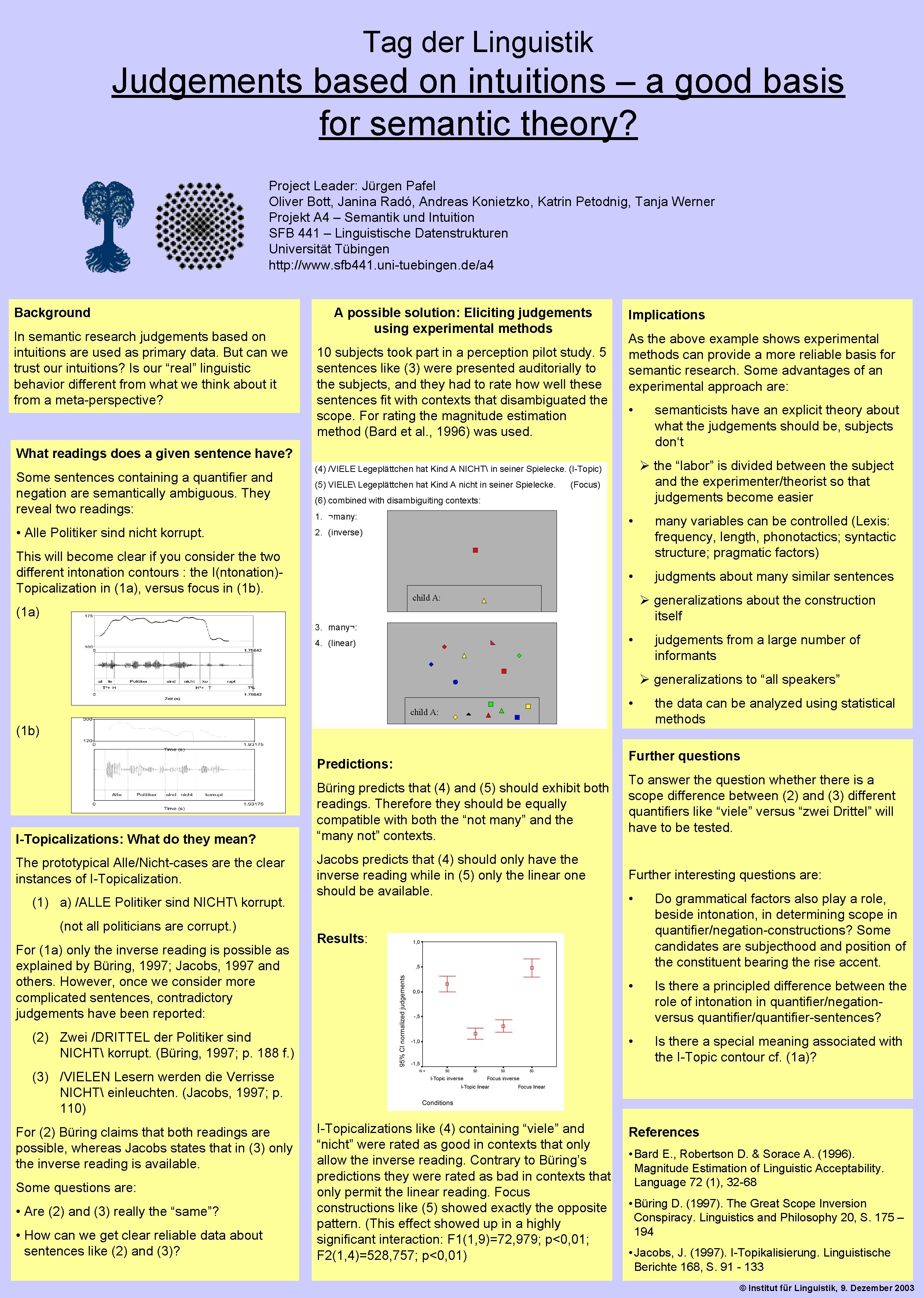
Tag der Linguistik Judgements based on intuitions – a good basis for semantic theory? Project Leader: Jürgen Pafel Oliver Bott, Janina Radó, Andreas Konietzko, Katrin Petodnig, Tanja Werner Projekt A 4 – Semantik und Intuition SFB 441 – Linguistische Datenstrukturen Universität Tübingen http: //www. sfb 441. uni-tuebingen. de/a 4 Background In semantic research judgements based on intuitions are used as primary data. But can we trust our intuitions? Is our “real” linguistic behavior different from what we think about it from a meta-perspective? A possible solution: Eliciting judgements using experimental methods 10 subjects took part in a perception pilot study. 5 sentences like (3) were presented auditorially to the subjects, and they had to rate how well these sentences fit with contexts that disambiguated the scope. For rating the magnitude estimation method (Bard et al. , 1996) was used. Implications As the above example shows experimental methods can provide a more reliable basis for semantic research. Some advantages of an experimental approach are: • What readings does a given sentence have? Some sentences containing a quantifier and negation are semantically ambiguous. They reveal two readings: • Alle Politiker sind nicht korrupt. Ø the “labor” is divided between the subject and the experimenter/theorist so that judgements become easier (4) /VIELE Legeplättchen hat Kind A NICHT in seiner Spielecke. (I-Topic) (5) VIELE Legeplättchen hat Kind A nicht in seiner Spielecke. (Focus) (6) combined with disambiguiting contexts: 1. ¬many: 2. (inverse) This will become clear if you consider the two different intonation contours : the I(ntonation)Topicalization in (1 a), versus focus in (1 b). • many variables can be controlled (Lexis: frequency, length, phonotactics; syntactic structure; pragmatic factors) • judgments about many similar sentences Ø generalizations about the construction itself child A: (1 a) 3. many¬: • 4. (linear) semanticists have an explicit theory about what the judgements should be, subjects don‘t judgements from a large number of informants Ø generalizations to “all speakers” child A: • (1 b) Predictions: I-Topicalizations: What do they mean? The prototypical Alle/Nicht-cases are the clear instances of I-Topicalization. (1) a) /ALLE Politiker sind NICHT korrupt. (not all politicians are corrupt. ) For (1 a) only the inverse reading is possible as explained by Büring, 1997; Jacobs, 1997 and others. However, once we consider more complicated sentences, contradictory judgements have been reported: Büring predicts that (4) and (5) should exhibit both readings. Therefore they should be equally compatible with both the “not many” and the “many not” contexts. Jacobs predicts that (4) should only have the inverse reading while in (5) only the linear one should be available. Further questions To answer the question whethere is a scope difference between (2) and (3) different quantifiers like “viele” versus “zwei Drittel” will have to be tested. Further interesting questions are: • Do grammatical factors also play a role, beside intonation, in determining scope in quantifier/negation-constructions? Some candidates are subjecthood and position of the constituent bearing the rise accent. • Is there a principled difference between the role of intonation in quantifier/negationversus quantifier/quantifier-sentences? • Is there a special meaning associated with the I-Topic contour cf. (1 a)? Results: (2) Zwei /DRITTEL der Politiker sind NICHT korrupt. (Büring, 1997; p. 188 f. ) the data can be analyzed using statistical methods (3) /VIELEN Lesern werden die Verrisse NICHT einleuchten. (Jacobs, 1997; p. 110) For (2) Büring claims that both readings are possible, whereas Jacobs states that in (3) only the inverse reading is available. Some questions are: • Are (2) and (3) really the “same”? • How can we get clear reliable data about sentences like (2) and (3)? I-Topicalizations like (4) containing “viele” and “nicht” were rated as good in contexts that only allow the inverse reading. Contrary to Büring’s predictions they were rated as bad in contexts that only permit the linear reading. Focus constructions like (5) showed exactly the opposite pattern. (This effect showed up in a highly significant interaction: F 1(1, 9)=72, 979; p<0, 01; F 2(1, 4)=528, 757; p<0, 01) References • Bard E. , Robertson D. & Sorace A. (1996). Magnitude Estimation of Linguistic Acceptability. Language 72 (1), 32 -68 • Büring D. (1997). The Great Scope Inversion Conspiracy. Linguistics and Philosophy 20, S. 175 – 194 • Jacobs, J. (1997). I-Topikalisierung. Linguistische Berichte 168, S. 91 - 133 © Institut für Linguistik, 9. Dezember 2003
- Slides: 1