
Tactical Media By Rita Raley About Tactical Media
Tactical Media By Rita Raley
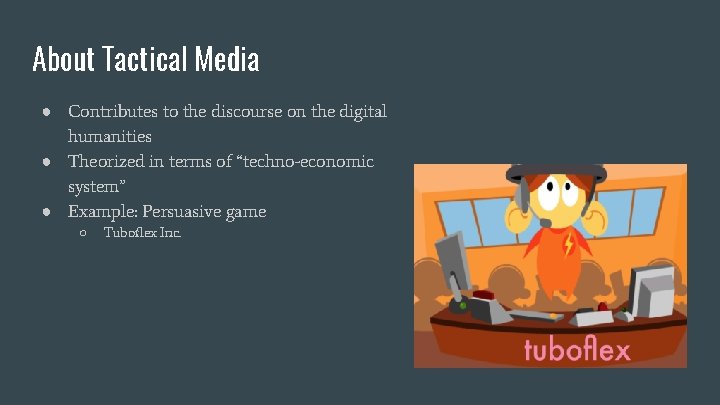
About Tactical Media ● Contributes to the discourse on the digital humanities ● Theorized in terms of “techno-economic system” ● Example: Persuasive game ○ Tuboflex Inc.
Characteristics of Tactical Media ● A mutual category that is not meant to be either fixed or exclusive ● Signifies the intervention and disruption of a dominant semiotic regime ● Operates in the field of the symbolic, the site of power in the postindustrial society ● Forced to operate within the parameters of global capitalism ● Tactical media in terms of performance rather than as static art object emphasizes viewer experience and engagement
Critical Art Ensemble and Bureau of Inverse Technology ● Provide assembly instruction for their products and projects, not all of which are designed to be fully realized ● Shows that tactical media requires a certain openness, a surrendering to chance ● It requires that its practitioners cede control over its outcomes
Next Five Minutes ● A conference held in Amsterdam in 1993 ● The term “tactical” was introduced to disrupt and go beyond the rigid dichotomies that have restricted thinking in this area for so long
Tactical Gizmology - Tactical media not only encompasses obvious technology-based activism but also work whose political critique is subtle or even covert. - Raley believes that Tactical media utilizes both the technological machinery as well as it’s content and representation. It’s not just about reappropriating the instrument but also about re-engineering systems and reflecting critically on institutions of power and control - The point of Tactical Media is to interact/engage with the technology while also becoming aware of our own limitations, such as our inability to make an immediate visible impact on political and socio-economic systems.
Data Visualization as Tactical Media - Uses data as a material then aestheticizes, modifies, interrupts, negates and returns it. - “an aesthetic investigation of the world as it currently exists ‘in data’” - The difference between functional/ pragmatic visualization and artistic visualization is not in the aesthetics, but rather in the intentionality and procedure. - “Tactical media do not just report events, as they are never impartial they always participate.
Data Visualization pt. 2 - These works depends on the real elements from which stats are drawn, but they also critique both their ideology and source. - Data visualizations don’t interrupt the flows of informational capitalism as much as they analyze/interpret/represent the relationship between capitalism and political regimes of control.
Virtuosity -Tactical media is based on continuous acts of refusal and protest -“Multiplicity of discontinuous sites of enunciation” (p. 25) -Tactical media acts as a political activity that supplements other forms of political engagement in the “network society” -Ties to the act of destructive creativity (hacking)
Virtuosity pt. 2 - Raley draws from Paolo Virno’s (2004) definition of virtuosity as a performance or activity that finds satisfaction in itself and is not focused on some kind of end result, ultimate victory, or identifiable product -Raley argues that the purpose of tactical media is not to prove a definitive point or be the catalyst of concrete social or political change, but rather to be used as an instrument for strengthening social relations. In this case, its merit as an art form, in her opinion, is based off of what extent its activities and events are virtuosic -Raley’s response to Lovink and Rossiter is that our focus should not be on “whether tactical media works or not” but on how the media projects impact social relations and by measuring their virtuosity
Virtuosity pt. 3 -Tactical media focuses on forms of spontaneous eruption and the idea of the unexpected event to create the potential for political change and social critique -Art in the present is “learning to inhabit the world in a better way” (p. 27) --Tactical media is a gesture, however fleeting, towards a better socio political future - Not about how it works or if it succeeds because, by definition, a sense of “victory” is impossible, but rather about how it opens up platforms for discussion and potential social change
- Slides: 11