
Tactical Combat Casualty Care for Medical Personnel August
Tactical Combat Casualty Care for Medical Personnel August 2018 (Based on TCCC-MP Guidelines 180801) Tactical Field Care 3 d Documentation of Care in TFC

Disclaimer “The opinions or assertions contained herein are the private views of the authors and are not to be construed as official or as reflecting the views of the Departments of the Army, Air Force, Navy or the Department of Defense. ” - There are no conflict of interest disclosures .
LEARNING OBJECTIVES Terminal Learning Objective • Perform documentation of care in Tactical Field Care. Enabling Learning Objectives • Identify the importance and methods of documenting casualty care in TCCC. • Identify the critical information, relevant abbreviations, and reporting criteria on the TCCC Casualty Care (DD 1380. )
LEARNING OBJECTIVES Enabling Learning Objectives • Identify the importance and information considerations of a TCCC casualty After Action Review submission.
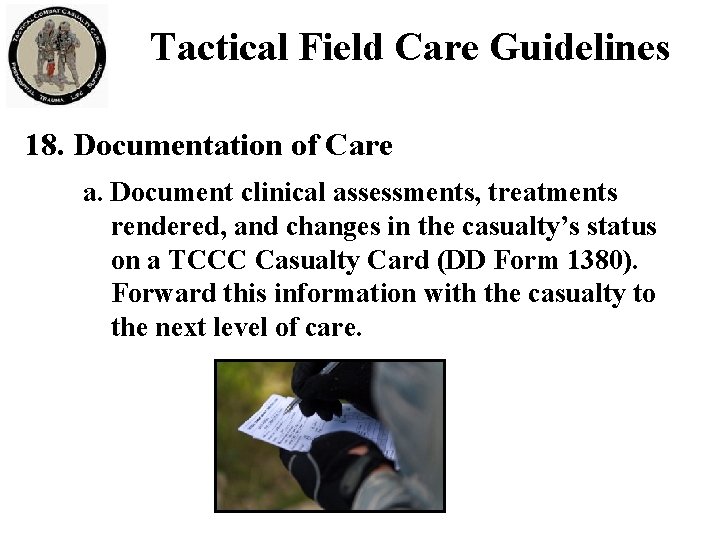
Tactical Field Care Guidelines 18. Documentation of Care a. Document clinical assessments, treatments rendered, and changes in the casualty’s status on a TCCC Casualty Card (DD Form 1380). Forward this information with the casualty to the next level of care.
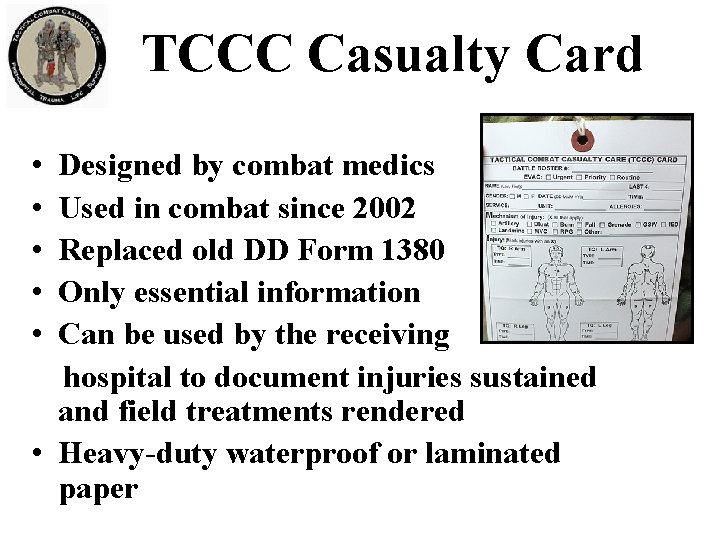
TCCC Casualty Card • • • Designed by combat medics Used in combat since 2002 Replaced old DD Form 1380 Only essential information Can be used by the receiving hospital to document injuries sustained and field treatments rendered • Heavy-duty waterproof or laminated paper
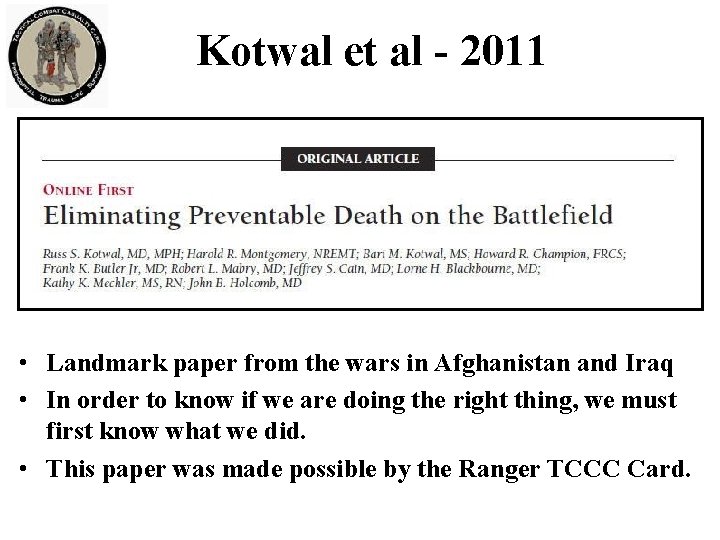
Kotwal et al - 2011 • Landmark paper from the wars in Afghanistan and Iraq • In order to know if we are doing the right thing, we must first know what we did. • This paper was made possible by the Ranger TCCC Card.
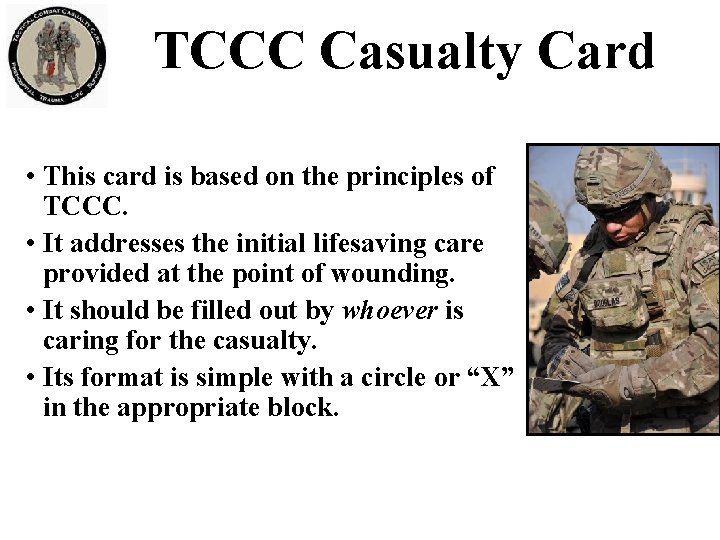
TCCC Casualty Card • This card is based on the principles of TCCC. • It addresses the initial lifesaving care provided at the point of wounding. • It should be filled out by whoever is caring for the casualty. • Its format is simple with a circle or “X” in the appropriate block.

TCCC Casualty Card (DD 1380) Front
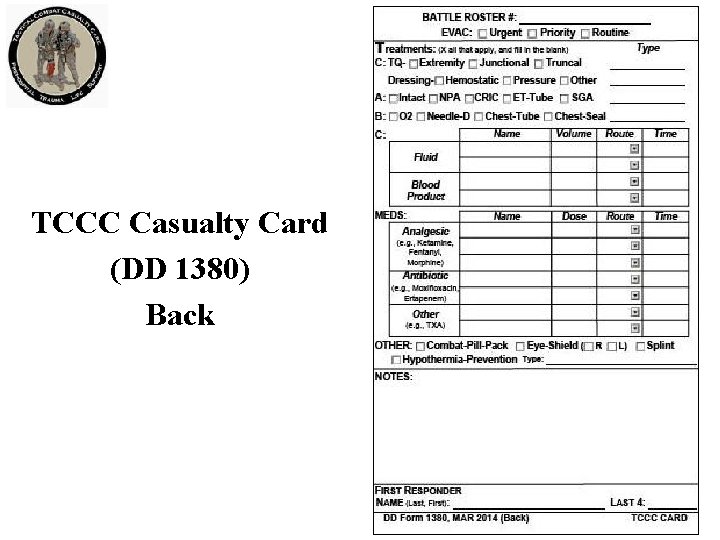
TCCC Casualty Card (DD 1380) Back
Instructions • A TCCC Casualty Card should be kept in each Individual First Aid Kit. • Use an indelible marker to fill it out. • When used, attach it to the casualty’s belt loop, or place it in their upper left sleeve, or the left trouser cargo pocket. • Include as much information as you can.
Documentation • Record each intervention in each category. • If you are not sure what to do, the card will prompt you where to go next. • Simply circle the intervention you performed. • Explain any action you want clarified in the remarks area.
Documentation • The card does not imply that every casualty needs all the interventions listed. • You may not be able to perform all the interventions that the casualty needs. • The next person caring for the casualty can add to the interventions performed. • This card can be filled out in less than two minutes. • It is important that we document the care given to the casualty. • You haven’t finished caring for your casualty until you have documented his or her care!
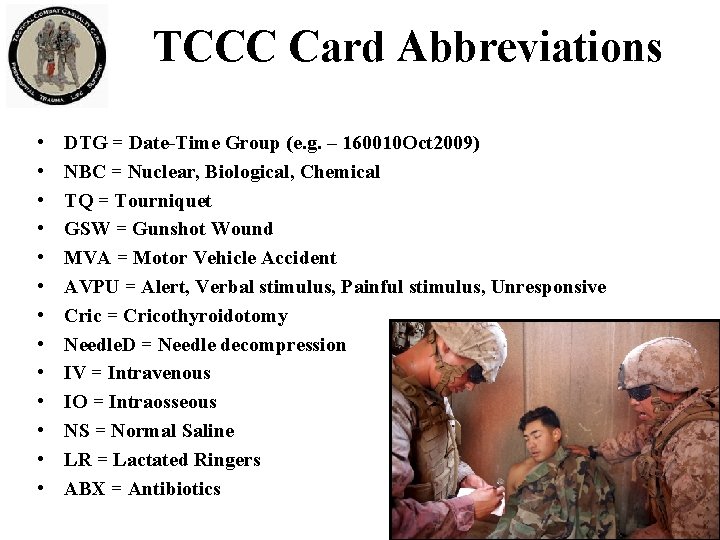
TCCC Card Abbreviations • • • • DTG = Date-Time Group (e. g. – 160010 Oct 2009) NBC = Nuclear, Biological, Chemical TQ = Tourniquet GSW = Gunshot Wound MVA = Motor Vehicle Accident AVPU = Alert, Verbal stimulus, Painful stimulus, Unresponsive Cric = Cricothyroidotomy Needle. D = Needle decompression IV = Intravenous IO = Intraosseous NS = Normal Saline LR = Lactated Ringers ABX = Antibiotics
TCCC After Action Report • This electronic AAR is intended to be completed when the first responder returns to base. • It is more complete than the TCCC Card. • It should be submitted to the Joint Theater Trauma System Director within 72 hours of casualty evacuation. • Both the TCCC Card and the TCCC AAR are required for optimal patient care documentation.
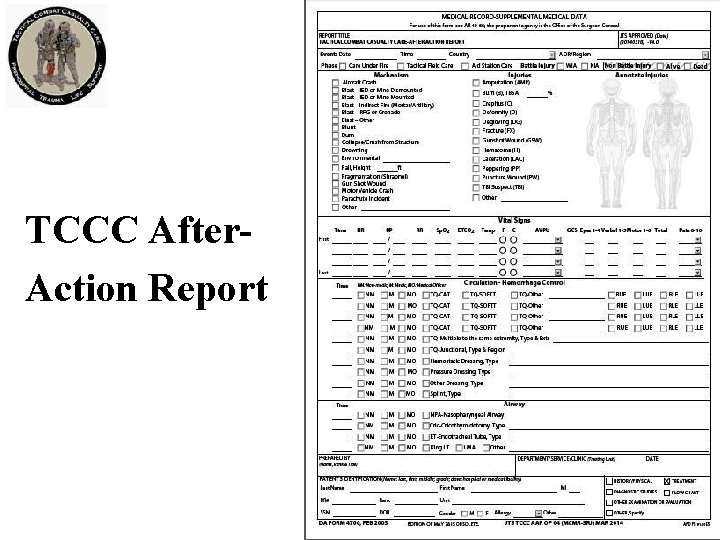
TCCC After. Action Report
Questions ? 17
- Slides: 17