
Tactical Combat Casualty Care for Medical Personnel August
Tactical Combat Casualty Care for Medical Personnel August 2017 (Based on TCCC-MP Guidelines 170131) Direct from the Battlefield: Tactical Combat Casualty Care Performance Improvement Items
Sources of TCCC Opportunities to Improve: • Reports from Joint Trauma System (JTS) weekly Trauma Telecons – every Thursday morning – Worldwide telecon to discuss every serious casualty admitted to a Role 3 hospital from that week • Published medical reports • Armed Forces Medical Examiner’s System • Theater AARs • Feedback from doctors, PAs, corpsmen, medics, and PJs

The Forgotten Tourniquet
The Forgotten Tourniquet • There was an adverse outcome from a tourniquet that was left in place for approximately 8 hours. • Be aggressive about putting tourniquets on in Care Under Fire for any life-threatening extremity hemorrhage BUT • Reassess the casualty in Tactical Field Care – remove it if it is not needed unless the casualty is in shock. • Always re-evaluate tourniquets at two hours and remove if possible.
Tourniquet Mistakes to Avoid! • Not using a tourniquet when you should • Using a tourniquet for minimal bleeding • Leaving the TQ too high--if placed "high and tight" during Care Under Fire, move to just above the wound during TFC • Not taking it off when indicated during TFC • Taking TQ off when the casualty is in shock or has only a short transport time to the hospital • Not making it tight enough – the tourniquet should both stop the bleeding and eliminate the distal pulse if the distal extremity is intact
Tourniquet Mistakes to Avoid! • Not using a second tourniquet if needed • Waiting too long to put the tourniquet on • Periodically loosening the tourniquet to allow blood flow to the injured extremity • Failing to reassess to make sure the bleeding is still stopped • Not attempting to convert a tourniquet if it has been on for two hours.
Opioid Analgesics for Casualties in Shock
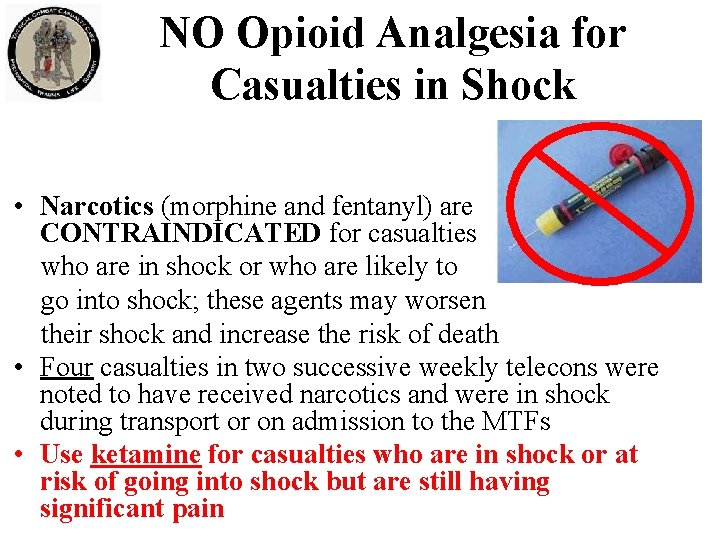
NO Opioid Analgesia for Casualties in Shock • Narcotics (morphine and fentanyl) are CONTRAINDICATED for casualties who are in shock or who are likely to go into shock; these agents may worsen their shock and increase the risk of death • Four casualties in two successive weekly telecons were noted to have received narcotics and were in shock during transport or on admission to the MTFs • Use ketamine for casualties who are in shock or at risk of going into shock but are still having significant pain
JTS Case Report 2017 • Casualty injured in a d. IED attack • CPR in progress on arrival at forward surgical capability • Multiple abdominal and pelvic injuries – Severe liver laceration (requiring packing) – Splenic laceration – Significant mesenteric bleeding – Left iliac vein injury – Pelvic fracture – Zone 1 REBOA placed with return of VS
JTS Case Report 2017 • Re-operated at Role 3 hospital several times • Stormy course but stabilized and was off pressor medications at time of transport • Private transport to a NATO partner hospital • On Precedex & ketamine at the Role 3, but changed to fentanyl and midazolam by the flight team • Casualty became hypotensive and was treated with escalating dose Levophed drip • Arrived at coalition partner hospital unstable • Died shortly thereafter of multi-organ failure
Untreated Pain on the Battlefield
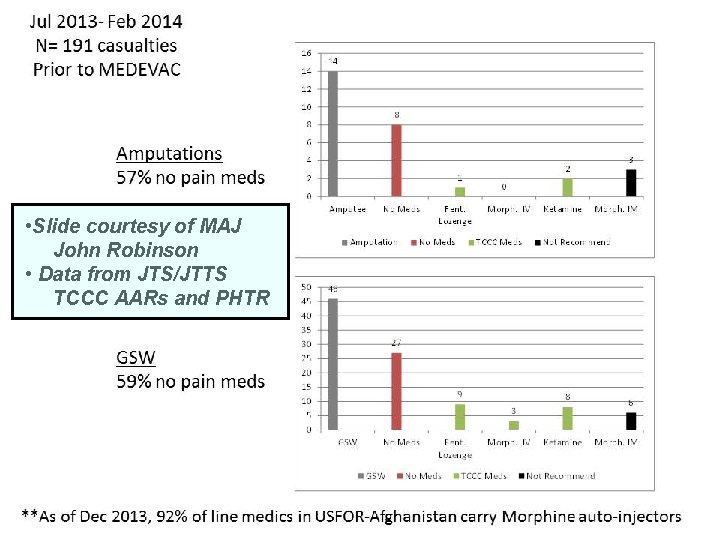
• Slide courtesy of MAJ John Robinson • Data from JTS/JTTS TCCC AARs and PHTR
Case Report • • • Male casualty with GSW to thigh Bleeding controlled by tourniquet In shock – alert but hypotensive Severe pain from tourniquet Repeated pleas to PA to remove the tourniquet PA did not want to use opioids because of the shock Perfect candidate for ketamine analgesia Ketamine not fielded at the time with this unit 50 mg ketamine autoinjectors would help - but approval from the FDA is needed to use ketamine in that mode
Opioid Analgesics Given in Combination with Benzodiazepines
Warning: Opioids and Benzos • Ketamine can safely be given after a fentanyl lozenge • Some practitioners use benzodiazepine medications such as midazolam to avoid ketamine side effects BUT • Midazolam may cause respiratory depression, especially when used with opioids • Avoid giving midazolam to casualties who have previously gotten fentanyl lozenges or morphine
Penetrating Eye Injuries
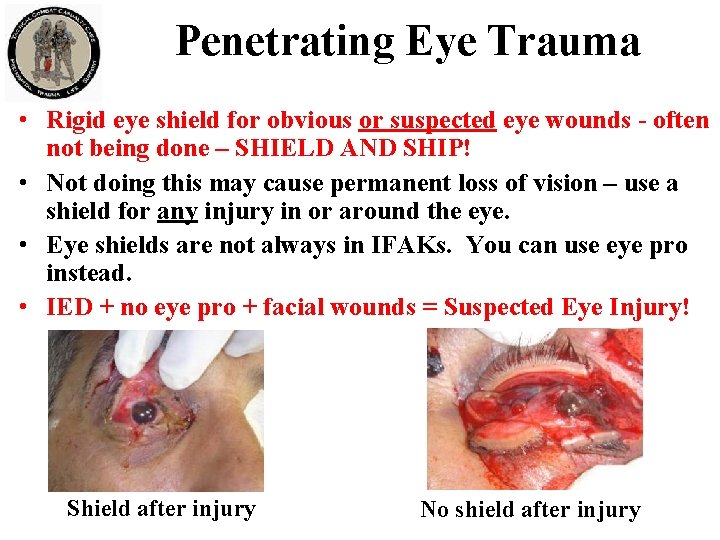
Penetrating Eye Trauma • Rigid eye shield for obvious or suspected eye wounds - often not being done – SHIELD AND SHIP! • Not doing this may cause permanent loss of vision – use a shield for any injury in or around the eye. • Eye shields are not always in IFAKs. You can use eye pro instead. • IED + no eye pro + facial wounds = Suspected Eye Injury! Shield after injury No shield after injury
Patched Open Globe • Shrapnel in right eye from IED • Had rigid eye shield placed • Reported as both pressure patched and as having a gauze pad placed under the eye shield without pressure • Extruded uveal tissue (intraocular contents) noted at time of operative repair of globe • Do not place gauze on injured eyes! COL Robb Mazzoli: Gauze can adhere to iris tissue and cause further extrusion when removed even if no pressure is applied to eye. • At least two other known occurrences of patching open globe injuries
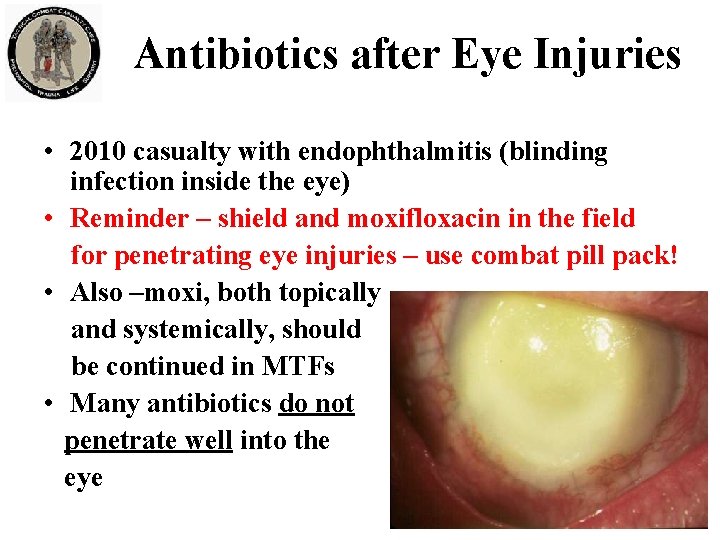
Antibiotics after Eye Injuries • 2010 casualty with endophthalmitis (blinding infection inside the eye) • Reminder – shield and moxifloxacin in the field for penetrating eye injuries – use combat pill pack! • Also –moxi, both topically and systemically, should be continued in MTFs • Many antibiotics do not penetrate well into the eye
Tension Pneumothorax
The Missed Tension Pneumothorax • One U. S. combat fatality in 2014 was found to have died with a tension pneumothorax • NO evidence of attempted needle decompression • Monitor anyone with torso trauma or polytrauma for respiratory distress – perform needle decompression when indicated • ALWAYS do bilateral NDC for a casualty with torso trauma who loses vital signs on the battlefield – this may be lifesaving

Combat Gauze
External Hemorrhage – No Combat Gauze • Casualty with gunshot wound in the left infraclavicular area with external hemorrhage • “Progressive deterioration” • External hemorrhage noted to increase as casualty resuscitated in ED • No record of Combat Gauze use • All injuries noted to be extrapleural • Lesson learned: see following slide
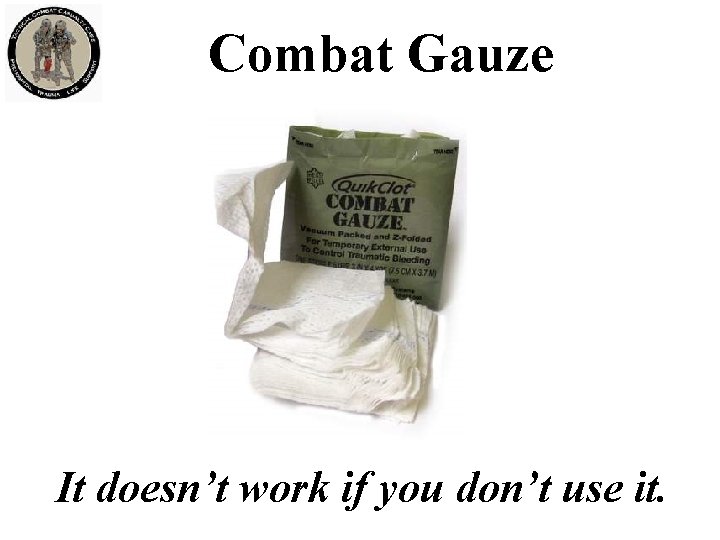
Combat Gauze It doesn’t work if you don’t use it.
Junctional Hemorrhage
Junctional Hemorrhage • A U. S. casualty in 2013 sustained a GSW to the inguinal area. • The CASEVAC platform did not have junctional tourniquets aboard. • The subsequent junctional hemorrhage was only partially controlled with Combat Gauze. • Casualty went into hemorrhagic shock and had to be transfused.
IED Blast Injury • 3 of 5 casualties had complex blast injuries. • All 3 had high traumatic LE amputations and reported difficulty with hemorrhage control despite tourniquet use. • Combat Gauze was reportedly not used. • All 3 would have been excellent candidates for a junctional tourniquet – none were fielded with this unit. • All 3 casualties required massive transfusions upon arrival at the Role 2 MTF.
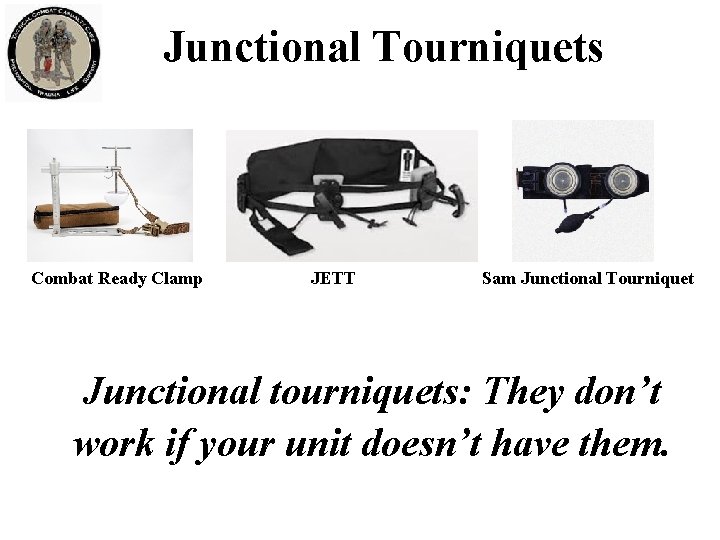
Junctional Tourniquets Combat Ready Clamp JETT Sam Junctional Tourniquet Junctional tourniquets: They don’t work if your unit doesn’t have them.
TCCC Training
Issues with Current TCCC Training • There is significant variation among TCCC courses, both military and commercial. • Some segments of the Do. D have had no TCCC training. • Some TCCC courses contain inappropriate training.
Problems with Non-Standard TCCC Courses • Incorrect messaging – Instructor drift • “Never take off a tourniquet in the field” • Inappropriate training • Vendor-supplied training is expensive
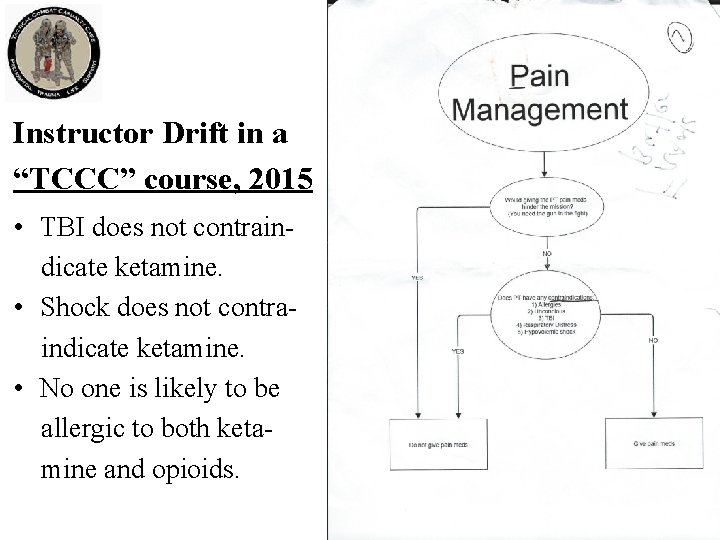
Instructor Drift in a “TCCC” course, 2015 • TBI does not contraindicate ketamine. • Shock does not contraindicate ketamine. • No one is likely to be allergic to both ketamine and opioids. 32
Inappropriate Training • “Shock labs” • “Cognition labs” • Insertion of intraosseous devices on course attendee volunteers • Regional nerve blocks by non-medical personnel • Central venous catheter placement by prehospital providers • Arterial blood draws
NAEMT TCCC Courses: Advantages • JTS recommends that TCCC should be a credential-producing training program for the MHS. • NAEMT TCCC courses and instructor courses follow the Co. TCCC-developed/JTS-approved curriculum without deviation. • NAEMT TCCC instructors undergo Quality Assurance evaluation. • The recommended TCCC training provided through the NAEMT educational system costs much less than equivalent training purchased from for-profit TCCC vendors.
NAEMT TCCC Courses: Advantages • The NAEMT system issues and tracks certification for instructors and students. – Cards and registries • The NAEMT system for establishing training sites is working very well for military commands using it. • NAEMT TCCC courses do not include live tissue training with its associated expense and logistic burden. • NAEMT TCCC courses are endorsed by the ACS-COT. • Additional training such as trauma lanes, field exercises, and live tissue training could be added to supplement the basic TCCC curriculum as unit time and resources allow.
TCCC Training for ALL combatants: Self and buddy aid should be part of the Warrior Culture in all combat units.
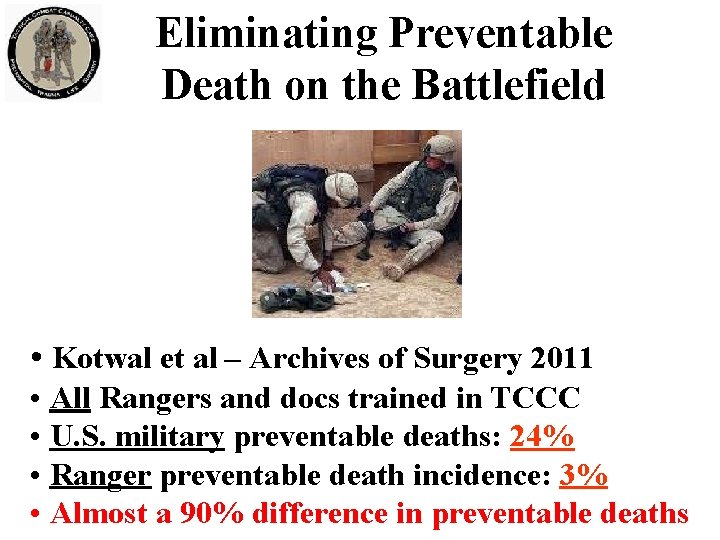
Eliminating Preventable Death on the Battlefield • Kotwal et al – Archives of Surgery 2011 • All Rangers and docs trained in TCCC • U. S. military preventable deaths: 24% • Ranger preventable death incidence: 3% • Almost a 90% difference in preventable deaths
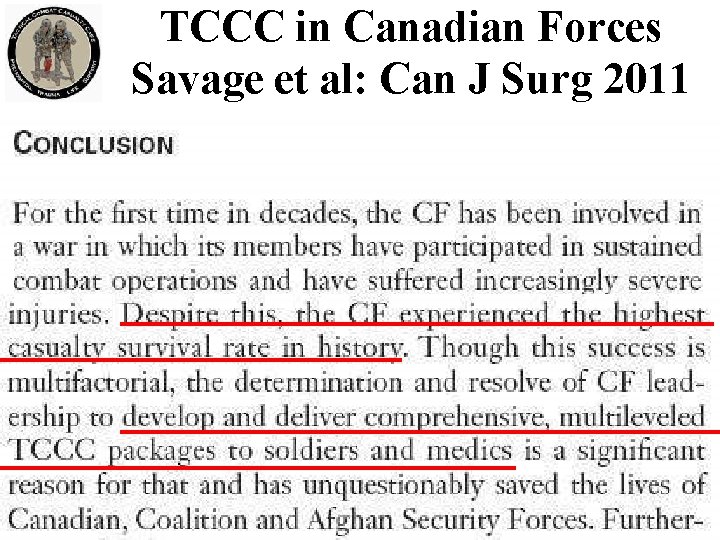
TCCC in Canadian Forces Savage et al: Can J Surg 2011
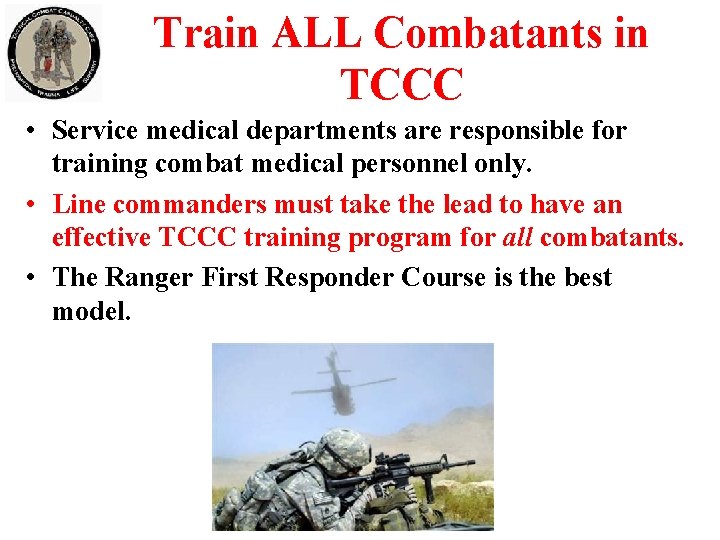
Train ALL Combatants in TCCC • Service medical departments are responsible for training combat medical personnel only. • Line commanders must take the lead to have an effective TCCC training program for all combatants. • The Ranger First Responder Course is the best model.
Documentation of TCCC Care
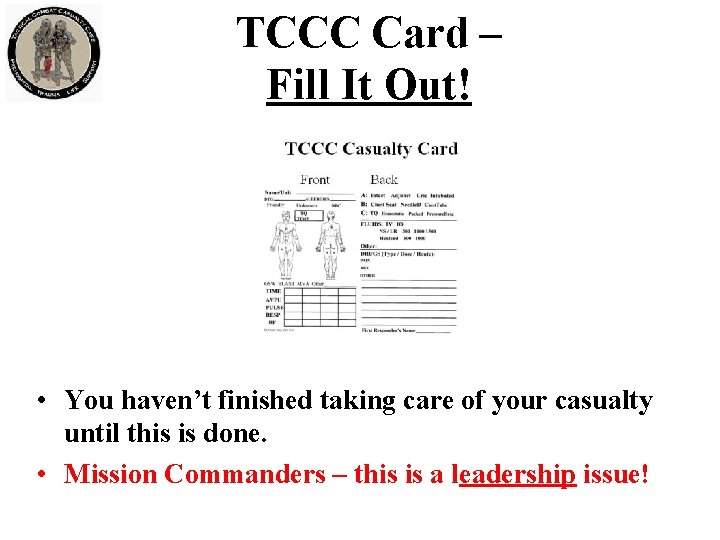
TCCC Card – Fill It Out! • You haven’t finished taking care of your casualty until this is done. • Mission Commanders – this is a leadership issue!
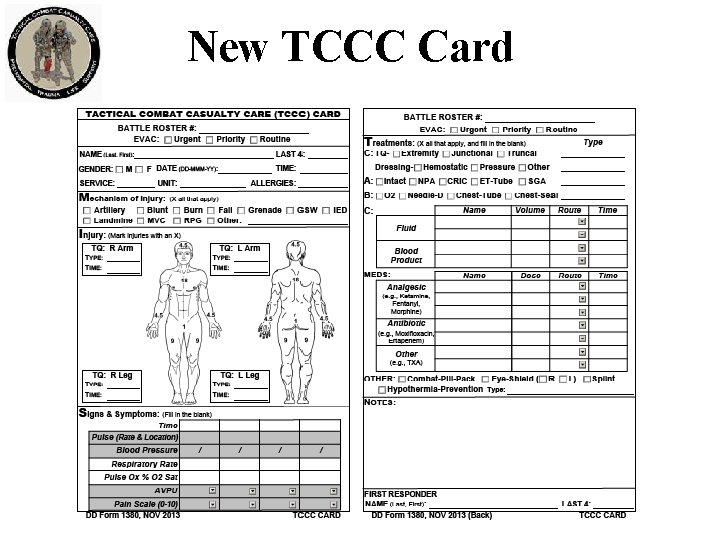
New TCCC Card
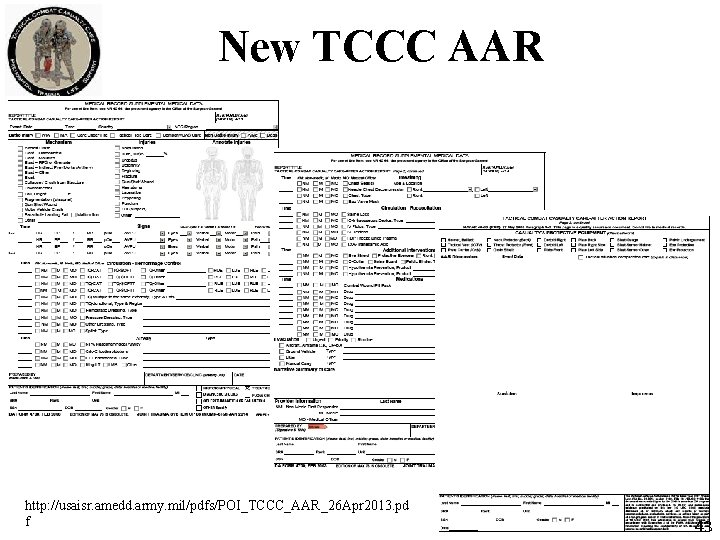
New TCCC AAR http: //usaisr. amedd. army. mil/pdfs/POI_TCCC_AAR_26 Apr 2013. pd f 43
Questions?
- Slides: 44