
Tackling Concurrent Enrollment as a Small Program Hosted

- Slides: 15
Tackling Concurrent Enrollment as a Small Program Hosted by Minnesota Concurrent Enrollment advancing quality college courses in h Partnerships (Mn. CEP)
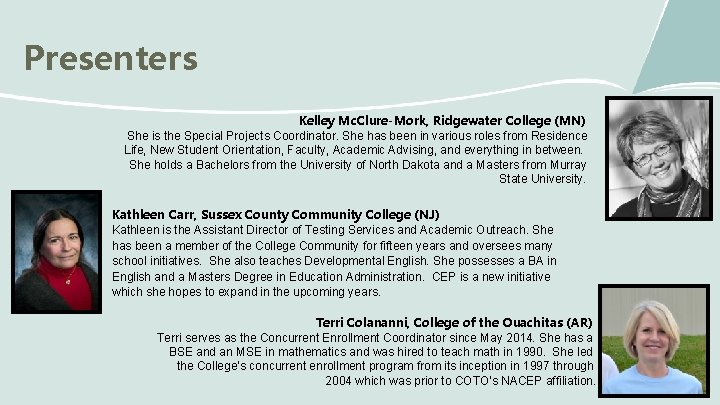
Presenters Kelley Mc. Clure-Mork, Ridgewater College (MN) She is the Special Projects Coordinator. She has been in various roles from Residence Life, New Student Orientation, Faculty, Academic Advising, and everything in between. She holds a Bachelors from the University of North Dakota and a Masters from Murray State University. Kathleen Carr, Sussex County Community College (NJ) Kathleen is the Assistant Director of Testing Services and Academic Outreach. She has been a member of the College Community for fifteen years and oversees many school initiatives. She also teaches Developmental English. She possesses a BA in English and a Masters Degree in Education Administration. CEP is a new initiative which she hopes to expand in the upcoming years. Terri Colananni, College of the Ouachitas (AR) Terri serves as the Concurrent Enrollment Coordinator since May 2014. She has a BSE and an MSE in mathematics and was hired to teach math in 1990. She led the College’s concurrent enrollment program from its inception in 1997 through 2004 which was prior to COTO’s NACEP affiliation.
Ridgewater College About the Program The numbers: • 8 high schools • 7 teachers (1 teacher works with 3 high schools)—we haven’t had a new HS teacher since 2014. • Subject areas include: Agriculture, Biology, English, Marketing & Sales Management, Nursing Assistant • High schools are throughout West Central Minnesota in rural districts • 117 unduplicated headcount Program started in 2006 offering one course—English Comp I Accredited by NACEP in May 2013. At time of application: 3 teachers at 2 high schools.
Ridgewater College Challenges Small isn’t a challenge…. a huge advantage. Frustrations? Of course! They’re the same challenges that other schools in the state of Minnesota face regardless of size and location.
Ridgewater College Tips and Tricks • Being small allows you to have personable customer service to parents & high schools • Find a way to document/track other than a spread sheet • Implement the 17 standards for accreditation from day 1. Just because you’re small doesn’t mean you can’t be accredited.
Ridgewater College How do we do… Professional Development: • Joint professional development day that includes 1: 1 time with their mentor for the discipline specific requirement. • Certificate of Participation • We do not provide stipends or mileage reimbursement, but we do offer lunch! Training/Orientation • Two tier approach—part 1 is online, part 2 is with mentor Registrations • I work with high schools to collect applications/transcripts/test scores • They send to me and I double check them before sending them over to registration.
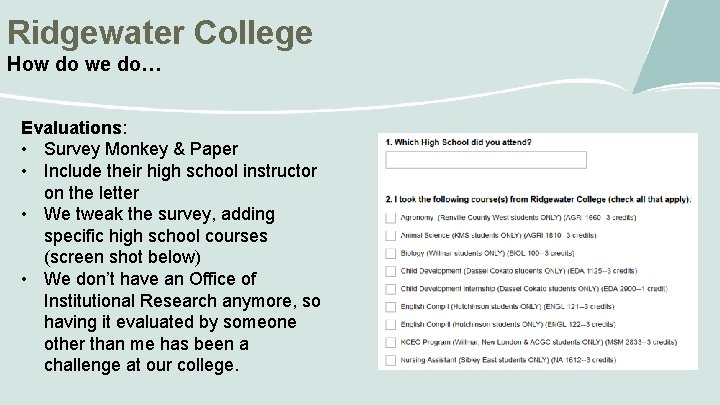
Ridgewater College How do we do… Evaluations: • Survey Monkey & Paper • Include their high school instructor on the letter • We tweak the survey, adding specific high school courses (screen shot below) • We don’t have an Office of Institutional Research anymore, so having it evaluated by someone other than me has been a challenge at our college.
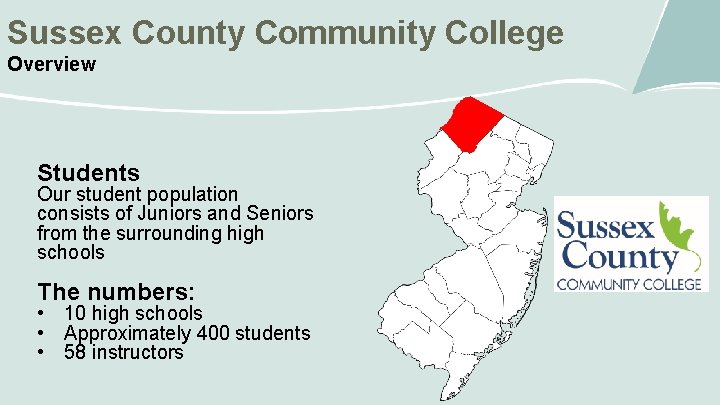
Sussex County Community College Overview Students Our student population consists of Juniors and Seniors from the surrounding high schools The numbers: • 10 high schools • Approximately 400 students • 58 instructors
Sussex County Community College Changes and Challenges Biggest Challenge: • Declining enrollment in the county’s high schools Changes to meet challenges: • Good outreach practices and additional courses have increased enrollment numbers. • Additional courses such as Agriculture, Welding, Cosmetology and Automotive make our program more attractive to all students
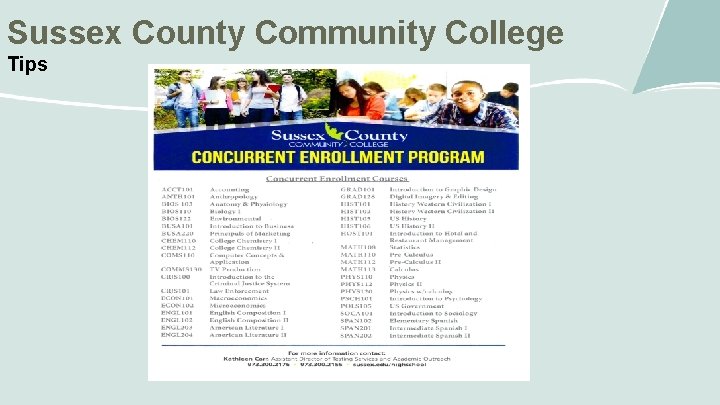
Sussex County Community College Tips
College of the Ouachitas About Us… Origin: From 1997 to now… The numbers: • • 7 High Schools 240 Students 12 CE Instructors 4 COTO Faculty Liaisons
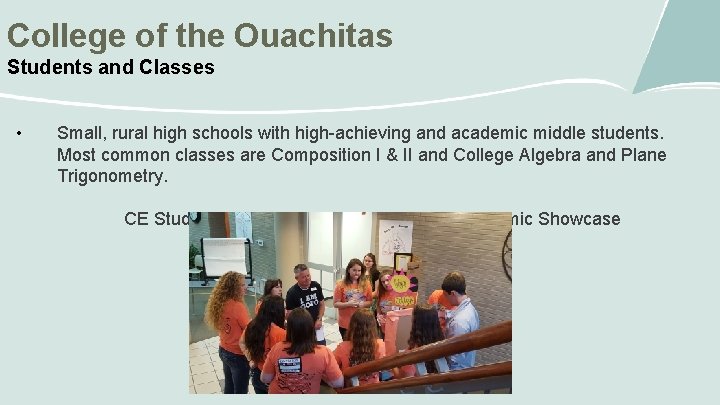
College of the Ouachitas Students and Classes • Small, rural high schools with high-achieving and academic middle students. Most common classes are Composition I & II and College Algebra and Plane Trigonometry. CE Students presenting at COTO’s 2016 Academic Showcase
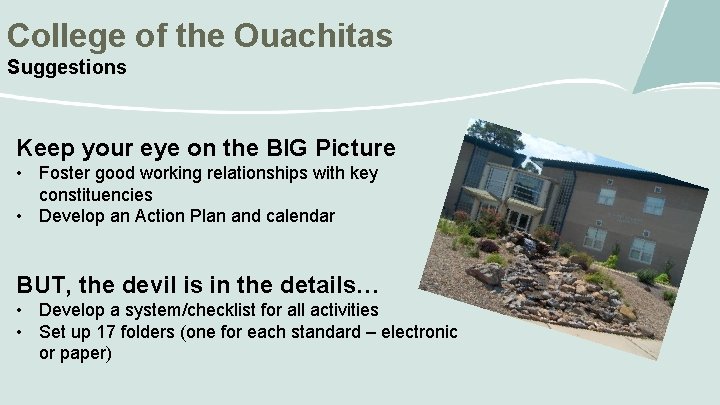
College of the Ouachitas Suggestions Keep your eye on the BIG Picture • Foster good working relationships with key constituencies • Develop an Action Plan and calendar BUT, the devil is in the details… • Develop a system/checklist for all activities • Set up 17 folders (one for each standard – electronic or paper)
College of the Ouachitas How we do it… All of COTO’s high schools are within a 30 -mile radius of the College. • • Orientation – New CEP Instructors come to campus and meet with the CE Coordinator and their Faculty Liaison. Professional Development – All CEP Instructors are expected to attend an annual dinner that includes a three hours discipline-specific breakout session. ($50 stipend) Evaluations – Faculty Liaisons, who receive a small stipend to serve, conduct student evaluations during their site visits or the CE Coordinator does it. Registration – Part-time Student Affairs Counselor travels to high schools for placement testing and registration as needed.
Future NACEP Events: October 4 th- Perkins in Practice: What is working (and not) in CTE-focused concurrent enrollment October 16 -18 th- NACEP National Conference November 29 th: Standards 101 Webinar