
Tables and Priority Queues Initially prepared by Dr
Tables and Priority Queues Initially prepared by Dr. İlyas Çiçekli; improved by various Bilkent CS 202 instructors. Spring 2018 CS 202 - Fundamental Structures of Computer Science II 1

Tables • Appropriate for problems that must manage data by value. • Some important operations of tables: An ordinary table of cities – Inserting a data item containing the value x. – Delete a data item containing the value x. – Retrieve a data item containing the value x. • Various table implementations are possible. – We have to analyze the possible implementations so that we can make an intelligent choice. • Some operations are implemented more in certain implementations. Spring 2017 CS 202 - Fundamental Structures of Computer Science II efficiently 2

Table Operations • Some of the table operations are possible: - Create an empty table Destroy a table Determine whether a table is empty Determine the number of items in the table Insert a new item into a table Delete the item with a given search key Retrieve the item with a given search key Traverse the table • The client may need a subset of these operations or require more • Are keys in the table are unique? – We will assume that keys in our tables are unique. – But, some other tables allow duplicate keys. Spring 2017 CS 202 - Fundamental Structures of Computer Science II 3
Selecting an Implementation • Since an array or a linked list represents items one after another, these implementations are called linear. • There are four categories of linear implementations: – – Unsorted, array based (an unsorted array) Unsorted, pointer based (a simple linked list) Sorted (by search key), array based (a sorted array) Sorted (by search key), pointer based (a sorted linked list). • We have also nonlinear implementations such as binary search trees. – Binary search tree implementation offers several advantages over linear implementations. Spring 2017 CS 202 - Fundamental Structures of Computer Science II 4

Sorted Linear Implementations Array-based implementation Pointer-based implementation Spring 2017 CS 202 - Fundamental Structures of Computer Science II 5
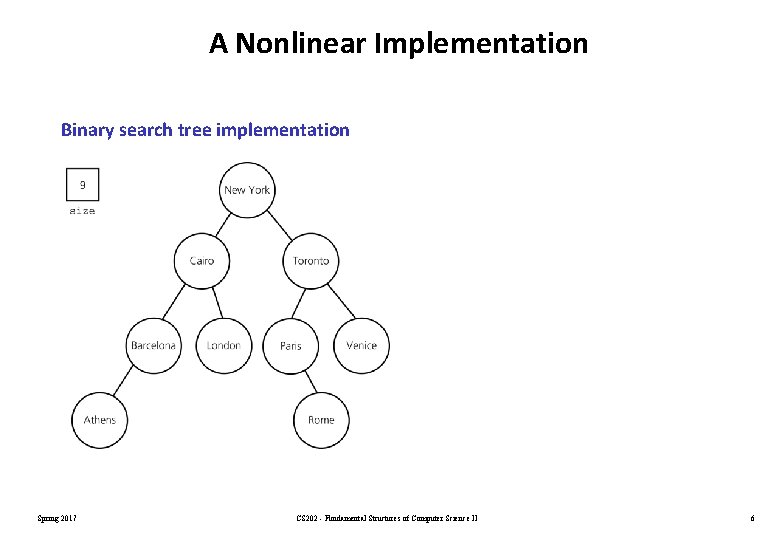
A Nonlinear Implementation Binary search tree implementation Spring 2017 CS 202 - Fundamental Structures of Computer Science II 6
Which Implementation? • It depends on our application. • Answer the following questions before selecting an implementation. 1. What operations are needed? • Our application may not need all operations. • Some operations can be implemented more efficiently in one implementation, and some others in another implementation. 2. How often is each operation required? • Some applications may require many occurrences of an operation, but other applications may not. – For example, some applications may perform many retrievals, but not so many insertions and deletions. On the other hand, other applications may perform many insertions and deletions. Spring 2017 CS 202 - Fundamental Structures of Computer Science II 7
How to Select an Implementation – Scenario A • Scenario A: Let us assume that we have an application: – Inserts data items into a table. – After all data items are inserted, traverses this table in no particular order. – Does not perform any retrieval and deletion operations. • Which implementation is appropriate for this application? – Keeping the items in a sorted order provides no advantage for this application. • In fact, it will be more costly for this application. Unsorted implementation is more appropriate. Spring 2017 CS 202 - Fundamental Structures of Computer Science II 8
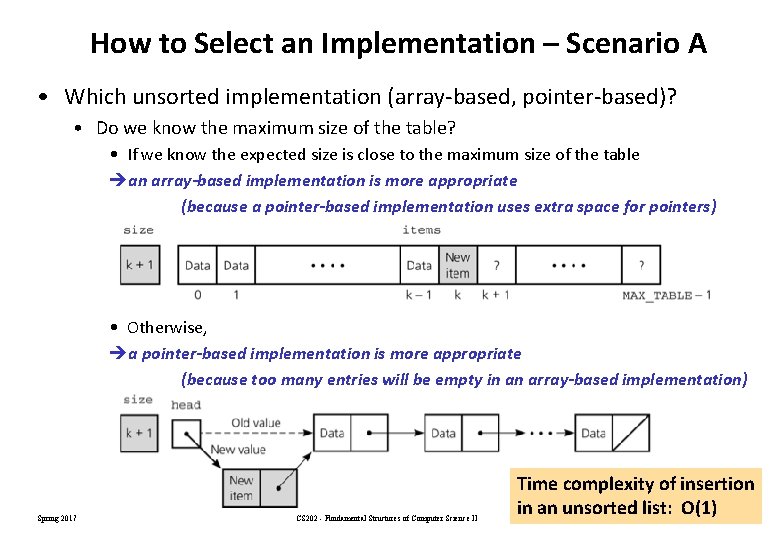
How to Select an Implementation – Scenario A • Which unsorted implementation (array-based, pointer-based)? • Do we know the maximum size of the table? • If we know the expected size is close to the maximum size of the table an array-based implementation is more appropriate (because a pointer-based implementation uses extra space for pointers) • Otherwise, a pointer-based implementation is more appropriate (because too many entries will be empty in an array-based implementation) Spring 2017 CS 202 - Fundamental Structures of Computer Science II Time complexity of insertion in an unsorted list: O(1) 9
How to Select an Implementation – Scenario B • Scenario B: Let us assume that we have an application: – Performs many retrievals, but few insertions and deletions • E. g. , a thesaurus (to look up synonyms of a word) • For this application, a sorted implementation is more appropriate – We can use binary search to access data, if we have sorted data. – A sorted linked-list implementation is not appropriate since binary search is not practical with linked lists. • If we know the maximum size of the table a sorted array-based implementation is more appropriate for frequent retrievals. • Otherwise a binary search tree implementation is more appropriate for frequent retrievals. (in fact, balanced binary search trees will be used) Spring 2017 CS 202 - Fundamental Structures of Computer Science II 10
How to Select an Implementation – Scenario C • Scenario C: Let us assume that we have an application: – Performs many retrievals as well as many insertions and deletions. ? Sorted Array Implementation • Retrievals are efficient. • But insertions and deletions are not efficient. a sorted array-based implementation is not appropriate for this application. ? Sorted Linked List Implementation • Retrievals, insertions, and deletions are not efficient. a sorted linked-list implementation is not appropriate for this application. ? Binary Search Tree Implementation • Retrieval, insertion, and deletion are efficient in the average case. a binary search tree implementation is appropriate for this application. (provided that the height of the BST is O(logn)) Spring 2017 CS 202 - Fundamental Structures of Computer Science II 11
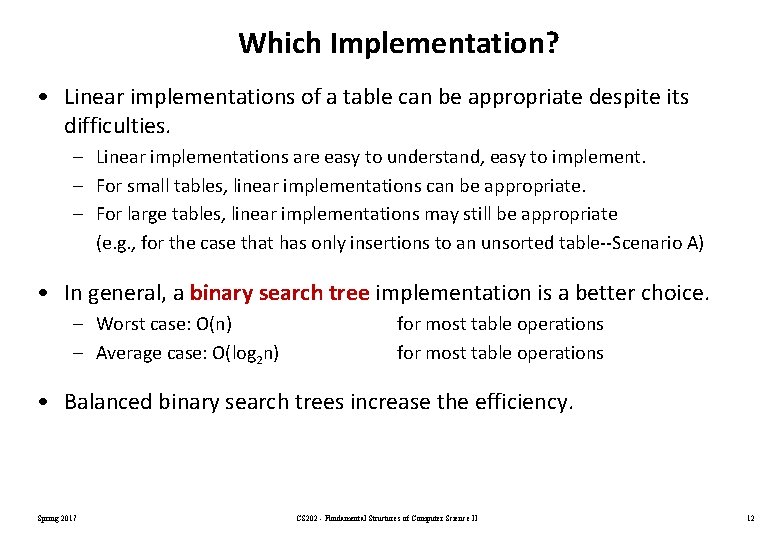
Which Implementation? • Linear implementations of a table can be appropriate despite its difficulties. – Linear implementations are easy to understand, easy to implement. – For small tables, linear implementations can be appropriate. – For large tables, linear implementations may still be appropriate (e. g. , for the case that has only insertions to an unsorted table--Scenario A) • In general, a binary search tree implementation is a better choice. – Worst case: O(n) – Average case: O(log 2 n) for most table operations • Balanced binary search trees increase the efficiency. Spring 2017 CS 202 - Fundamental Structures of Computer Science II 12
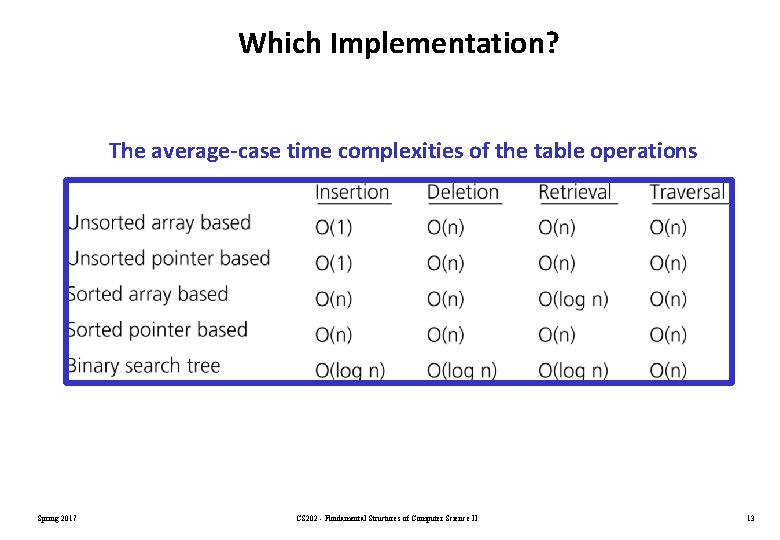
Which Implementation? The average-case time complexities of the table operations Spring 2017 CS 202 - Fundamental Structures of Computer Science II 13
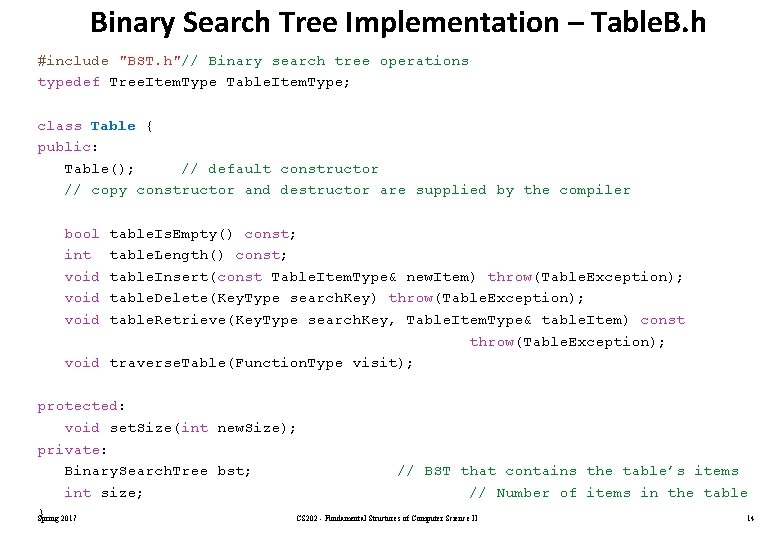
Binary Search Tree Implementation – Table. B. h #include "BST. h"// Binary search tree operations typedef Tree. Item. Type Table. Item. Type; class Table { public: Table(); // default constructor // copy constructor and destructor are supplied by the compiler bool int void table. Is. Empty() const; table. Length() const; table. Insert(const Table. Item. Type& new. Item) throw(Table. Exception); table. Delete(Key. Type search. Key) throw(Table. Exception); table. Retrieve(Key. Type search. Key, Table. Item. Type& table. Item) const throw(Table. Exception); void traverse. Table(Function. Type visit); protected: void set. Size(int new. Size); private: Binary. Search. Tree bst; // BST that contains the table’s items int size; // Number of items in the table } 2017 Spring CS 202 - Fundamental Structures of Computer Science II 14
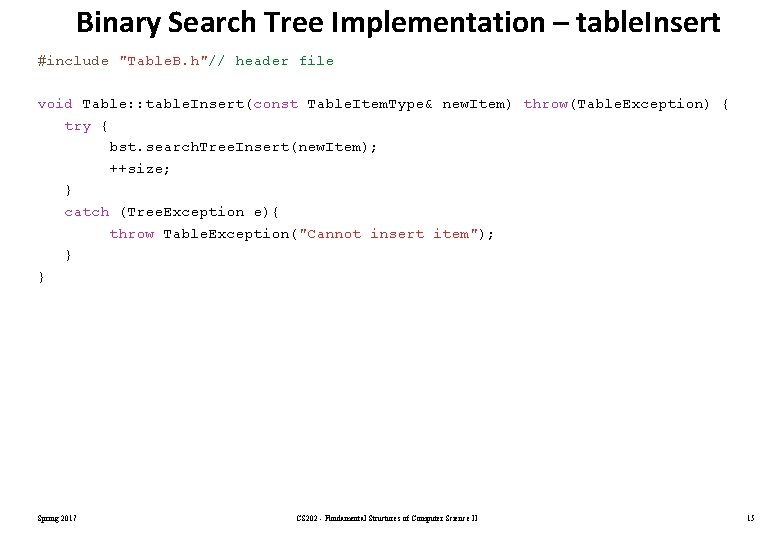
Binary Search Tree Implementation – table. Insert #include "Table. B. h"// header file void Table: : table. Insert(const Table. Item. Type& new. Item) throw(Table. Exception) { try { bst. search. Tree. Insert(new. Item); ++size; } catch (Tree. Exception e){ throw Table. Exception("Cannot insert item"); } } Spring 2017 CS 202 - Fundamental Structures of Computer Science II 15
The Priority Queue Priority queue is a variation of the table. • Each data item in a priority queue has a priority value. • Using a priority queue we prioritize a list of tasks: – Job scheduling Major operations: • Insert an item with a priority value into its proper position in the priority queue. • Deletion is not the same as the deletion in the table. We delete the item with the highest priority. Spring 2017 CS 202 - Fundamental Structures of Computer Science II 16
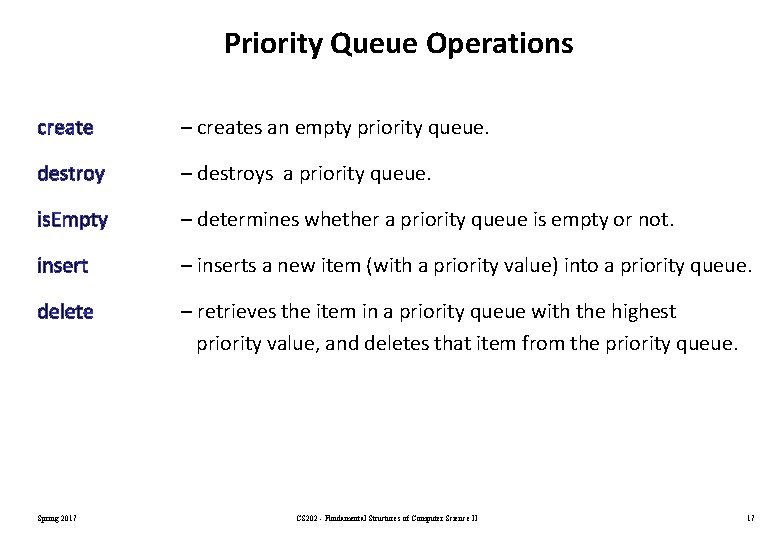
Priority Queue Operations create – creates an empty priority queue. destroy – destroys a priority queue. is. Empty – determines whether a priority queue is empty or not. insert – inserts a new item (with a priority value) into a priority queue. delete – retrieves the item in a priority queue with the highest priority value, and deletes that item from the priority queue. Spring 2017 CS 202 - Fundamental Structures of Computer Science II 17
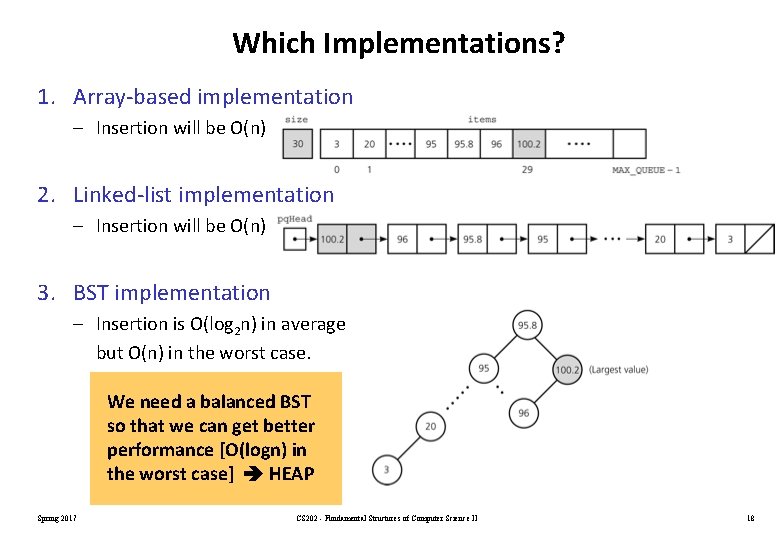
Which Implementations? 1. Array-based implementation – Insertion will be O(n) 2. Linked-list implementation – Insertion will be O(n) 3. BST implementation – Insertion is O(log 2 n) in average but O(n) in the worst case. We need a balanced BST so that we can get better performance [O(logn) in the worst case] HEAP Spring 2017 CS 202 - Fundamental Structures of Computer Science II 18
Heaps Definition: A heap is a complete binary tree such that – It is empty, or – Its root contains a search key greater than or equal to the search key in each of its children, and each of its children is also a heap. • Since the root contains the item with the largest search key, heap in this definition is also known as maxheap. • On the other hand, a heap which places the smallest search key in its root is know as minheap. • We will talk about maxheap as heap in the rest of our discussions. Spring 2017 CS 202 - Fundamental Structures of Computer Science II 19
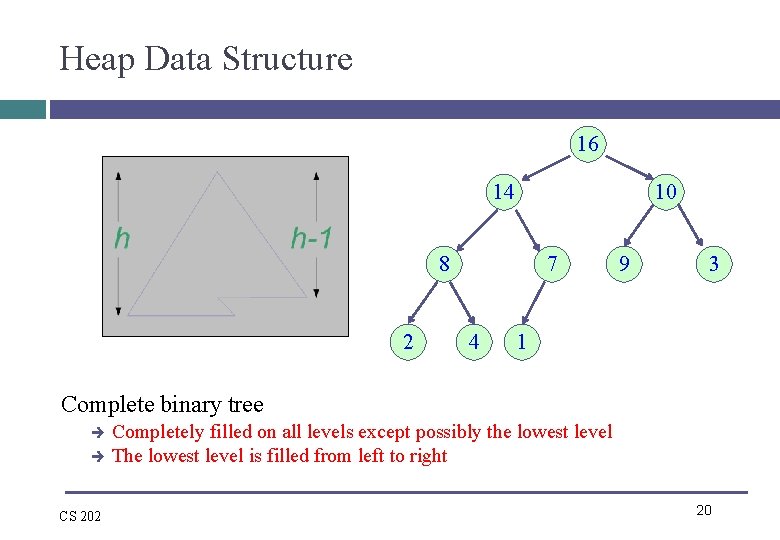
Heap Data Structure 16 14 10 8 2 7 4 9 3 1 Complete binary tree CS 202 Completely filled on all levels except possibly the lowest level The lowest level is filled from left to right 20
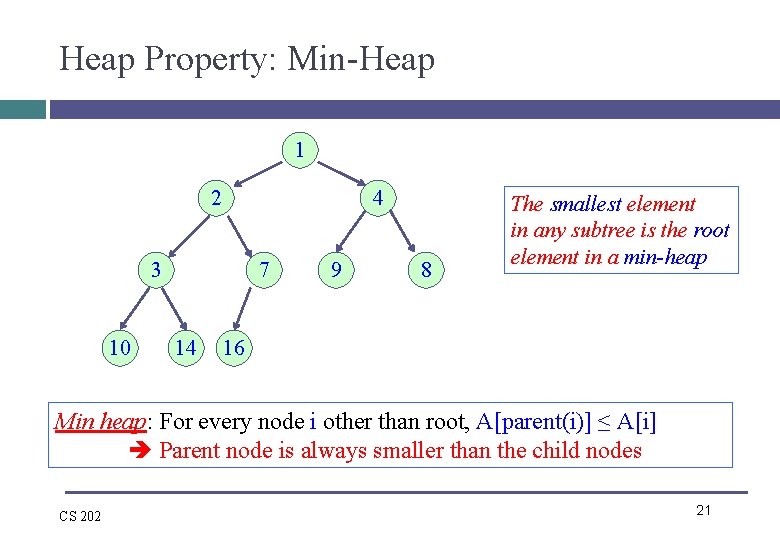
Heap Property: Min-Heap 1 2 4 3 10 7 14 9 8 The smallest element in any subtree is the root element in a min-heap 16 Min heap: For every node i other than root, A[parent(i)] ≤ A[i] Parent node is always smaller than the child nodes CS 202 21
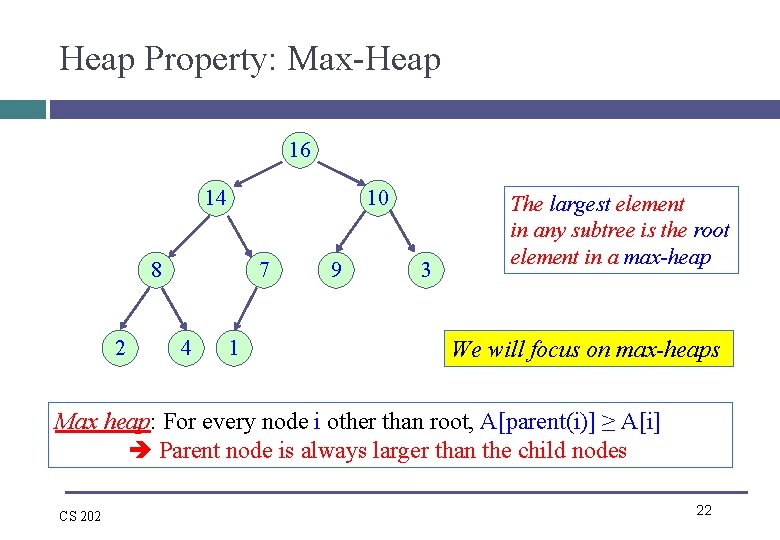
Heap Property: Max-Heap 16 14 10 8 2 7 4 1 9 3 The largest element in any subtree is the root element in a max-heap We will focus on max-heaps Max heap: For every node i other than root, A[parent(i)] ≥ A[i] Parent node is always larger than the child nodes CS 202 22
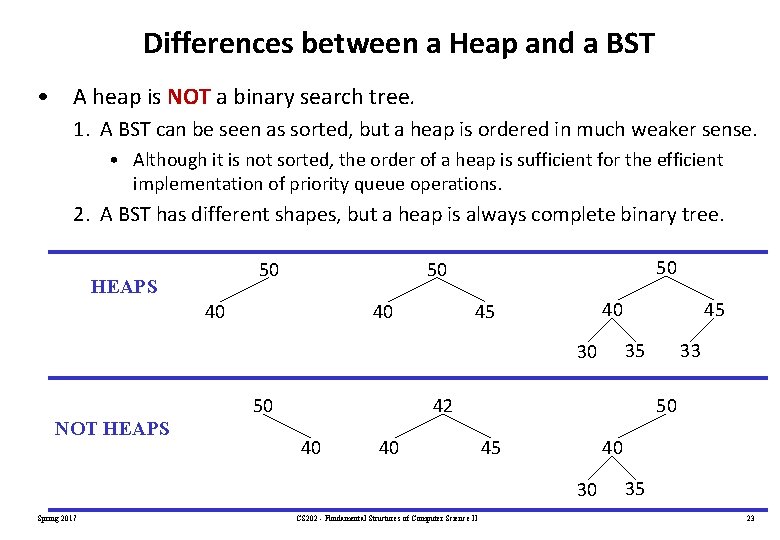
Differences between a Heap and a BST • A heap is NOT a binary search tree. 1. A BST can be seen as sorted, but a heap is ordered in much weaker sense. • Although it is not sorted, the order of a heap is sufficient for the efficient implementation of priority queue operations. 2. A BST has different shapes, but a heap is always complete binary tree. 50 HEAPS 50 50 40 45 35 30 NOT HEAPS 50 42 40 40 CS 202 - Fundamental Structures of Computer Science II 33 50 45 40 30 Spring 2017 45 35 23
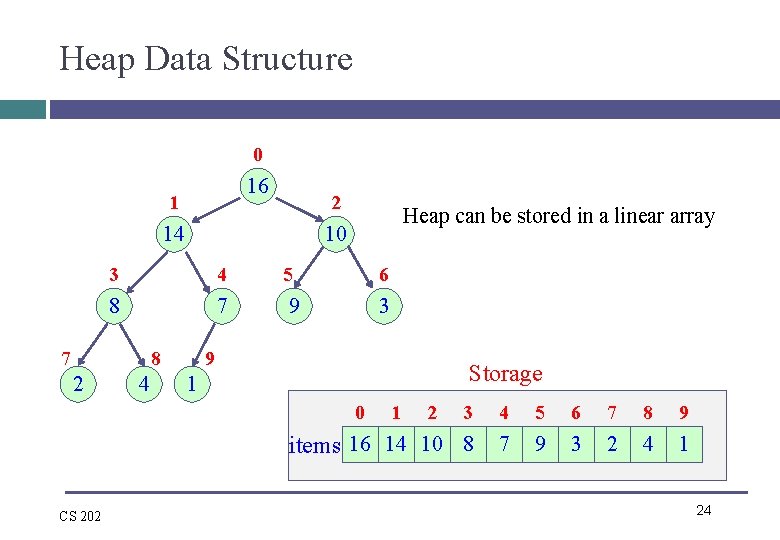
Heap Data Structure 0 16 1 2 14 10 3 4 5 6 8 7 9 3 7 8 2 Heap can be stored in a linear array 4 9 Storage 1 0 CS 202 1 2 3 4 5 6 7 8 9 items 16 14 10 8 7 9 3 2 4 1 24
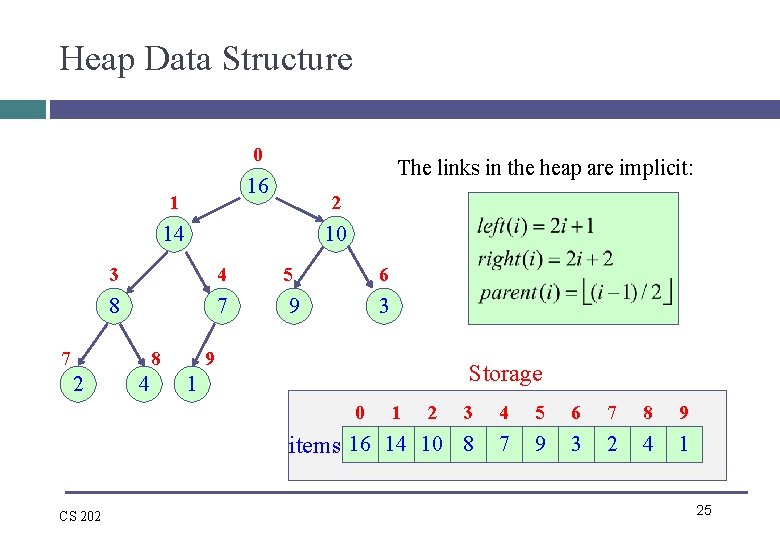
Heap Data Structure 0 The links in the heap are implicit: 16 1 2 14 10 3 4 5 6 8 7 9 3 7 8 2 4 9 Storage 1 0 CS 202 1 2 3 4 5 6 7 8 9 items 16 14 10 8 7 9 3 2 4 1 25
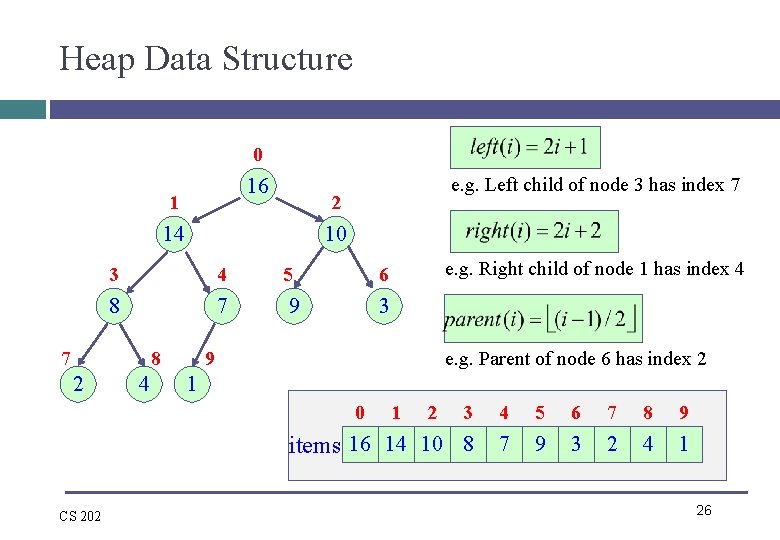
Heap Data Structure 0 16 1 2 14 10 3 4 5 6 8 7 9 3 7 8 2 e. g. Left child of node 3 has index 7 4 9 e. g. Parent of node 6 has index 2 1 0 CS 202 e. g. Right child of node 1 has index 4 1 2 3 4 5 6 7 8 9 items 16 14 10 8 7 9 3 2 4 1 26
![Heap Data Structure items[0] is always the root element Array items has two attributes:](http://slidetodoc.com/presentation_image_h2/db1ba6c2e90a19a1d27f0bf554058a1c/image-27.jpg "Heap Data Structure items[0] is always the root element Array items has two attributes:")
Heap Data Structure items[0] is always the root element Array items has two attributes: � � MAX_SIZE: Size of the memory allocated for array items size: The number elements in heap at a given time size ≤ MAX_SIZE CS 202 27
Major Heap Operations • Two major heap operations are insertion and deletion. Insertion – Inserts a new item into a heap. – After the insertion, the heap must satisfy the heap properties. Deletion – Retrieves and deletes the root of the heap. – After the deletion, the heap must satisfy the heap properties. Spring 2017 CS 202 - Fundamental Structures of Computer Science II 28
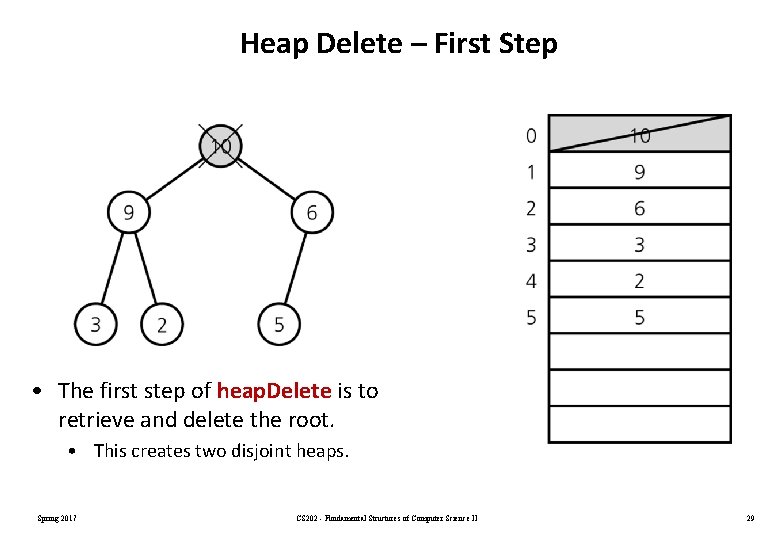
Heap Delete – First Step • The first step of heap. Delete is to retrieve and delete the root. • This creates two disjoint heaps. Spring 2017 CS 202 - Fundamental Structures of Computer Science II 29
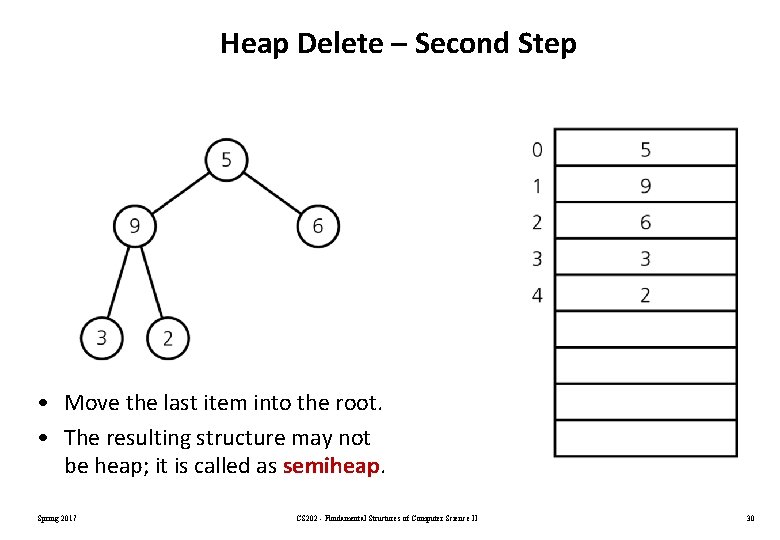
Heap Delete – Second Step • Move the last item into the root. • The resulting structure may not be heap; it is called as semiheap. Spring 2017 CS 202 - Fundamental Structures of Computer Science II 30
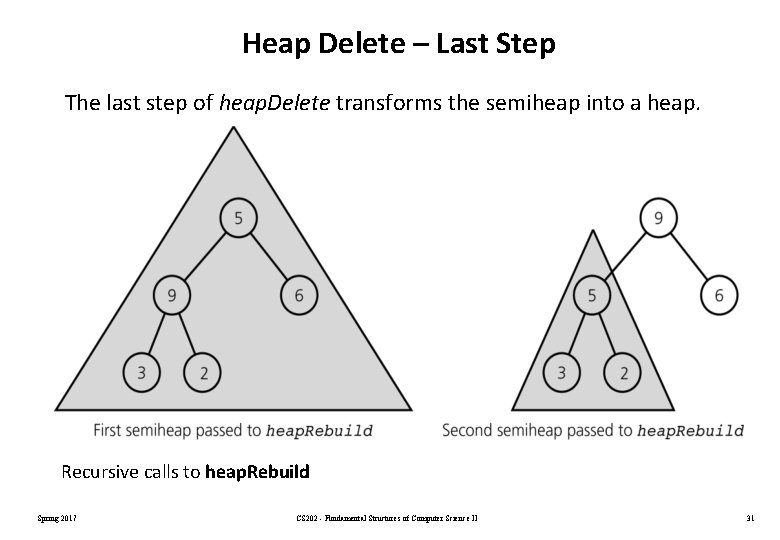
Heap Delete – Last Step The last step of heap. Delete transforms the semiheap into a heap. Recursive calls to heap. Rebuild Spring 2017 CS 202 - Fundamental Structures of Computer Science II 31
![Heap Delete max= heap. Delete (items, size) max items[0] items[size-1] size 1 heap. Rebuild(items,](http://slidetodoc.com/presentation_image_h2/db1ba6c2e90a19a1d27f0bf554058a1c/image-32.jpg "Heap Delete max= heap. Delete (items, size) max items[0] items[size-1] size 1 heap. Rebuild(items,")
Heap Delete max= heap. Delete (items, size) max items[0] items[size-1] size 1 heap. Rebuild(items, 0, size) return max 0 16 1 2 14 10 3 4 5 6 8 7 9 3 7 8 2 4 9 1 Return the max element, and reorganize the heap to maintain heap property CS 202 32
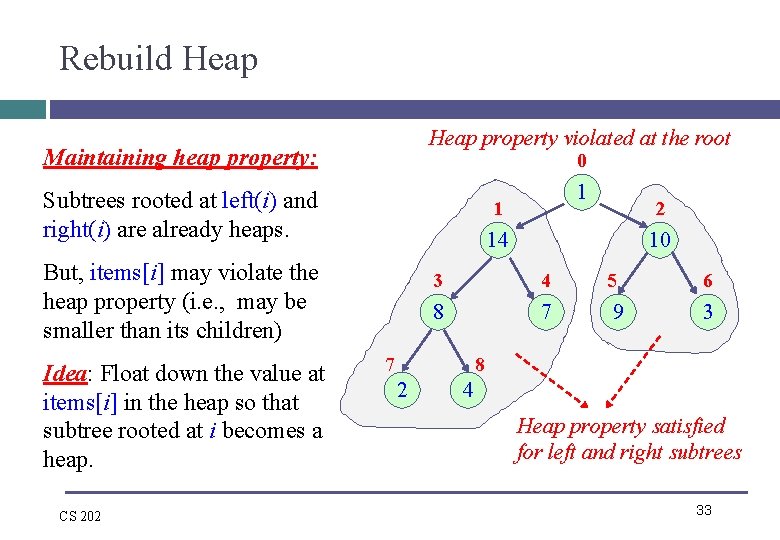
Rebuild Heap property violated at the root Maintaining heap property: 0 Subtrees rooted at left(i) and right(i) are already heaps. 1 CS 202 2 14 But, items[i] may violate the heap property (i. e. , may be smaller than its children) Idea: Float down the value at items[i] in the heap so that subtree rooted at i becomes a heap. 1 10 3 4 5 6 8 7 9 3 7 8 2 4 Heap property satisfied for left and right subtrees 33
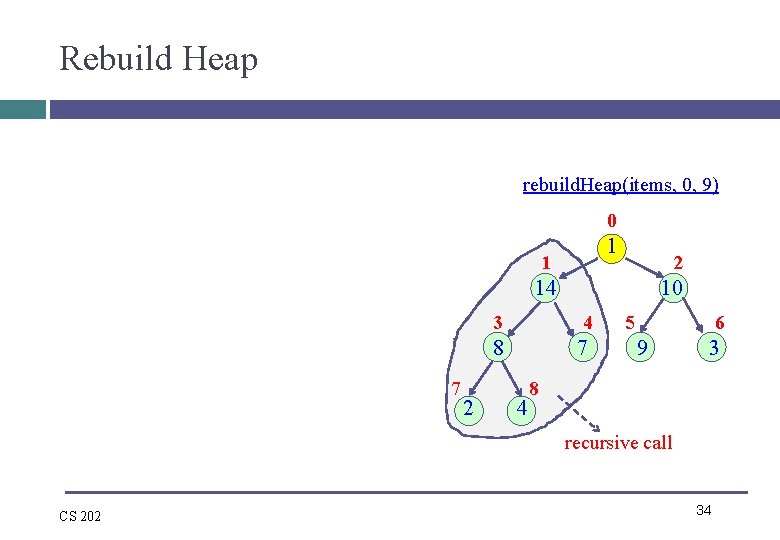
Rebuild Heap rebuild. Heap(items, 0, 9) 0 1 1 2 14 7 2 10 3 4 8 7 4 5 6 9 3 8 recursive call CS 202 34
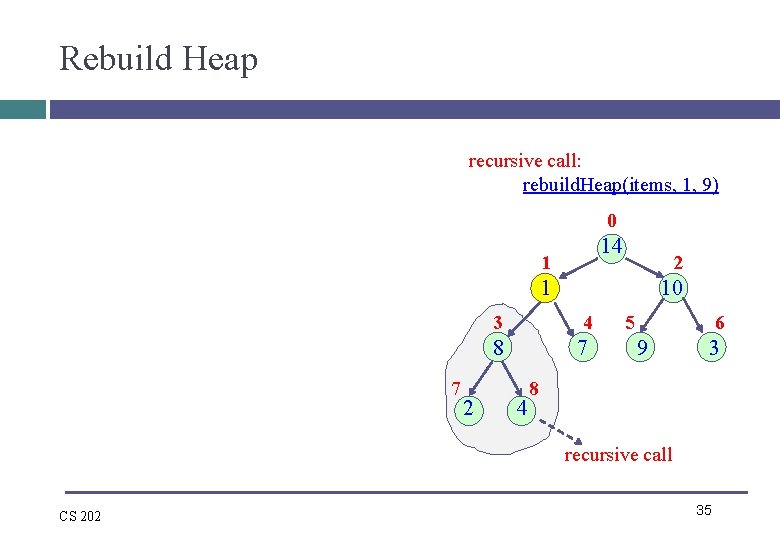
Rebuild Heap recursive call: rebuild. Heap(items, 1, 9) 0 14 1 2 1 7 2 10 3 4 8 7 4 5 6 9 3 8 recursive call CS 202 35
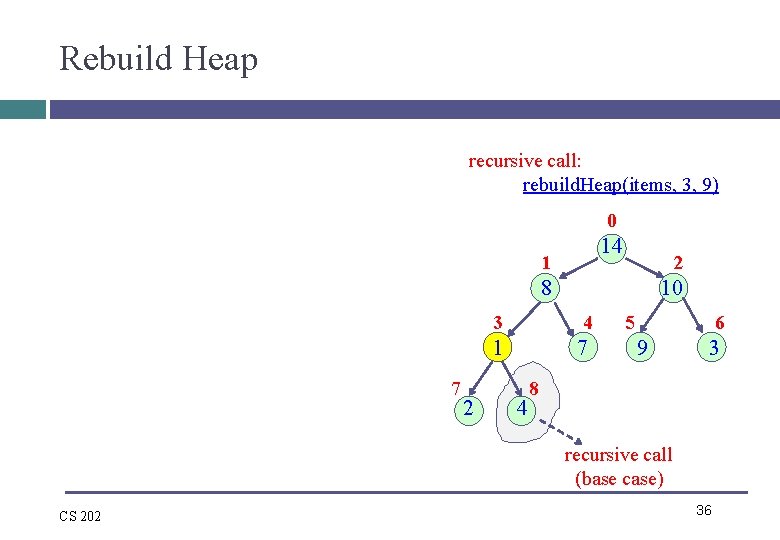
Rebuild Heap recursive call: rebuild. Heap(items, 3, 9) 0 14 1 2 8 7 2 10 3 4 1 7 4 5 6 9 3 8 recursive call (base case) CS 202 36
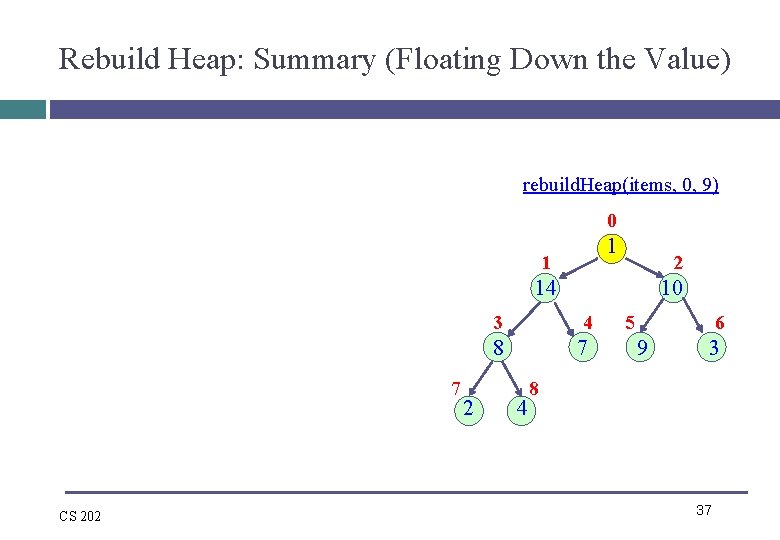
Rebuild Heap: Summary (Floating Down the Value) rebuild. Heap(items, 0, 9) 0 1 1 2 14 7 CS 202 2 10 3 4 8 7 4 5 6 9 3 8 37
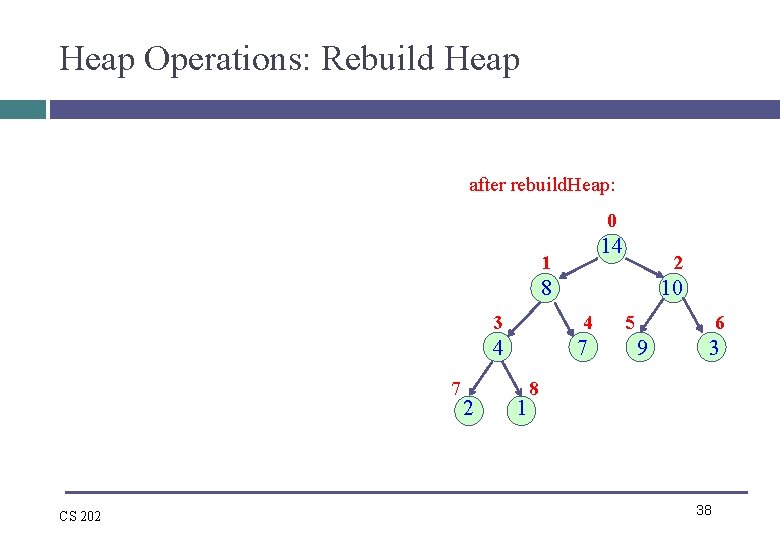
Heap Operations: Rebuild Heap after rebuild. Heap: 0 14 1 2 8 7 CS 202 2 10 3 4 4 7 1 5 6 9 3 8 38
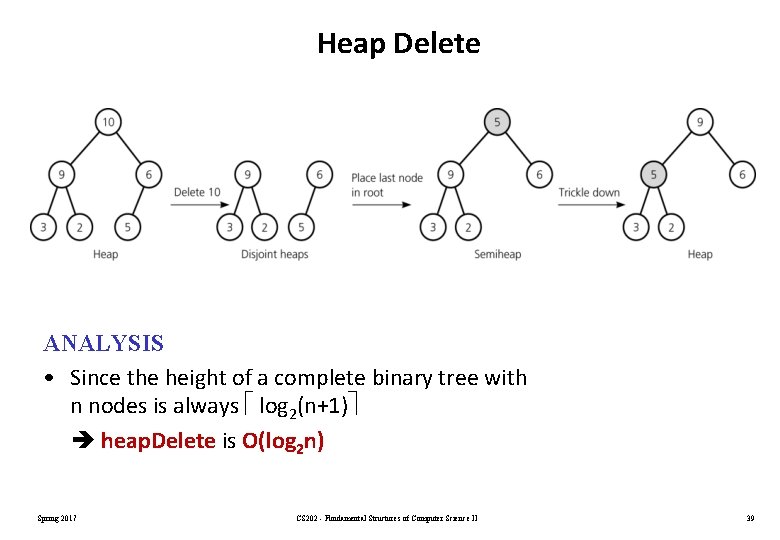
Heap Delete ANALYSIS • Since the height of a complete binary tree with n nodes is always log 2(n+1) heap. Delete is O(log 2 n) Spring 2017 CS 202 - Fundamental Structures of Computer Science II 39
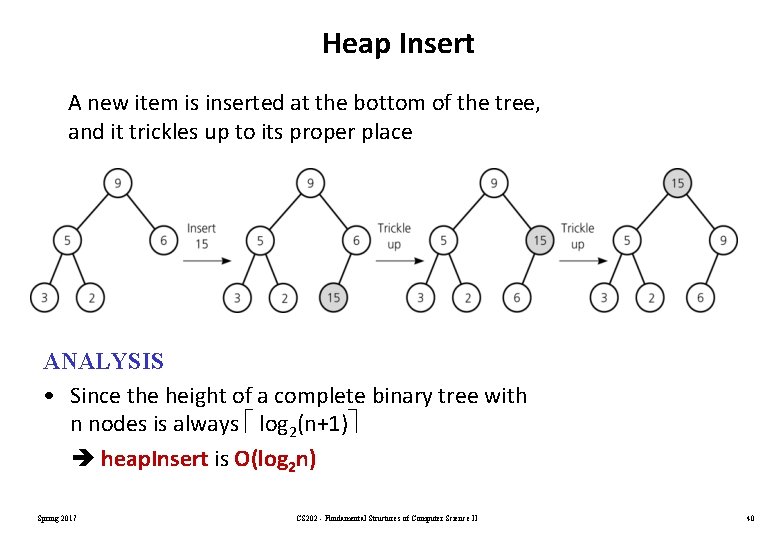
Heap Insert A new item is inserted at the bottom of the tree, and it trickles up to its proper place ANALYSIS • Since the height of a complete binary tree with n nodes is always log 2(n+1) heap. Insert is O(log 2 n) Spring 2017 CS 202 - Fundamental Structures of Computer Science II 40
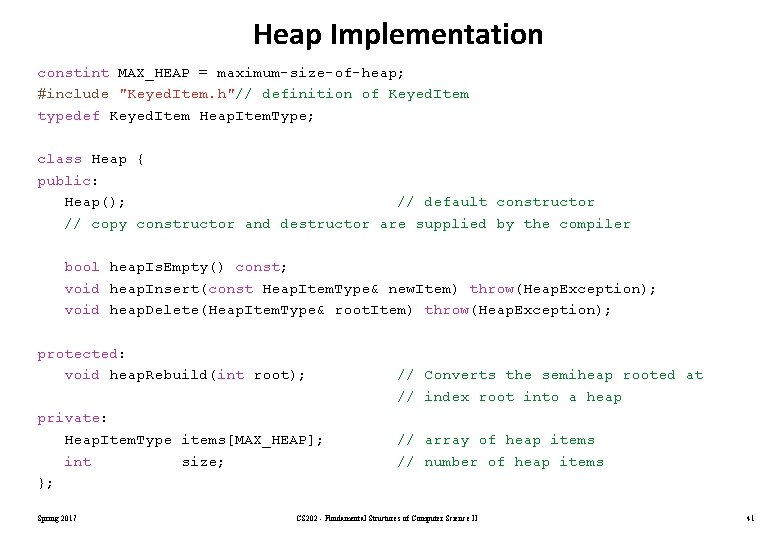
Heap Implementation constint MAX_HEAP = maximum-size-of-heap; #include "Keyed. Item. h"// definition of Keyed. Item typedef Keyed. Item Heap. Item. Type; class Heap { public: Heap(); // default constructor // copy constructor and destructor are supplied by the compiler bool heap. Is. Empty() const; void heap. Insert(const Heap. Item. Type& new. Item) throw(Heap. Exception); void heap. Delete(Heap. Item. Type& root. Item) throw(Heap. Exception); protected: void heap. Rebuild(int root); private: Heap. Item. Type items[MAX_HEAP]; int size; }; Spring 2017 // Converts the semiheap rooted at // index root into a heap // array of heap items // number of heap items CS 202 - Fundamental Structures of Computer Science II 41
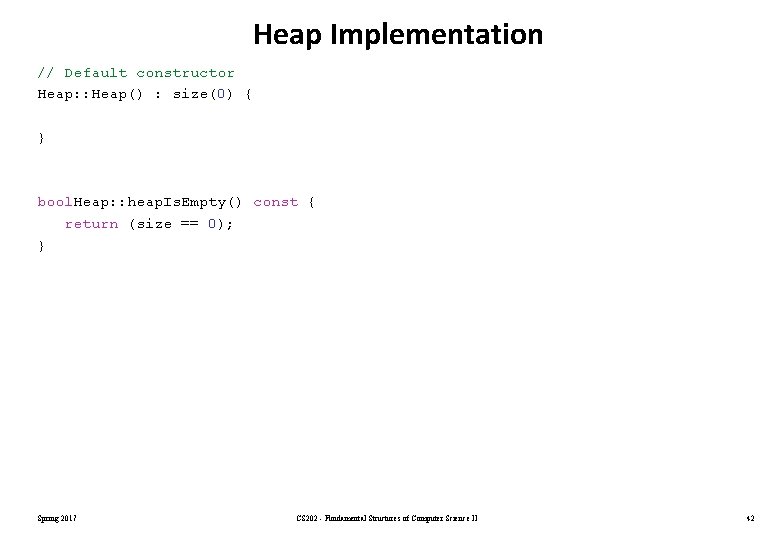
Heap Implementation // Default constructor Heap: : Heap() : size(0) { } bool. Heap: : heap. Is. Empty() const { return (size == 0); } Spring 2017 CS 202 - Fundamental Structures of Computer Science II 42
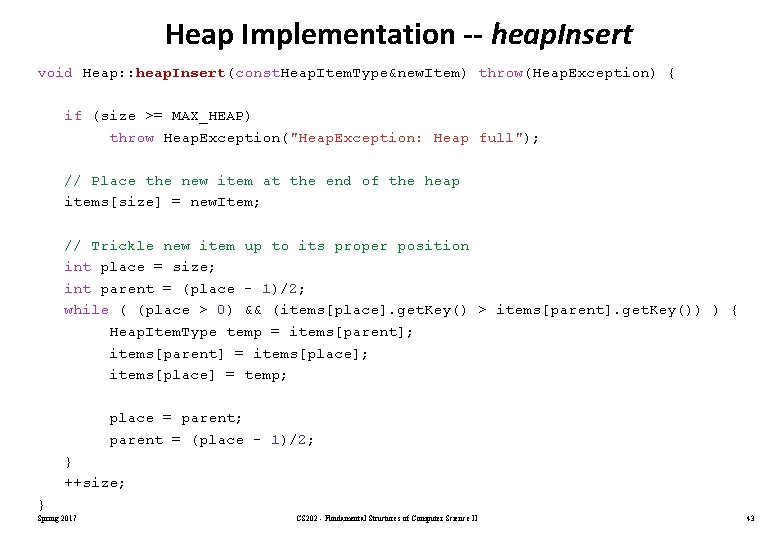
Heap Implementation -- heap. Insert void Heap: : heap. Insert(const. Heap. Item. Type&new. Item) throw(Heap. Exception) { if (size >= MAX_HEAP) throw Heap. Exception("Heap. Exception: Heap full"); // Place the new item at the end of the heap items[size] = new. Item; // Trickle new item up to its proper position int place = size; int parent = (place - 1)/2; while ( (place > 0) && (items[place]. get. Key() > items[parent]. get. Key()) ) { Heap. Item. Type temp = items[parent]; items[parent] = items[place]; items[place] = temp; place = parent; parent = (place - 1)/2; } ++size; } Spring 2017 CS 202 - Fundamental Structures of Computer Science II 43
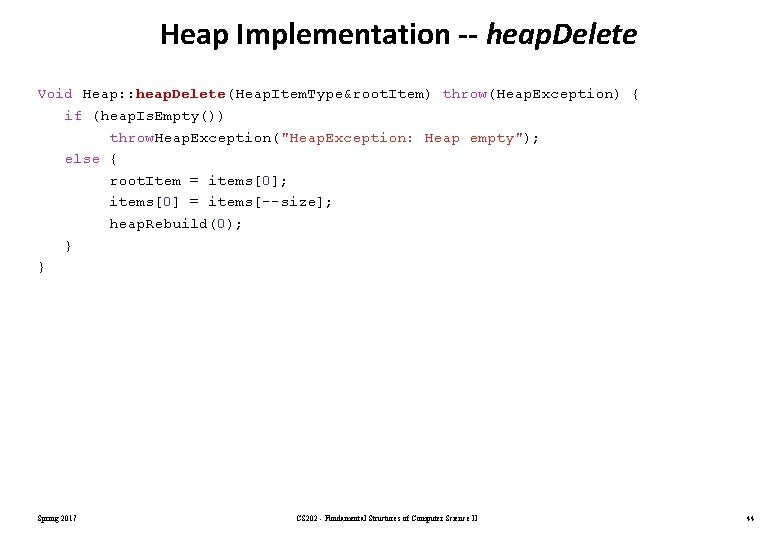
Heap Implementation -- heap. Delete Void Heap: : heap. Delete(Heap. Item. Type&root. Item) throw(Heap. Exception) { if (heap. Is. Empty()) throw. Heap. Exception("Heap. Exception: Heap empty"); else { root. Item = items[0]; items[0] = items[--size]; heap. Rebuild(0); } } Spring 2017 CS 202 - Fundamental Structures of Computer Science II 44
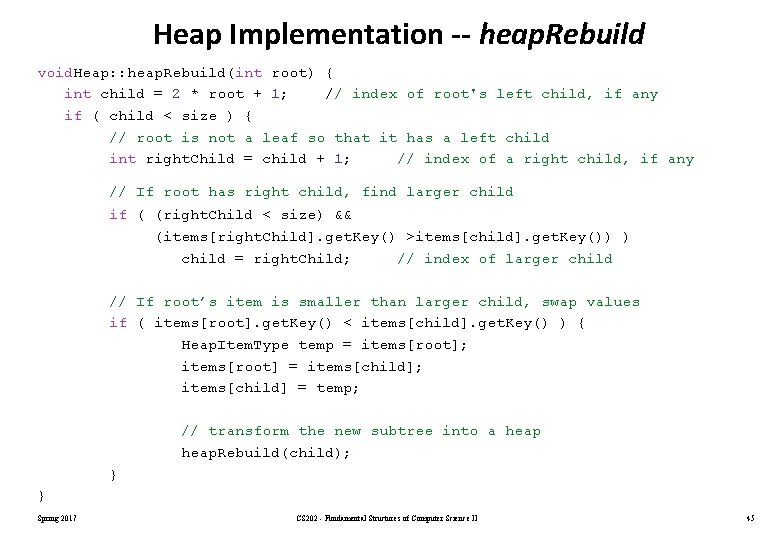
Heap Implementation -- heap. Rebuild void. Heap: : heap. Rebuild(int root) { int child = 2 * root + 1; // index of root's left child, if any if ( child < size ) { // root is not a leaf so that it has a left child int right. Child = child + 1; // index of a right child, if any // If root has right child, find larger child if ( (right. Child < size) && (items[right. Child]. get. Key() >items[child]. get. Key()) ) child = right. Child; // index of larger child // If root’s item is smaller than larger child, swap values if ( items[root]. get. Key() < items[child]. get. Key() ) { Heap. Item. Type temp = items[root]; items[root] = items[child]; items[child] = temp; // transform the new subtree into a heap. Rebuild(child); } } Spring 2017 CS 202 - Fundamental Structures of Computer Science II 45
Heap Implementation of Priority. Queue • The heap implementation of the priority queue is straightforward – Since the heap operations and the priority queue operations are the same. • When we use the heap, – Insertion and deletion operations of the priority queue will be O(log 2 n). Spring 2017 CS 202 - Fundamental Structures of Computer Science II 46
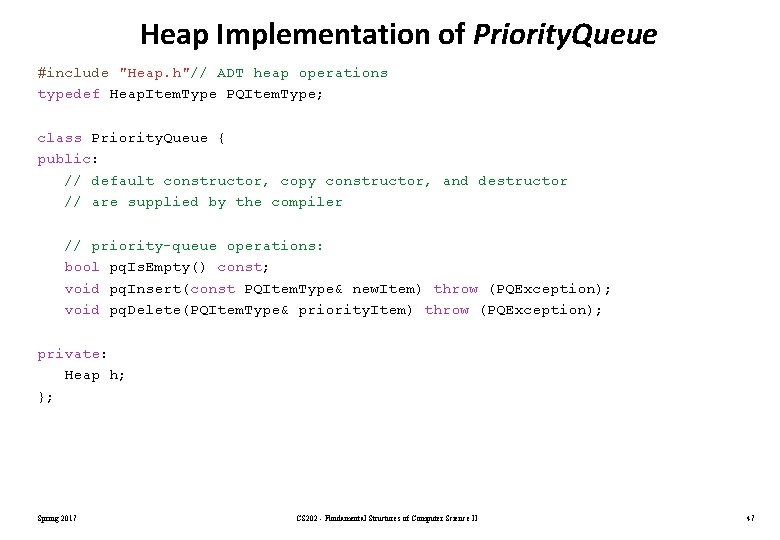
Heap Implementation of Priority. Queue #include "Heap. h"// ADT heap operations typedef Heap. Item. Type PQItem. Type; class Priority. Queue { public: // default constructor, copy constructor, and destructor // are supplied by the compiler // priority-queue operations: bool pq. Is. Empty() const; void pq. Insert(const PQItem. Type& new. Item) throw (PQException); void pq. Delete(PQItem. Type& priority. Item) throw (PQException); private: Heap h; }; Spring 2017 CS 202 - Fundamental Structures of Computer Science II 47
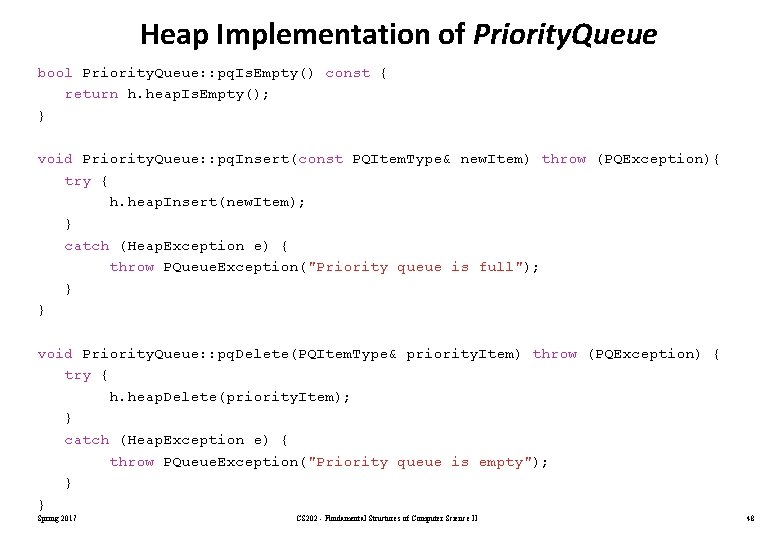
Heap Implementation of Priority. Queue bool Priority. Queue: : pq. Is. Empty() const { return h. heap. Is. Empty(); } void Priority. Queue: : pq. Insert(const PQItem. Type& new. Item) throw (PQException){ try { h. heap. Insert(new. Item); } catch (Heap. Exception e) { throw PQueue. Exception("Priority queue is full"); } } void Priority. Queue: : pq. Delete(PQItem. Type& priority. Item) throw (PQException) { try { h. heap. Delete(priority. Item); } catch (Heap. Exception e) { throw PQueue. Exception("Priority queue is empty"); } } Spring 2017 CS 202 - Fundamental Structures of Computer Science II 48
Heap or Binary Search Tree? Spring 2017 CS 202 - Fundamental Structures of Computer Science II 49
Heapsort We can make use of a heap to sort an array: 1. Create a heap from the given initial array with n items. 2. Swap the root of the heap with the last element in the heap. 3. Now, we have a semiheap with n-1 items, and a sorted array with one item. 4. Using heap. Rebuild convert this semiheap into a heap. Now we will have a heap with n-1 items. 5. Repeat the steps 2 -4 as long as the number of items in the heap is more than 1. Spring 2017 CS 202 - Fundamental Structures of Computer Science II 50
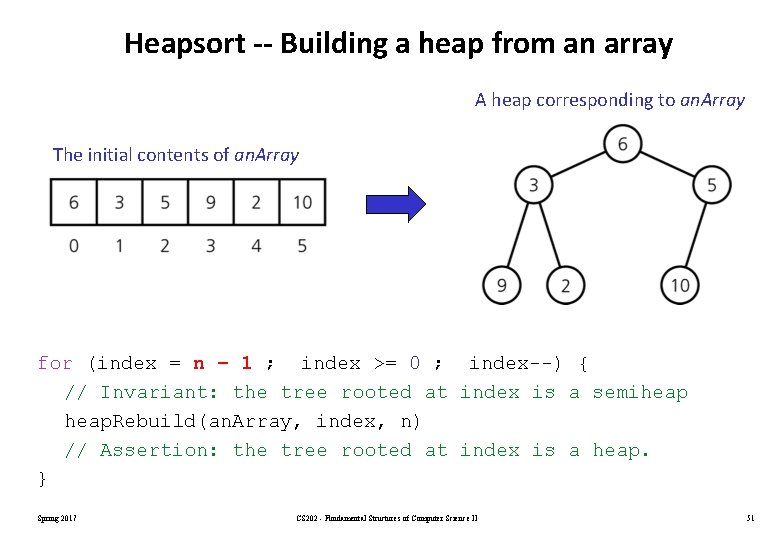
Heapsort -- Building a heap from an array A heap corresponding to an. Array The initial contents of an. Array for (index = n – 1 ; index >= 0 ; index--) { // Invariant: the tree rooted at index is a semiheap. Rebuild(an. Array, index, n) // Assertion: the tree rooted at index is a heap. } Spring 2017 CS 202 - Fundamental Structures of Computer Science II 51
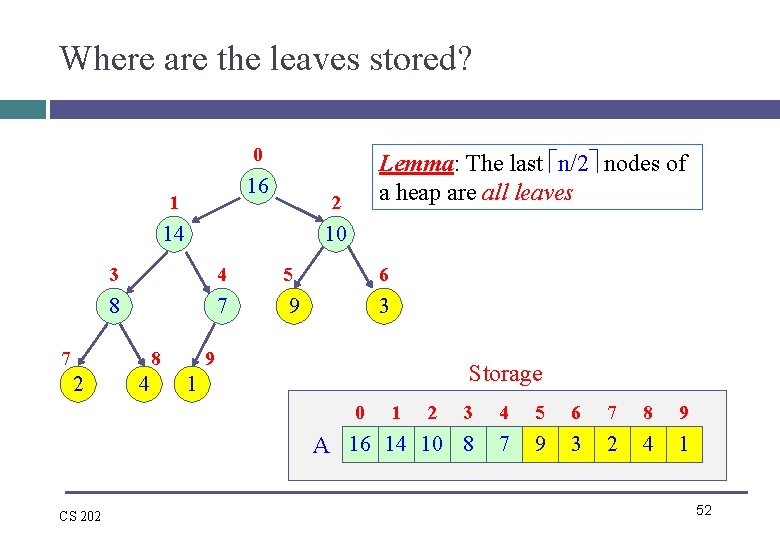
Where are the leaves stored? 0 16 1 2 14 10 3 4 5 6 8 7 9 3 7 8 2 Lemma: The last n/2 nodes of a heap are all leaves 4 9 Storage 1 0 CS 202 1 2 3 4 5 6 7 8 9 A 16 14 10 8 7 9 3 2 4 1 52
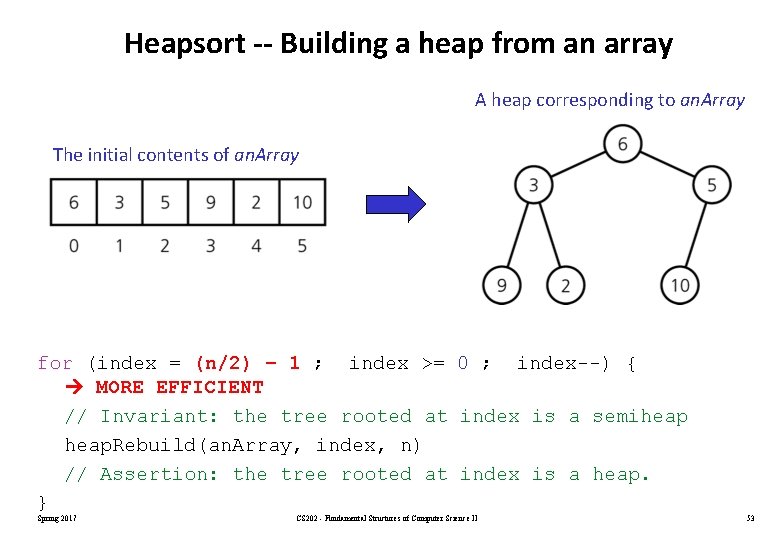
Heapsort -- Building a heap from an array A heap corresponding to an. Array The initial contents of an. Array for (index = (n/2) – 1 ; index >= 0 ; index--) { MORE EFFICIENT // Invariant: the tree rooted at index is a semiheap. Rebuild(an. Array, index, n) // Assertion: the tree rooted at index is a heap. } Spring 2017 CS 202 - Fundamental Structures of Computer Science II 53
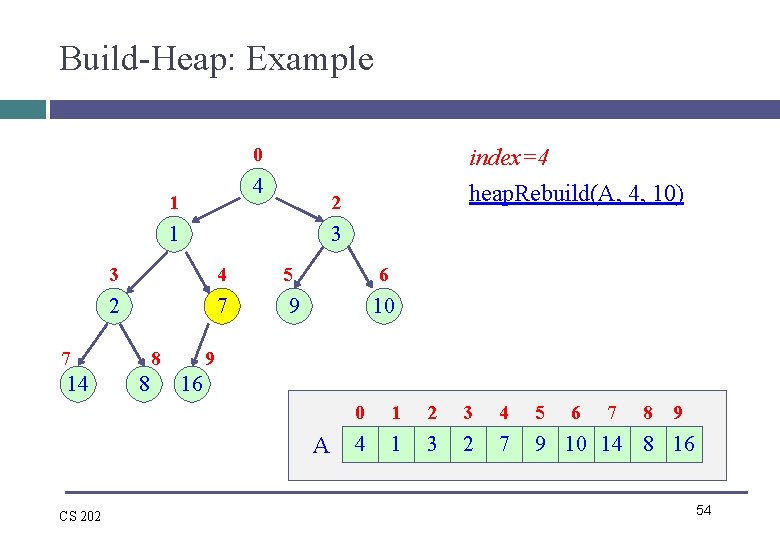
Build-Heap: Example 0 4 1 2 1 3 3 4 5 6 2 7 9 10 7 14 8 8 9 16 A CS 202 index=4 heap. Rebuild(A, 4, 10) 0 1 2 3 4 5 6 7 8 9 4 1 3 2 7 9 10 14 8 16 54
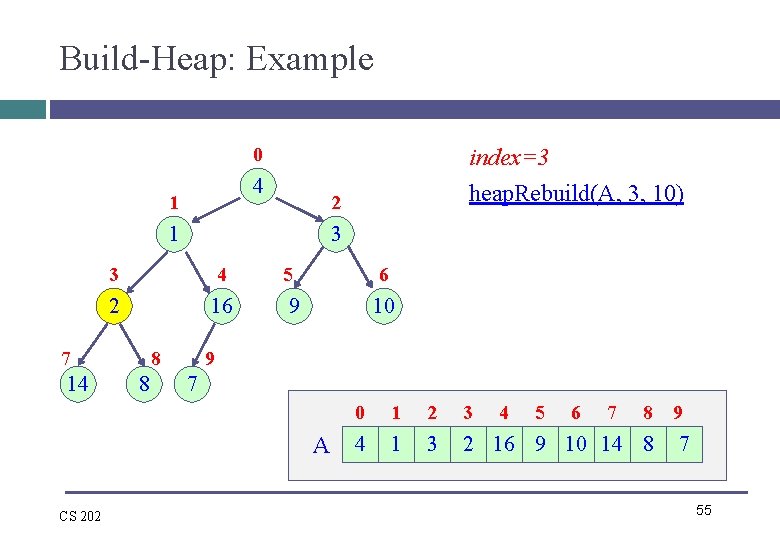
Build-Heap: Example 0 4 1 2 1 3 3 4 5 6 2 16 9 10 7 14 8 8 9 7 A CS 202 index=3 heap. Rebuild(A, 3, 10) 0 1 2 3 4 5 6 7 8 4 1 3 2 16 9 10 14 8 9 7 55
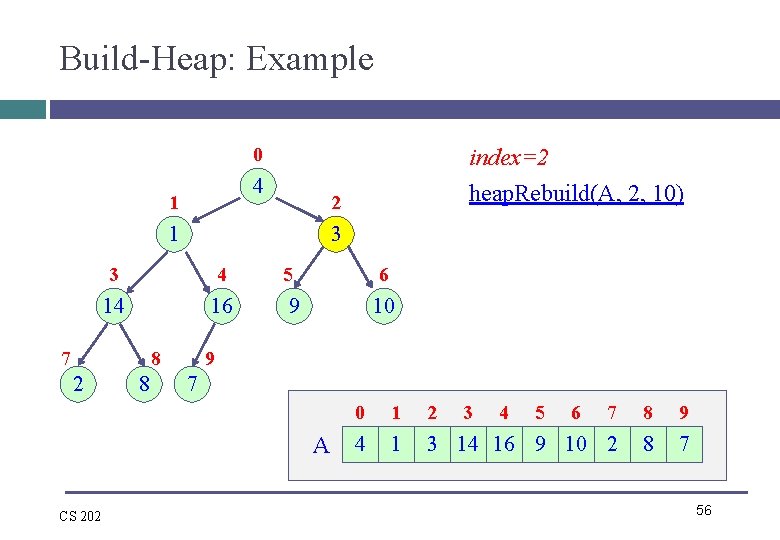
Build-Heap: Example 0 4 1 2 1 3 3 4 5 6 14 16 9 10 7 8 2 8 9 7 A CS 202 index=2 heap. Rebuild(A, 2, 10) 0 1 2 3 4 5 6 7 8 9 4 1 3 14 16 9 10 2 8 7 56
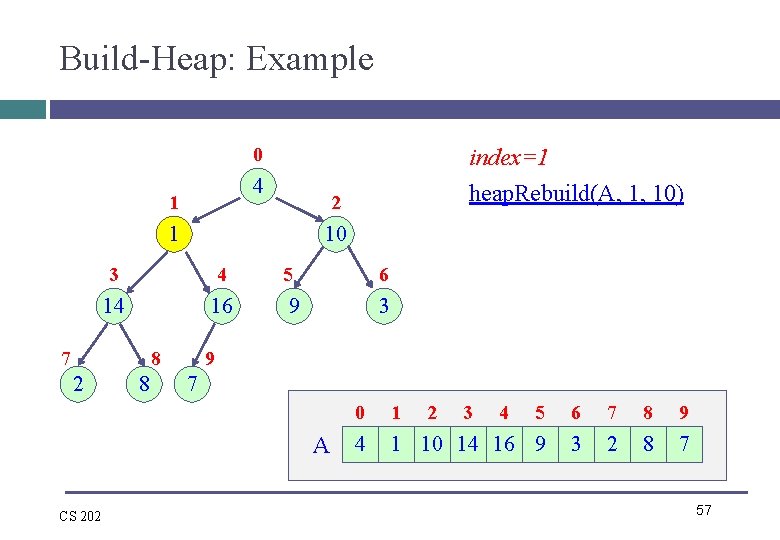
Build-Heap: Example 0 4 1 2 1 10 3 4 5 6 14 16 9 3 7 8 2 8 9 7 A CS 202 index=1 heap. Rebuild(A, 1, 10) 0 1 2 3 4 5 6 7 8 9 4 1 10 14 16 9 3 2 8 7 57
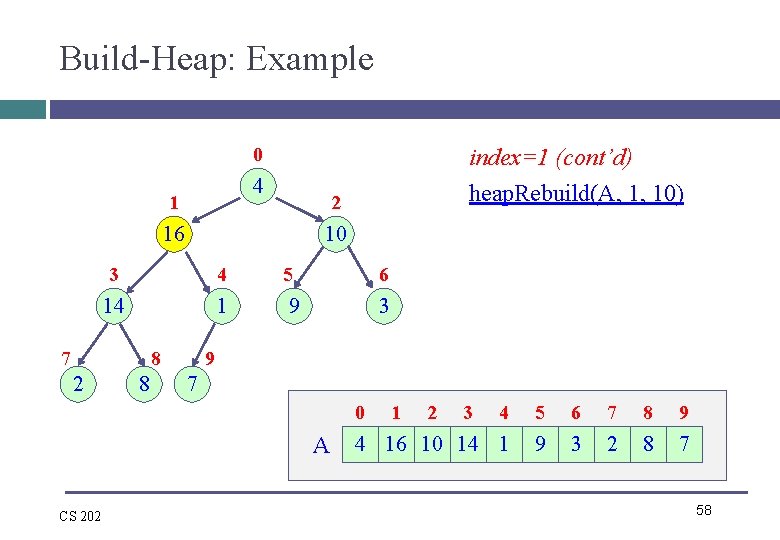
Build-Heap: Example 0 4 1 2 16 10 3 4 5 6 14 1 9 3 7 8 2 index=1 (cont’d) heap. Rebuild(A, 1, 10) 8 9 7 0 A CS 202 1 2 3 4 5 6 7 8 9 4 16 10 14 1 9 3 2 8 7 58
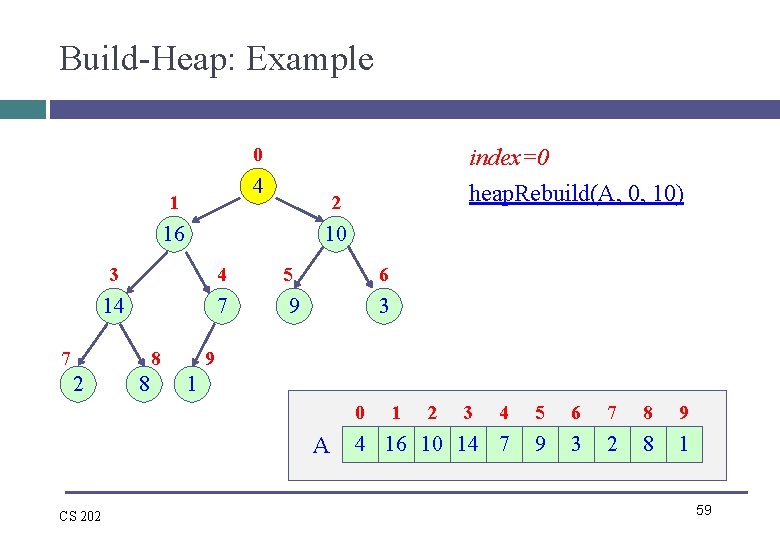
Build-Heap: Example 0 4 1 2 16 10 3 4 5 6 14 7 9 3 7 8 2 index=0 heap. Rebuild(A, 0, 10) 8 9 1 0 A CS 202 1 2 3 4 5 6 7 8 9 4 16 10 14 7 9 3 2 8 1 59
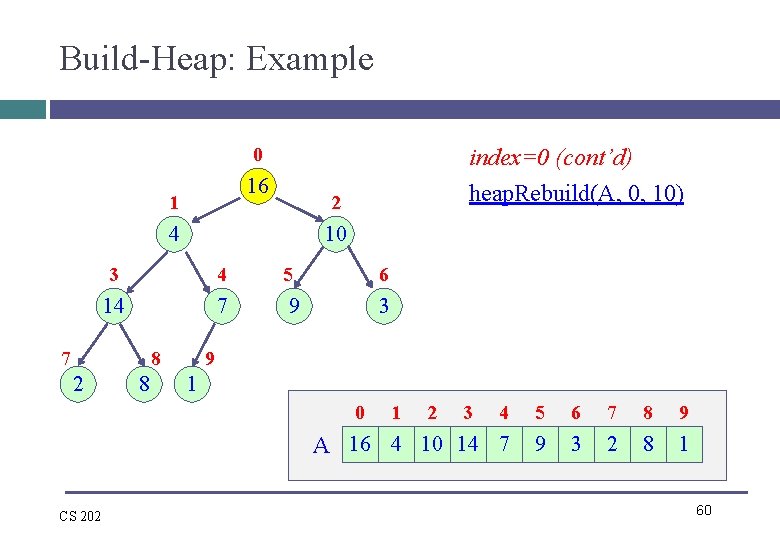
Build-Heap: Example 0 16 1 2 4 10 3 4 5 6 14 7 9 3 7 8 2 index=0 (cont’d) heap. Rebuild(A, 0, 10) 8 9 1 0 CS 202 1 2 3 4 5 6 7 8 9 A 16 4 10 14 7 9 3 2 8 1 60
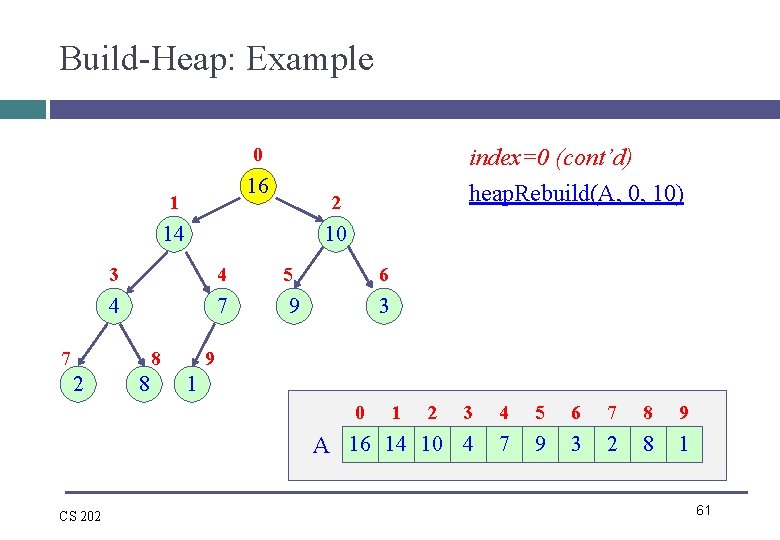
Build-Heap: Example 0 16 1 2 14 10 3 4 5 6 4 7 9 3 7 8 2 index=0 (cont’d) heap. Rebuild(A, 0, 10) 8 9 1 0 CS 202 1 2 3 4 5 6 7 8 9 A 16 14 10 4 7 9 3 2 8 1 61
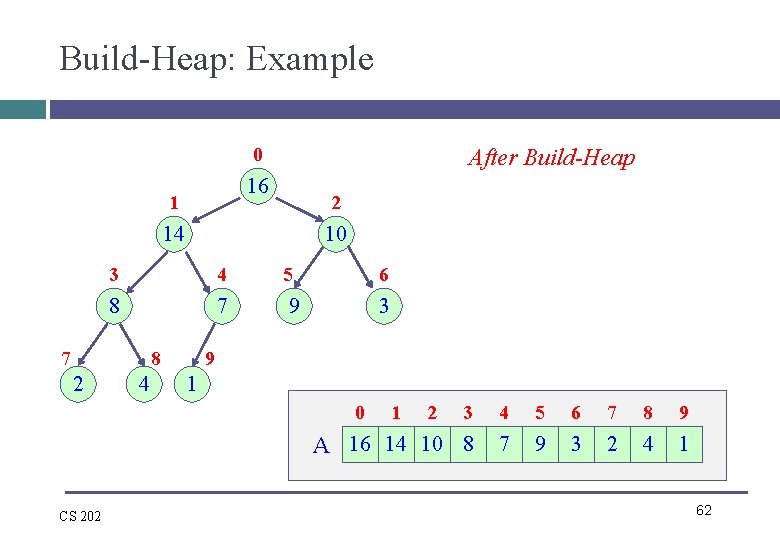
Build-Heap: Example 0 After Build-Heap 16 1 2 14 10 3 4 5 6 8 7 9 3 7 8 2 4 9 1 0 CS 202 1 2 3 4 5 6 7 8 9 A 16 14 10 8 7 9 3 2 4 1 62
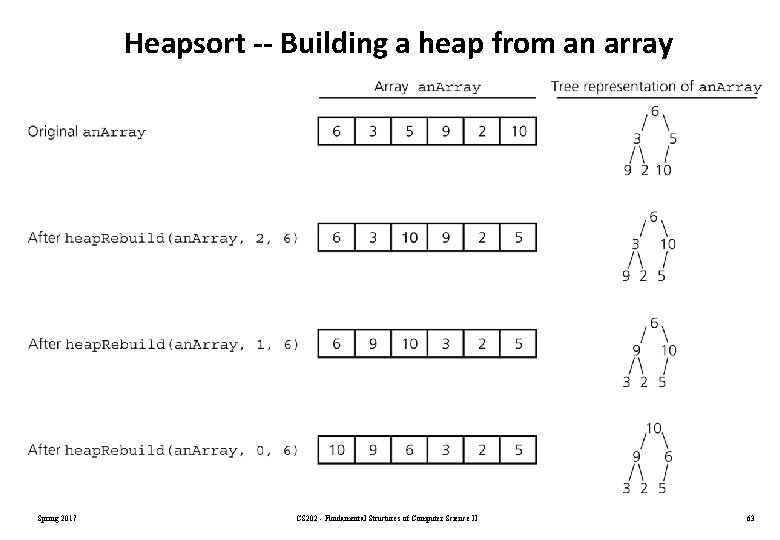
Heapsort -- Building a heap from an array Spring 2017 CS 202 - Fundamental Structures of Computer Science II 63
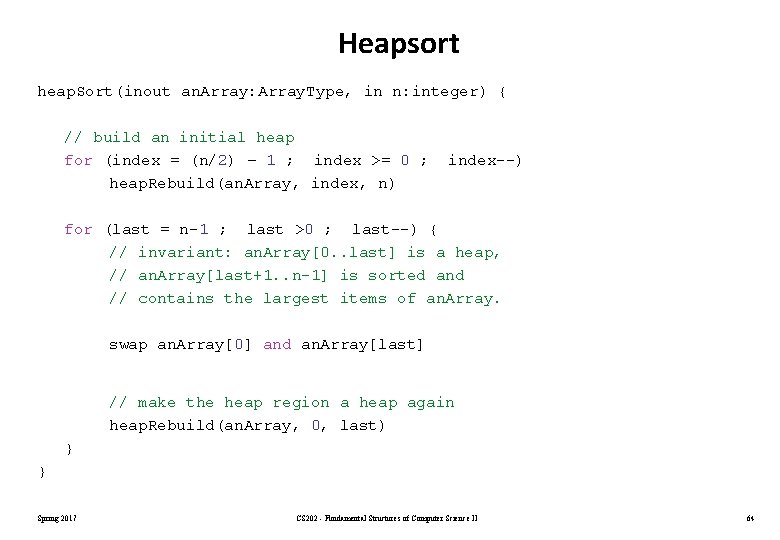
Heapsort heap. Sort(inout an. Array: Array. Type, in n: integer) { // build an initial heap for (index = (n/2) – 1 ; index >= 0 ; heap. Rebuild(an. Array, index, n) index--) for (last = n-1 ; last >0 ; last--) { // invariant: an. Array[0. . last] is a heap, // an. Array[last+1. . n-1] is sorted and // contains the largest items of an. Array. swap an. Array[0] and an. Array[last] // make the heap region a heap again heap. Rebuild(an. Array, 0, last) } } Spring 2017 CS 202 - Fundamental Structures of Computer Science II 64
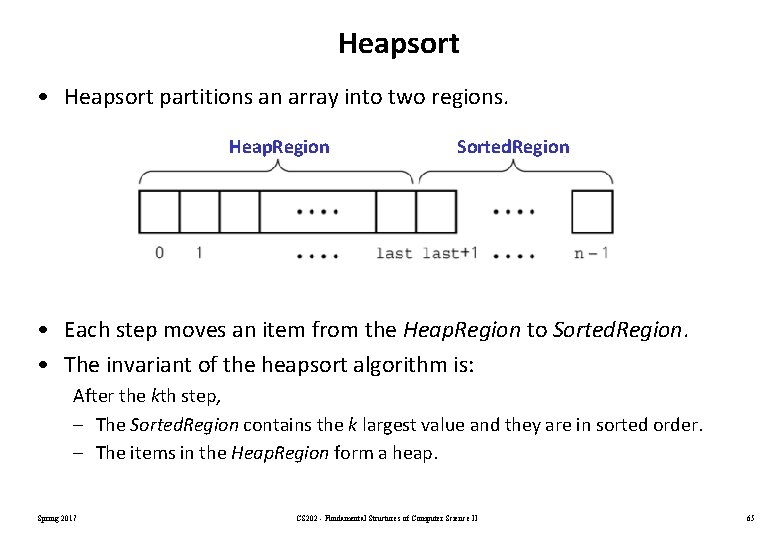
Heapsort • Heapsort partitions an array into two regions. Heap. Region Sorted. Region • Each step moves an item from the Heap. Region to Sorted. Region. • The invariant of the heapsort algorithm is: After the kth step, – The Sorted. Region contains the k largest value and they are in sorted order. – The items in the Heap. Region form a heap. Spring 2017 CS 202 - Fundamental Structures of Computer Science II 65
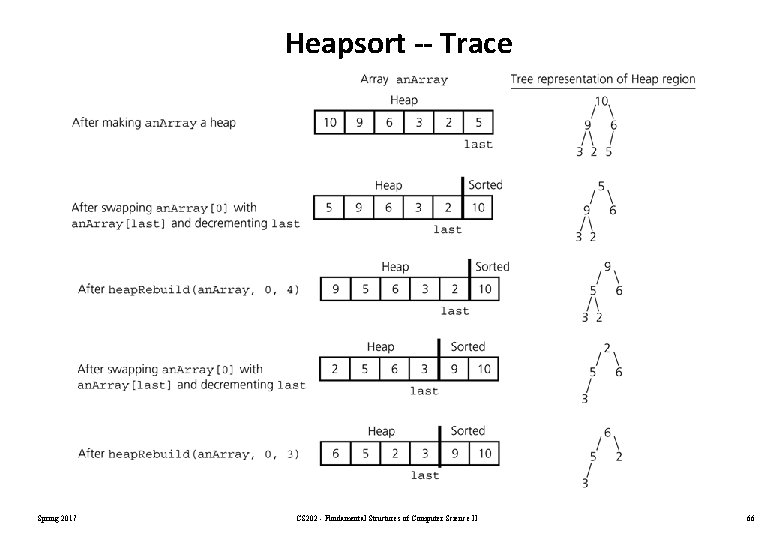
Heapsort -- Trace Spring 2017 CS 202 - Fundamental Structures of Computer Science II 66
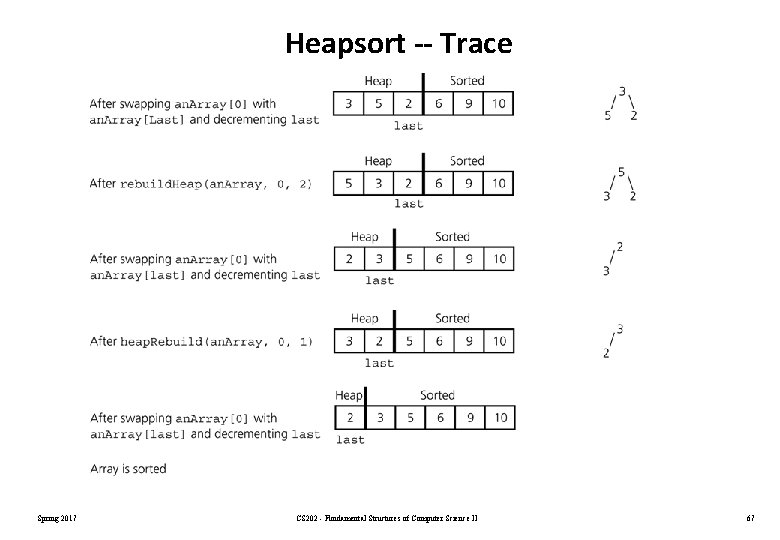
Heapsort -- Trace Spring 2017 CS 202 - Fundamental Structures of Computer Science II 67
Heapsort -- Analysis • Heapsort is O(n log n) at the average case at the worst case • Compared against quicksort, – Heapsort usually takes more time at the average case – But its worst case is also O(n log n). Spring 2017 CS 202 - Fundamental Structures of Computer Science II 68
- Slides: 68