
Table Top Exercises Secure Community Network 1 Training
Table Top Exercises Secure Community Network 1
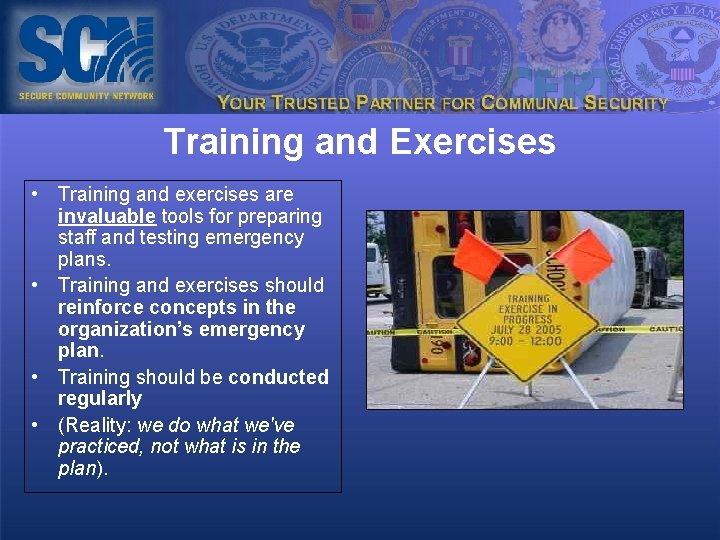
Training and Exercises • Training and exercises are invaluable tools for preparing staff and testing emergency plans. • Training and exercises should reinforce concepts in the organization’s emergency plan. • Training should be conducted regularly • (Reality: we do what we've practiced, not what is in the plan). 2
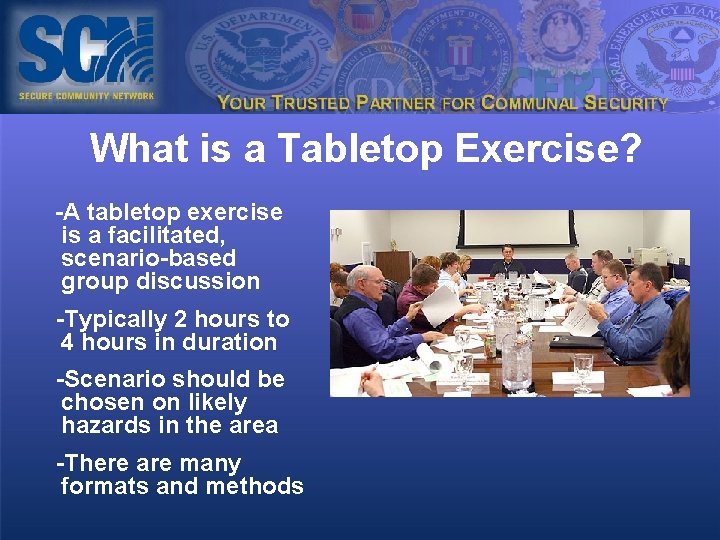
What is a Tabletop Exercise? -A tabletop exercise is a facilitated, scenario-based group discussion -Typically 2 hours to 4 hours in duration -Scenario should be chosen on likely hazards in the area -There are many formats and methods 3

Why Table Top Exercises? • Are low-stress discussion of coordination and policy within the organization and/or between the organization and other agencies. • Provide a good environment for problem solving. • Provide an opportunity for key agencies and stakeholders to become acquainted with one another, their interrelated roles, and their respective responsibilities. • Provide good preparation for a functional exercise. • Cost Effective • Minimal Disruption • Validation of your Plan 4
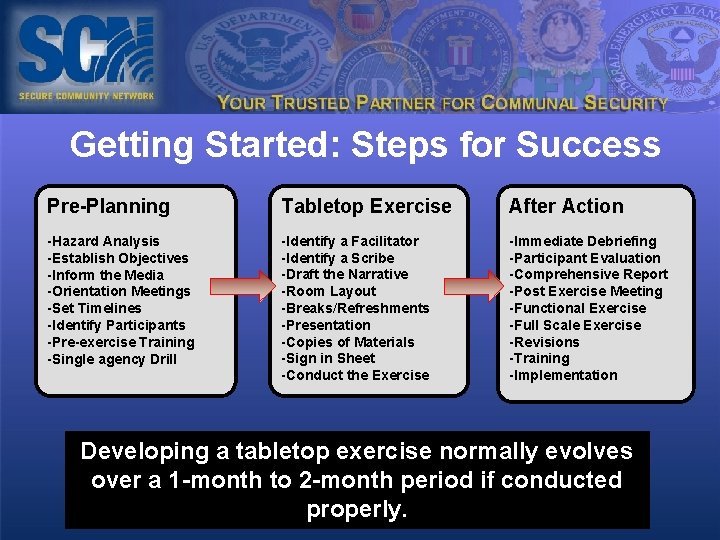
Getting Started: Steps for Success Pre-Planning Tabletop Exercise After Action -Hazard Analysis -Establish Objectives -Inform the Media -Orientation Meetings -Set Timelines -Identify Participants -Pre-exercise Training -Single agency Drill -Identify a Facilitator -Identify a Scribe -Draft the Narrative -Room Layout -Breaks/Refreshments -Presentation -Copies of Materials -Sign in Sheet -Conduct the Exercise -Immediate Debriefing -Participant Evaluation -Comprehensive Report -Post Exercise Meeting -Functional Exercise -Full Scale Exercise -Revisions -Training -Implementation Developing a tabletop exercise normally evolves over a 1 -month to 2 -month period if conducted properly. 5
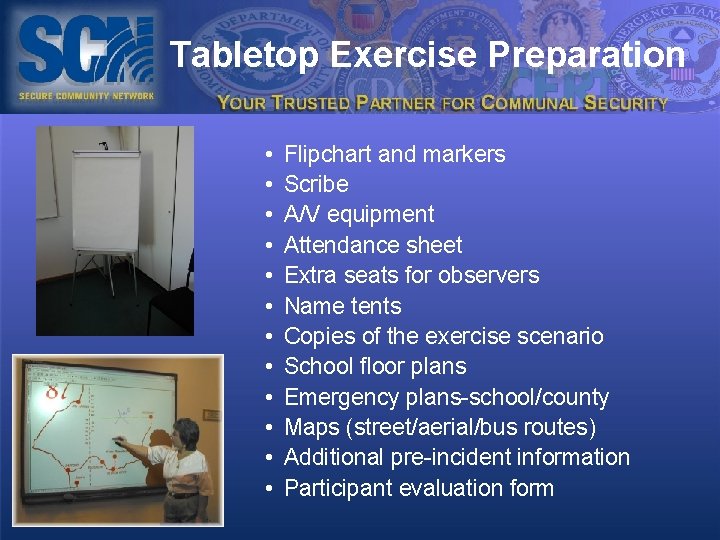
Tabletop Exercise Preparation • • • Flipchart and markers Scribe A/V equipment Attendance sheet Extra seats for observers Name tents Copies of the exercise scenario School floor plans Emergency plans-school/county Maps (street/aerial/bus routes) Additional pre-incident information Participant evaluation form 6
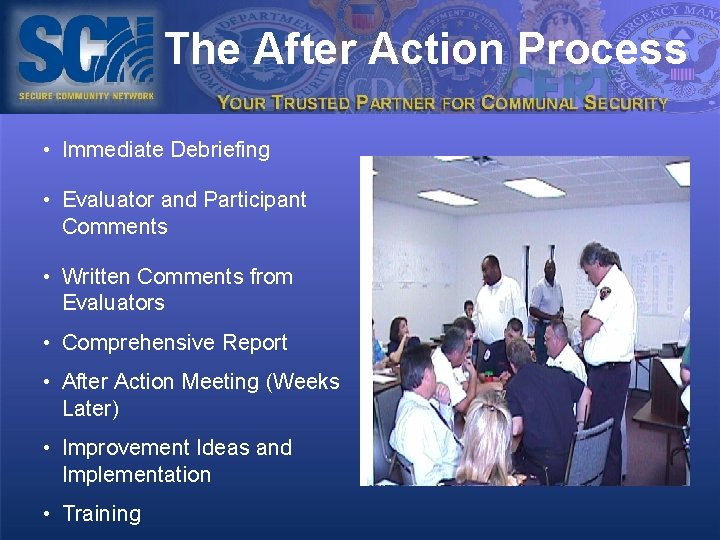
The After Action Process • Immediate Debriefing • Evaluator and Participant Comments • Written Comments from Evaluators • Comprehensive Report • After Action Meeting (Weeks Later) • Improvement Ideas and Implementation • Training 7
After-Action Review • After-action reviews capture key lessons learned from emergency response and make recommendations for improvements. • Benefits of after-action reviews • Supports proactive response management • Provides documentation for any future litigation • Identifies areas for improvement. • After-action reviews must not be an after-thought! 8
After-Action Review u u Consideration must be made for the best time for this - not necessarily immediately after! A skilled facilitator is important. Tension must be constructive. Identify components of after-action reviews: – – – – Exercise / emergency overview Exercise goals and objectives Analysis of outcomes Analysis of capacity to perform critical tasks Summary Recommendations Specific improvements for each partner Accountability plan. 9
Through Exercises, Organizations Can: • • Test and evaluate plans, policies, and procedures. Reveal planning weaknesses. Reveal gaps in resources. Improve organizational coordination and communications. Clarify roles and responsibilities. Train personnel in roles and responsibilities. Improve individual performance. Gain program recognition and support of officials. • Satisfy regulatory requirements. 10
- Slides: 10