
Table of Contents Title Types of Sedimentary Rocks
Table of Contents Title: Types of Sedimentary Rocks Page #: 42 Date: 12/3/2012
Objective § Students will be able to describe three types of sedimentary rocks.
Word of the Day § Reservoir: Any place in which water, liquid gas, or oil may be stored.
Types of Sedimentary Rocks § Clastic: Formed from loose sediments on Earth’s surface. § 3 Categories: 1. Coarse Grained: Gravel sized grain. • • Conglomerate - gravel sized, well rounded grains. Formed by fast flowing water. Breccia - large angular grains, particles. Not transported very far.

Conglomerate Breccia
Types of Sedimentary Rocks § Clastic: Formed from loose sediments on Earth’s surface. § 3 Categories: 2. Medium Grained: Sand sized grains. • • Example: Sandstone. High porosity - lots of spaces between grains. • Means rock may hold water, gas, oil - it’s a reservoir!

Sandstone - medium sized grains
Types of Sedimentary Rocks § Clastic: Formed from loose sediments on Earth’s surface. § 3 Categories: 3. Fine Grained - Silt and clay sized particles. • Example: Shale - low porosity. Formed by swaps and ponds - low currents = horizontal layering.

Limestone - fine grained
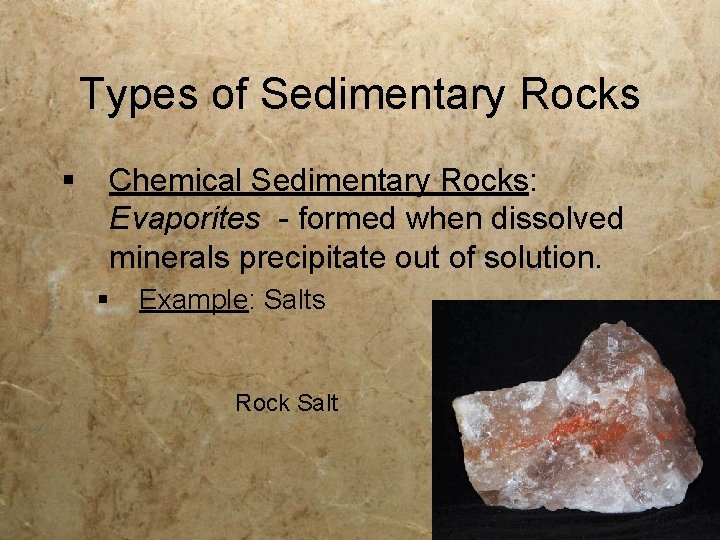
Types of Sedimentary Rocks § Chemical Sedimentary Rocks: Evaporites - formed when dissolved minerals precipitate out of solution. § Example: Salts Rock Salt
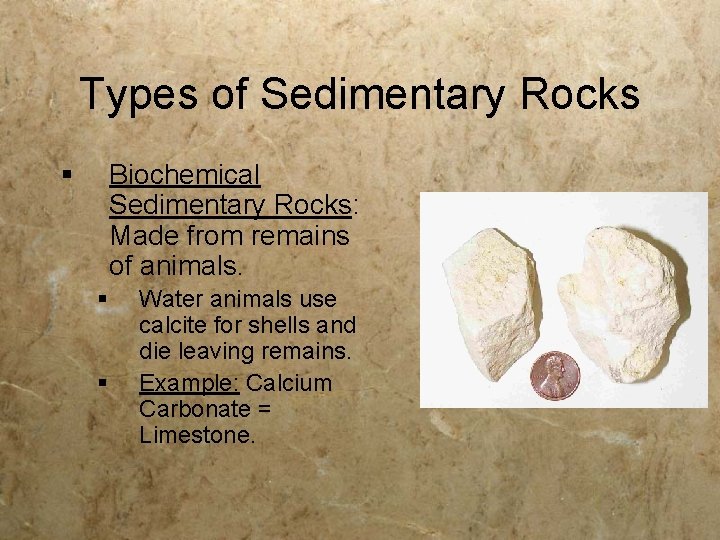
Types of Sedimentary Rocks § Biochemical Sedimentary Rocks: Made from remains of animals. § § Water animals use calcite for shells and die leaving remains. Example: Calcium Carbonate = Limestone.
Classwork § Is it sedimentary or Igneous?
- Slides: 12