
Table of Contents Title 17 3 Plate Boundaries

Table of Contents Title: 17. 3 Plate Boundaries Page #: Date: 3/31/2013
Objective • Students will be able to describe how Earth’s tectonic plates result in many geologic features. • Students will be able to compare and contrast the three types of boundaries and the features associated with each. • Student will be able to generalize the processes associated with subduction zones.
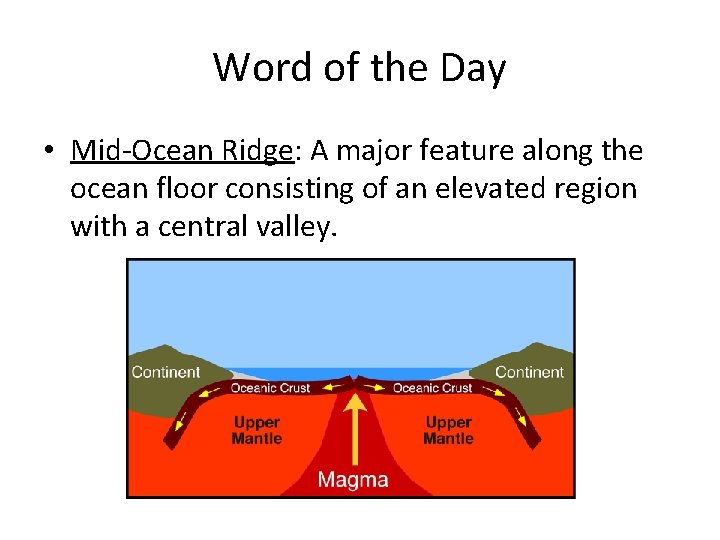
Word of the Day • Mid-Ocean Ridge: A major feature along the ocean floor consisting of an elevated region with a central valley.
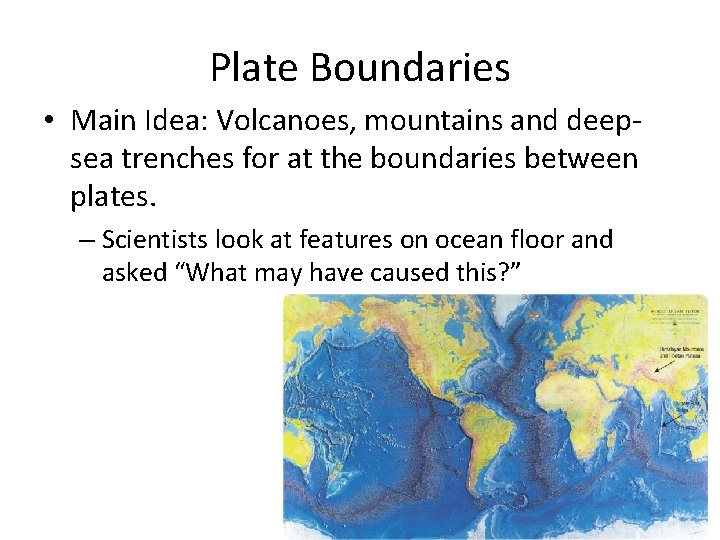
Plate Boundaries • Main Idea: Volcanoes, mountains and deepsea trenches for at the boundaries between plates. – Scientists look at features on ocean floor and asked “What may have caused this? ”
Plate Boundaries Theory of Plate Tectonics Pg. 480 • Evidence of Seafloor spreading suggests that continental and oceanic crust move as enormous slabs. • Plate tectonics • Tectonic Plates: huge pieces of crust and rigid unifies the upper mantle that fit together at their edges theories of to cover Earth’s surface. continental drift and • Plate Tectonics: The theory that describes seafloor how tectonic plates move and shape Earth’s spreading. surface. (Plates move a few centimeters per year. )
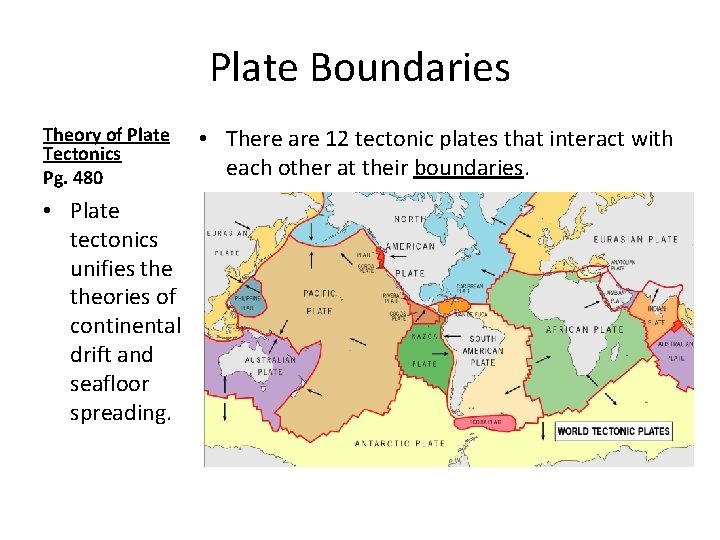
Plate Boundaries Theory of Plate Tectonics Pg. 480 • Plate tectonics unifies theories of continental drift and seafloor spreading. • There are 12 tectonic plates that interact with each other at their boundaries.
Plate Boundaries Divergent Boundaries Pg. 481 • Where crust is formed. • Divergent Boundaries are where 2 tectonic plates move apart from one another. – Found at rift valleys. – Magma rising through rift’s faults forms a midocean ridge and new seafloor.
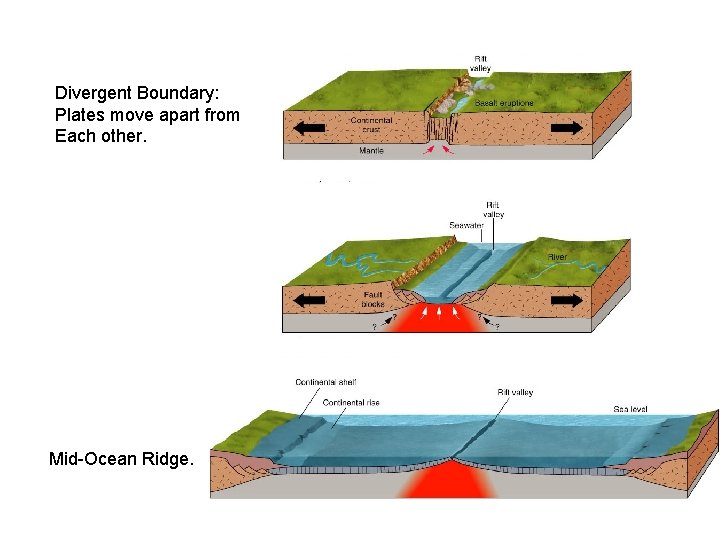
Divergent Boundary: Plates move apart from Each other. Mid-Ocean Ridge.
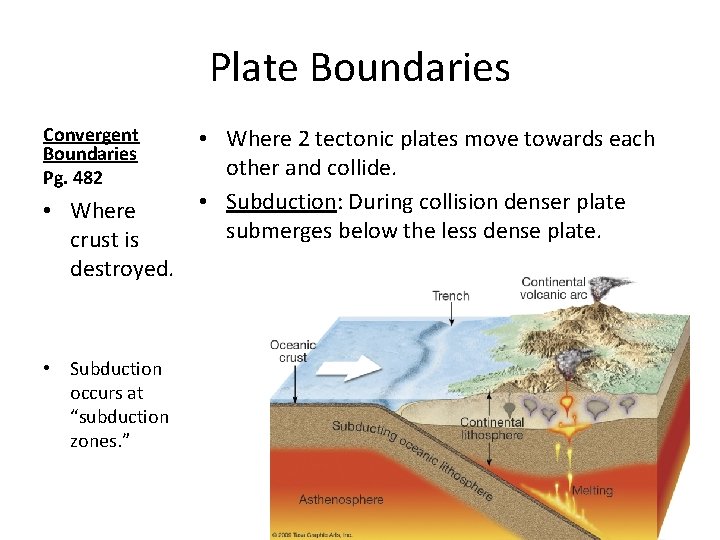
Plate Boundaries Convergent Boundaries Pg. 482 • Where crust is destroyed. • Subduction occurs at “subduction zones. ” • Where 2 tectonic plates move towards each other and collide. • Subduction: During collision denser plate submerges below the less dense plate.
Plate Boundaries Convergent Boundaries Pg. 482 • Where crust is destroyed. • 3 Types of Convergent Boundaries: Classification is based on the type of crust involved. • Oceanic Crust: Basaltic, dark in color, lots of iron and magnesium (metals. ) – Dense!! • Continental Crust: Granitic, light in color, feldspar and quartz. – Less Dense!!
Plate Boundaries Convergent Boundaries Pg. 482 • Where crust is destroyed. • 3 Types of Convergent Boundaries: – Oceanic: One oceanic plate (denser one) will descend below the other one at a subduction zone. • Creates an ocean trench. • Creates an island arc as subducting (descending) plate melts and material returns to the surface. • Example: Aleutian Islands in North Pacific.
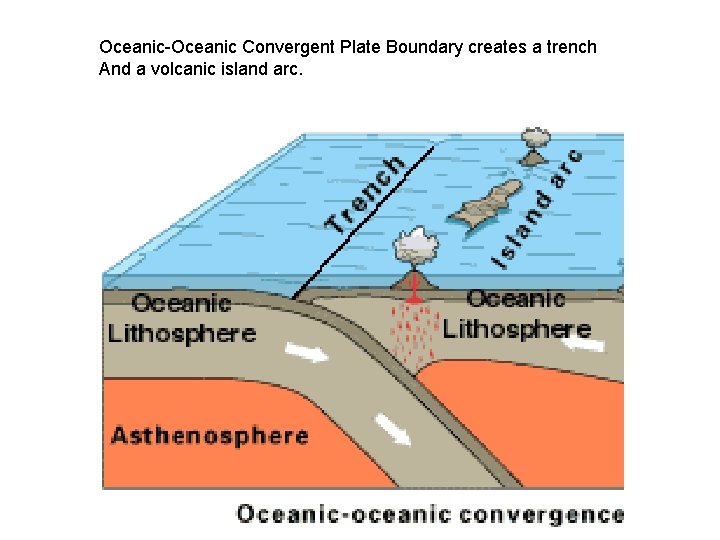
Oceanic-Oceanic Convergent Plate Boundary creates a trench And a volcanic island arc.
Plate Boundaries Convergent Boundaries Pg. 482 • Where crust is destroyed. • 3 Types of Convergent Boundaries: – Oceanic – Continental: Denser oceanic plate descends under less dense continental plate. • Produces a trench and a volcanic arc at edge of continental plate (not an island chain. ) • Arc is characterized by mountain chain and many volcanoes. • Example: Preu-Chile trench and Andes Mountains.
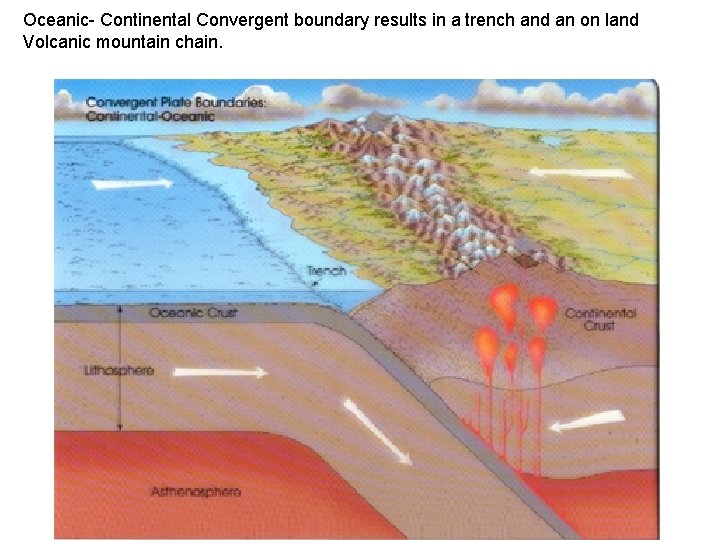
Oceanic- Continental Convergent boundary results in a trench and an on land Volcanic mountain chain.
Plate Boundaries Convergent Boundaries Pg. 484 • Where crust is destroyed. • 3 Types of Convergent Boundaries: – Continental: Happens long after ocean-continent convergence (when oceanic plate is completely subducted. ) – Continents are passengers that ride on oceanic crust. – Because both continents are not very dense, neither sinks. – Continents become crumpled, folded and uplifted. • Forms mountains. • Example: Himalayas
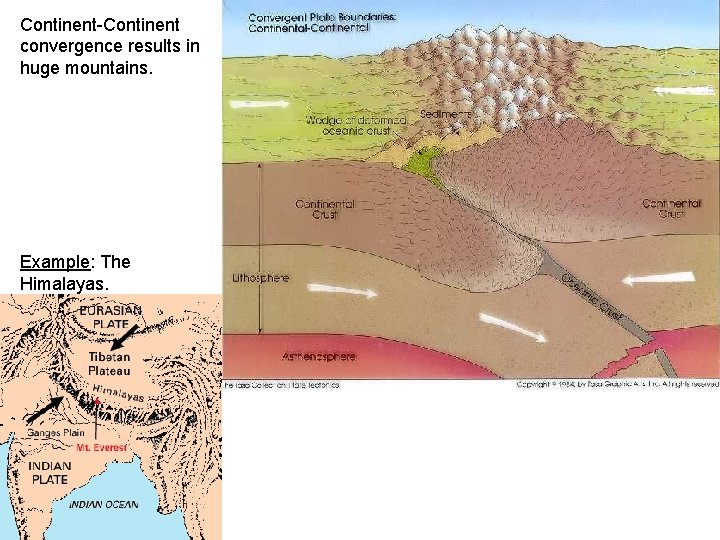
Continent-Continent convergence results in huge mountains. Example: The Himalayas.
Plate Boundaries Transform Boundaries Pg. 484 • 3 Types of Convergent Boundaries: – Transform Boundaries: When two plates slide past each other in opposite directions. • Crust becomes deformed and fractured.
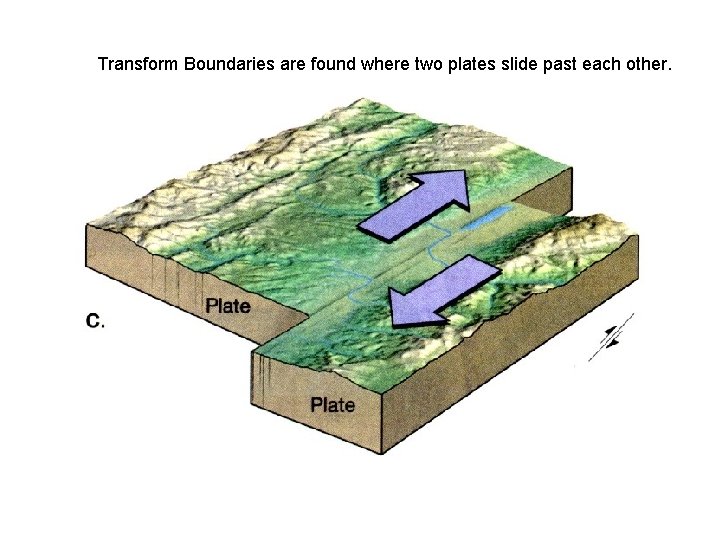
Transform Boundaries are found where two plates slide past each other.
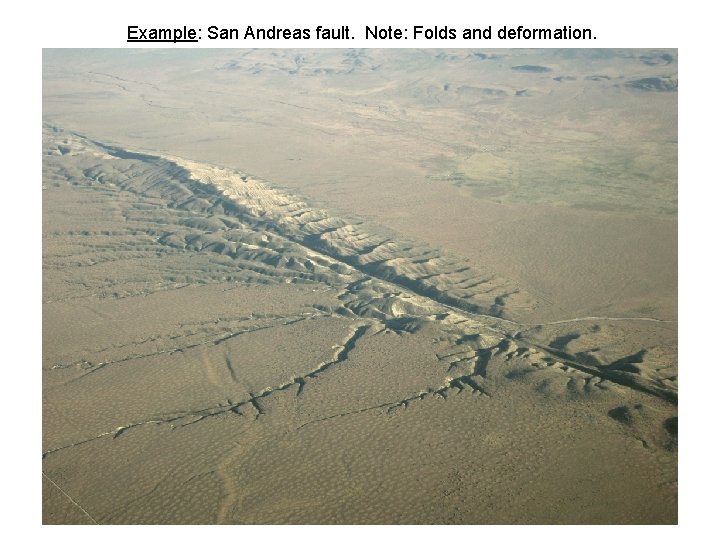
Example: San Andreas fault. Note: Folds and deformation.
- Slides: 19