
Table of Contents Chapter The Solar System Section
Table of Contents Chapter: The Solar System Section 1: The Solar System Section 2: The Inner Planets Section 3: The Outer Planets Section 4: Other Objects in the Solar System
The Solar System 1 Ideas About the Solar System— Earth-Centered Model • Many early Greek scientists thought the planets, the sun, and the moon were fixed in separate spheres that rotated around Earth.
The Solar System 1 Ideas About the Solar System— System Earth-Centered Model • The stars were thought to be in another sphere that also rotated around Earth. • This is called the Earth-centered model of the solar system.
The Solar System 1 Sun-Centered Model • In 1543, Nicholas Copernicus stated that the moon revolved around Earth and that Earth and the other planets revolved around the Sun.
The Solar System 1 Sun-Centered Model • He also stated that the daily movement of the planets and the stars was caused by Earth's rotation. • This is the Sun-centered model of the solar system.
The Solar System 1 Sun-Centered Model • Using his telescope, Galileo Galilei observed that Venus went through a full cycle of phases like the Moon's. • He also observed that the apparent diameter of Venus was smallest when the phase was near full.
The Solar System 1 Sun-Centered Model • This only could be explained if Venus were orbiting the Sun. • Galileo concluded that the Sun is the center of the solar system.
The Solar System 1 Modern View of the Solar System • We now know that the solar system is made up of nine planets, including Earth, and many smaller objects that orbit the Sun. • The Sun's gravity holds the planets and other objects in the solar system in their orbits.
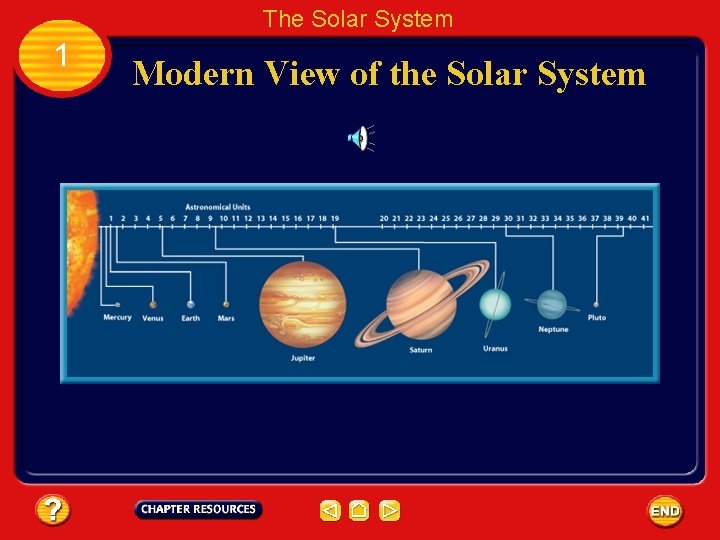
The Solar System 1 Modern View of the Solar System

The Solar System 1 How the Solar System Formed • Scientists hypothesize that the solar system formed from part of a nebula of gas, ice, and dust. • A nearby star might have exploded or nearby O- or B-type stars formed, and the shock waves produced by these events could have caused the cloud to start contracting.
The Solar System 1 How the Solar System Formed • The density in the cloud fragments became greater, and the attraction of gravity pulled more gas and dust toward several centers of contraction. • As the cloud fragments continued to contract, they began to rotate faster and faster.
The Solar System 1 How the Solar System Formed • As each cloud fragment contracted, its temperature increased. • Eventually, the temperature in the core of one of these cloud fragments reached about 10 million degrees Celsius and nuclear fusion began. • A star was born—the beginning of the Sun.
The Solar System 1 How the Solar System Formed • A cluster of stars like the Sun, or smaller, likely formed from fragments of the original cloud. • The Sun probably escaped from this cluster and has since revolved around the galaxy about 20 times.
The Solar System 1 Planet Formation • The matter that did not get pulled into the center collided and stuck together to form the planets and asteroids. • The inner planets of the solar system— Mercury, Venus, Earth, and Mars—are small, rocky planets with iron cores.
The Solar System 1 Planet Formation • The outer planets are Jupiter, Saturn, Uranus, Neptune, and Pluto. • Pluto, a small planet, is the only outer planet made mostly of rock and ice.
The Solar System 1 Planet Formation • The other outer planets are much larger and are made mostly of lighter substances such as hydrogen, helium, methane, and ammonia.
The Solar System 1 Motions of the Planets • In the early 1600 s, German mathematician Johannes Kepler began studying the orbits of the planets. • He discovered that the shapes of the orbits are not circular. • They are oval shaped, or elliptical.
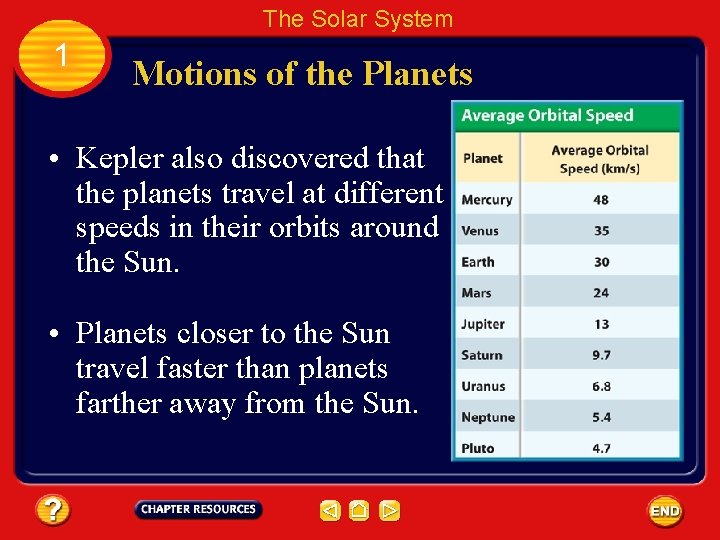
The Solar System 1 Motions of the Planets • Kepler also discovered that the planets travel at different speeds in their orbits around the Sun. • Planets closer to the Sun travel faster than planets farther away from the Sun.
Section Check 1 Question 1 _____ gravity holds the solar system together. A. Earth’s B. Jupiter’s C. The Moon’s D. The Sun’s
Section Check 1 Answer The answer is D. Earth’s gravity holds the Moon in its orbit; the Sun’s gravity holds the solar system together.
Section Check 1 Question 2 The Sun, nine planets, and many smaller objects that orbit the Sun make up the _____. A. galaxy B. solar system C. inner planets D. outer planets
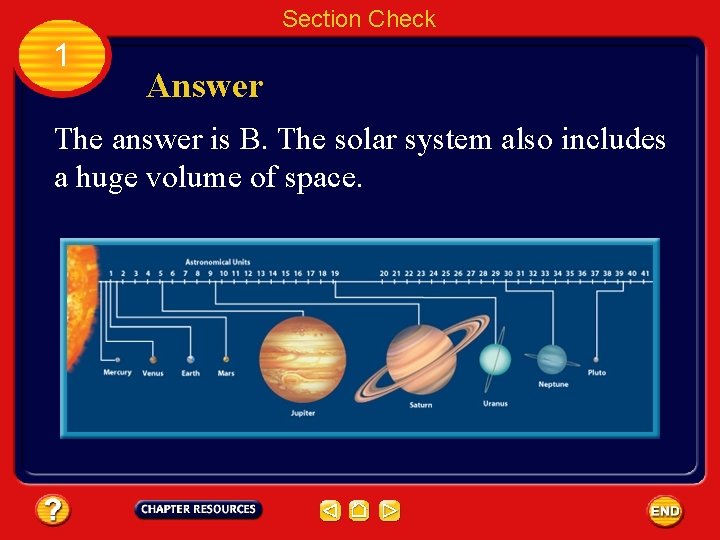
Section Check 1 Answer The answer is B. The solar system also includes a huge volume of space.
Section Check 1 Question 3 _____ developed the first Sun-centered model of the solar system. A. Euripides B. Copernicus C. Galileo D. Kepler
Section Check 1 Answer The answer is B. Nicholas Copernicus published his Sun-centered model in 1543.
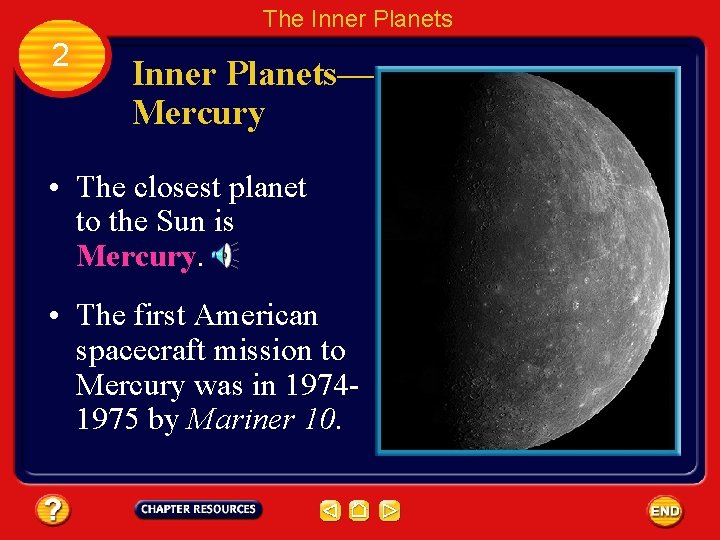
The Inner Planets 2 Inner Planets— Mercury • The closest planet to the Sun is Mercury. • The first American spacecraft mission to Mercury was in 19741975 by Mariner 10.
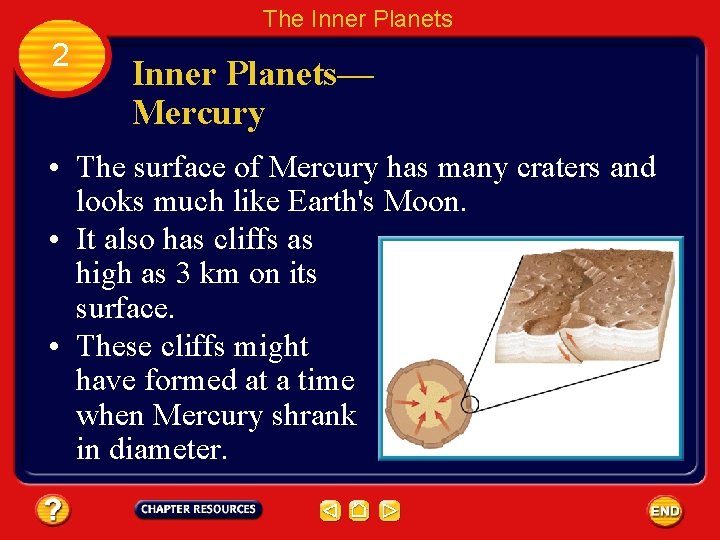
The Inner Planets 2 Inner Planets— Planets Mercury • The surface of Mercury has many craters and looks much like Earth's Moon. • It also has cliffs as high as 3 km on its surface. • These cliffs might have formed at a time when Mercury shrank in diameter.
The Inner Planets 2 Inner Planets—Mercury Planets • Why would Mercury have shrunk? • Mariner 10 detected a weak magnetic field around Mercury. • This indicates that the planet has an iron core.
The Inner Planets 2 Inner Planets—Mercury Planets • Scientists hypothesize that Mercury's crust solidified while the iron core was still hot and molten. • As the core started to solidify, it contracted.
The Inner Planets 2 Does Mercury have an atmosphere? • Because of Mercury's low gravitational pull and high daytime temperatures, most gases that could form an atmosphere escape into space. • Hydrogen and helium gas that were first thought to be an atmosphere are now known to be temporarily taken from the solar wind.
The Inner Planets 2 Does Mercury have an atmosphere? • Earth-based observations have found traces of sodium and potassium around Mercury. • These atoms probably come from rocks in the planet’s crust. • Therefore, Mercury has no true atmosphere. • Mercury's temperature can reach 425 C during the day, and it can drop to – 170 C at night.
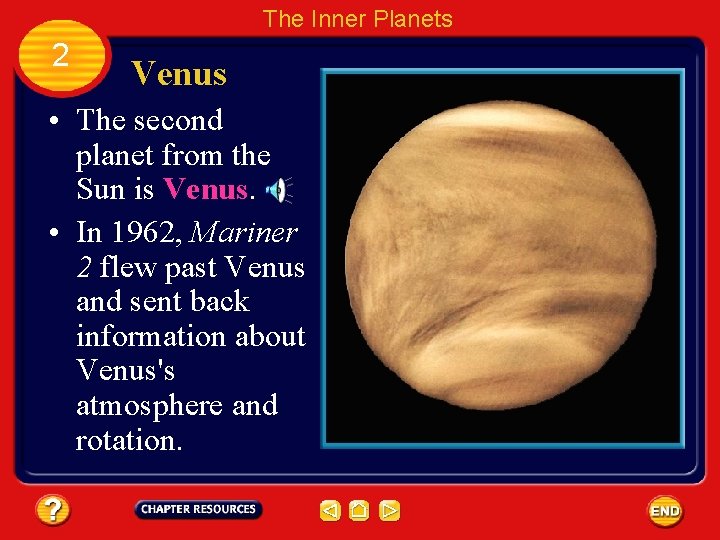
The Inner Planets 2 Venus • The second planet from the Sun is Venus. • In 1962, Mariner 2 flew past Venus and sent back information about Venus's atmosphere and rotation.
The Inner Planets 2 Venus • Between 1990 and 1994, the U. S. Magellan probe used its radar to make the most detailed maps yet of Venus's surface. • Clouds on Venus are so dense that only a small percentage of the sunlight that strikes the top of the clouds reaches the planet’s surface.
The Inner Planets 2 Venus • The sunlight that does get through warms Venus's surface, which then gives off heat to the atmosphere. • Much of this heat is absorbed by carbon dioxide gas in Venus’s atmosphere.
The Inner Planets 2 Venus • This causes a greenhouse effect. • Due to this intense greenhouse effect, the temperature on the surface of Venus is between 450°C and 475°C.
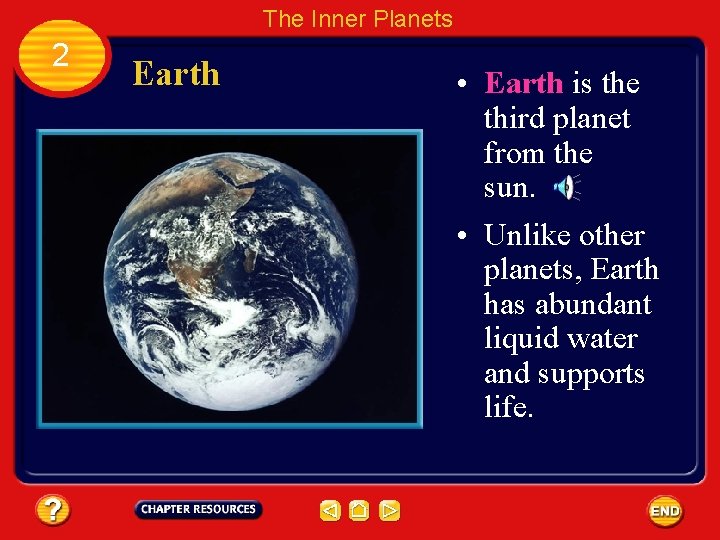
The Inner Planets 2 Earth • Earth is the third planet from the sun. • Unlike other planets, Earth has abundant liquid water and supports life.
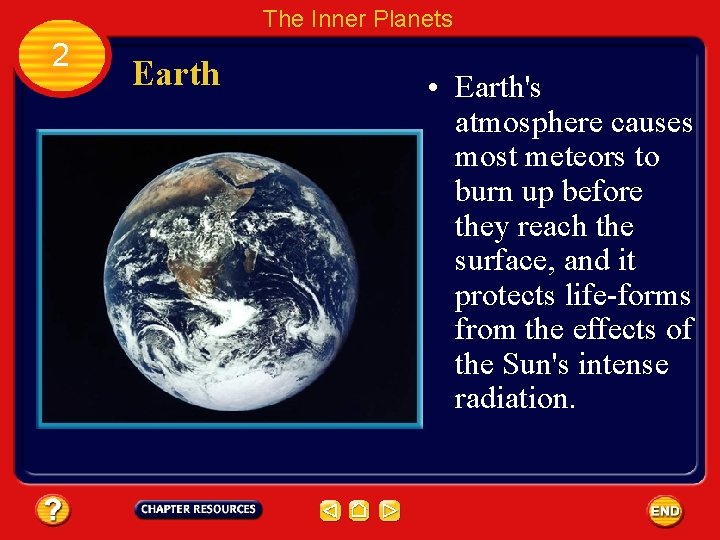
The Inner Planets 2 Earth • Earth's atmosphere causes most meteors to burn up before they reach the surface, and it protects life-forms from the effects of the Sun's intense radiation.
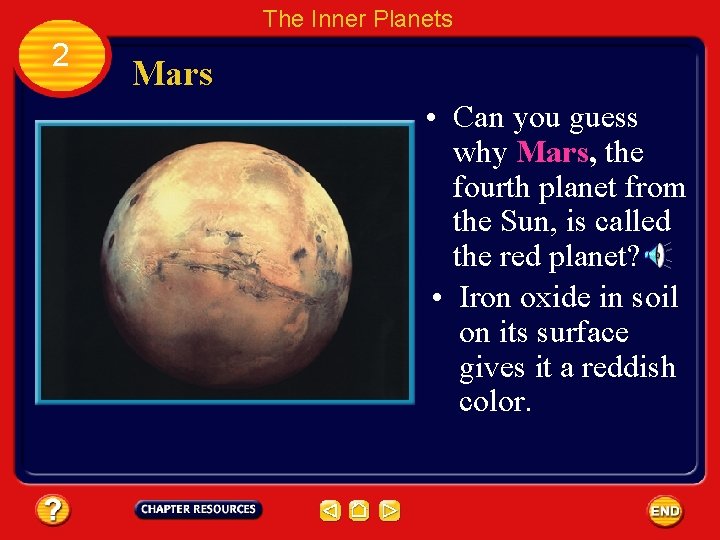
The Inner Planets 2 Mars • Can you guess why Mars, the fourth planet from the Sun, is called the red planet? • Iron oxide in soil on its surface gives it a reddish color.
The Inner Planets 2 Mars • Other features visible from Earth are Mars's polar ice caps and changes in the coloring of the planet’s surface. • The ice caps are made of frozen water covered by a layer of frozen carbon dioxide.
The Inner Planets 2 Mars • Most of the information scientists have about Mars came from Mariner 9, the Viking probes, Mars Pathfinder, Mars Global Surveyor, and Mars Odyssey. • Mariner 9 revealed long channels on the planet that might have been carved by flowing water. • Mariner 9 also discovered the largest volcano in the solar system, Olympus Mons.
The Inner Planets 2 Mars • Olympus Mons is probably extinct. • Large rift valleys that formed in the Martian crust also were discovered.
The Inner Planets 2 The Viking Probes • The Viking 1 and 2 probes arrived at Mars in 1976. • Each spacecraft consisted of an orbiter and a lander. • The Viking 1 and 2 orbiters photographed the entire surface of Mars, while the Viking 1 and 2 landers touched down on the planet’s surface.
The Inner Planets 2 The Viking Probes • The landers carried equipment to detect possible life on Mars. • These experiments found no conclusive evidence of life on Mars.
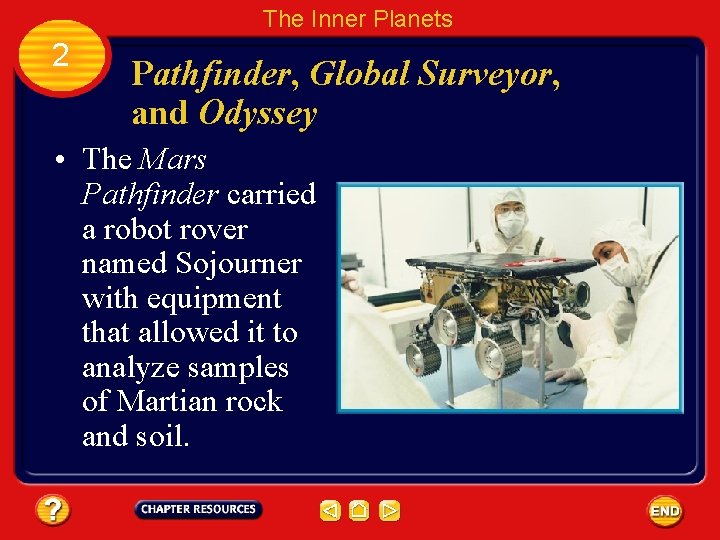
The Inner Planets 2 Pathfinder, Global Surveyor, and Odyssey • The Mars Pathfinder carried a robot rover named Sojourner with equipment that allowed it to analyze samples of Martian rock and soil.
The Inner Planets 2 Pathfinder, Global Surveyor, and Odyssey • Cameras onboard Global Surveyor showed features that look like gullies formed by flowing water and deposits of sediment carried by the water flows.
The Inner Planets 2 Pathfinder, Global Surveyor, and Odyssey • The features are young enough that scientists are considering the idea that liquid groundwater might exist on Mars and that it sometimes reaches the surface.
The Inner Planets 2 Pathfinder, Global Surveyor, and Odyssey • Instruments on another probe called Mars Odyssey detected frozen water on Mars. • The water occurs as frost beneath a thin layer of soil.
The Inner Planets 2 Mars's Atmosphere • Mars's atmosphere is much thinner than Earth's. It is composed mostly of carbon dioxide, with some nitrogen and argon. Surface temperatures range from – 125 C to 35 C.
The Inner Planets 2 Martian Seasons • Mars goes through seasons as it orbits the Sun, just like Earth does. • The polar ice caps on Mars change with the season. • During winter, carbon dioxide ice accumulates and makes the ice cap larger.
The Inner Planets 2 Martian Seasons • During summer, carbon dioxide ice changes to carbon dioxide gas and the ice cap shrinks. • The color of the ice caps and other areas on Mars also changes with the season. • The movement of dust and sand during dust storms causes the changing colors.
The Inner Planets 2 Martian Moons • Mars has two small, irregularly shaped moons that are heavily cratered. • Phobos is about 25 km in length, and Deimos is about 13 km in length.
The Inner Planets 2 Martian Moons • Phobos has many interesting surface features. • Grooves and chains of smaller craters seem to radiate out from the large Stickney Crater. • These features probably are the result of the large impact that formed the Stickney Crater.
The Inner Planets 2 Martian Moons • Deimos is among the smallest known moons in the solar system. • Its surface is smoother in appearance than that of Phobos because some of its craters have partially filled with soil and rock.
Section Check 2 Question 1 Which planet is closest to the Sun? A. Mars B. Mercury C. Earth D. Venus
Section Check 2 Answer The answer is B. Mercury is the closest planet to the Sun. Venus is the second planet from the Sun.
Section Check 2 Question 2 Which planet has size and mass similar to Earth’s? A. Jupiter B. Mercury C. Pluto D. Venus
Section Check 2 Answer The answer is D. Venus has similar size and mass but the temperatures on its surface are between 450º C and 475º C.
Section Check 2 Question 3 Earth is the _____ planet from the Sun. A. second B. third C. fourth D. fifth
Section Check 2 Answer The answer is B. Mercury and Venus are closer to the Sun than Earth.
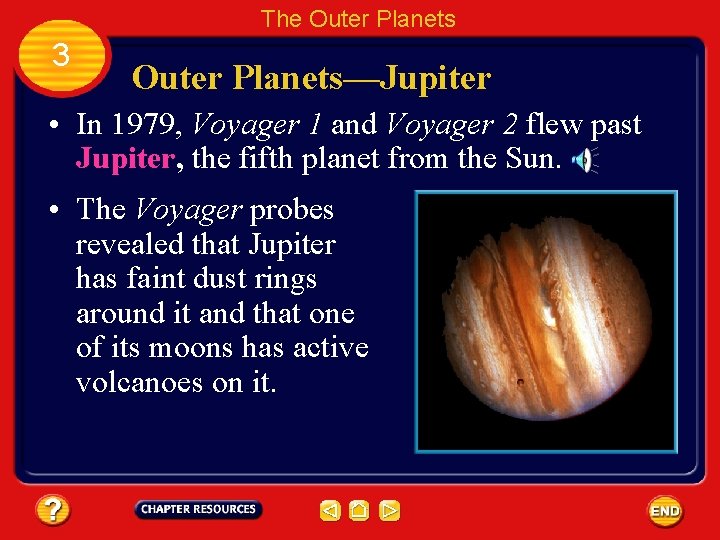
The Outer Planets 3 Outer Planets—Jupiter • In 1979, Voyager 1 and Voyager 2 flew past Jupiter, the fifth planet from the Sun. • The Voyager probes revealed that Jupiter has faint dust rings around it and that one of its moons has active volcanoes on it.
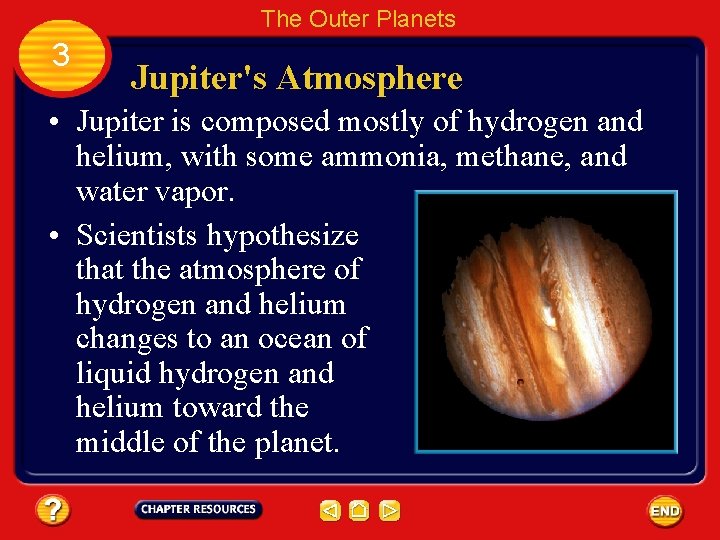
The Outer Planets 3 Jupiter's Atmosphere • Jupiter is composed mostly of hydrogen and helium, with some ammonia, methane, and water vapor. • Scientists hypothesize that the atmosphere of hydrogen and helium changes to an ocean of liquid hydrogen and helium toward the middle of the planet.
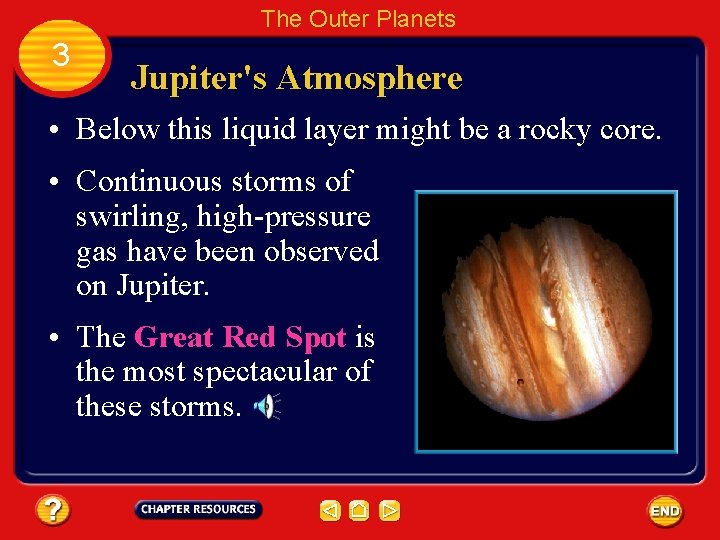
The Outer Planets 3 Jupiter's Atmosphere • Below this liquid layer might be a rocky core. • Continuous storms of swirling, high-pressure gas have been observed on Jupiter. • The Great Red Spot is the most spectacular of these storms.
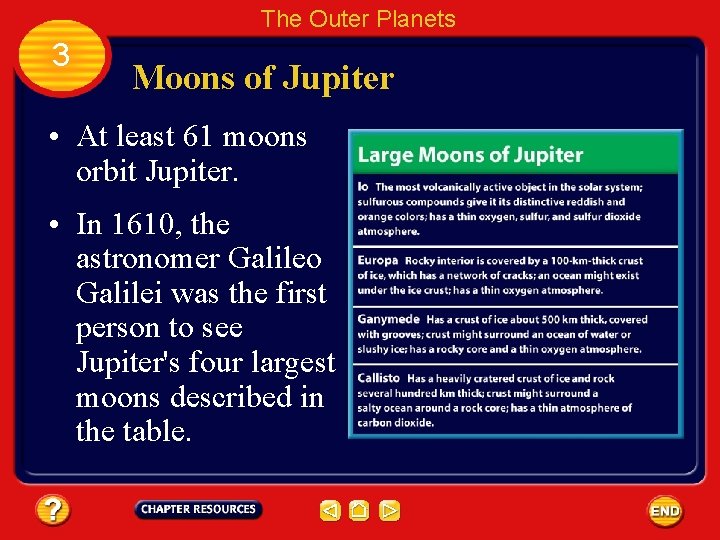
The Outer Planets 3 Moons of Jupiter • At least 61 moons orbit Jupiter. • In 1610, the astronomer Galileo Galilei was the first person to see Jupiter's four largest moons described in the table.
The Outer Planets 3 Saturn • The Voyager probes surveyed Saturn in 1980 and 1981. • Saturn is the sixth planet from the Sun. • It is the second-largest planet in the solar system, but it has the lowest density.
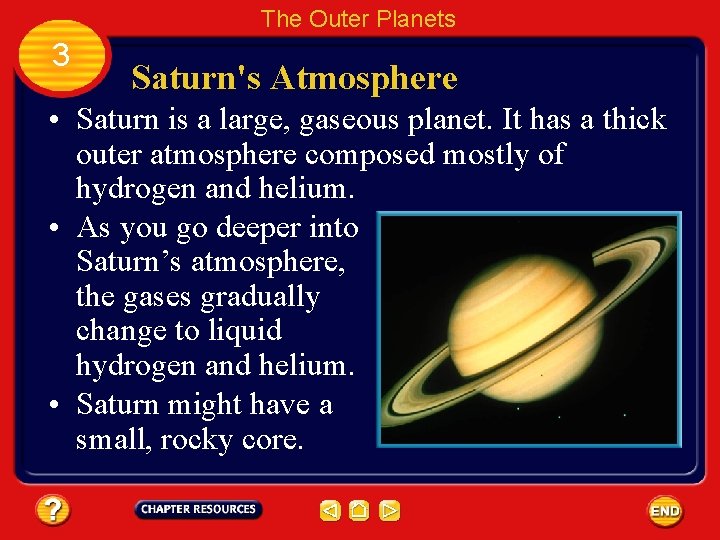
The Outer Planets 3 Saturn's Atmosphere • Saturn is a large, gaseous planet. It has a thick outer atmosphere composed mostly of hydrogen and helium. • As you go deeper into Saturn’s atmosphere, the gases gradually change to liquid hydrogen and helium. • Saturn might have a small, rocky core.
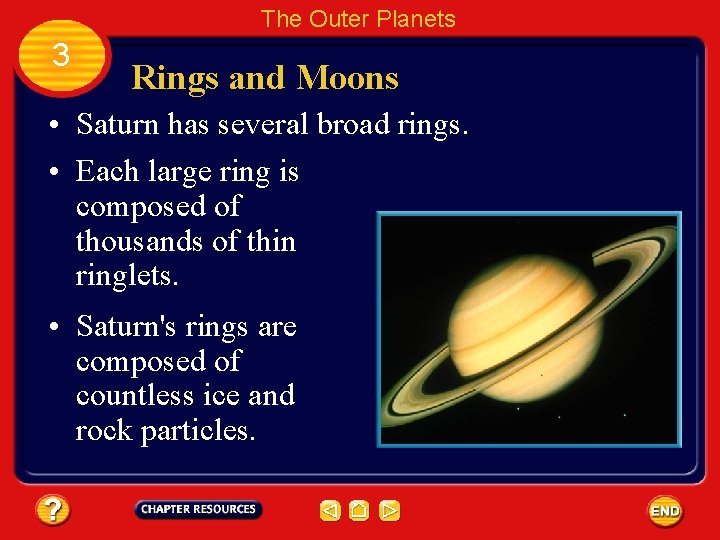
The Outer Planets 3 Rings and Moons • Saturn has several broad rings. • Each large ring is composed of thousands of thin ringlets. • Saturn's rings are composed of countless ice and rock particles.
The Outer Planets 3 Rings and Moons • At least 31 moons orbit Saturn. • The largest of Saturn's moons, Titan, is larger than the planet Mercury. • It has an atmosphere of nitrogen, argon, and methane.
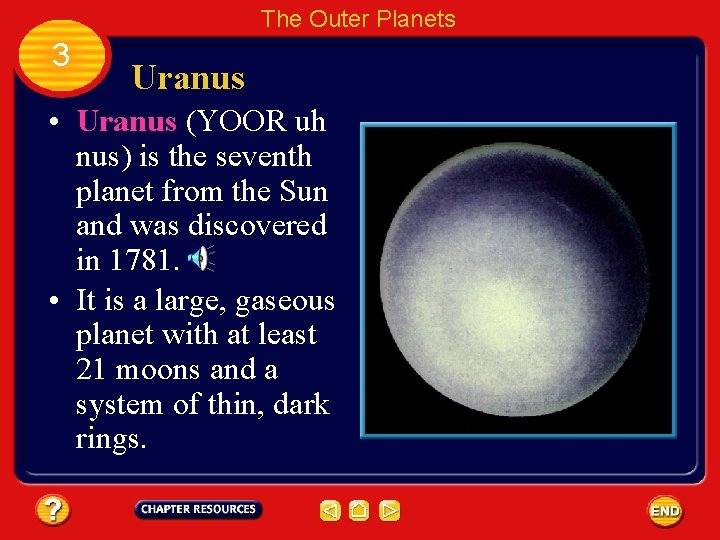
The Outer Planets 3 Uranus • Uranus (YOOR uh nus) is the seventh planet from the Sun and was discovered in 1781. • It is a large, gaseous planet with at least 21 moons and a system of thin, dark rings.
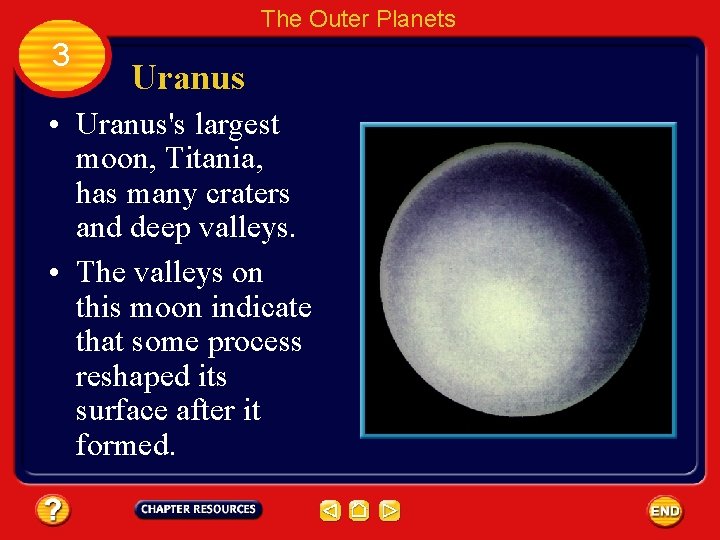
The Outer Planets 3 Uranus • Uranus's largest moon, Titania, has many craters and deep valleys. • The valleys on this moon indicate that some process reshaped its surface after it formed.
The Outer Planets 3 Uranus's Characteristics • The atmosphere of Uranus is composed of hydrogen, helium, and some methane. • Methane gives the planet bluish green color. • Evidence suggests that under its atmosphere, Uranus has a mantle of liquid water, methane, and ammonia surrounding a rocky core.
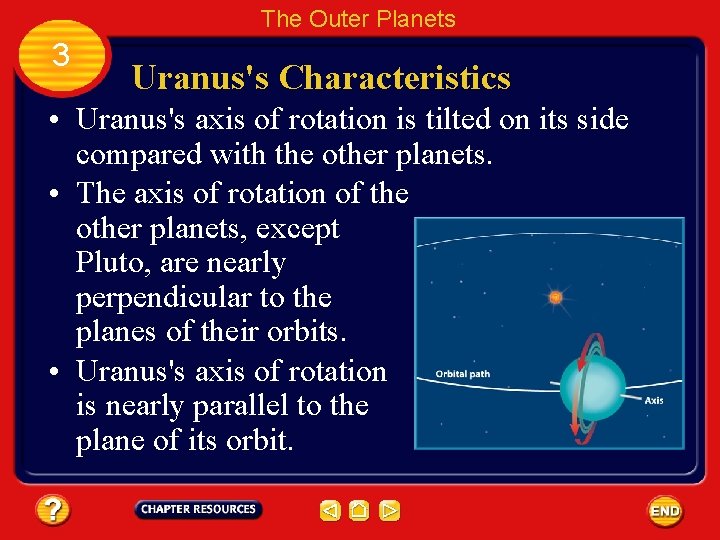
The Outer Planets 3 Uranus's Characteristics • Uranus's axis of rotation is tilted on its side compared with the other planets. • The axis of rotation of the other planets, except Pluto, are nearly perpendicular to the planes of their orbits. • Uranus's axis of rotation is nearly parallel to the plane of its orbit.
The Outer Planets 3 Neptune • Discovered in 1846, Neptune is usually the eighth planet from the Sun. However, Pluto's orbit crosses inside Neptune's during part of its voyage around the Sun. • Between 1979 and 1999, Pluto was closer to the Sun than was Neptune.
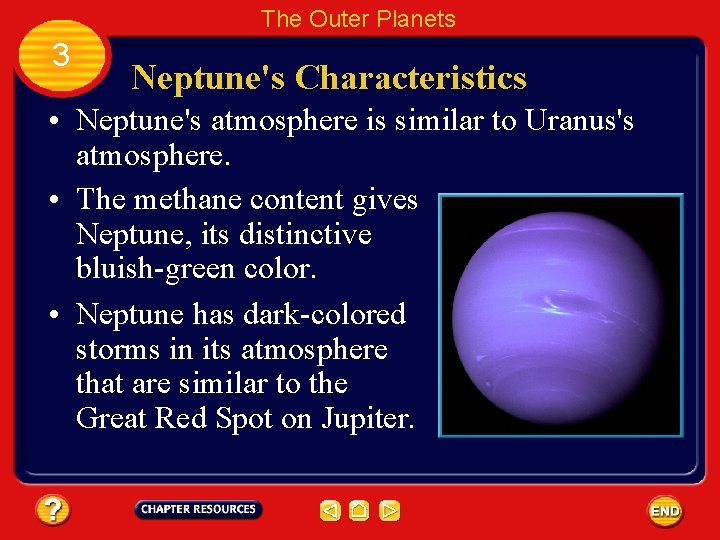
The Outer Planets 3 Neptune's Characteristics • Neptune's atmosphere is similar to Uranus's atmosphere. • The methane content gives Neptune, its distinctive bluish-green color. • Neptune has dark-colored storms in its atmosphere that are similar to the Great Red Spot on Jupiter.
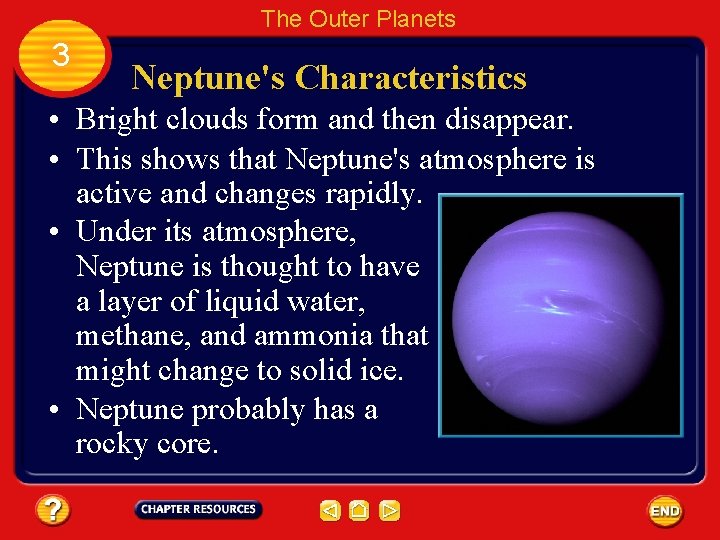
The Outer Planets 3 Neptune's Characteristics • Bright clouds form and then disappear. • This shows that Neptune's atmosphere is active and changes rapidly. • Under its atmosphere, Neptune is thought to have a layer of liquid water, methane, and ammonia that might change to solid ice. • Neptune probably has a rocky core.
The Outer Planets 3 Neptune's Characteristics • Neptune has at least 11 moons and several rings. • Triton, is Neptune's largest moon. • Neptune's rings are young and probably won't last very long.
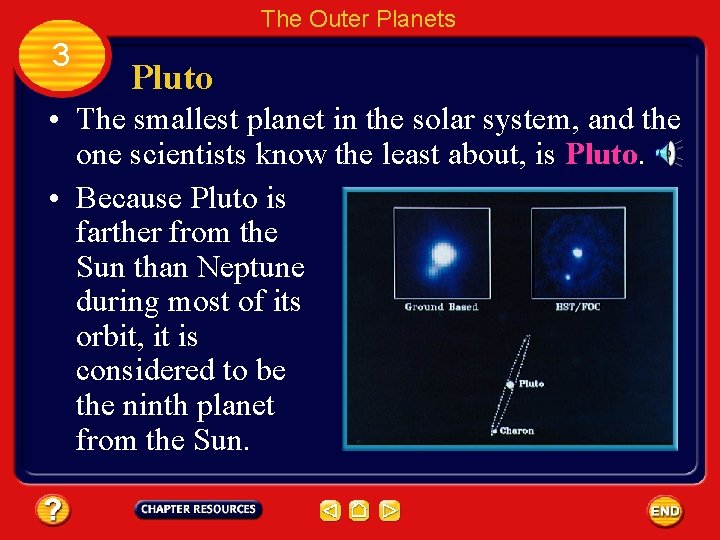
The Outer Planets 3 Pluto • The smallest planet in the solar system, and the one scientists know the least about, is Pluto. • Because Pluto is farther from the Sun than Neptune during most of its orbit, it is considered to be the ninth planet from the Sun.
The Outer Planets 3 Pluto • Pluto is vastly different from the other outer planets. • It's surrounded by only a thin atmosphere, and it's the only outer planet with a solid, icy-rock surface.
The Outer Planets 3 Pluto's Moon • Pluto's single moon, Charon, has a diameter about half the size of Pluto's. • Because of their close size and orbit, some scientists consider them to be a double planet.
The Outer Planets 3 Pluto's Moon • Data from the Hubble Space Telescope indicate the presence of a vast disk of icy objects called the Kuiper Belt beyond Neptune's orbits. • Many astronomers think that Pluto and Charon are members of the Kuiper Belt.
Section Check 3 Question 1 The fifth planet from the Sun is _____. A. Jupiter B. Neptune C. Saturn D. Pluto
Section Check 3 Answer The answer is A. Jupiter is the largest planet in the solar system.
Section Check 3 Question 2 Which of Jupiter’s large moons is closest to Jupiter and the most volcanically active object in the solar system? A. Callisto B. Europa C. Ganymede D. Io
Section Check 3 Answer The answer is D. Jupiter exerts tremendous gravitational pull on Io.
Section Check 3 Question 3 It takes Pluto _____ to orbit the Sun one time. A. 2 years B. 24 years C. 124 years D. 248 years
Section Check 3 Answer The answer is D. During part of its orbit, Pluto is closer to the Sun than Neptune, but is still considered to be the ninth planet from the Sun.
Other Objects in the Solar System 4 Comets • Comets, meteoroids and asteroids are other important objects in the solar system. • A comet is composed of dust and rock particles mixed with frozen water, methane, and ammonia.
Other Objects in the Solar System 4 Oort Cloud • Astronomer Jan Oort proposed the idea that billions of comets surround the solar system. • This cloud of comets, called the Oort Cloud, is located beyond the orbit of Pluto. • Oort suggested that the gravities of the Sun and nearby stars interact with comets in the Oort Cloud.

Other Objects in the Solar System 4 Comet Hale-Bopp • On July 23, 1995, two amateur astronomers made an exciting discovery. • A new comet, Comet Hale. Bopp, was headed toward the Sun. • Larger than most that approach the Sun, it was the brightest comet visible from Earth in 20 years.
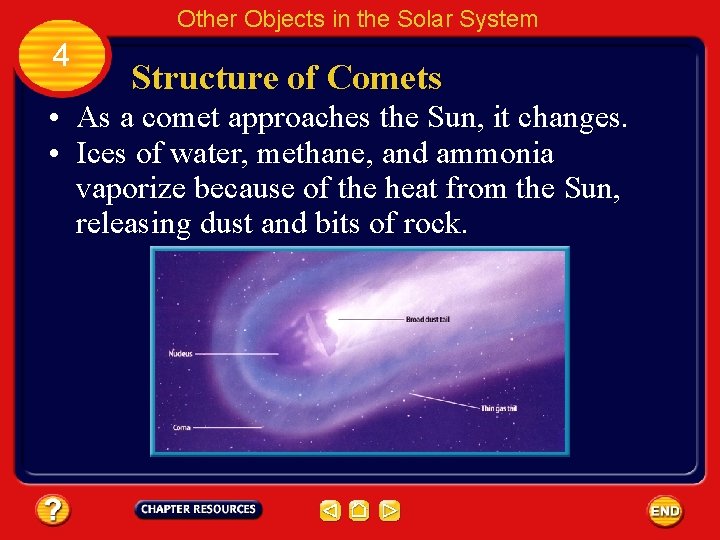
Other Objects in the Solar System 4 Structure of Comets • As a comet approaches the Sun, it changes. • Ices of water, methane, and ammonia vaporize because of the heat from the Sun, releasing dust and bits of rock.
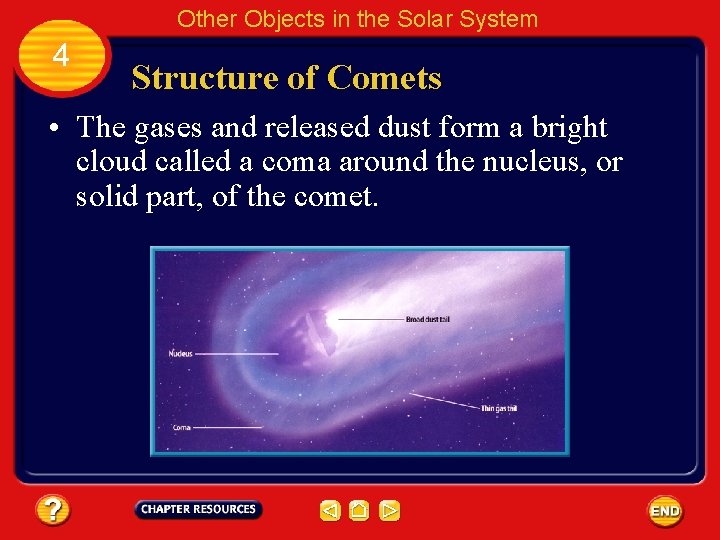
Other Objects in the Solar System 4 Structure of Comets • The gases and released dust form a bright cloud called a coma around the nucleus, or solid part, of the comet.

Other Objects in the Solar System 4 Structure of Comets • The solar wind pushes on the gases and dust in the coma, causing the particles to form separate tails that point away from the Sun. • After many trips around the Sun, most of the ice in a comet's nucleus has vaporized. • All that's left are dust and rock, which are spread throughout the orbit of the original comet.
Other Objects in the Solar System 4 Meteoroids, Meteors, and Meteorites • The small pieces from the comet's nucleus spread out into a loose group within the original orbit of the comet. • These pieces of dust and rock, along with those derived from other sources, are called meteoroids.
Other Objects in the Solar System 4 Meteoroids, Meteors, and Meteorites • Most meteoroids are so small that they completely burn up in Earth's atmosphere. • A meteoroid that burns up in Earth's atmosphere is called a meteor.
Other Objects in the Solar System 4 Meteor Showers • Each time Earth passes through the loose group of particles within the old orbit of a comet, many small particles of rock and dust enter the atmosphere. • Because more meteors than usual are seen, the event is called a meteor shower.
Other Objects in the Solar System 4 Meteor Showers • When a meteoroid is large enough, it might not burn up completely in the atmosphere. • If it strikes Earth, it is called a meteorite. • Most meteorites are probably debris from asteroid collisions or broken-up comets, but some originate from the Moon and Mars.
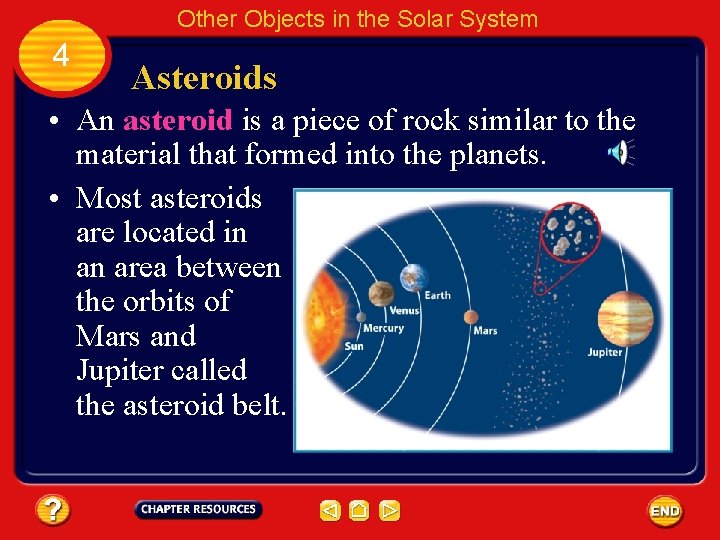
Other Objects in the Solar System 4 Asteroids • An asteroid is a piece of rock similar to the material that formed into the planets. • Most asteroids are located in an area between the orbits of Mars and Jupiter called the asteroid belt.
Other Objects in the Solar System 4 Asteroids • Other asteroids are scattered throughout the solar system. • They might have been thrown out of the belt by Jupiter's gravity. • Scientists monitor the positions of these asteroids. However, it is unlikely that an asteroid will hit Earth in the near future.
Other Objects in the Solar System 4 Exploring Asteroids • The sizes of the asteroids in the asteroid belt range from tiny particles to objects 940 km in diameter. • Ceres is the largest and the first one discovered. • The next three in order of size are Vesta (530 km), Pallas (522 km), and 10 Hygiea (430 km).
Other Objects in the Solar System 4 NEAR • On February 14, 2000, the Near Earth Asteroid Rendezvous (NEAR) spacecraft went into orbit around the asteroid 433 Eros and successfully began its one-year mission of data gathering. • On February 12, 2001, NEAR ended its mission by becoming the first spacecraft to land softly on an asteroid.
Section Check 4 Question 1 A _____ is composed of dust and rock particles mixed with frozen water, methane and ammonia. A. asteroid B. comet C. planet D. sun
Section Check 4 Answer The answer is B. Some comets, such as Hale. Bopp, are named after the astronomers who discover them.
Section Check 4 Question 2 Small pieces from a comet’s nucleus that spread out into a loose group are called ______. A. asteroids B. meteorites C. meteoroids D. meteors
Section Check 4 Answer The answer is C. A meteoroid that burns up in Earth’s atmosphere is called a meteor.
Section Check 4 Question 3 What is a meteorite? Answer Meteorites are meteoroids that strike Earth.
Help To advance to the next item or next page click on any of the following keys: mouse, space bar, enter, down or forward arrow. Click on this icon to return to the table of contents Click on this icon to return to the previous slide Click on this icon to move to the next slide Click on this icon to open the resources file. Click on this icon to go to the end of the presentation.
End of Chapter Summary File
- Slides: 106