
Table of Contents Chapter Chemical Bonds Section 1

Table of Contents Chapter: Chemical Bonds Section 1: Stability in Bonding Section 2: Types of Bonds Section 3: Writing Formulas and Naming Compounds
Stability in Bonding 1 Compounds • Some of the matter around you is in the form of uncombined elements such as copper, sulfur, and oxygen. • Like many other sets of elements, these three elements unite chemically to form a compound when the conditions are right.
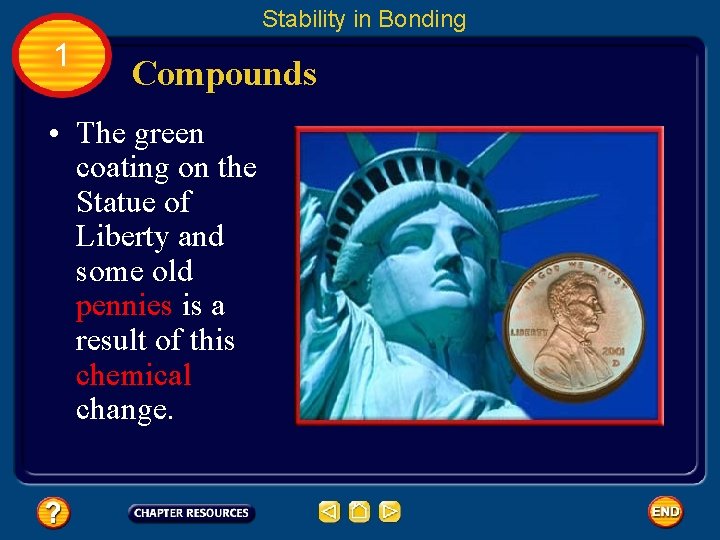
Stability in Bonding 1 Compounds • The green coating on the Statue of Liberty and some old pennies is a result of this chemical change.
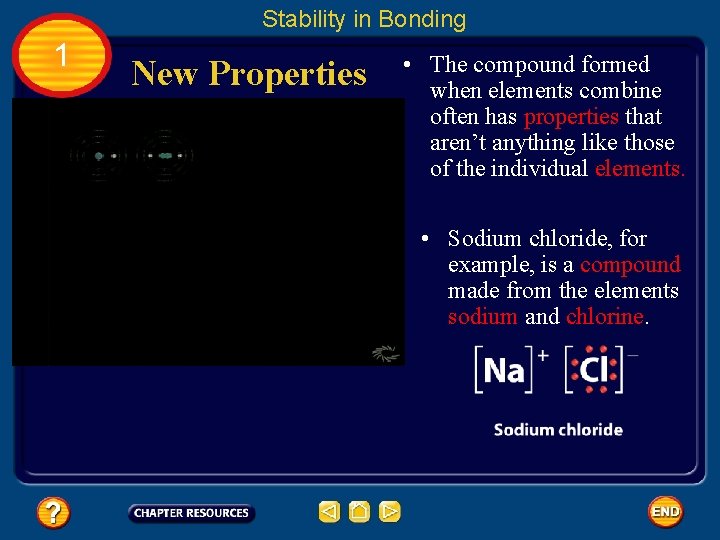
Stability in Bonding 1 New Properties • The compound formed when elements combine often has properties that aren’t anything like those of the individual elements. • Sodium chloride, for example, is a compound made from the elements sodium and chlorine.
Stability in Bonding 1 Formulas • A chemical formula tells what elements a compound contains and the exact number of atoms of each element in a unit of that compound. • The compound that you are probably most familiar with is H 2 O, more commonly known as water.
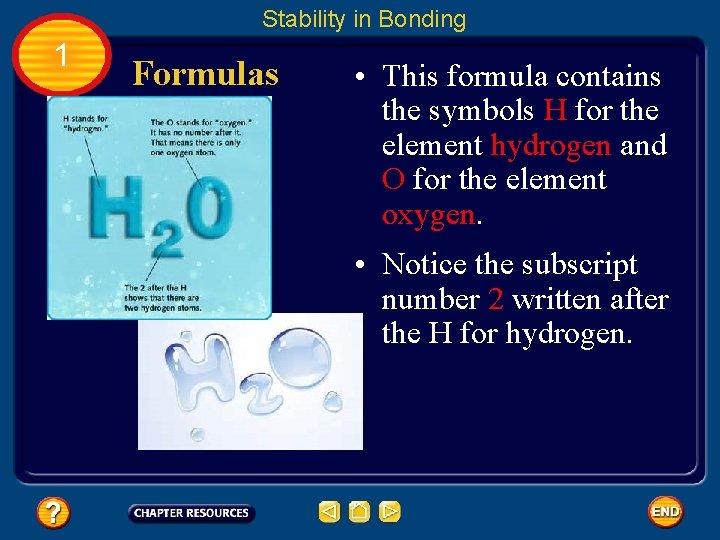
Stability in Bonding 1 Formulas • This formula contains the symbols H for the element hydrogen and O for the element oxygen. • Notice the subscript number 2 written after the H for hydrogen.
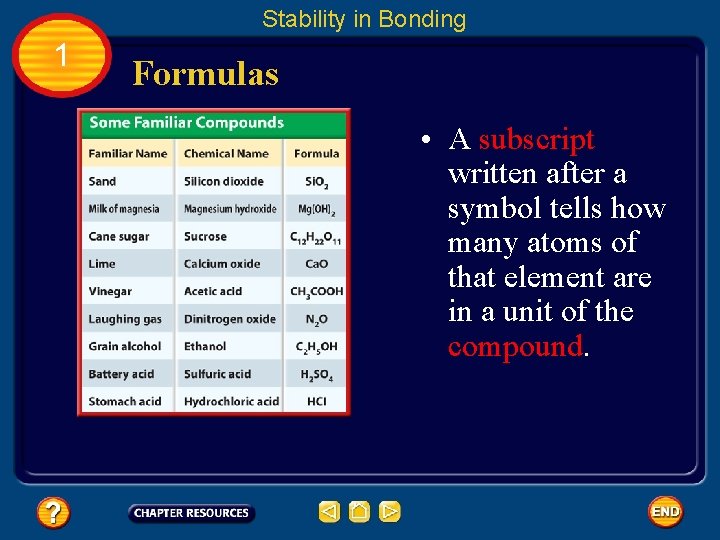
Stability in Bonding 1 Formulas • A subscript written after a symbol tells how many atoms of that element are in a unit of the compound.

Stability in Bonding 1 Formulas • If a symbol has no subscript, the unit contains only one atom of that element. A unit of H 2 O contains two hydrogen atoms and one oxygen atom.
Stability in Bonding 1 Atomic Stability • The electric forces between oppositely charged electrons and protons hold atoms and molecules together, and thus are the forces that cause compounds to form.
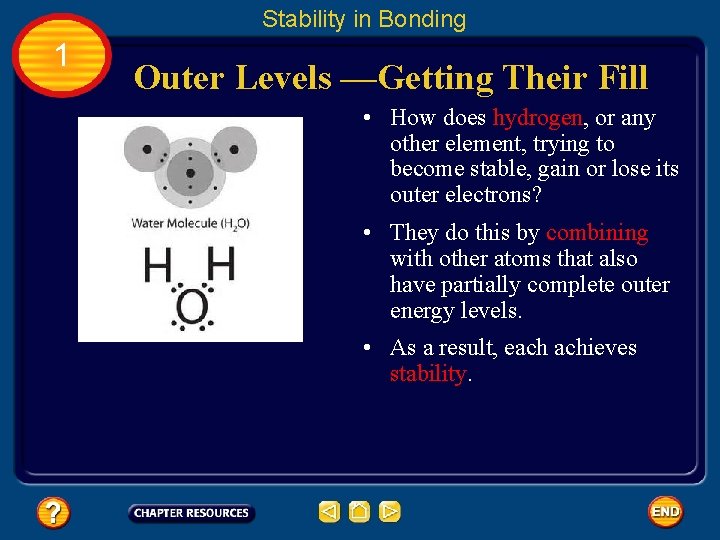
Stability in Bonding 1 Outer Levels —Getting Their Fill • How does hydrogen, or any other element, trying to become stable, gain or lose its outer electrons? • They do this by combining with other atoms that also have partially complete outer energy levels. • As a result, each achieves stability.
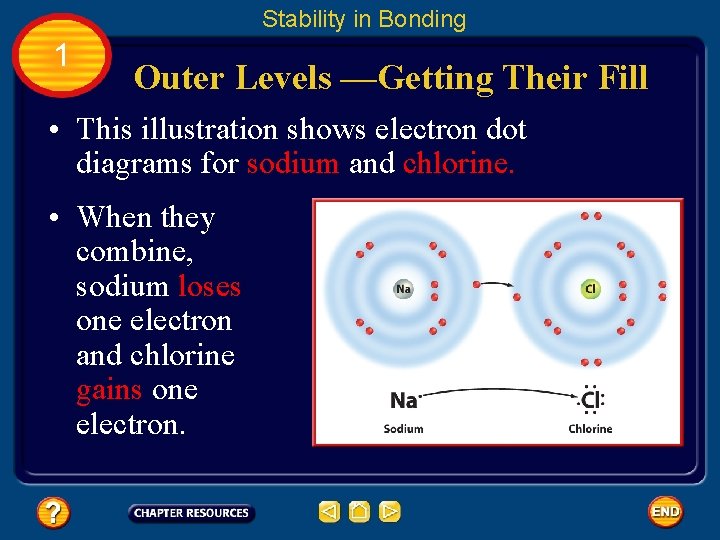
Stability in Bonding 1 Outer Levels —Getting Their Fill • This illustration shows electron dot diagrams for sodium and chlorine. • When they combine, sodium loses one electron and chlorine gains one electron.
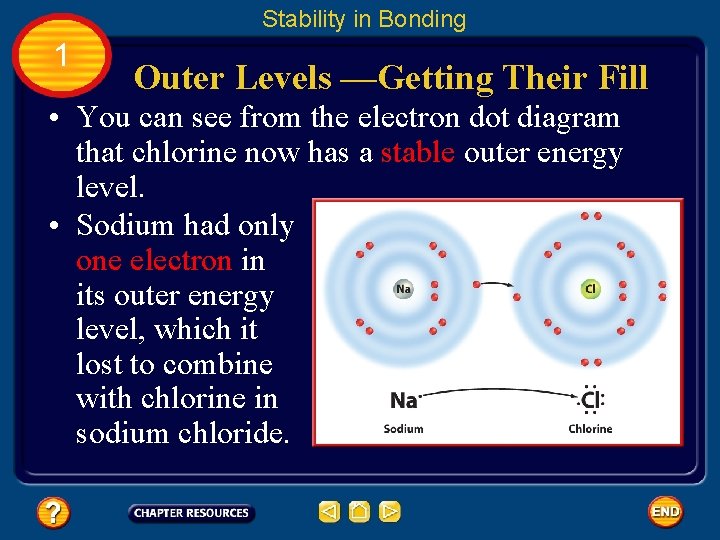
Stability in Bonding 1 Outer Levels —Getting Their Fill • You can see from the electron dot diagram that chlorine now has a stable outer energy level. • Sodium had only one electron in its outer energy level, which it lost to combine with chlorine in sodium chloride.
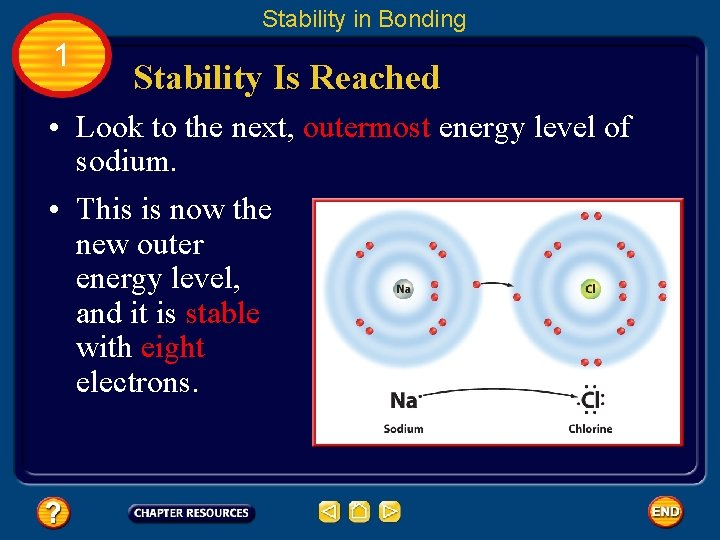
Stability in Bonding 1 Stability Is Reached • Look to the next, outermost energy level of sodium. • This is now the new outer energy level, and it is stable with eight electrons.
Stability in Bonding 1 Stability Is Reached • When atoms gain, lose, or share electrons, an attraction forms between the atoms, pulling them together to form a compound. • This attraction is called a chemical bond. A chemical bond is the force that holds atoms together in a compound.
Section Check 1 Question 1 What shows the elements a compound contains and how many atoms of each element are found in the compound?
Section Check 1 Answer A chemical formula is a form of chemical shorthand that tells what elements and how many atoms of each are in one molecule of a compound.
Section Check 1 Question 2 The number of _____ in each group’s outer energy level increases across the periodic table. A. B. C. D. electrons neutrons protons and neutrons
Section Check 1 Answer The answer is A. Protons and neutrons are located in the nucleus of the atom.
Section Check 1 Question 3 What is the force that holds atoms together in compounds? Answer The force that holds atoms together in compounds is a chemical bond.
- Slides: 20