
Table of Contents Chapter 7 Elements Basic Concepts
Table of Contents Chapter 7: Elements Basic Concepts Additional Concepts
Elements: Basic Concepts Periodic Properties of the Elements • Understanding the relationship between electron configuration and position in the periodic table enables you to predict the properties of the elements and the outcome of many chemical reactions.

Elements: Basic Concepts Behavior of Main Group Elements • Elements in the same group (vertical column) of the periodic table have the same number of valence electrons, and because of this, they have similar properties. • But elements in a period (horizontal row) have properties different from one another.
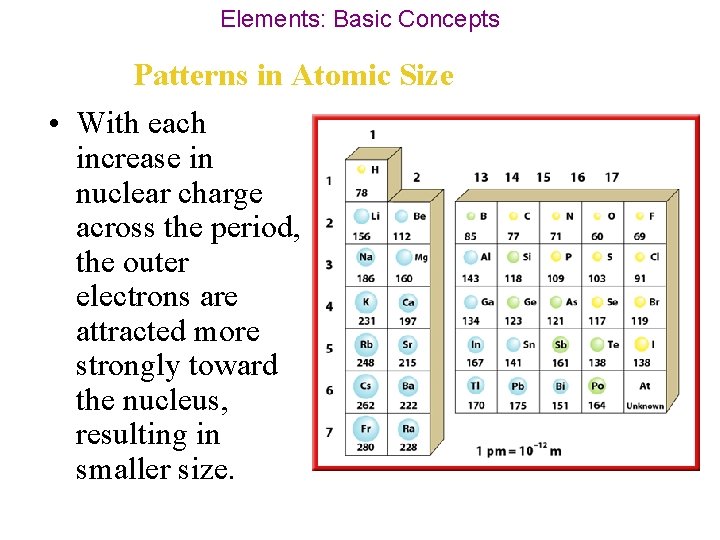
Elements: Basic Concepts Patterns in Atomic Size • With each increase in nuclear charge across the period, the outer electrons are attracted more strongly toward the nucleus, resulting in smaller size.
Elements: Basic Concepts Ionic Size • Atomic size is an important factor in the chemical reactivity of an element. • Ionic size is also important in determining how ions behave in solution and the structure of solid ionic compounds.
Elements: Basic Concepts Ionic Size • When metallic atoms lose one or more electrons to become positive ions, they acquire the configuration of the noble gas in the preceding period. • This means that the outermost electrons of the ion are in a lower energy level than the valence electrons of the neutral atom.
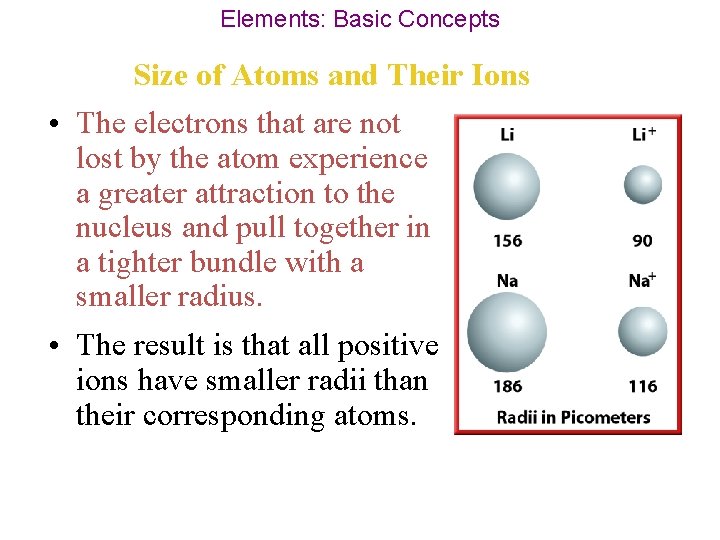
Elements: Basic Concepts Size of Atoms and Their Ions • The electrons that are not lost by the atom experience a greater attraction to the nucleus and pull together in a tighter bundle with a smaller radius. • The result is that all positive ions have smaller radii than their corresponding atoms.
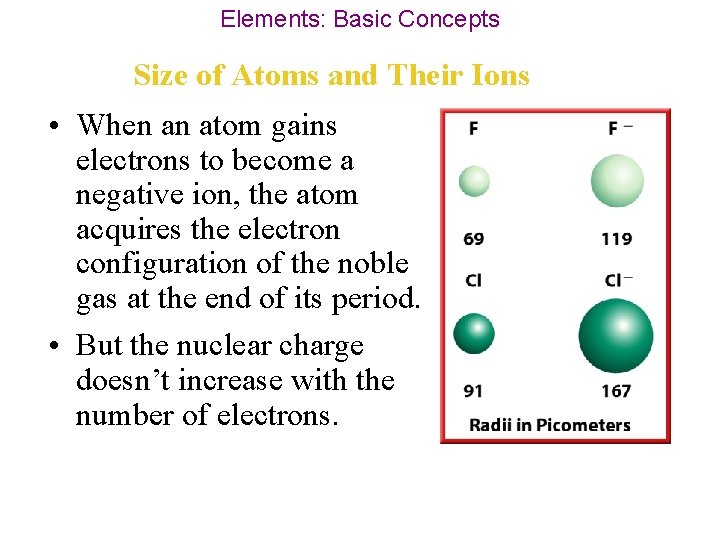
Elements: Basic Concepts Size of Atoms and Their Ions • When an atom gains electrons to become a negative ion, the atom acquires the electron configuration of the noble gas at the end of its period. • But the nuclear charge doesn’t increase with the number of electrons.
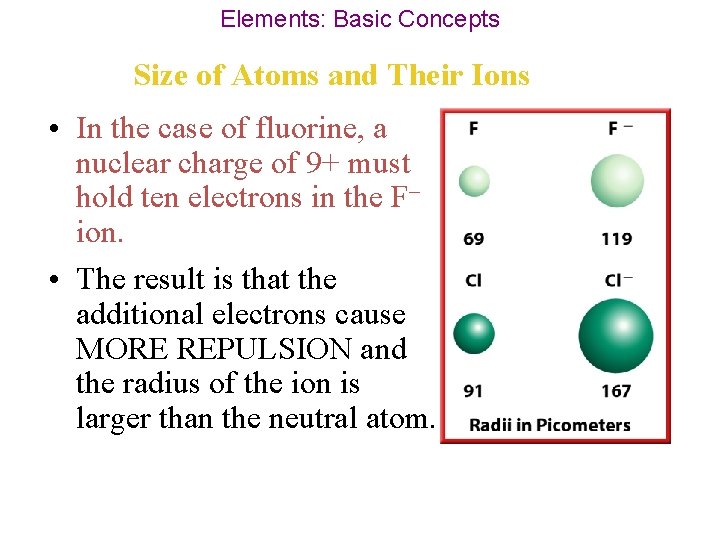
Elements: Basic Concepts Size of Atoms and Their Ions • In the case of fluorine, a nuclear charge of 9+ must hold ten electrons in the F– ion. • The result is that the additional electrons cause MORE REPULSION and the radius of the ion is larger than the neutral atom.
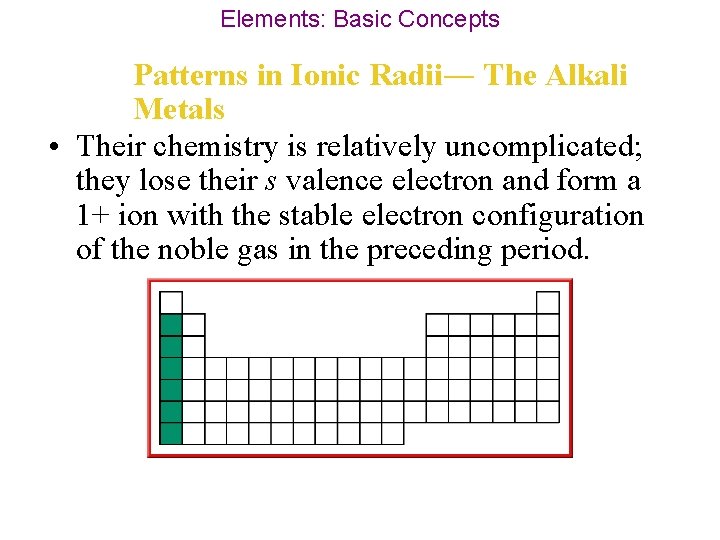
Elements: Basic Concepts Patterns in Ionic Radii― The Alkali Metals • Their chemistry is relatively uncomplicated; they lose their s valence electron and form a 1+ ion with the stable electron configuration of the noble gas in the preceding period.
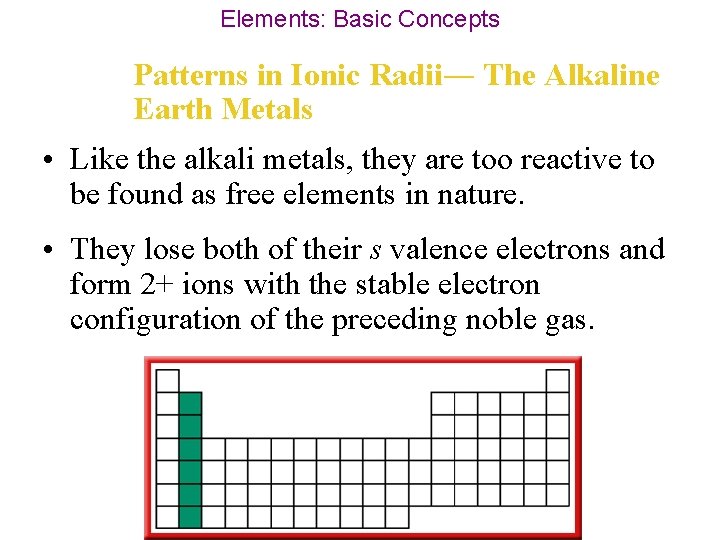
Elements: Basic Concepts Patterns in Ionic Radii― The Alkaline Earth Metals • Like the alkali metals, they are too reactive to be found as free elements in nature. • They lose both of their s valence electrons and form 2+ ions with the stable electron configuration of the preceding noble gas.
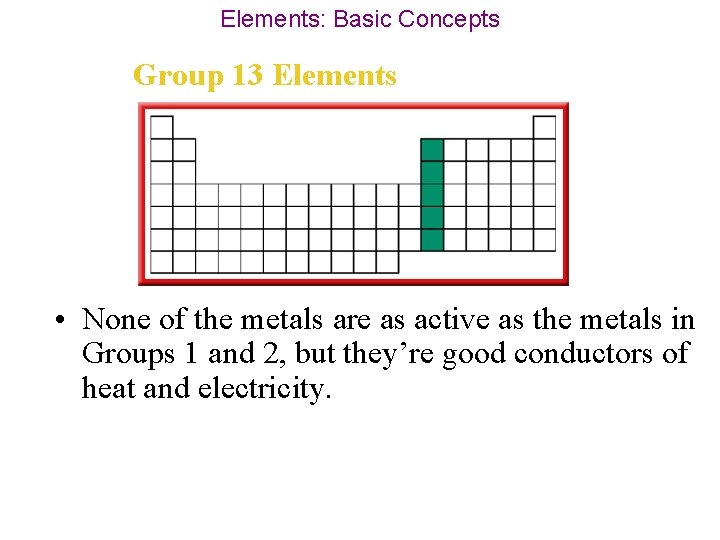
Elements: Basic Concepts Group 13 Elements • None of the metals are as active as the metals in Groups 1 and 2, but they’re good conductors of heat and electricity.
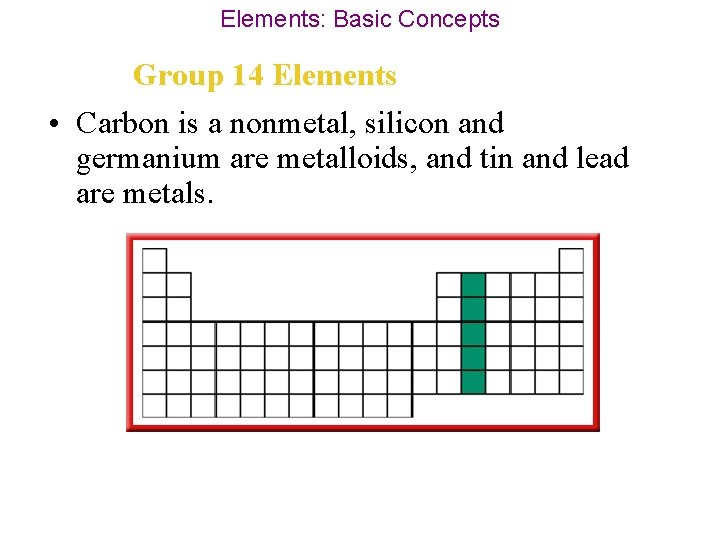
Elements: Basic Concepts Group 14 Elements • Carbon is a nonmetal, silicon and germanium are metalloids, and tin and lead are metals.
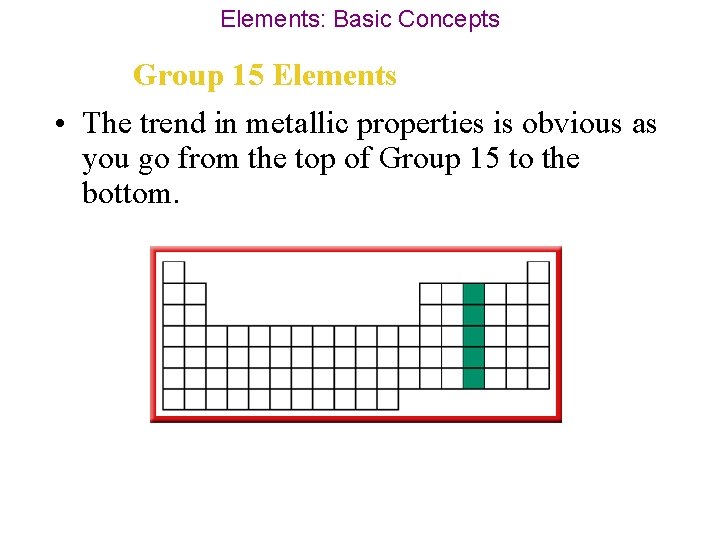
Elements: Basic Concepts Group 15 Elements • The trend in metallic properties is obvious as you go from the top of Group 15 to the bottom.
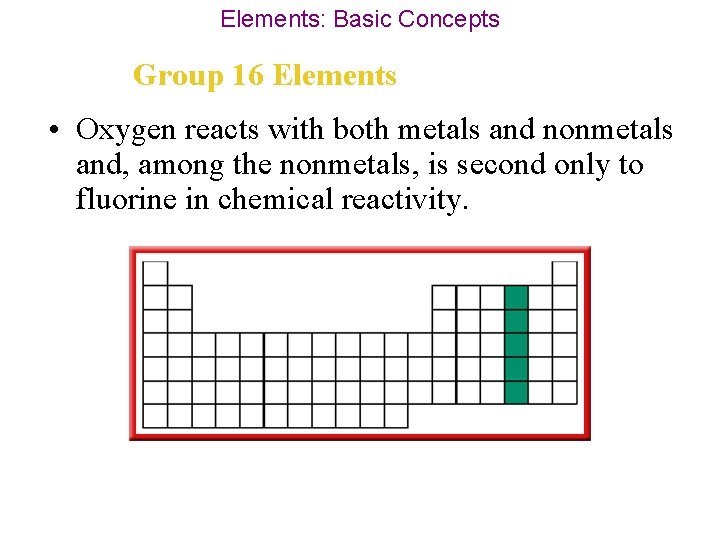
Elements: Basic Concepts Group 16 Elements • Oxygen reacts with both metals and nonmetals and, among the nonmetals, is second only to fluorine in chemical reactivity.
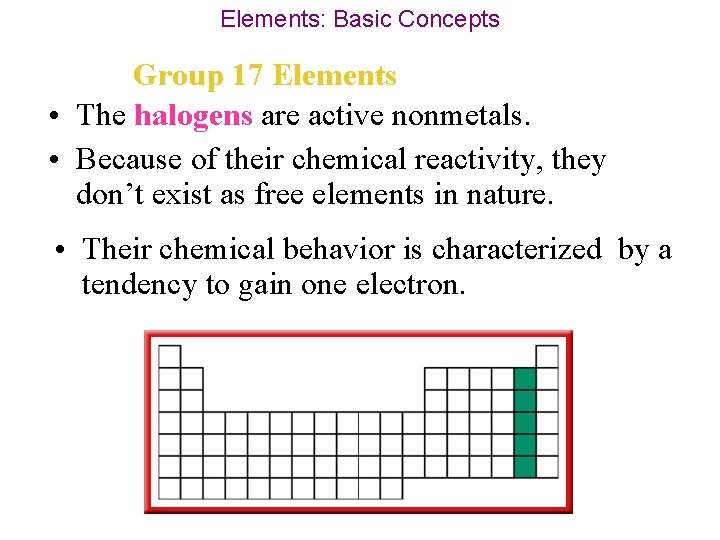
Elements: Basic Concepts Group 17 Elements • The halogens are active nonmetals. • Because of their chemical reactivity, they don’t exist as free elements in nature. • Their chemical behavior is characterized by a tendency to gain one electron.
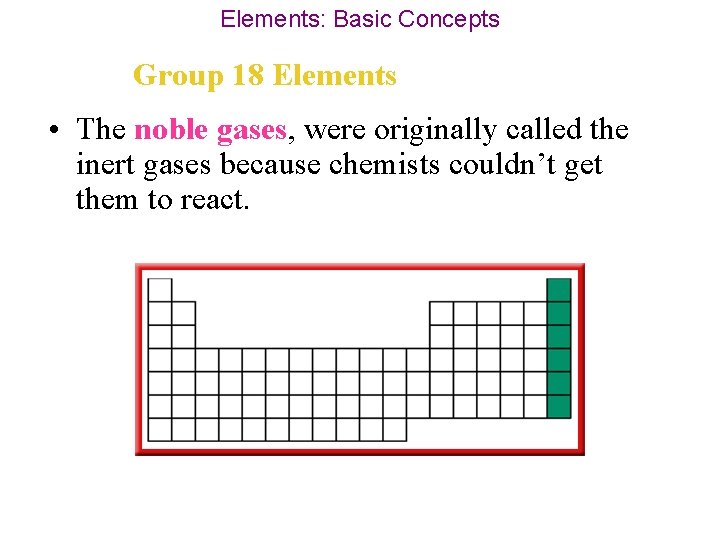
Elements: Basic Concepts Group 18 Elements • The noble gases, were originally called the inert gases because chemists couldn’t get them to react.
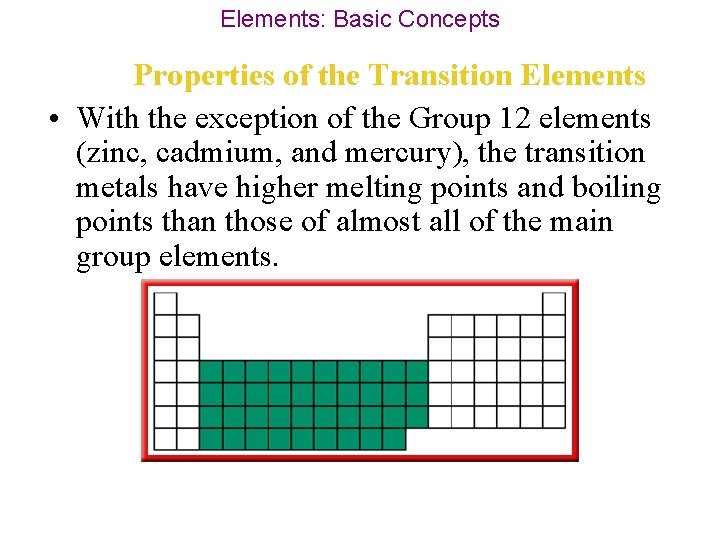
Elements: Basic Concepts Properties of the Transition Elements • With the exception of the Group 12 elements (zinc, cadmium, and mercury), the transition metals have higher melting points and boiling points than those of almost all of the main group elements.
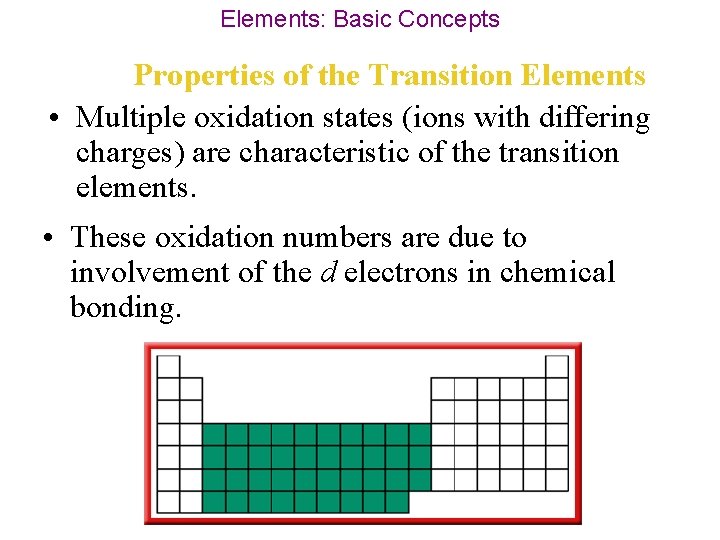
Elements: Basic Concepts Properties of the Transition Elements • Multiple oxidation states (ions with differing charges) are characteristic of the transition elements. • These oxidation numbers are due to involvement of the d electrons in chemical bonding.
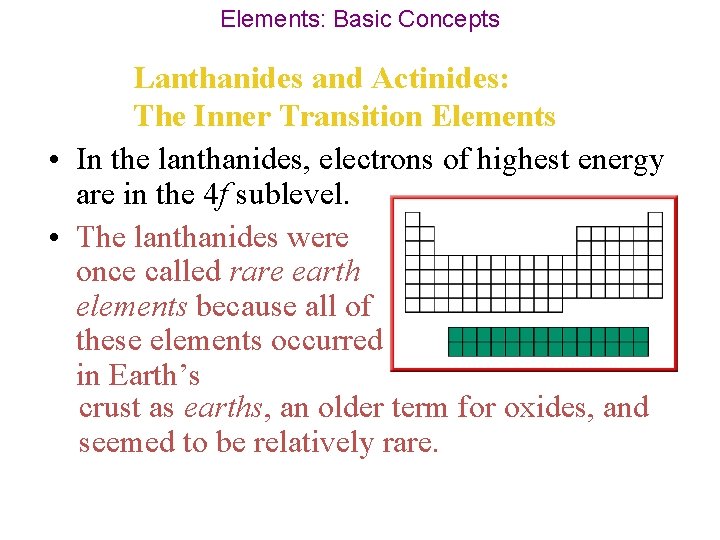
Elements: Basic Concepts Lanthanides and Actinides: The Inner Transition Elements • In the lanthanides, electrons of highest energy are in the 4 f sublevel. • The lanthanides were once called rare earth elements because all of these elements occurred in Earth’s crust as earths, an older term for oxides, and seemed to be relatively rare.
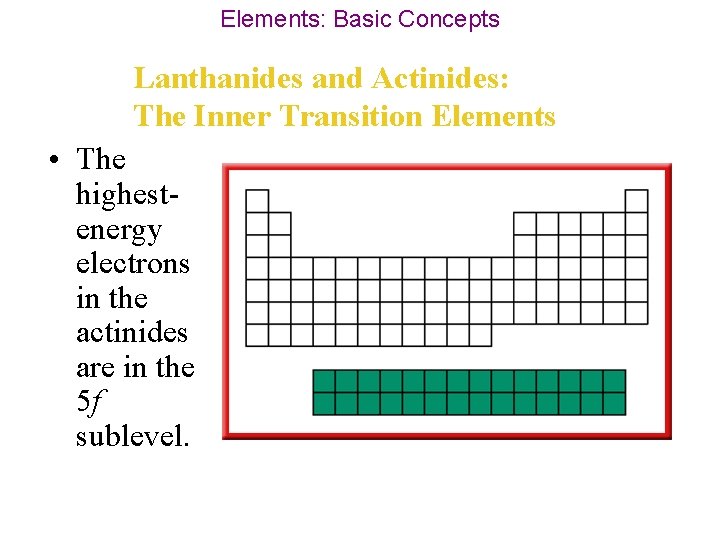
Elements: Basic Concepts Lanthanides and Actinides: The Inner Transition Elements • The highestenergy electrons in the actinides are in the 5 f sublevel.
- Slides: 21