
Table of Contents Chapter 20 OxidationReduction 20 3
Table of Contents Chapter 20: Oxidation-Reduction 20. 3: Half-Reactions
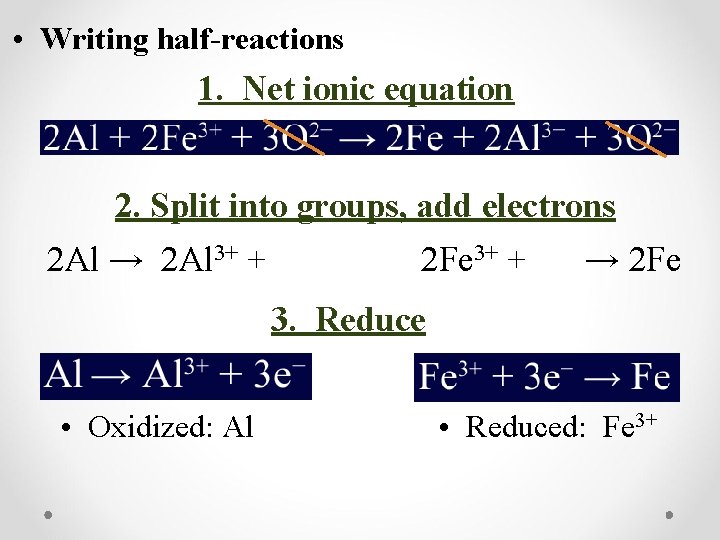
• Writing half-reactions 1. Net ionic equation 2. Split into groups, add electrons 2 Al → 2 Al 3+ + 6 e- 2 Fe 3+ + 6 e- → 2 Fe 3. Reduce • Oxidized: Al • Reduced: Fe 3+
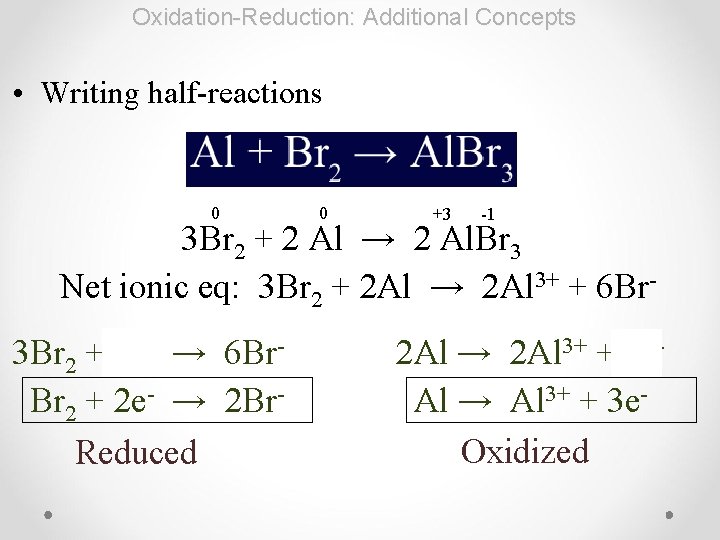
Oxidation-Reduction: Additional Concepts • Writing half-reactions 0 0 +3 -1 3 Br 2 + 2 Al → 2 Al. Br 3 Net ionic eq: 3 Br 2 + 2 Al → 2 Al 3+ + 6 Br 3 Br 2 + 6 e- → 6 Br. Br 2 + 2 e- → 2 Br. Reduced 2 Al → 2 Al 3+ + 6 e. Al → Al 3+ + 3 e. Oxidized
Oxidizing and Reducing Agents • Tarnishing metals is a redox reaction: 3. What is oxidized? 4. Why? 1. What is reduced? 2. Why? Click box to view movie clip. • The opposite process can remove tarnish from metal objects
Oxidation-Reduction: Basic Concepts Oxidizing and Reducing Agents • Several oxidizing and reducing agents play significant roles in your daily life. • For example, when you add chlorine bleach to your laundry to whiten clothes, you are using an aqueous solution of sodium hypochlorite (Na. Cl. O), an oxidizing agent.

Oxidation-Reduction: Basic Concepts Oxidizing and Reducing Agents • Hydrogen peroxide (H 2 O 2) can be used as an antiseptic because it oxidizes some of the vital biomolecules of germs, or as an agent to lighten hair because it oxidizes the dark pigment of the hair.
It’s your time! • Start bringing scientific calculators to class

End of Topic Summary File
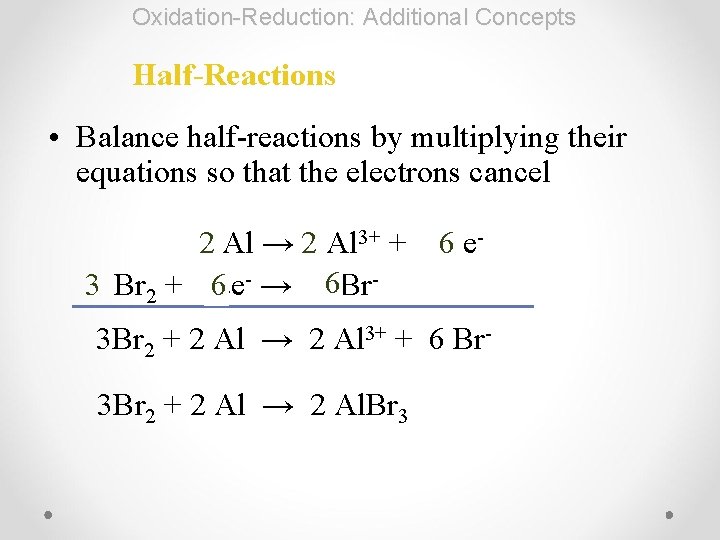
Oxidation-Reduction: Additional Concepts Half-Reactions • Balance half-reactions by multiplying their equations so that the electrons cancel 2 Al → 2 Al 3+ + 36 e 6 3 Br 2 + 62 e- → 2 Br 3 Br 2 + 2 Al → 2 Al 3+ + 6 Br 3 Br 2 + 2 Al → 2 Al. Br 3
- Slides: 9