
Table of Contents Chapter 2 Data Analysis Basic
Table of Contents Chapter 2: Data Analysis Basic Concepts Additional Concepts
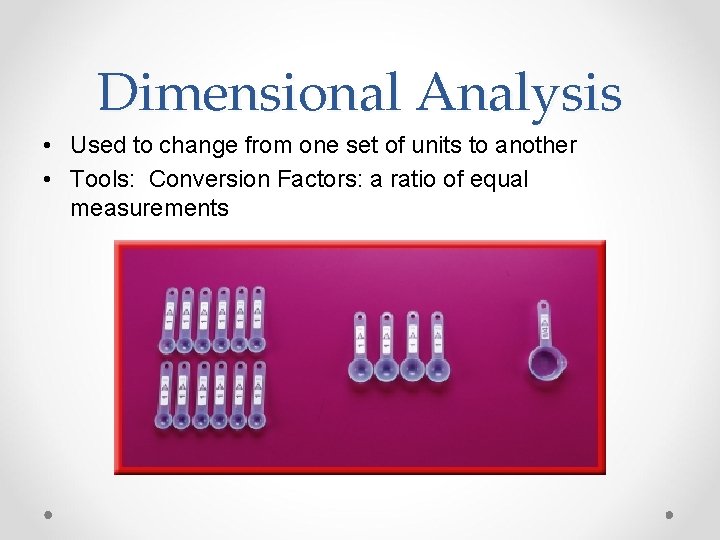
Dimensional Analysis • Used to change from one set of units to another • Tools: Conversion Factors: a ratio of equal measurements
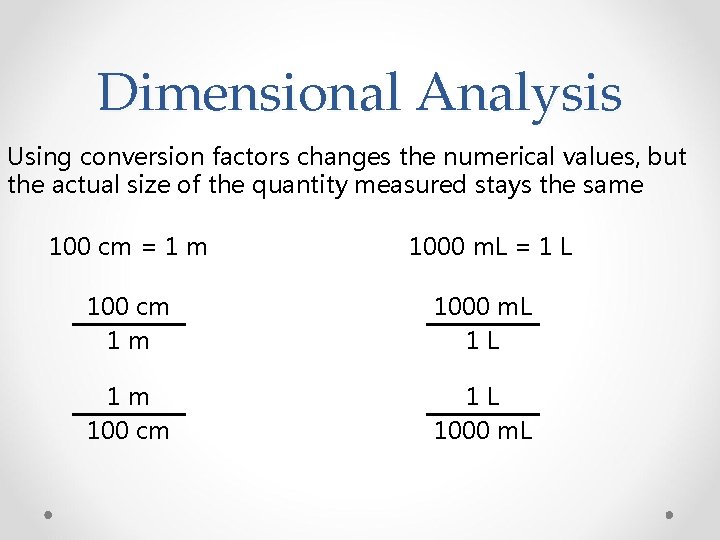
Dimensional Analysis Using conversion factors changes the numerical values, but the actual size of the quantity measured stays the same 100 cm = 1 m 1000 m. L = 1 L 100 cm 1 m 1000 m. L 1 L 1 m 100 cm 1 L 1000 m. L
Dimensional Analysis • Used to change from one set of units to another Process: 1. Set up a T chart 2. Determine a goal 3. Determine a starting point • in top left corner of T chart • set it equal to goal
Dimensional Analysis Process: 4. Use conversions to transition to your goal • you could start by identifying possibilities • conversion factors must be a fraction = 1 • units must cancel to leave desired units in answer (top right corner) 5. Solve for your goal • multiply by the top • divide by the bottom
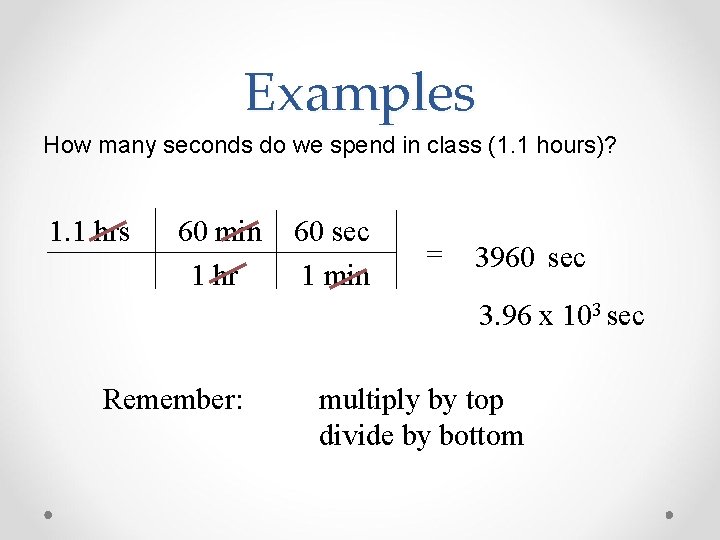
Examples How many seconds do we spend in class (1. 1 hours)? 1. 1 hrs 60 min 1 hr 60 sec 1 min = 3960 sec 3. 96 x 103 sec Remember: multiply by top divide by bottom
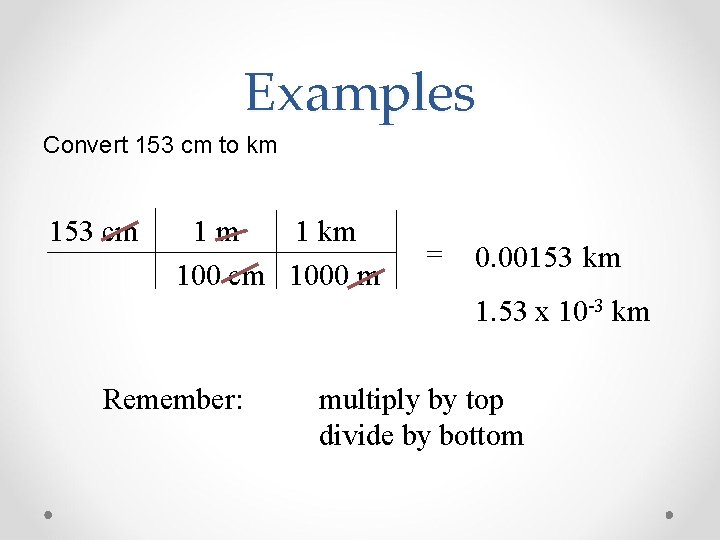
Examples Convert 153 cm to km 153 cm 1 m 1 km 100 cm 1000 m = 0. 00153 km 1. 53 x 10 -3 km Remember: multiply by top divide by bottom
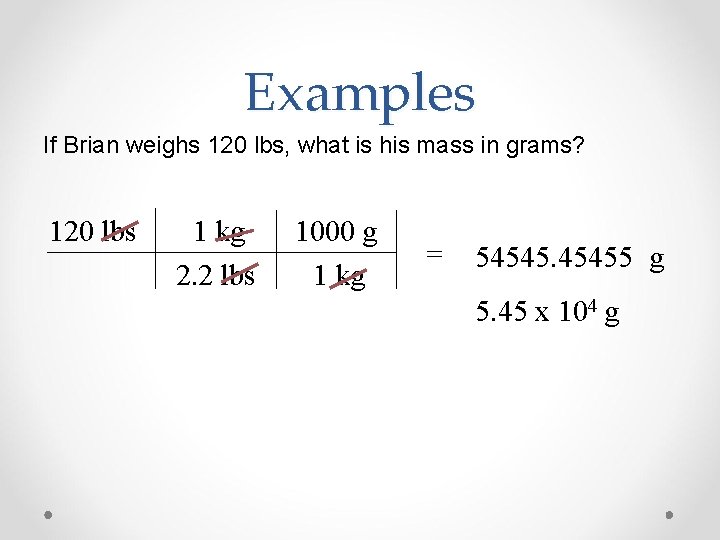
Examples If Brian weighs 120 lbs, what is his mass in grams? 120 lbs 1 kg 2. 2 lbs 1000 g 1 kg = 545455 g 5. 45 x 104 g
It’s your turn • We will correct the “Dimensional Analysis (Factor Label) Problems” #1 -10 on Thursday at the beginning of class • Show ALL work in this format (including units) • This entire worksheet is due on Friday at the end of class
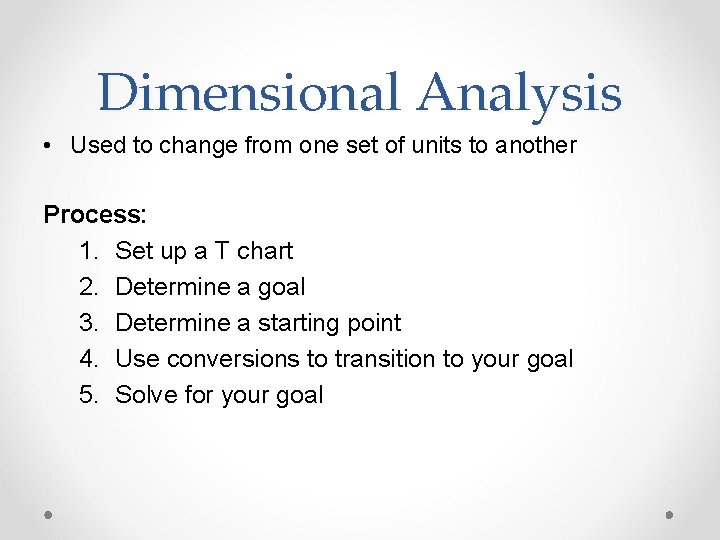
Dimensional Analysis • Used to change from one set of units to another Process: 1. Set up a T chart 2. Determine a goal 3. Determine a starting point 4. Use conversions to transition to your goal 5. Solve for your goal
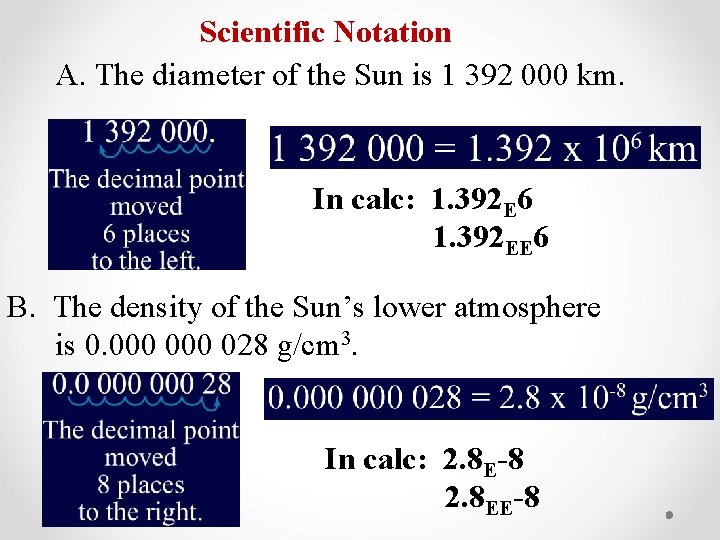
Scientific Notation A. The diameter of the Sun is 1 392 000 km. In calc: 1. 392 E 6 1. 392 EE 6 B. The density of the Sun’s lower atmosphere is 0. 000 028 g/cm 3. In calc: 2. 8 E-8 2. 8 EE-8
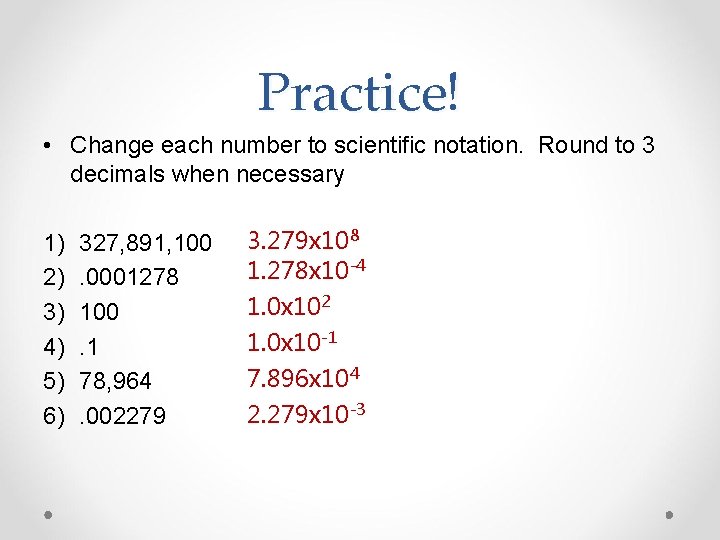
Practice! • Change each number to scientific notation. Round to 3 decimals when necessary 1) 2) 3) 4) 5) 6) 327, 891, 100. 0001278 100. 1 78, 964. 002279 3. 279 x 108 1. 278 x 10 -4 1. 0 x 102 1. 0 x 10 -1 7. 896 x 104 2. 279 x 10 -3
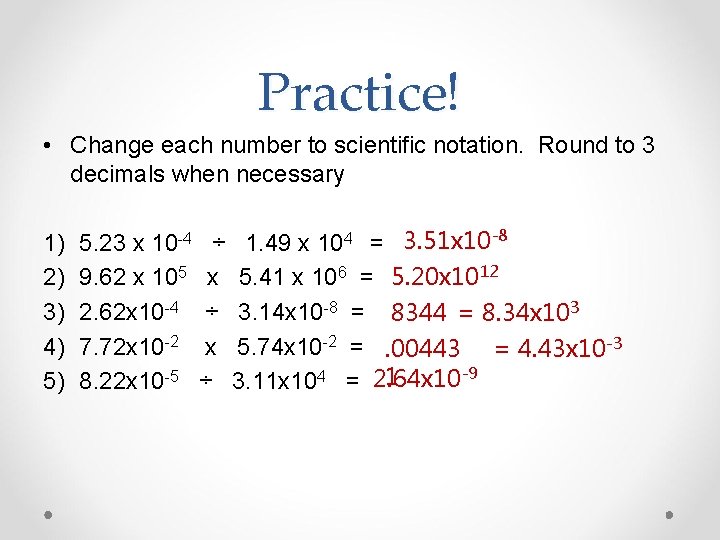
Practice! • Change each number to scientific notation. Round to 3 decimals when necessary 1) 2) 3) 4) 5) 5. 23 x 10 -4 ÷ 1. 49 x 104 = 3. 51 x 10 -8 9. 62 x 105 x 5. 41 x 106 = 5. 20 x 1012 2. 62 x 10 -4 ÷ 3. 14 x 10 -8 = 8344 = 8. 34 x 103 7. 72 x 10 -2 x 5. 74 x 10 -2 =. 00443 = 4. 43 x 10 -3 -9 1 8. 22 x 10 -5 ÷ 3. 11 x 104 = 2. 64 x 10
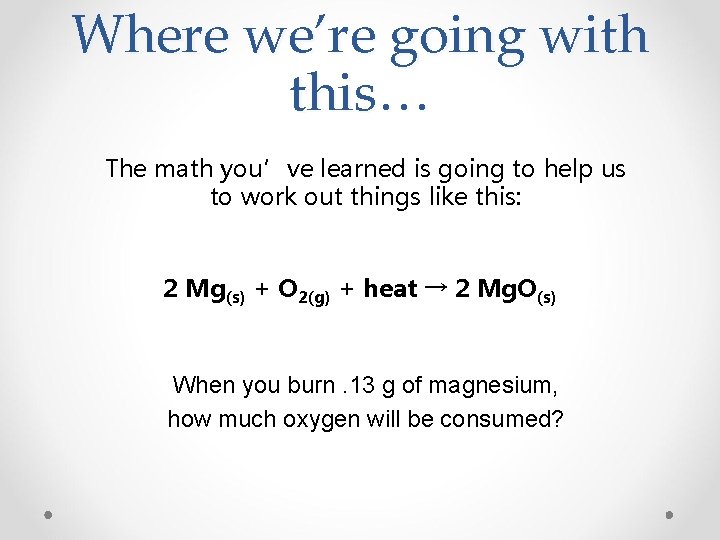
Where we’re going with this… The math you’ve learned is going to help us to work out things like this: 2 Mg(s) + O 2(g) + heat → 2 Mg. O(s) When you burn. 13 g of magnesium, how much oxygen will be consumed?
It’s your turn • We will correct this entire worksheet at 2: 10. • Show ALL work in this format (including units)
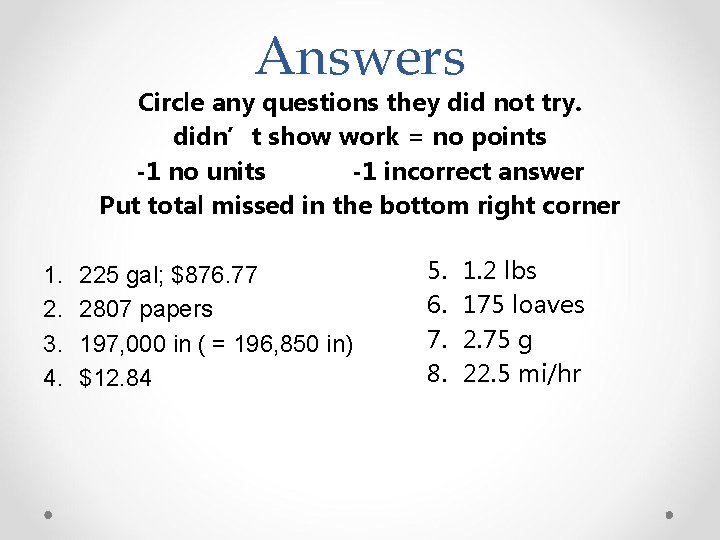
Answers Circle any questions they did not try. didn’t show work = no points -1 no units -1 incorrect answer Put total missed in the bottom right corner 1. 2. 3. 4. 225 gal; $876. 77 2807 papers 197, 000 in ( = 196, 850 in) $12. 84 5. 6. 7. 8. 1. 2 lbs 175 loaves 2. 75 g 22. 5 mi/hr
- Slides: 16