
Table of Contents Chapter 18 Chemical Equilibrium 18
Table of Contents Chapter 18: Chemical Equilibrium 18. 1: A state of dynamic balance 18. 2: Factors affecting chemical 18. 3: Using equilibrium constants
Table of Contents Chapter 18: Chemical Equilibrium 18. 1: Equilibrium: A state of dynamic balance
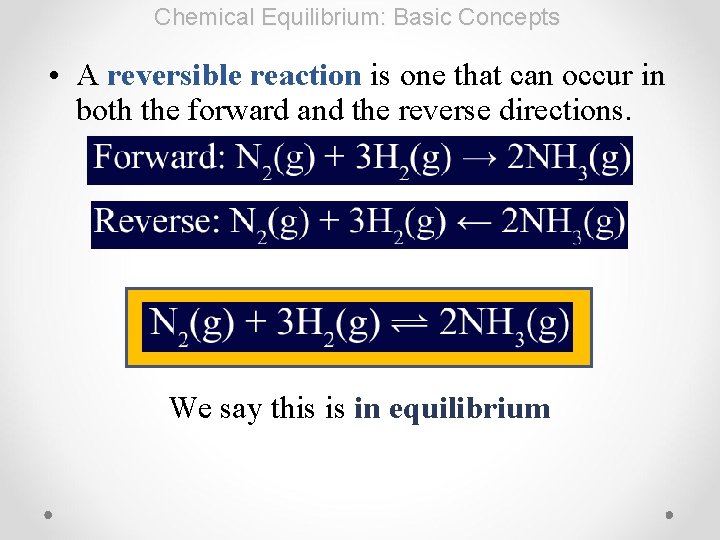
Chemical Equilibrium: Basic Concepts • A reversible reaction is one that can occur in both the forward and the reverse directions. We say this is in equilibrium
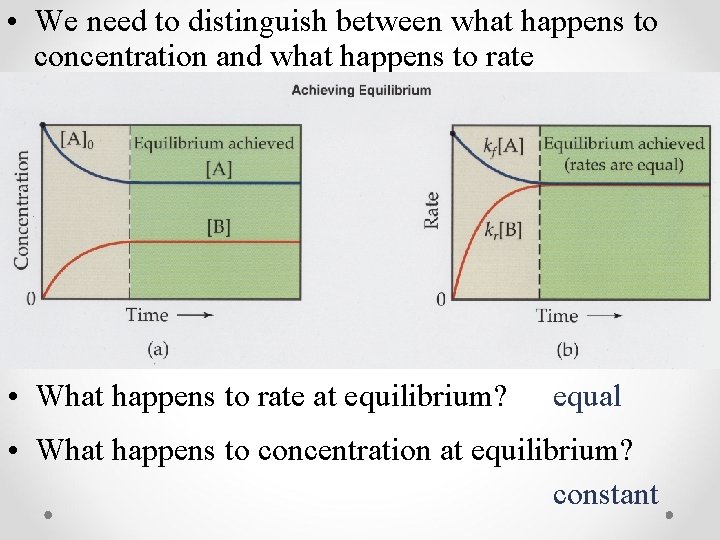
• We need to distinguish between what happens to concentration and what happens to rate • What happens to rate at equilibrium? equal • What happens to concentration at equilibrium? constant
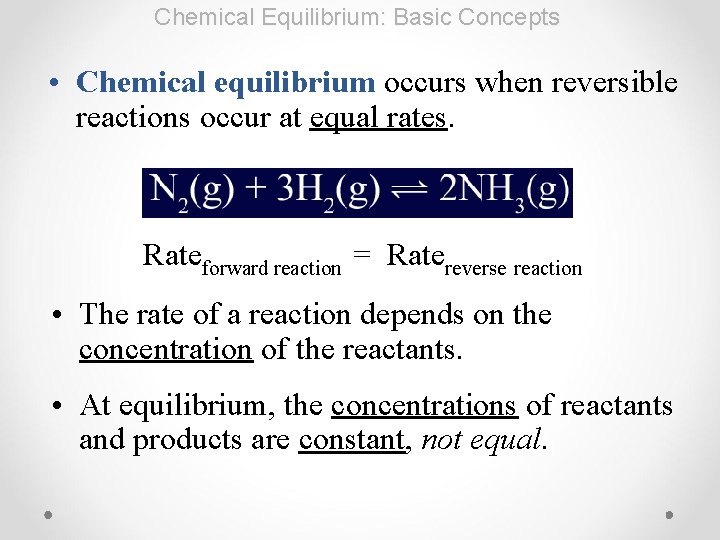
Chemical Equilibrium: Basic Concepts • Chemical equilibrium occurs when reversible reactions occur at equal rates. Rateforward reaction = Ratereverse reaction • The rate of a reaction depends on the concentration of the reactants. • At equilibrium, the concentrations of reactants and products are constant, not equal.
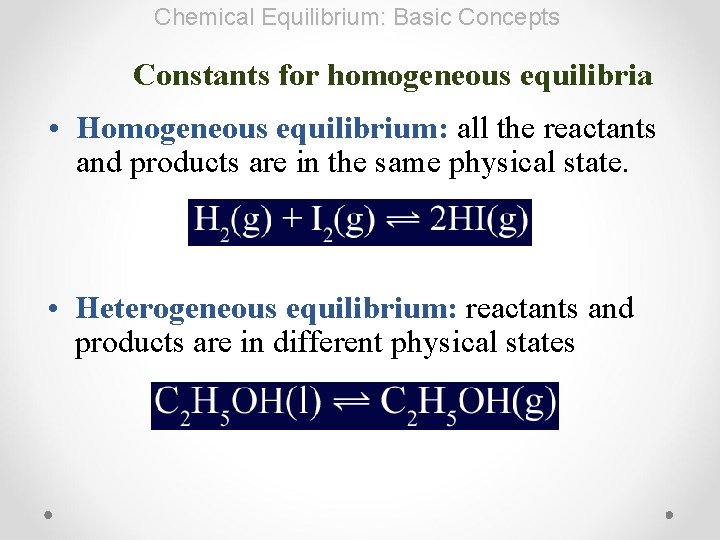
Chemical Equilibrium: Basic Concepts Constants for homogeneous equilibria • Homogeneous equilibrium: all the reactants and products are in the same physical state. • Heterogeneous equilibrium: reactants and products are in different physical states
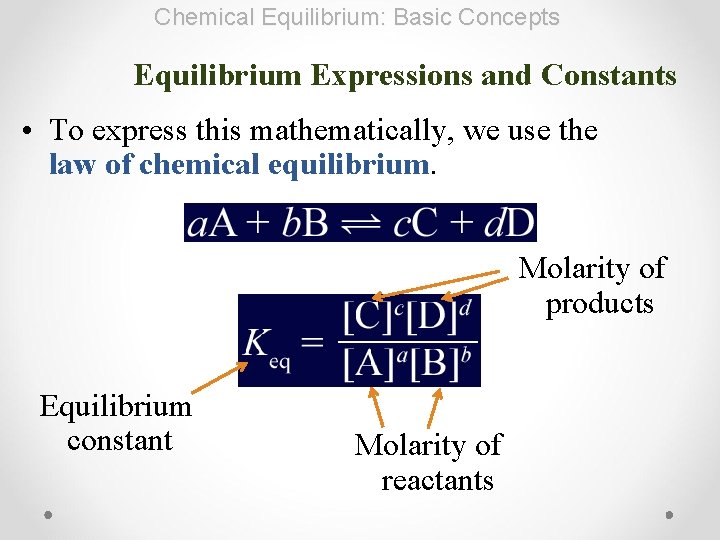
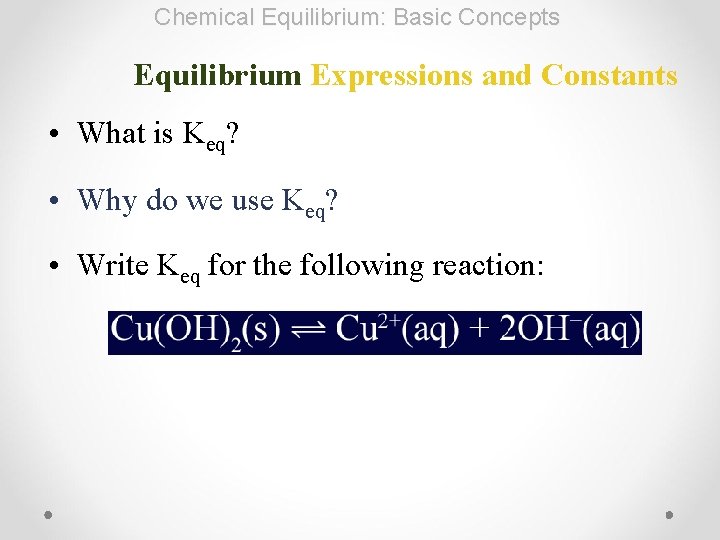
Chemical Equilibrium: Basic Concepts Equilibrium Expressions and Constants • To express this mathematically, we use the law of chemical equilibrium. Molarity of products Equilibrium constant Molarity of reactants
Chemical Equilibrium: Basic Concepts Equilibrium Expressions and Constants • This ratio is called the equilibrium constant expression (Keq). It has no units. • The square brackets indicate the concentration (Molarity: mol/L) the of reactants and products • The value of Keq is constant only at a specified temperature.
Chemical Equilibrium: Basic Concepts Constants for heterogeneous equilibria • Equilibrium positions depend upon the initial concentrations of the reactants and products. • In an equilibrium expression, do not include pure solids (s) or liquids (l) • This is because their concentration is their density, which does not change at any given temperature.
Chemical Equilibrium: Basic Concepts Equilibrium Expressions and Constants • Keq > 1: More products than reactants at equilibrium. • Keq < 1: More reactants than products at equilibrium. So, Keq tells us at a glance how much we have of our reactants and products
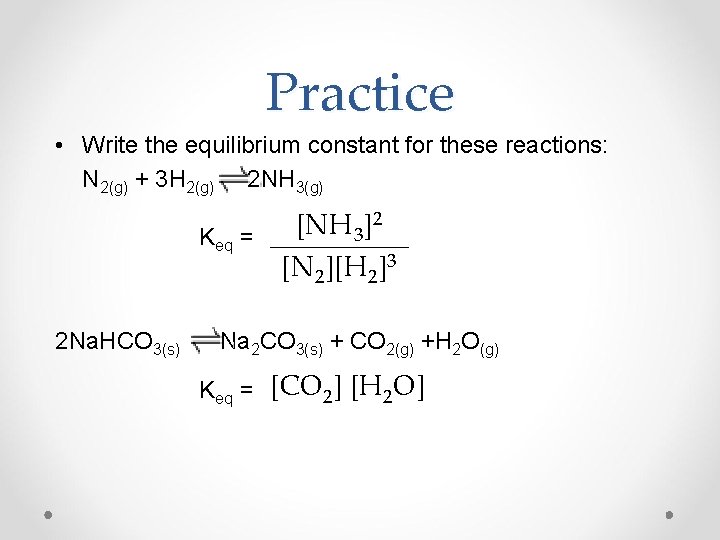
Practice • Write the equilibrium constant for these reactions: N 2(g) + 3 H 2(g) 2 NH 3(g) 2 [NH ] 3 Keq = [N 2][H 2]3 2 Na. HCO 3(s) Na 2 CO 3(s) + CO 2(g) +H 2 O(g) Keq = [CO 2] [H 2 O]
![Practice • Write the equilibrium constant for these reactions: Keq = [HI]2 [H 2][I](http://slidetodoc.com/presentation_image_h2/8814f21586777026b966bbab0035b904/image-12.jpg "Practice • Write the equilibrium constant for these reactions: Keq = [HI]2 [H 2][I")
Practice • Write the equilibrium constant for these reactions: Keq = [HI]2 [H 2][I 2] Keq = [C 2 H 5 OH]
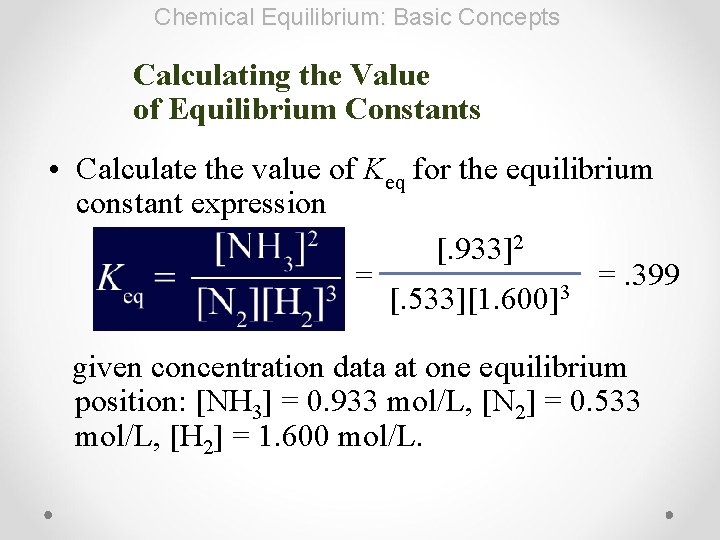
Chemical Equilibrium: Basic Concepts Calculating the Value of Equilibrium Constants • Calculate the value of Keq for the equilibrium constant expression [. 933]2 =. 399 = 3 [. 533][1. 600] given concentration data at one equilibrium position: [NH 3] = 0. 933 mol/L, [N 2] = 0. 533 mol/L, [H 2] = 1. 600 mol/L.
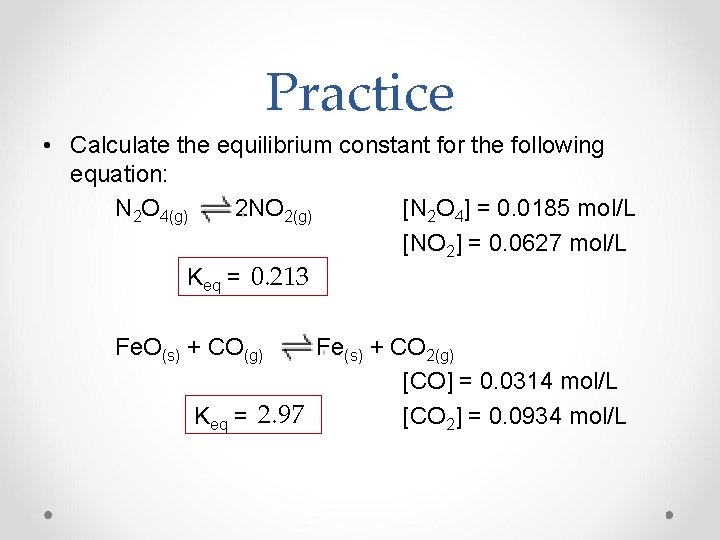
Practice • Calculate the equilibrium constant for the following equation: N 2 O 4(g) 2 NO 2(g) [N 2 O 4] = 0. 0185 mol/L [NO 2] = 0. 0627 mol/L Keq = 0. 213 Fe. O(s) + CO(g) Fe(s) + CO 2(g) [CO] = 0. 0314 mol/L Keq = 2. 97 [CO 2] = 0. 0934 mol/L
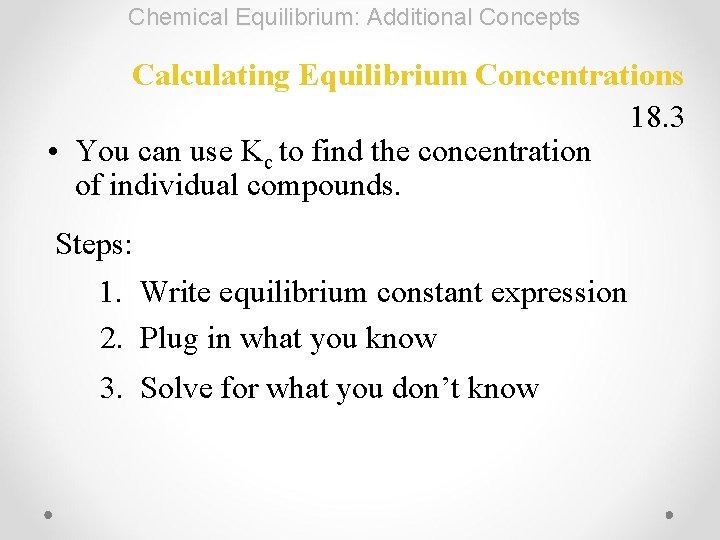
Chemical Equilibrium: Additional Concepts Calculating Equilibrium Concentrations 18. 3 • You can use Kc to find the concentration of individual compounds. Steps: 1. Write equilibrium constant expression 2. Plug in what you know 3. Solve for what you don’t know
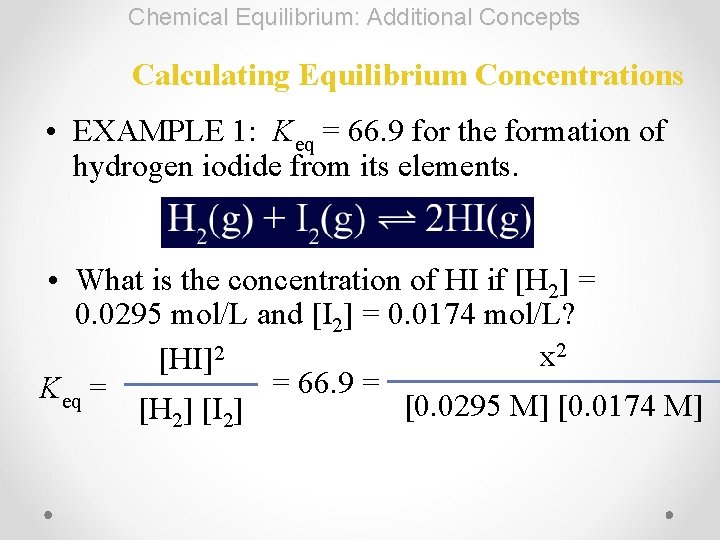
Chemical Equilibrium: Additional Concepts Calculating Equilibrium Concentrations • EXAMPLE 1: Keq = 66. 9 for the formation of hydrogen iodide from its elements. • What is the concentration of HI if [H 2] = 0. 0295 mol/L and [I 2] = 0. 0174 mol/L? x 2 [HI]2 = 66. 9 = Keq = [0. 0295 M] [0. 0174 M] [H 2] [I 2]
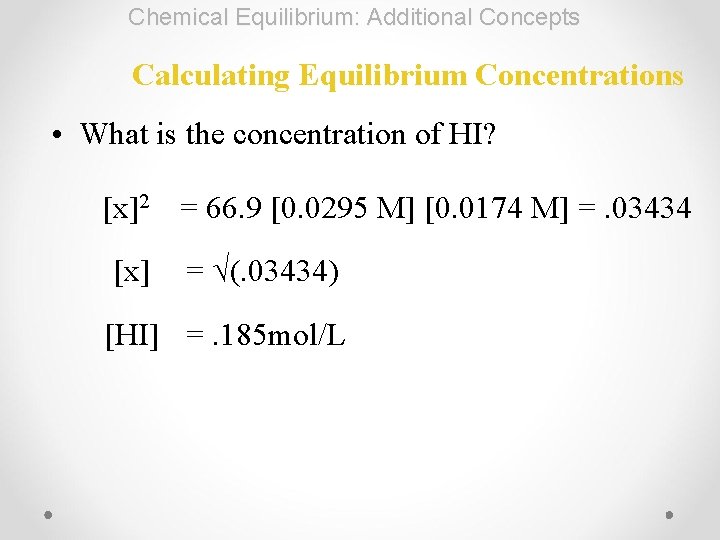
Chemical Equilibrium: Additional Concepts Calculating Equilibrium Concentrations • What is the concentration of HI? [x]2 = 66. 9 [0. 0295 M] [0. 0174 M] =. 03434 [x] = √(. 03434) [HI] =. 185 mol/L
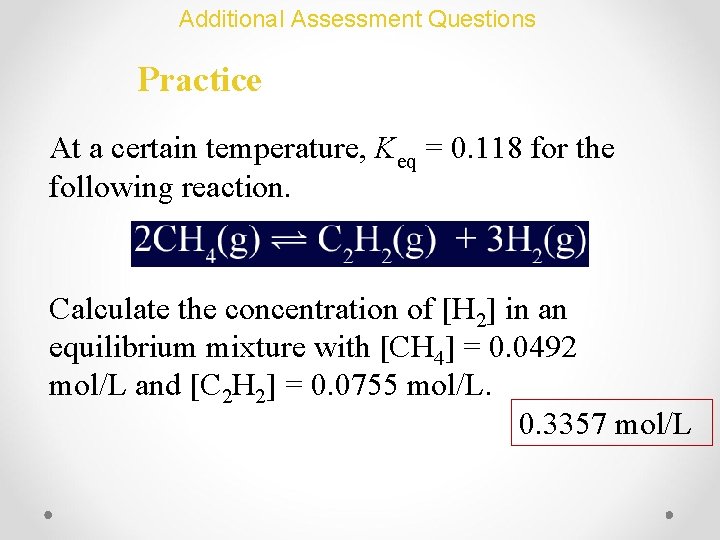
Additional Assessment Questions Practice At a certain temperature, Keq = 0. 118 for the following reaction. Calculate the concentration of [H 2] in an equilibrium mixture with [CH 4] = 0. 0492 mol/L and [C 2 H 2] = 0. 0755 mol/L. 0. 3357 mol/L
End 18. 1
Table of Contents Chapter 18: Chemical Equilibrium 18. 2: Factors affecting chemical equilibrium
Chemical Equilibrium: Basic Concepts Factors Affecting Chemical Equilibrium • Le Châtelier’s principle: If a system at equilibrium is stressed, it will shift to reduce the stress. • Rule of Thumb: “Same side does the opposite, opposite side does the same” • Equilibrium shifts in the direction that increases in the end.
Chemical Equilibrium: Basic Concepts Factors Affecting Chemical Equilibrium • Equilibrium can be disturbed by 3 factors: 1. Changing concentration: adding or removing a reactant or product. 2. Changing temperature 3. Changing volume & pressure
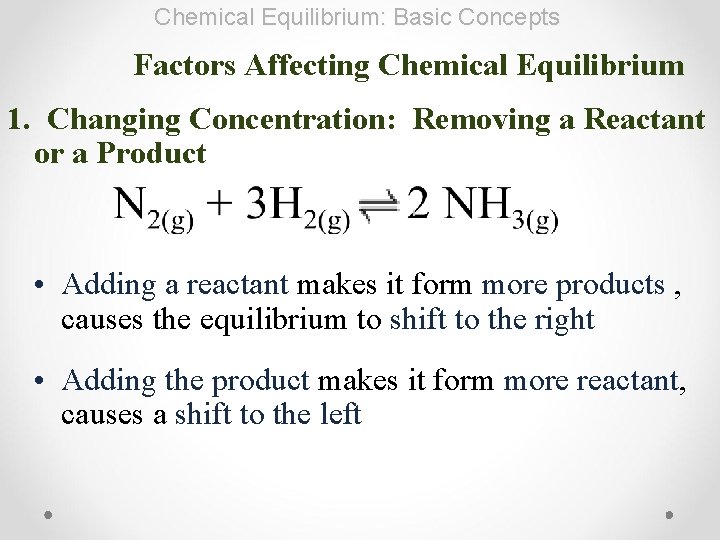
Chemical Equilibrium: Basic Concepts Factors Affecting Chemical Equilibrium 1. Changing Concentration: Removing a Reactant or a Product • Adding a reactant makes it form more products , causes the equilibrium to shift to the right • Adding the product makes it form more reactant, causes a shift to the left
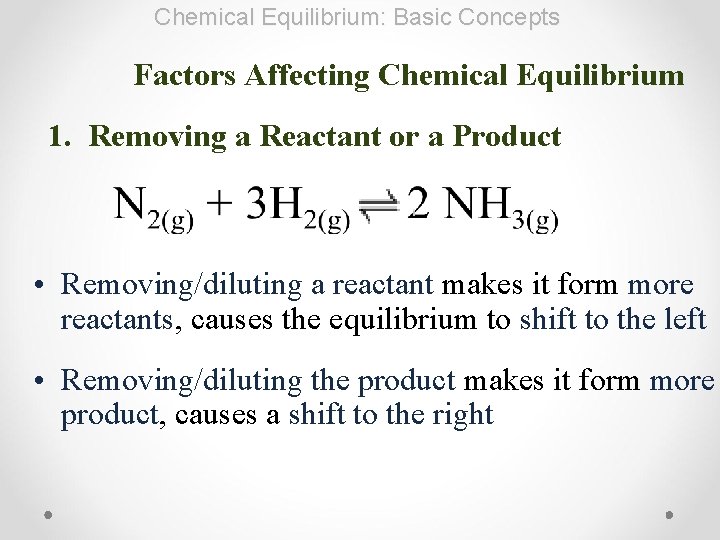
Chemical Equilibrium: Basic Concepts Factors Affecting Chemical Equilibrium 1. Removing a Reactant or a Product • Removing/diluting a reactant makes it form more reactants, causes the equilibrium to shift to the left • Removing/diluting the product makes it form more product, causes a shift to the right
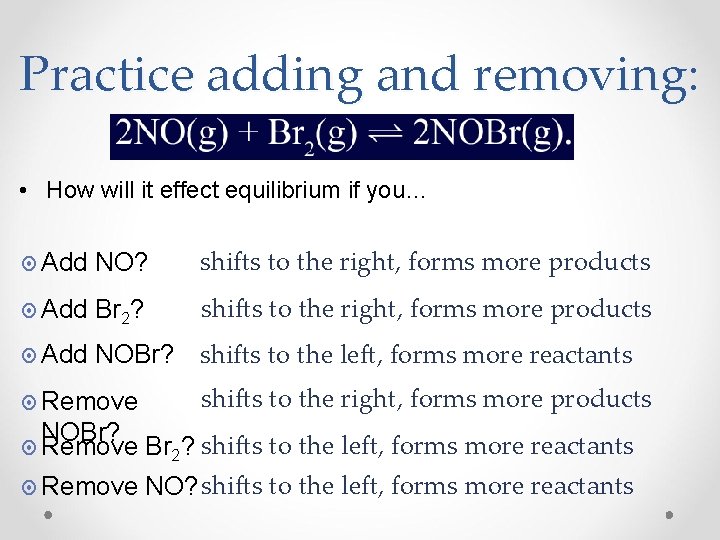
Practice adding and removing: • How will it effect equilibrium if you… Add NO? shifts to the right, forms more products Add Br 2? shifts to the right, forms more products Add NOBr? shifts to the left, forms more reactants Remove shifts to the right, forms more products Remove NOBr? Br 2? shifts to the left, forms more reactants Remove NO? shifts to the left, forms more reactants
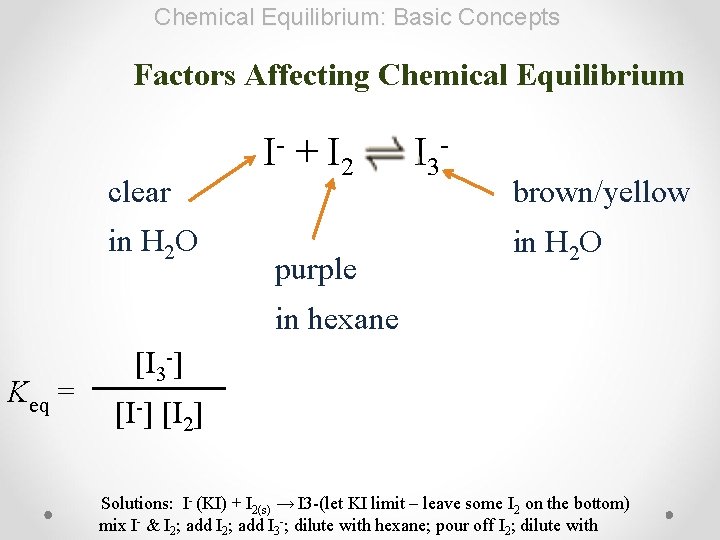
Chemical Equilibrium: Basic Concepts Factors Affecting Chemical Equilibrium clear in H 2 O I- + I 2 purple I 3 - brown/yellow in H 2 O in hexane Keq = [I 3 -] [I 2] Solutions: I- (KI) + I 2(s) → I 3 -(let KI limit – leave some I 2 on the bottom) mix I- & I 2; add I 3 -; dilute with hexane; pour off I 2; dilute with
Chemical Equilibrium: Basic Concepts 2. Changes in temperature • Changes in temperature, causes a shift in equilibrium by changing the value of Keq. • In contrast, changes in concentration or pressure cause a shift in equilibrium without changing Keq
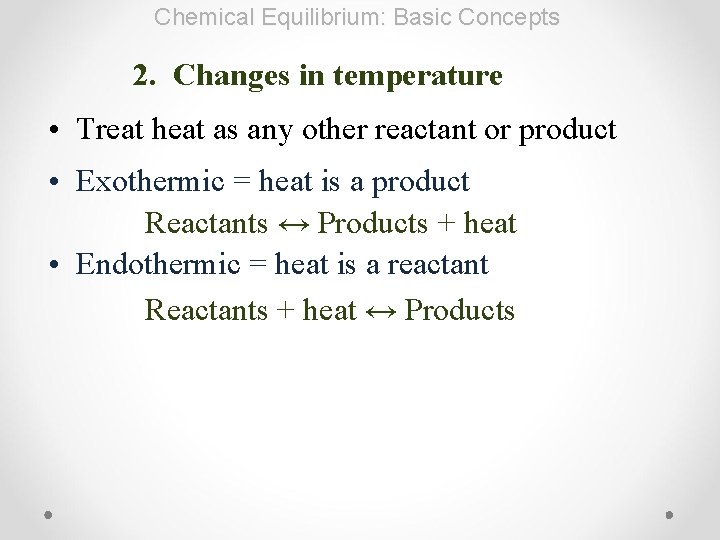
Chemical Equilibrium: Basic Concepts 2. Changes in temperature • Treat heat as any other reactant or product • Exothermic = heat is a product Reactants ↔ Products + heat • Endothermic = heat is a reactant Reactants + heat ↔ Products
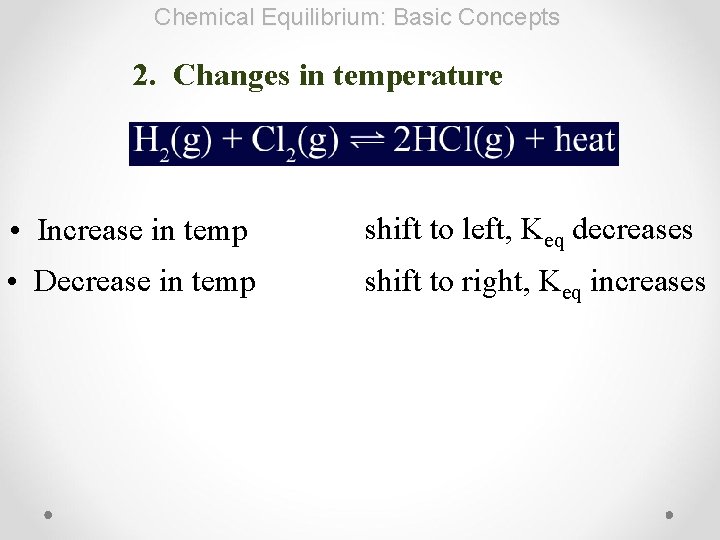
Chemical Equilibrium: Basic Concepts 2. Changes in temperature • Increase in temp shift to left, Keq decreases • Decrease in temp shift to right, Keq increases
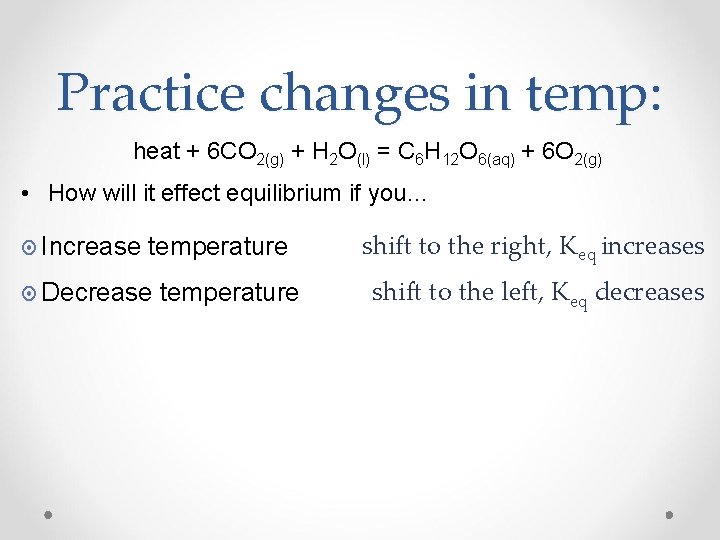
Practice changes in temp: heat + 6 CO 2(g) + H 2 O(l) = C 6 H 12 O 6(aq) + 6 O 2(g) • How will it effect equilibrium if you… Increase temperature Decrease temperature shift to the right, Keq increases shift to the left, Keq decreases
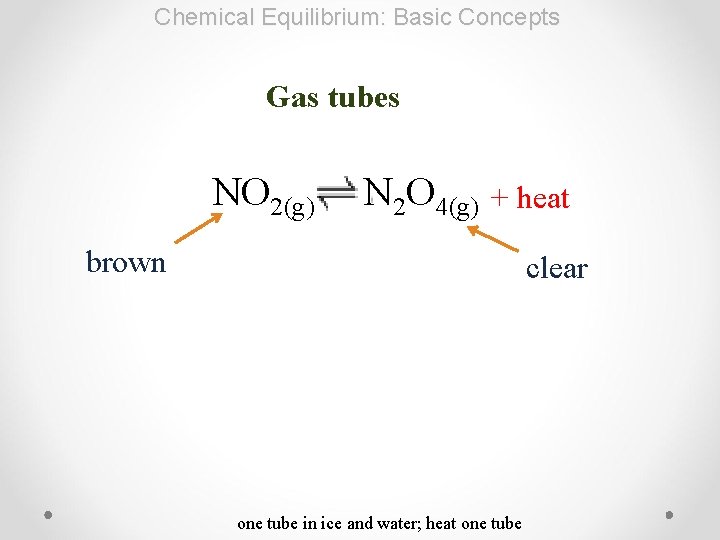
Chemical Equilibrium: Basic Concepts Gas tubes NO 2(g) N 2 O 4(g) + heat brown clear one tube in ice and water; heat one tube
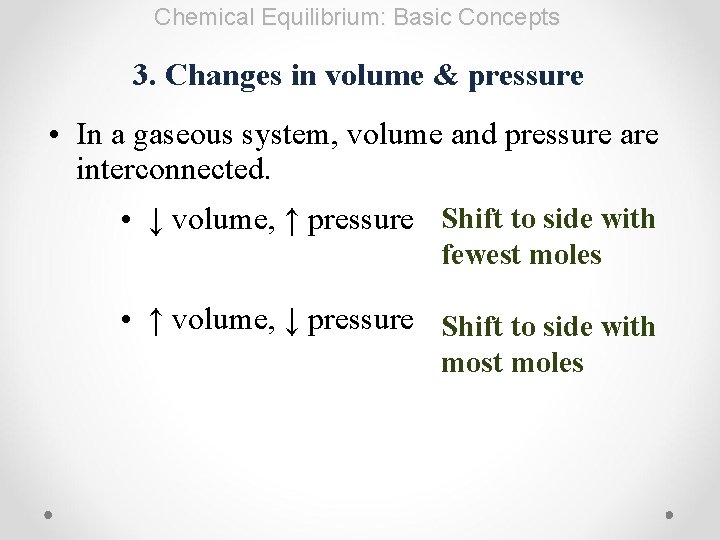
Chemical Equilibrium: Basic Concepts 3. Changes in volume & pressure • In a gaseous system, volume and pressure are interconnected. • ↓ volume, ↑ pressure Shift to side with fewest moles • ↑ volume, ↓ pressure Shift to side with most moles
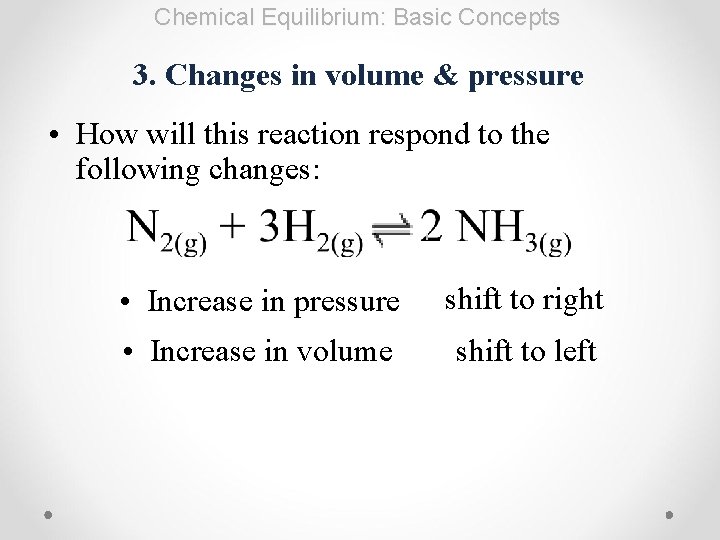
Chemical Equilibrium: Basic Concepts 3. Changes in volume & pressure • How will this reaction respond to the following changes: • Increase in pressure shift to right • Increase in volume shift to left
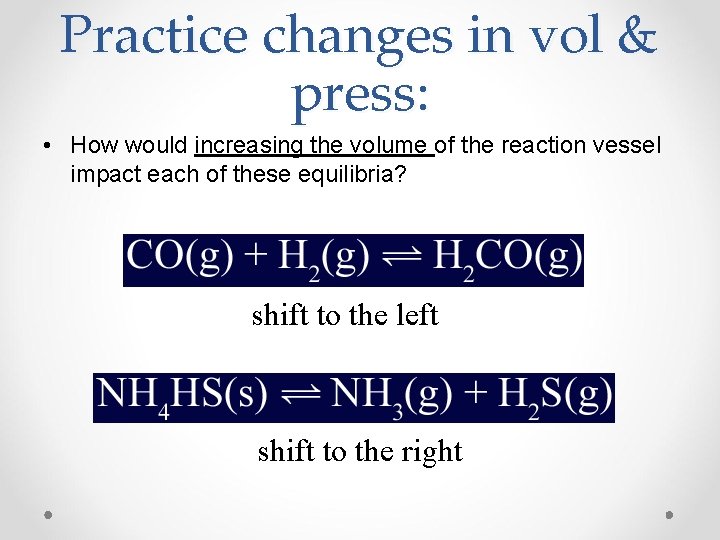
Practice changes in vol & press: • How would increasing the volume of the reaction vessel impact each of these equilibria? shift to the left shift to the right
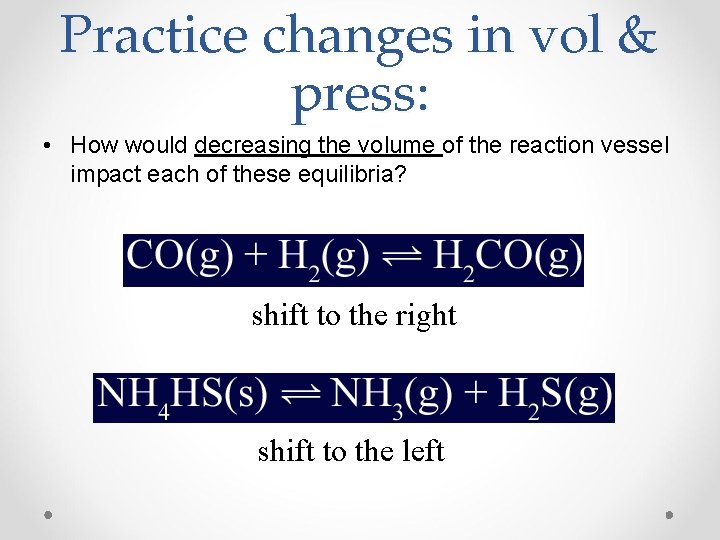
Practice changes in vol & press: • How would decreasing the volume of the reaction vessel impact each of these equilibria? shift to the right shift to the left
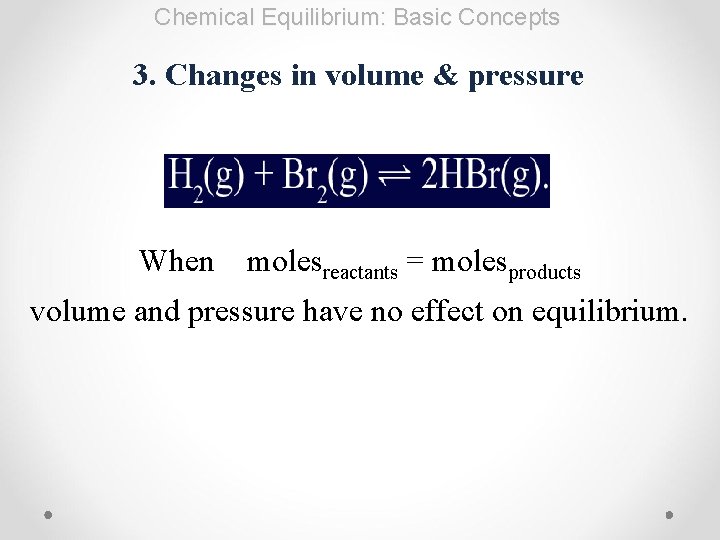
Chemical Equilibrium: Basic Concepts 3. Changes in volume & pressure When molesreactants = molesproducts volume and pressure have no effect on equilibrium.
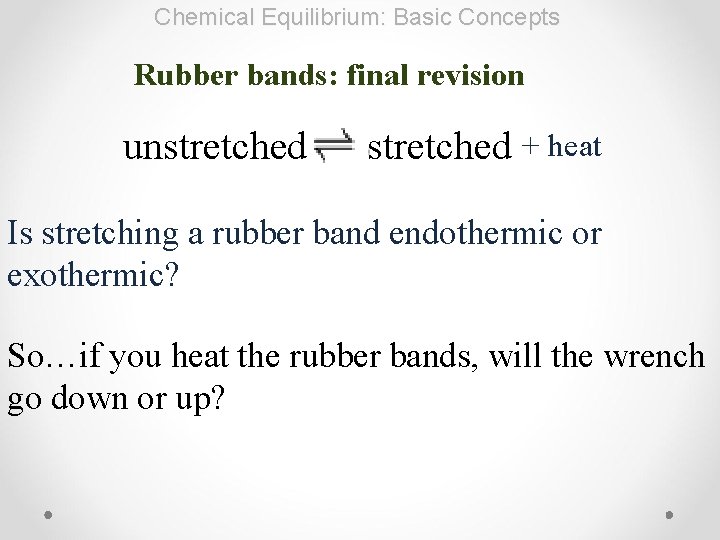
Chemical Equilibrium: Basic Concepts Rubber bands: final revision unstretched + heat Is stretching a rubber band endothermic or exothermic? So…if you heat the rubber bands, will the wrench go down or up?
End 18. 2
Table of Contents Chapter 18: Chemical Equilibrium 18. 3: Using equilibrium constants

The Plan • Tuesday – individual work: o o o Web. Assign Ch 18 (a big one!) Ch 18 practice problems Preview notes for ch. 19 Web. Assign CRT Review (a bigger one!) The sub has permission to kick you off of computers if you are misusing time • Wednesday – group work: o Ch 18 practice problems (due Thursday) o Ch 18 Review – due with the 21 May o The sub has permission to separate groups if you are not using your time well
Chemical Equilibrium: Basic Concepts Equilibrium Expressions and Constants • What is Keq? • Why do we use Keq? • Write Keq for the following reaction:
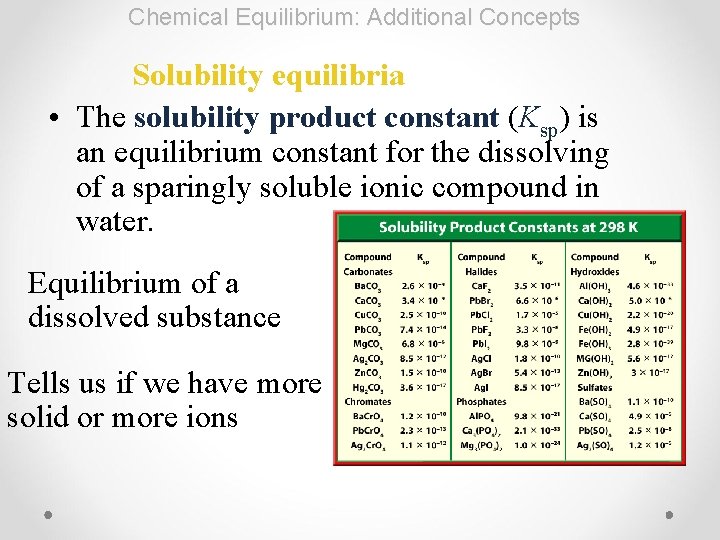
Chemical Equilibrium: Additional Concepts Solubility equilibria • The solubility product constant (Ksp) is an equilibrium constant for the dissolving of a sparingly soluble ionic compound in water. Equilibrium of a dissolved substance Tells us if we have more solid or more ions
Chemical Equilibrium: Additional Concepts Solubility equilibria When you know Ksp, you can… 1. calculate the molar solubility of a sparingly soluble ionic compound 2. calculate moles per liter of a saturated substance. 3. calculate ion concentrations in a saturated solution. These all use the same process!
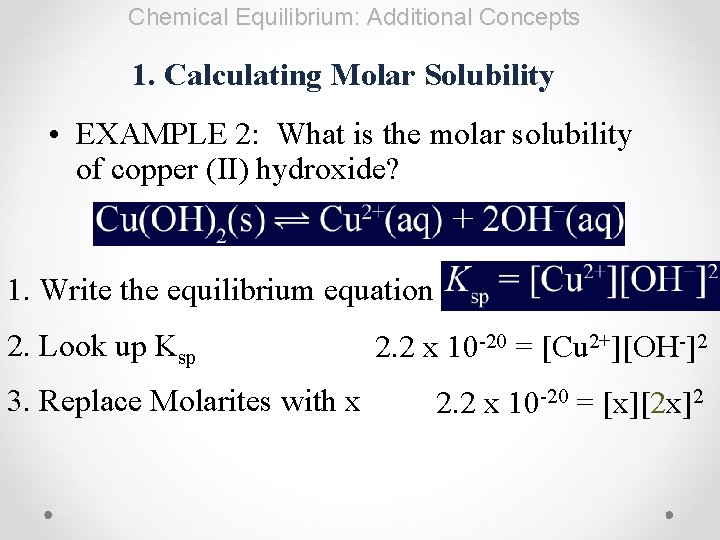
Chemical Equilibrium: Additional Concepts 1. Calculating Molar Solubility • EXAMPLE 2: What is the molar solubility of copper (II) hydroxide? 1. Write the equilibrium equation 2. Look up Ksp 3. Replace Molarites with x 2. 2 x 10 -20 = [Cu 2+][OH-]2 2. 2 x 10 -20 = [x][2 x]2
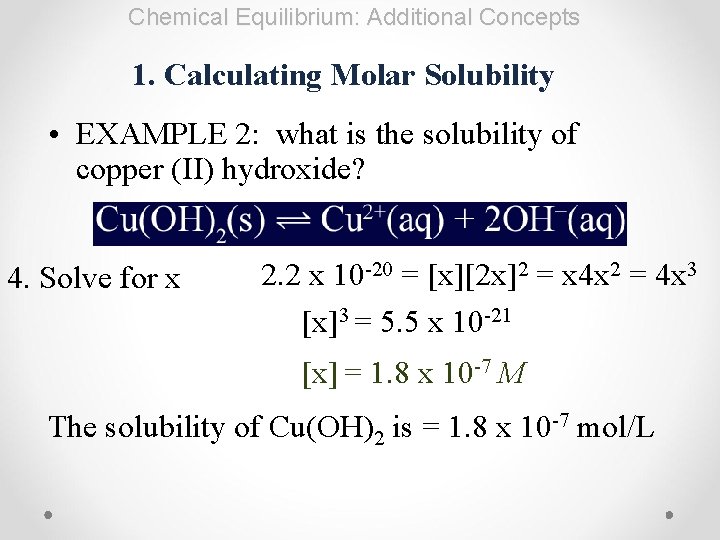
Chemical Equilibrium: Additional Concepts 1. Calculating Molar Solubility • EXAMPLE 2: what is the solubility of copper (II) hydroxide? 4. Solve for x 2. 2 x 10 -20 = [x][2 x]2 = x 4 x 2 = 4 x 3 [x]3 = 5. 5 x 10 -21 [x] = 1. 8 x 10 -7 M The solubility of Cu(OH)2 is = 1. 8 x 10 -7 mol/L
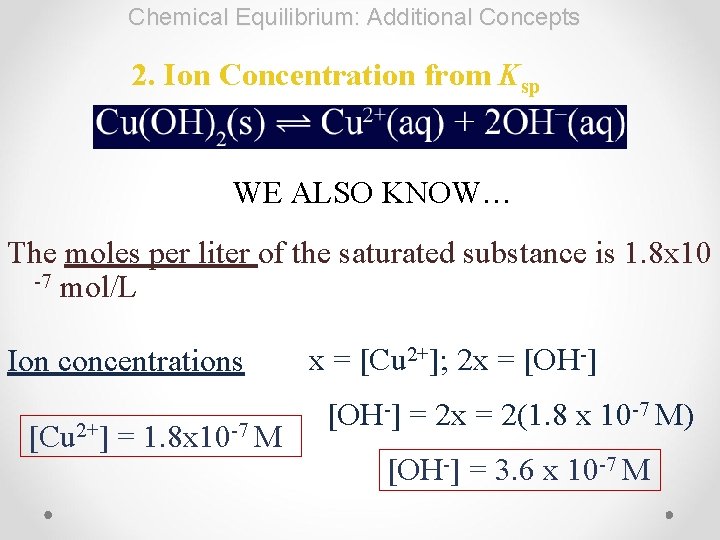
Chemical Equilibrium: Additional Concepts 2. Ion Concentration from Ksp WE ALSO KNOW… The moles per liter of the saturated substance is 1. 8 x 10 -7 mol/L Ion concentrations [Cu 2+] = 1. 8 x 10 -7 M x = [Cu 2+]; 2 x = [OH-] = 2 x = 2(1. 8 x 10 -7 M) [OH-] = 3. 6 x 10 -7 M
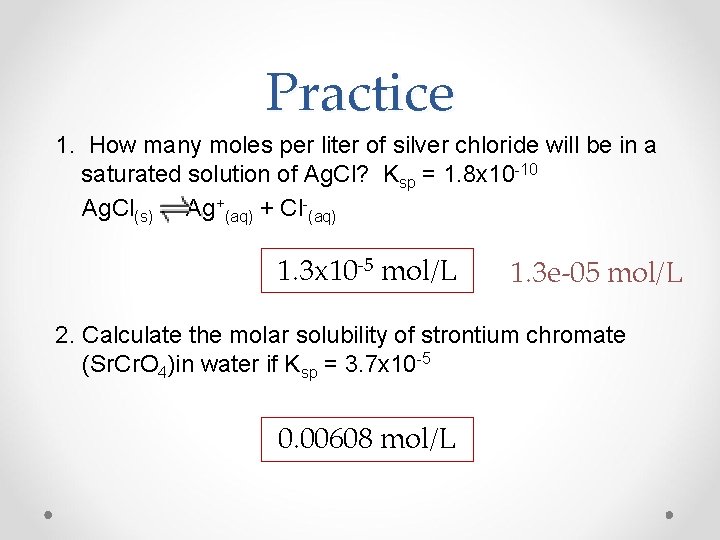
Practice 1. How many moles per liter of silver chloride will be in a saturated solution of Ag. Cl? Ksp = 1. 8 x 10 -10 Ag. Cl(s) Ag+(aq) + Cl-(aq) 1. 3 x 10 -5 mol/L 1. 3 e-05 mol/L 2. Calculate the molar solubility of strontium chromate (Sr. Cr. O 4)in water if Ksp = 3. 7 x 10 -5 0. 00608 mol/L
Chemical Equilibrium: Additional Concepts Predicting precipitates • Ksp can also be used to predict whether a precipitate will form • Use the ion product, Qsp. • Ksp = Qsp at only at equilibrium • They are calculated the same way • Instantaneous concentrations • The relationship between K and Q allows us to predict the direction of a rxn
Chemical Equilibrium: Additional Concepts Predicting precipitates • If Qsp < Ksp, no precipitate forms • If Qsp > Ksp, a precipitate will form • If Qsp = Ksp, no change will occur
Chemical Equilibrium: Additional Concepts Common ion effect • Common ion effect: The solubility of a substance is reduced when the substance is dissolved in a solution containing a common ion. • For example, Pb. I 2 is less soluble in an aqueous solution of Na. I than in pure water. • Because the common ion I– is already present in the Na. I solution. It reduces the maximum possible concentration of Pb 2+ and thus reduces the solubility of Pb. I 2.
Homework • Web. Assign ch 18: Due Wednesday, 11 pm o Don’t do #19 or #21 o You will not be graded on those problems • Ch 18 Practice Problems: due Thursday, 10 May • Ch 18 review: due 21 May

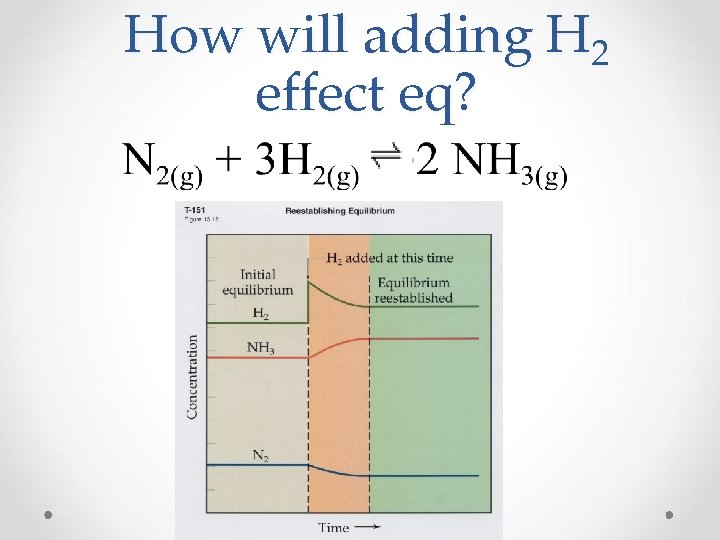
How will adding H 2 effect eq?
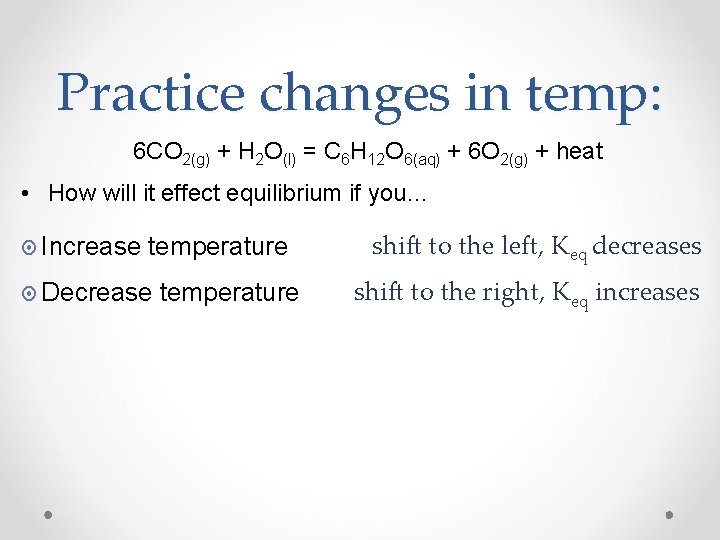
Practice changes in temp: 6 CO 2(g) + H 2 O(l) = C 6 H 12 O 6(aq) + 6 O 2(g) + heat • How will it effect equilibrium if you… Increase temperature Decrease temperature shift to the left, Keq decreases shift to the right, Keq increases
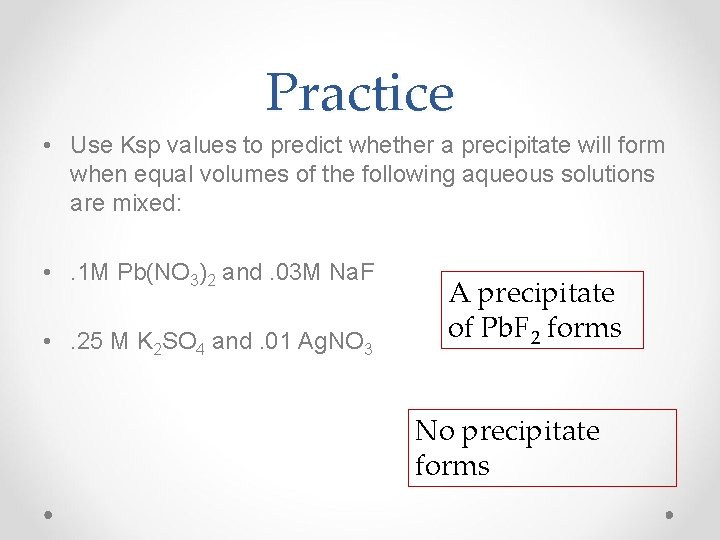
Practice • Use Ksp values to predict whether a precipitate will form when equal volumes of the following aqueous solutions are mixed: • . 1 M Pb(NO 3)2 and. 03 M Na. F • . 25 M K 2 SO 4 and. 01 Ag. NO 3 A precipitate of Pb. F 2 forms No precipitate forms
- Slides: 55