
Table ILP SemiStructured Reasoning for Answering Science Questions

Table. ILP: Semi-Structured Reasoning for Answering Science Questions Daniel Khashabi, Dan Roth (UIUC) Tushar Khot, Ashish Sabharwal, Peter Clark, Oren Etzioni (Allen Institute for Artificial Intelligence)
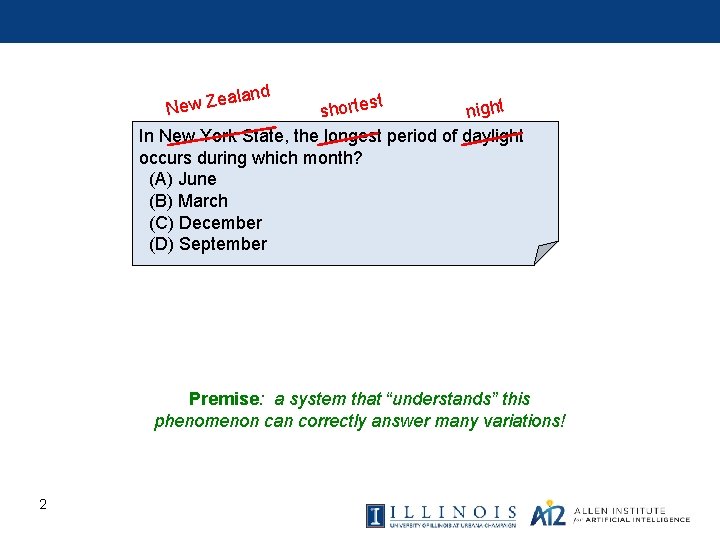
land a e Z st w Ne shorte night In New York State, the longest period of daylight occurs during which month? (A) June (B) March (C) December (D) September Premise: a system that “understands” this phenomenon can correctly answer many variations! 2
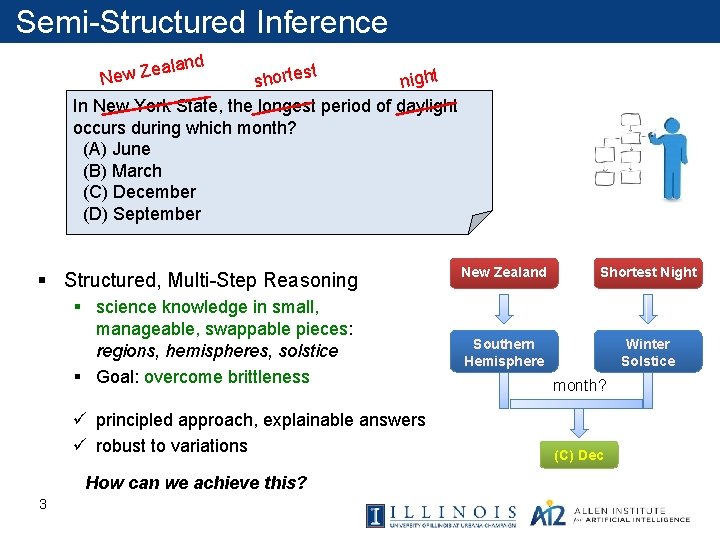
Semi-Structured Inference and l a e Z New st shorte night In New York State, the longest period of daylight occurs during which month? (A) June (B) March (C) December (D) September § Structured, Multi-Step Reasoning § science knowledge in small, manageable, swappable pieces: regions, hemispheres, solstice § Goal: overcome brittleness ü principled approach, explainable answers ü robust to variations How can we achieve this? 3 New Zealand York Shortest Longest. Night Day Southern Northern Hemisphere Summer Winter Solstice month? (A) (C)June Dec
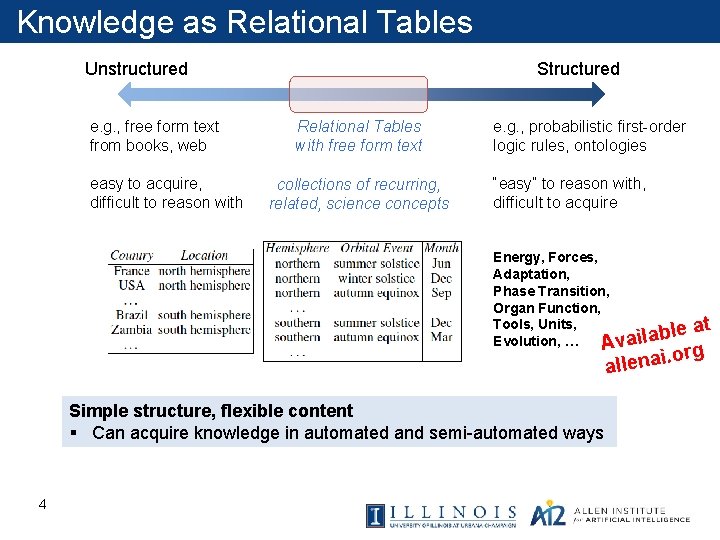
Knowledge as Relational Tables Unstructured e. g. , free form text from books, web easy to acquire, difficult to reason with Structured Relational Tables with free form text collections of recurring, related, science concepts e. g. , probabilistic first-order logic rules, ontologies “easy” to reason with, difficult to acquire Energy, Forces, Adaptation, Phase Transition, Organ Function, Tools, Units, ble Evolution, … Availa at nai. org alle Simple structure, flexible content § Can acquire knowledge in automated and semi-automated ways 4
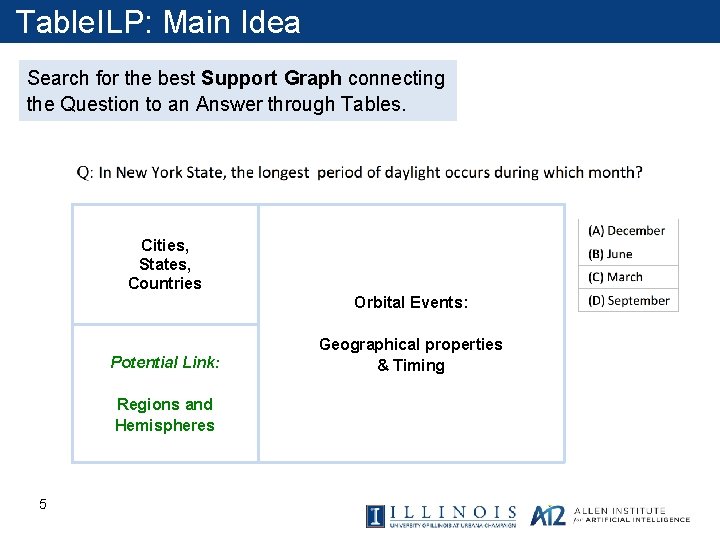
Table. ILP: Main Idea Search for the best Support Graph connecting the Question to an Answer through Tables. Cities, States, Countries Orbital Events: How is relevant information expressed in my KB? Potential Link: Regions and Hemispheres 5 Geographical properties & Timing
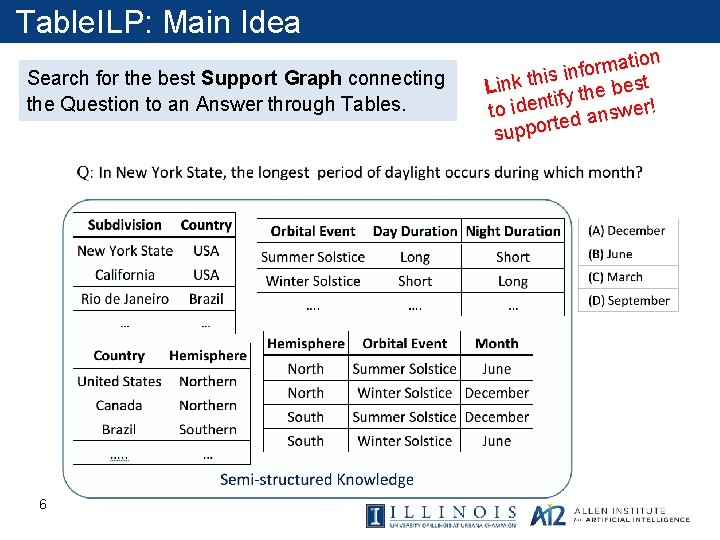
Table. ILP: Main Idea Search for the best Support Graph connecting the Question to an Answer through Tables. 6 ion t a m r o is inf h t k n i est L b e h t tify to iden d answer! te suppor
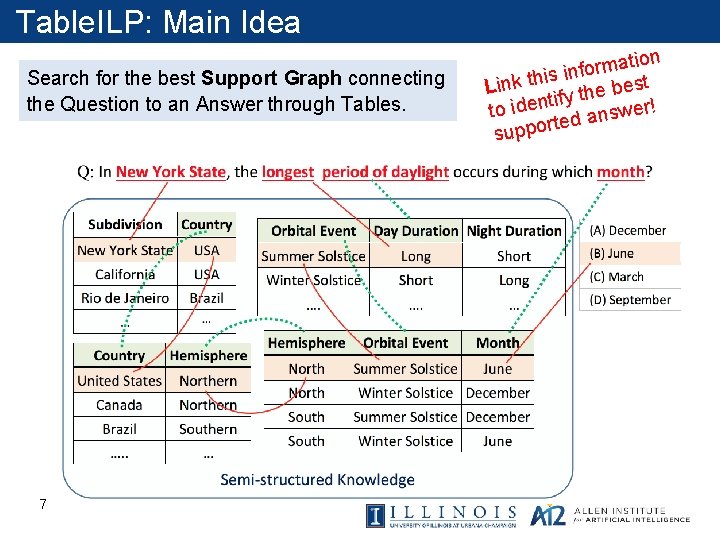
Table. ILP: Main Idea Search for the best Support Graph connecting the Question to an Answer through Tables. 7 ion t a m r o is inf h t k n i est L b e h t tify to iden d answer! te suppor
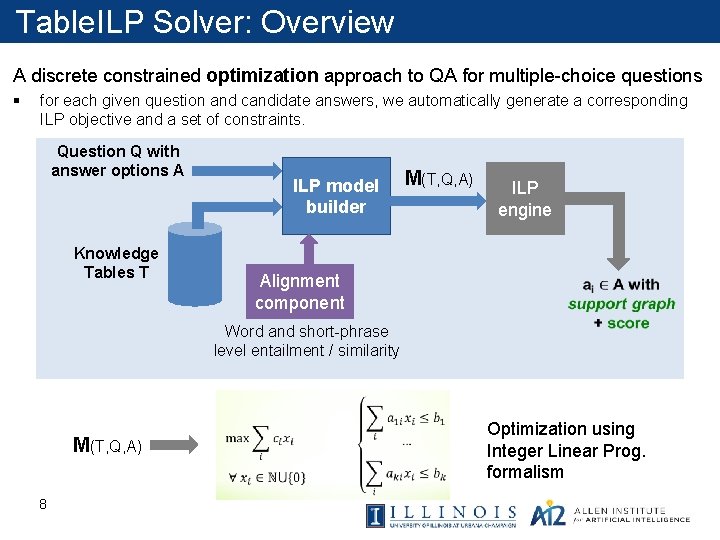
Table. ILP Solver: Overview A discrete constrained optimization approach to QA for multiple-choice questions § for each given question and candidate answers, we automatically generate a corresponding ILP objective and a set of constraints. Question Q with answer options A Knowledge Tables T ILP model builder M(T, Q, A) ILP engine Alignment component Word and short-phrase level entailment / similarity M(T, Q, A) 8 Optimization using Integer Linear Prog. formalism
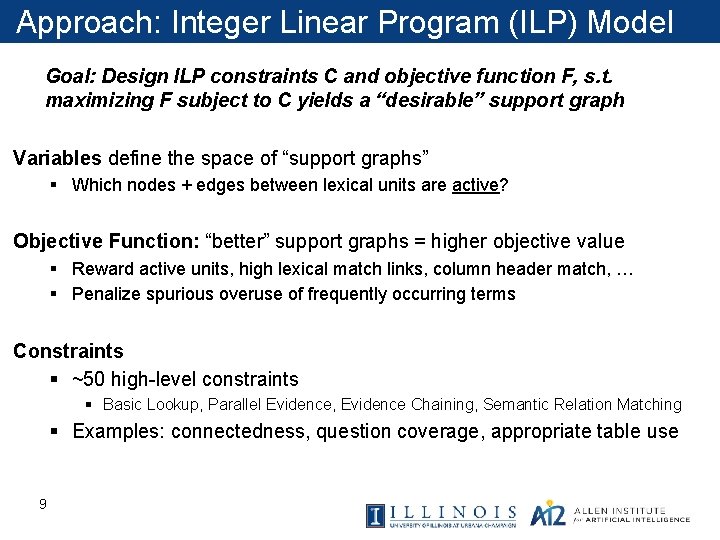
Approach: Integer Linear Program (ILP) Model Goal: Design ILP constraints C and objective function F, s. t. maximizing F subject to C yields a “desirable” support graph Variables define the space of “support graphs” § Which nodes + edges between lexical units are active? Objective Function: “better” support graphs = higher objective value § Reward active units, high lexical match links, column header match, … § Penalize spurious overuse of frequently occurring terms Constraints § ~50 high-level constraints § Basic Lookup, Parallel Evidence, Evidence Chaining, Semantic Relation Matching § Examples: connectedness, question coverage, appropriate table use 9
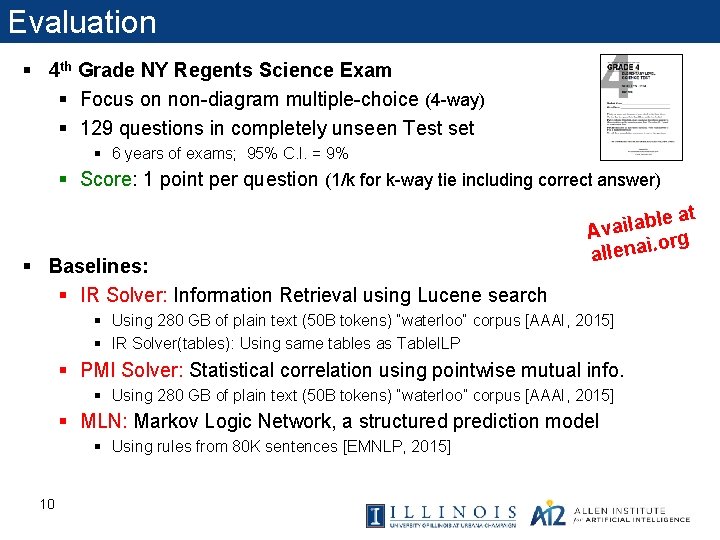
Evaluation § 4 th Grade NY Regents Science Exam § Focus on non-diagram multiple-choice (4 -way) § 129 questions in completely unseen Test set § 6 years of exams; 95% C. I. = 9% § Score: 1 point per question (1/k for k-way tie including correct answer) § Baselines: § IR Solver: Information Retrieval using Lucene search at e l b a l i Ava org. i a n e l al § Using 280 GB of plain text (50 B tokens) “waterloo” corpus [AAAI, 2015] § IR Solver(tables): Using same tables as Table. ILP § PMI Solver: Statistical correlation using pointwise mutual info. § Using 280 GB of plain text (50 B tokens) “waterloo” corpus [AAAI, 2015] § MLN: Markov Logic Network, a structured prediction model § Using rules from 80 K sentences [EMNLP, 2015] 10
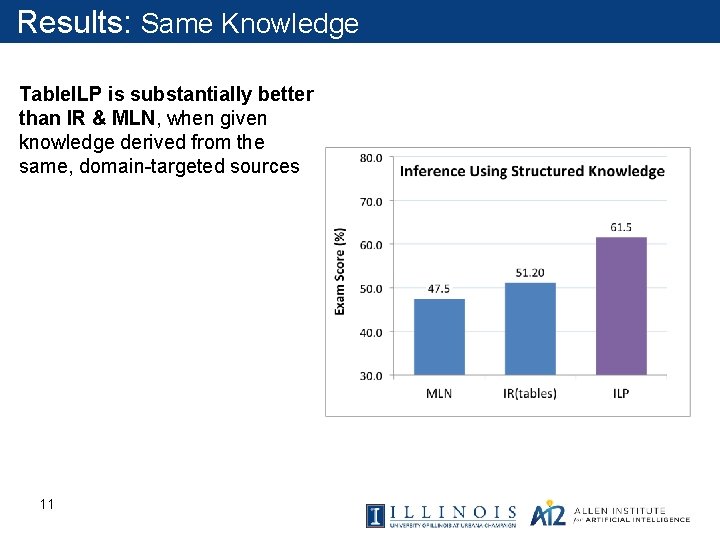
Results: Same Knowledge Table. ILP is substantially better than IR & MLN, when given knowledge derived from the same, domain-targeted sources 11
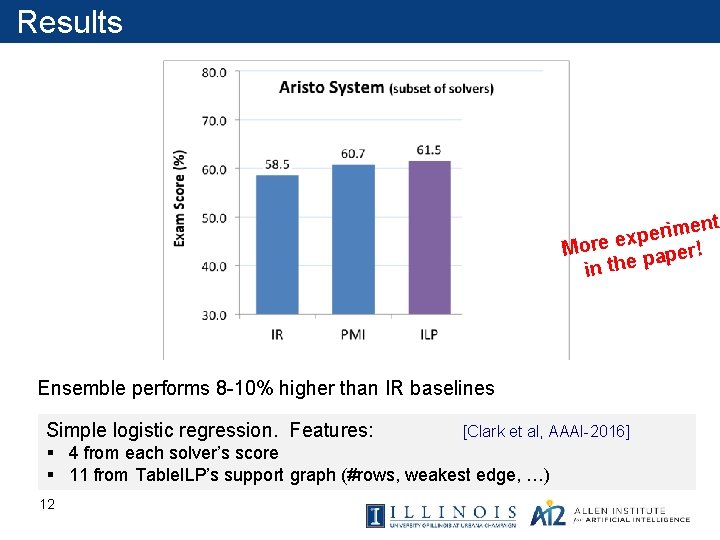
Results ent m i r e p x More e paper! in the Ensemble performs 8 -10% higher than IR baselines Simple logistic regression. Features: [Clark et al, AAAI-2016] § 4 from each solver’s score § 11 from Table. ILP’s support graph (#rows, weakest edge, …) 12

Conclusions § Table. ILP: Semi-structured reasoning can be very effective § Beyond IR § Just starting to scratch the surface! § Code: https: //github. com/allenai/tableilp § Ongoing efforts + future extensions § Scaling up to medium/large scale KB § Automated parameter tuning / learning § Improved semantics (better question interpretation, negations, … 13

EXTRA SLIDES 14
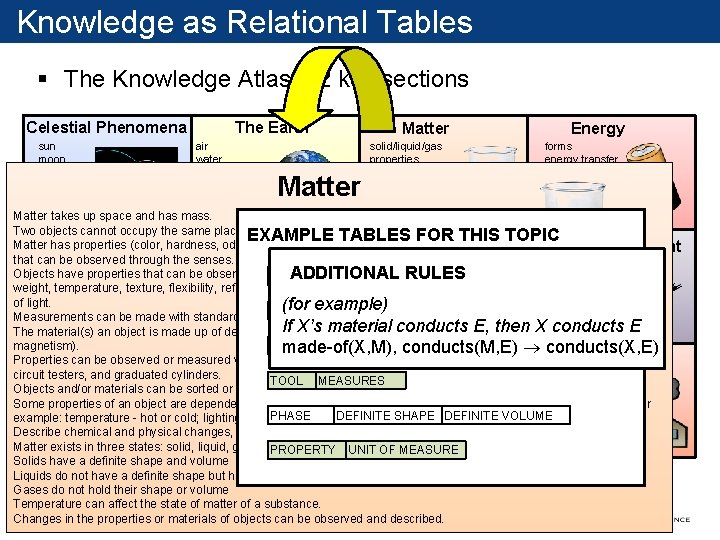
Knowledge as Relational Tables § The Knowledge Atlas: 12 key sections Celestial Phenomena The Earth sun air moon water stars land day/night, weather rotation precipitation revolution erosion Matter takes up space and has mass. Matter solid/liquid/gas properties conductivity texture temperature measuring tools Energy forms energy transfer heat electricity chemical energy conversion Two objects cannot occupy the same place at the same time. TABLES FOR THIS TOPIC EXAMPLE Forces Living things Matter has properties (color, hardness, odor, sound, taste, etc. ) Inheritance The Environment gravity that can be observed through the senses. living inherited traits and Adaptation magnetism Objects have properties that can benonliving observed, described, and/or measured: length, width, volume, size, shape, mass or resemblance ADDITIONAL RULES ENTITY COLOR senses force characteristics acquired traits weight, temperature, texture, flexibility, reflectiveness habitats friction animals learned traits of light. (for example) behavior pull/pushing PHASE TRANSITION FROM TO USING plants metric body features Measurements can be made with standard units and nonstandard units. camouflage attraction fish skills conducts If X’sspecific material E, (sink/float, then Xconductivity, conducts E The material(s) an object is made up of determine some properties of the object survival MATERIAL COLOR CONDUCTIVITY HARDNESS magnetism). made-of(X, M), conducts(M, E) conducts(X, E) Interdependence Humanmagnets, Impact Life Functions Properties can be observed or measured with tools such as hand lenses, metric rulers, thermometers, balances, Continuity of Life circuit food web human activities lifetesters, cycle and graduated cylinders. breathing TOOL MEASURES producers Objects and/or materials can be sorted or classified according to their properties. environment life span growing Some properties of an object are dependent on the conditions of theconsumers present surroundings in which ecosystem the object exists. For offspring eating decomposers PHASE DEFINITE SHAPE DEFINITE VOLUME pollution reproduction food example: temperature - hot or cold; lighting - shadows, color; moisture - wet or dry predators conservation coloration air Describe chemical and physical changes, including changes in states of matter. prey deforestation mating water Matter exists in three states: solid, liquid, gas. PROPERTY UNIT OF MEASURE Solids have a definite shape and volume Liquids do not have a definite shape but have a definite volume. Gases do not hold their shape or volume Temperature can affect the state of matter of a substance. Changes in the properties or materials of objects can be observed and described.
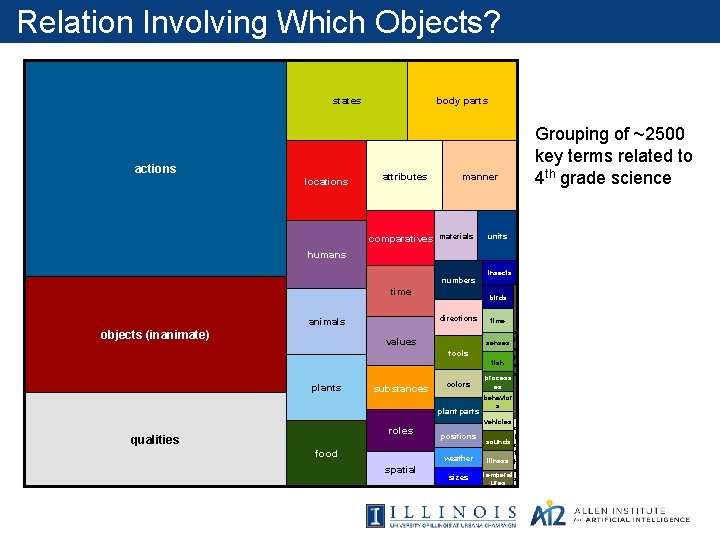
Relation Involving Which Objects? states actions locations body parts attributes comparatives manner materials units humans numbers time objects (inanimate) birds directions animals values tools plants substances insects colors plant parts time s senses h a p fish e s process es behavior s vehicles roles qualities food positions weather spatial sizes c l sounds o t illness h e temperat s ures Grouping of ~2500 key terms related to 4 th grade science
![Semi-Structured Inference: Challenge #2 Reasoning: effective, controllable, scalable RULE solver [AKBC 2014] forward chaining](http://slidetodoc.com/presentation_image_h2/f7e7821743d107e2bb88b86543cb2c58/image-17.jpg "Semi-Structured Inference: Challenge #2 Reasoning: effective, controllable, scalable RULE solver [AKBC 2014] forward chaining")
Semi-Structured Inference: Challenge #2 Reasoning: effective, controllable, scalable RULE solver [AKBC 2014] forward chaining of logic rules Integer Linear Programming (ILP) framework approx. inference with probabilistic first-order logic Pros: easy to understand constraints and preferences, behavior (state space) Pros: “natural” fit, high-level specification Cons: focuses on how to search rather than what to look for Cons: inefficient, difficult to control, brittle with noisy input industrial-strength solvers 17 MLN solver [EMNLP 2015]
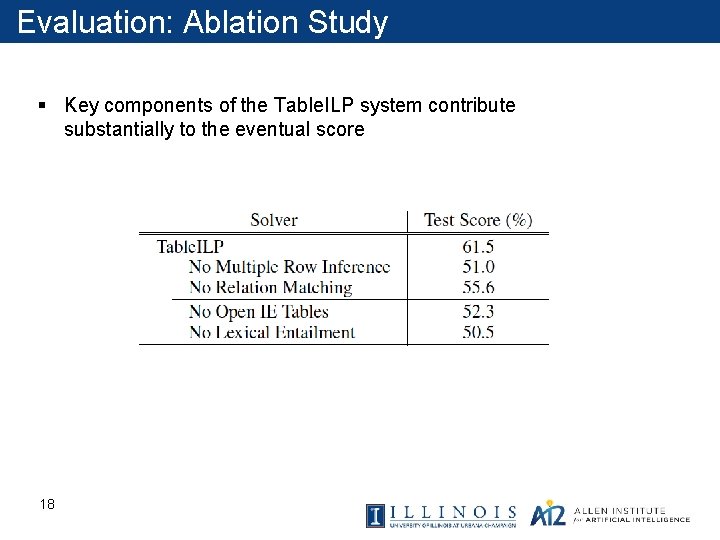
Evaluation: Ablation Study § Key components of the Table. ILP system contribute substantially to the eventual score 18
![Aristo: Ensemble Approach [AAAI-2016] 19](http://slidetodoc.com/presentation_image_h2/f7e7821743d107e2bb88b86543cb2c58/image-19.jpg "Aristo: Ensemble Approach [AAAI-2016] 19")
Aristo: Ensemble Approach [AAAI-2016] 19
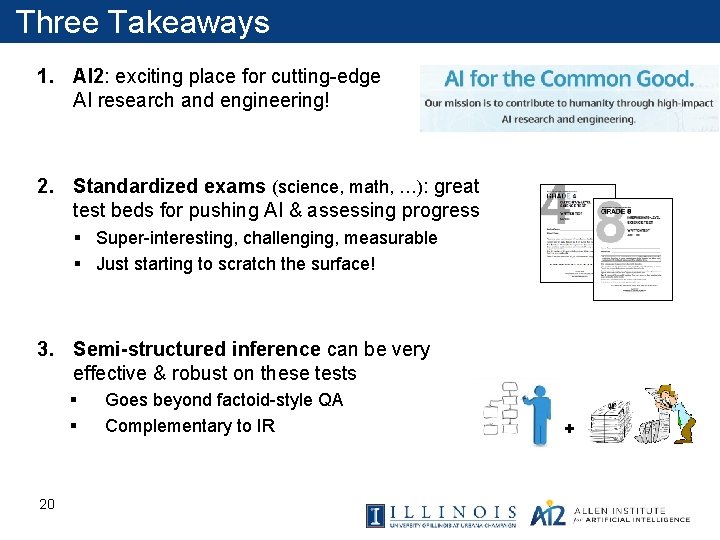
Three Takeaways 1. AI 2: exciting place for cutting-edge AI research and engineering! 2. Standardized exams (science, math, …): great test beds for pushing AI & assessing progress § Super-interesting, challenging, measurable § Just starting to scratch the surface! 3. Semi-structured inference can be very effective & robust on these tests § § 20 Goes beyond factoid-style QA Complementary to IR +
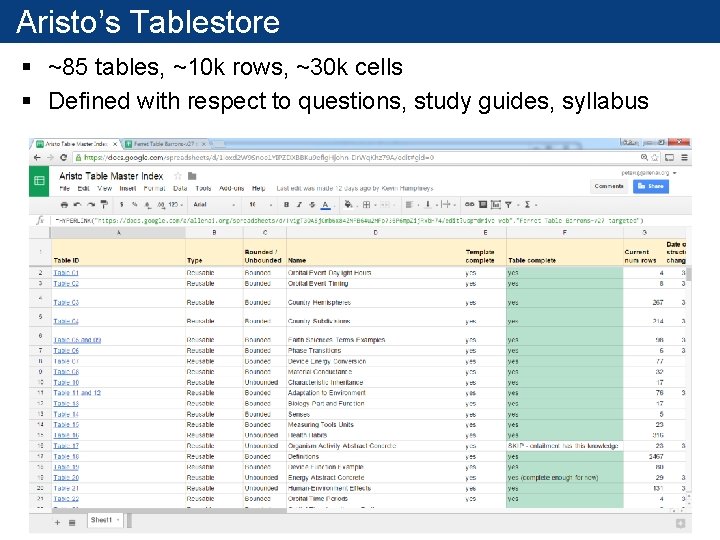
Aristo’s Tablestore § ~85 tables, ~10 k rows, ~30 k cells § Defined with respect to questions, study guides, syllabus
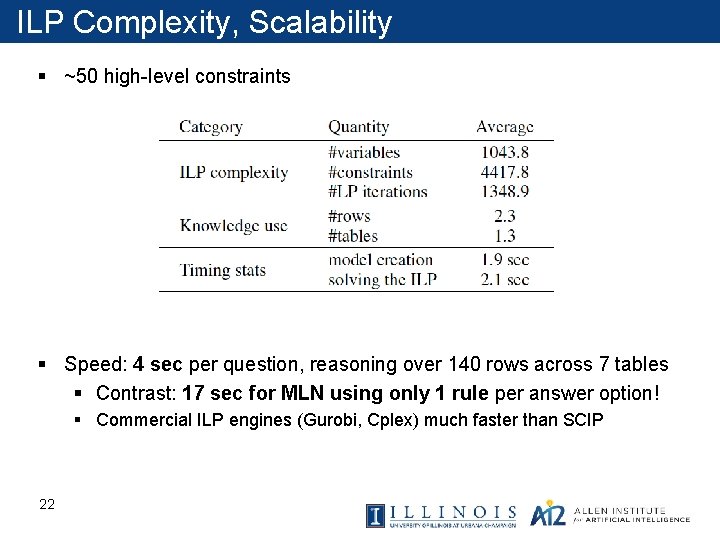
ILP Complexity, Scalability § ~50 high-level constraints § Speed: 4 sec per question, reasoning over 140 rows across 7 tables § Contrast: 17 sec for MLN using only 1 rule per answer option! § Commercial ILP engines (Gurobi, Cplex) much faster than SCIP 22
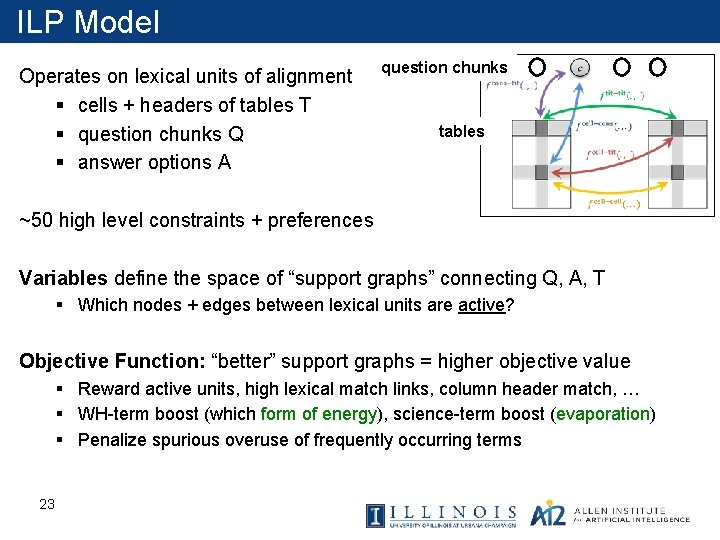
ILP Model Operates on lexical units of alignment § cells + headers of tables T § question chunks Q § answer options A question chunks tables ~50 high level constraints + preferences Variables define the space of “support graphs” connecting Q, A, T § Which nodes + edges between lexical units are active? Objective Function: “better” support graphs = higher objective value § Reward active units, high lexical match links, column header match, … § WH-term boost (which form of energy), science-term boost (evaporation) § Penalize spurious overuse of frequently occurring terms 23
ILP Model: Constraints Dual goal: scalability, consider only meaningful support graphs § Structural Constraints § Meaningful proof structures § connectedness, question coverage, appropriate table use § parallel evidence => identical multi-row activity signature § Simplicity appropriate for 4 th / 8 th grade § Semantic Constraints § Chaining => table joins between semantically similar column pairs § Relation matching (ruler measures length, change from water to liquid) § Table Relevance Ranking § TF-IDF scoring to identify top N relevant tables 24
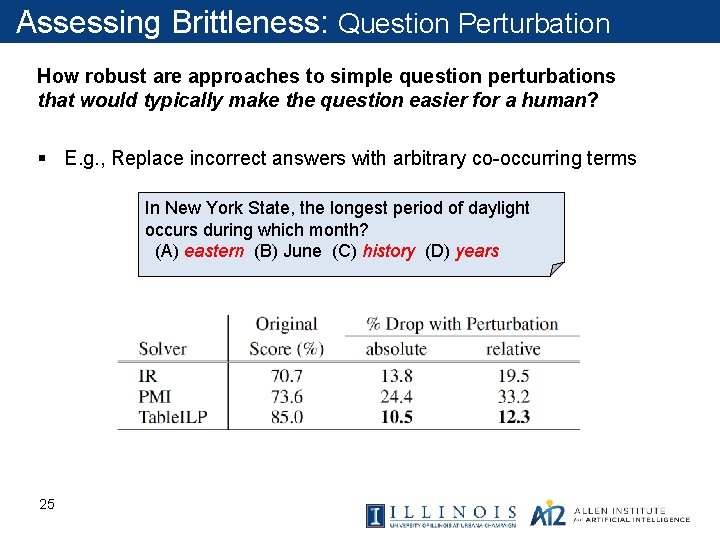
Assessing Brittleness: Question Perturbation How robust are approaches to simple question perturbations that would typically make the question easier for a human? § E. g. , Replace incorrect answers with arbitrary co-occurring terms In New York State, the longest period of daylight occurs during which month? (A) eastern (B) June (C) history (D) years 25
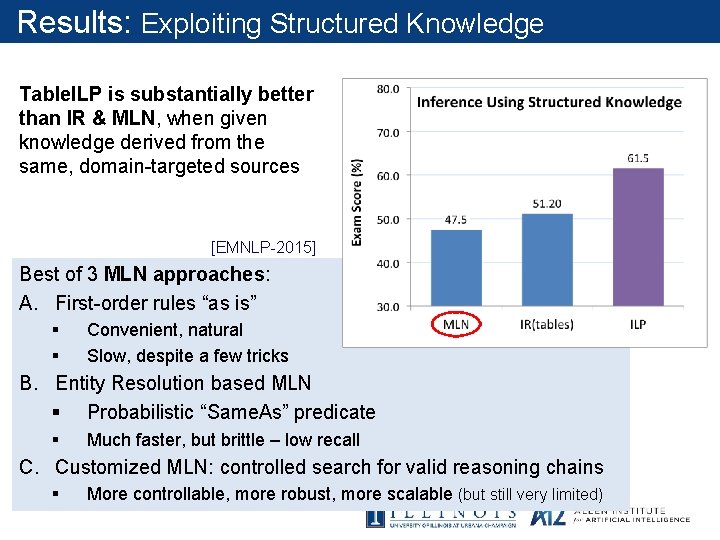
Results: Exploiting Structured Knowledge Table. ILP is substantially better than IR & MLN, when given knowledge derived from the same, domain-targeted sources [EMNLP-2015] Best of 3 MLN approaches: A. First-order rules “as is” § § Convenient, natural Slow, despite a few tricks B. Entity Resolution based MLN § Probabilistic “Same. As” predicate § Much faster, but brittle – low recall C. Customized MLN: controlled search for valid reasoning chains § 26 More controllable, more robust, more scalable (but still very limited)
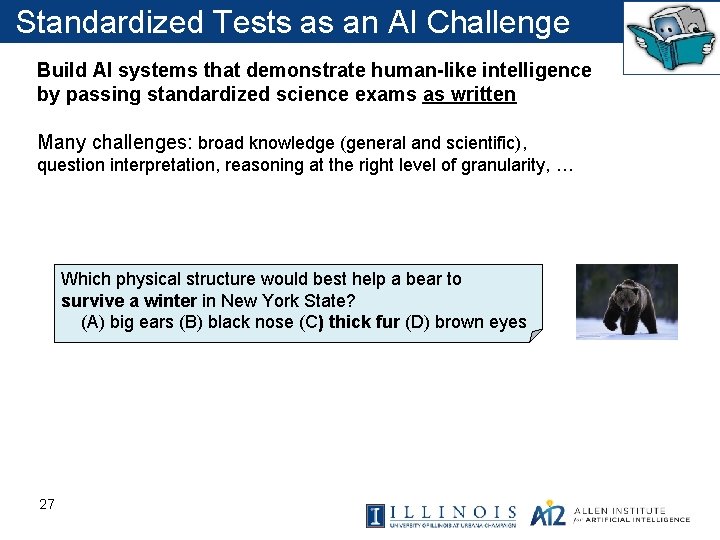
Standardized Tests as an AI Challenge Build AI systems that demonstrate human-like intelligence by passing standardized science exams as written Many challenges: broad knowledge (general and scientific), question interpretation, reasoning at the right level of granularity, … Which physical structure would best help a bear to survive a winter in New York State? (A) big ears (B) black nose (C) thick fur (D) brown eyes 27
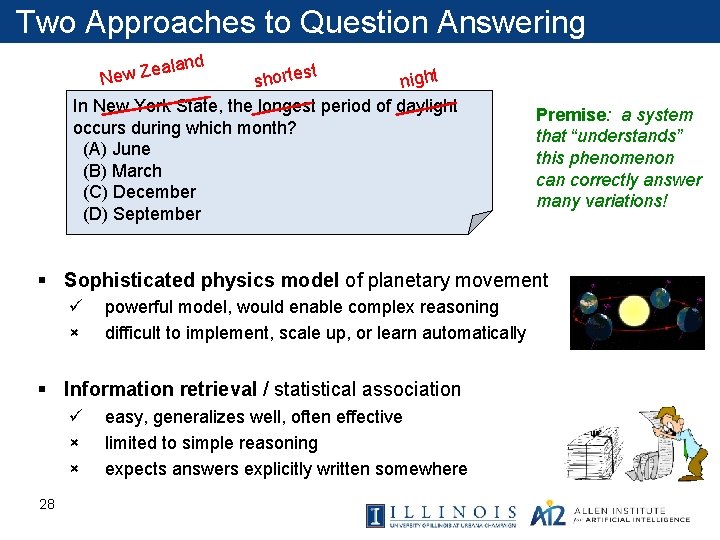
Two Approaches to Question Answering and l a e Z New st shorte night In New York State, the longest period of daylight occurs during which month? (A) June (B) March (C) December (D) September Premise: a system that “understands” this phenomenon can correctly answer many variations! § Sophisticated physics model of planetary movement ü × powerful model, would enable complex reasoning difficult to implement, scale up, or learn automatically § Information retrieval / statistical association ü × × 28 easy, generalizes well, often effective limited to simple reasoning expects answers explicitly written somewhere
- Slides: 28