
Table 3 Summary of waste management and sanitation
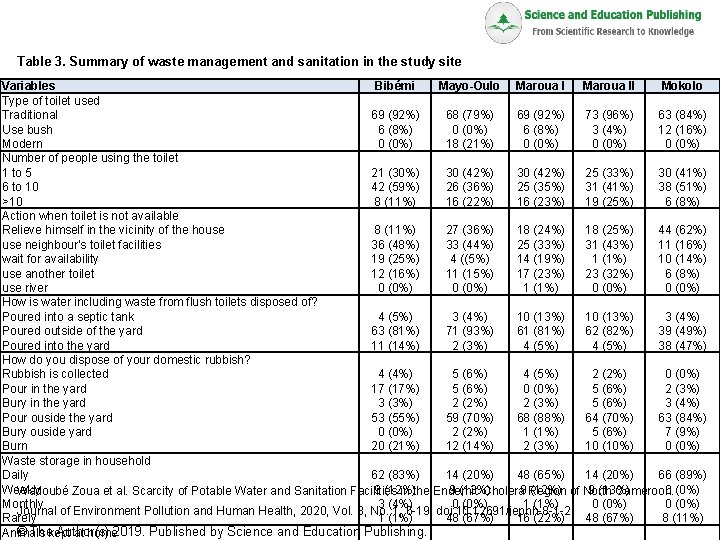
Table 3. Summary of waste management and sanitation in the study site Variables Bibémi Mayo-Oulo Maroua II Mokolo Type of toilet used Traditional 69 (92%) 68 (79%) 69 (92%) 73 (96%) 63 (84%) Use bush 6 (8%) 0 (0%) 6 (8%) 3 (4%) 12 (16%) Modern 0 (0%) 18 (21%) 0 (0%) Number of people using the toilet 1 to 5 21 (30%) 30 (42%) 25 (33%) 30 (41%) 6 to 10 42 (59%) 26 (36%) 25 (35%) 31 (41%) 38 (51%) >10 8 (11%) 16 (22%) 16 (23%) 19 (25%) 6 (8%) Action when toilet is not available Relieve himself in the vicinity of the house 8 (11%) 27 (36%) 18 (24%) 18 (25%) 44 (62%) use neighbour's toilet facilities 36 (48%) 33 (44%) 25 (33%) 31 (43%) 11 (16%) wait for availability 19 (25%) 4 ((5%) 14 (19%) 1 (1%) 10 (14%) use another toilet 12 (16%) 11 (15%) 17 (23%) 23 (32%) 6 (8%) use river 0 (0%) 1 (1%) 0 (0%) How is water including waste from flush toilets disposed of? Poured into a septic tank 4 (5%) 3 (4%) 10 (13%) 3 (4%) Poured outside of the yard 63 (81%) 71 (93%) 61 (81%) 62 (82%) 39 (49%) Poured into the yard 11 (14%) 2 (3%) 4 (5%) 38 (47%) How do you dispose of your domestic rubbish? Rubbish is collected 4 (4%) 5 (6%) 4 (5%) 2 (2%) 0 (0%) Pour in the yard 17 (17%) 5 (6%) 0 (0%) 5 (6%) 2 (3%) Bury in the yard 3 (3%) 2 (2%) 2 (3%) 5 (6%) 3 (4%) Pour ouside the yard 53 (55%) 59 (70%) 68 (88%) 64 (70%) 63 (84%) Bury ouside yard 0 (0%) 2 (2%) 1 (1%) 5 (6%) 7 (9%) Burn 20 (21%) 12 (14%) 2 (3%) 10 (10%) 0 (0%) Waste storage in household Daily 62 (83%) 14 (20%) 48 (65%) 14 (20%) 66 (89%) Weekly 9 (12%) 9 (13%) (12%) of North 9 (13%) 0 (0%) Wadoubé Zoua et al. Scarcity of Potable Water and Sanitation Facilities in the Endemic Cholera 9 Region Cameroon. Monthly 3 (4%) 0 (0%) 1 (1%) 0 (0%) Journal of Environment Pollution and Human Health, 2020, Vol. 8, No. 1, 6 -19. doi: 10. 12691/jephh-8 -1 -2 Rarely 1 (1%) 48 (67%) 16 (22%) 48 (67%) 8 (11%) © Thekept Author(s) Animals at home 2019. Published by Science and Education Publishing.
- Slides: 1