
Table 3 Summary of Key Features in the
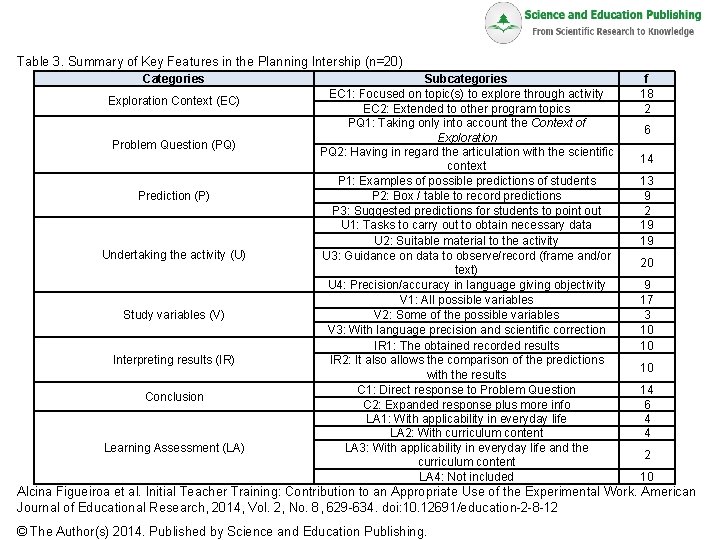
Table 3. Summary of Key Features in the Planning Intership (n=20) Categories Exploration Context (EC) Problem Question (PQ) Prediction (P) Undertaking the activity (U) Study variables (V) Interpreting results (IR) Conclusion Learning Assessment (LA) Subcategories EC 1: Focused on topic(s) to explore through activity EC 2: Extended to other program topics PQ 1: Taking only into account the Context of Exploration PQ 2: Having in regard the articulation with the scientific context P 1: Examples of possible predictions of students P 2: Box / table to record predictions P 3: Suggested predictions for students to point out U 1: Tasks to carry out to obtain necessary data U 2: Suitable material to the activity U 3: Guidance on data to observe/record (frame and/or text) U 4: Precision/accuracy in language giving objectivity V 1: All possible variables V 2: Some of the possible variables V 3: With language precision and scientific correction IR 1: The obtained recorded results IR 2: It also allows the comparison of the predictions with the results C 1: Direct response to Problem Question C 2: Expanded response plus more info LA 1: With applicability in everyday life LA 2: With curriculum content LA 3: With applicability in everyday life and the curriculum content LA 4: Not included f 18 2 6 14 13 9 2 19 19 20 9 17 3 10 10 10 14 6 4 4 2 10 Alcina Figueiroa et al. Initial Teacher Training: Contribution to an Appropriate Use of the Experimental Work. American Journal of Educational Research, 2014, Vol. 2, No. 8, 629 -634. doi: 10. 12691/education-2 -8 -12 © The Author(s) 2014. Published by Science and Education Publishing.
- Slides: 1