
Table 3 Grid question to measure students cognitive
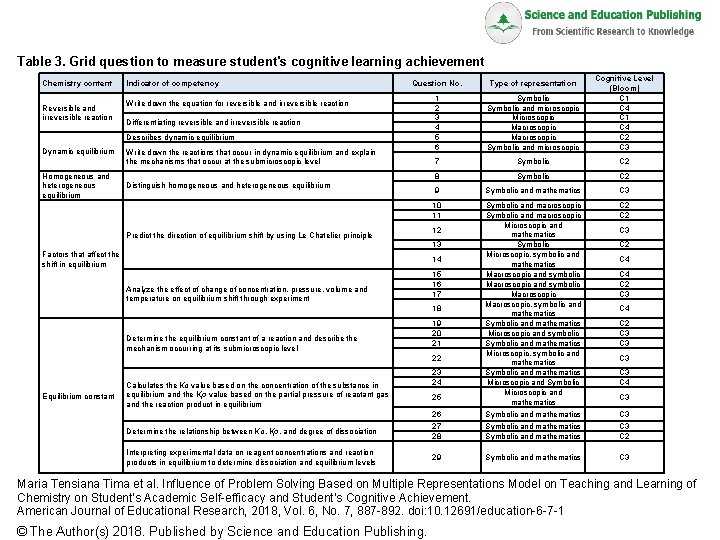
Table 3. Grid question to measure student's cognitive learning achievement Chemistry content Reversible and irreversible reaction Indicator of competency Question No. Type of representation 1 2 3 4 5 6 Symbolic and microscopic Macroscopic Symbolic and microscopic Cognitive Level (Bloom) C 1 C 4 C 2 C 3 7 Symbolic C 2 8 Symbolic C 2 9 Symbolic and mathematics C 3 10 11 Symbolic and macroscopic Microscopic and mathematics Symbolic Microscopic, symbolic and mathematics Macroscopic and symbolic Macroscopic, symbolic and mathematics Symbolic and mathematics Microscopic and symbolic Symbolic and mathematics Microscopic, symbolic and mathematics Symbolic and mathematics Microscopic and Symbolic Microscopic and mathematics C 2 26 27 28 Symbolic and mathematics C 3 C 2 29 Symbolic and mathematics C 3 Write down the equation for reversible and irreversible reaction Differentiating reversible and irreversible reaction Describes dynamic equilibrium Dynamic equilibrium Homogeneous and heterogeneous equilibrium Write down the reactions that occur in dynamic equilibrium and explain the mechanisms that occur at the submicroscopic level Distinguish homogeneous and heterogeneous equilibrium Predict the direction of equilibrium shift by using Le Chatelier principle 12 13 Factors that affect the shift in equilibrium 14 Analyze the effect of change of concentration, pressure, volume and temperature on equilibrium shift through experiment 15 16 17 18 Determine the equilibrium constant of a reaction and describe the mechanism occurring at its submicroscopic level 19 20 21 22 Equilibrium constant Calculates the Kc value based on the concentration of the substance in equilibrium and the Kp value based on the partial pressure of reactant gas and the reaction product in equilibrium Determine the relationship between K c, Kp, and degree of dissociation Interpreting experimental data on reagent concentrations and reaction products in equilibrium to determine dissociation and equilibrium levels 23 24 25 C 3 C 2 C 4 C 2 C 3 C 3 C 4 C 3 Maria Tensiana Tima et al. Influence of Problem Solving Based on Multiple Representations Model on Teaching and Learning of Chemistry on Student’s Academic Self-efficacy and Student’s Cognitive Achievement. American Journal of Educational Research, 2018, Vol. 6, No. 7, 887 -892. doi: 10. 12691/education-6 -7 -1 © The Author(s) 2018. Published by Science and Education Publishing.
- Slides: 1