
Table 3 AFP stool specimen handling and transport
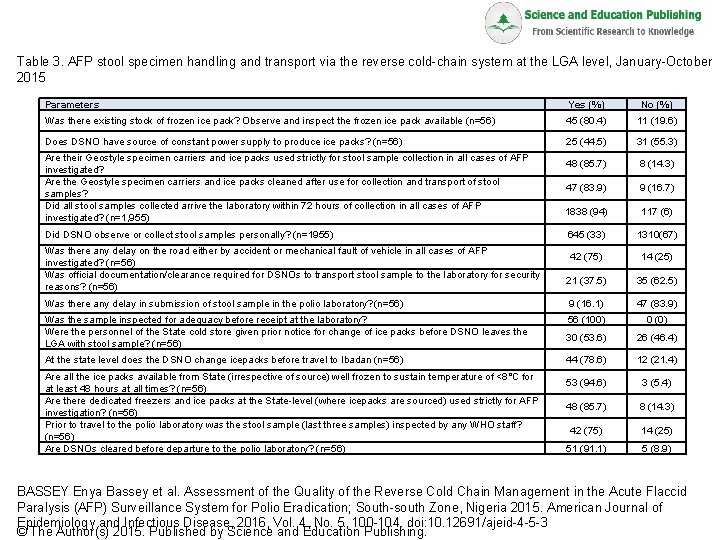
Table 3. AFP stool specimen handling and transport via the reverse cold-chain system at the LGA level, January-October 2015 Parameters Yes (%) No (%) Was there existing stock of frozen ice pack? Observe and inspect the frozen ice pack available (n=56) 45 (80. 4) 11 (19. 6) Does DSNO have source of constant power supply to produce ice packs? (n=56) 25 (44. 5) 31 (55. 3) 48 (85. 7) 8 (14. 3) 47 (83. 9) 9 (16. 7) 1838 (94) 117 (6) 645 (33) 1310(67) 42 (75) 14 (25) 21 (37. 5) 35 (62. 5) Was there any delay in submission of stool sample in the polio laboratory? (n=56) 9 (16. 1) 47 (83. 9) Was the sample inspected for adequacy before receipt at the laboratory? Were the personnel of the State cold store given prior notice for change of ice packs before DSNO leaves the LGA with stool sample? (n=56) 56 (100) 0 (0) 30 (53. 6) 26 (46. 4) 44 (78. 6) 12 (21. 4) 53 (94. 6) 3 (5. 4) 48 (85. 7) 8 (14. 3) 42 (75) 14 (25) 51 (91. 1) 5 (8. 9) Are their Geostyle specimen carriers and ice packs used strictly for stool sample collection in all cases of AFP investigated? Are the Geostyle specimen carriers and ice packs cleaned after use for collection and transport of stool samples? Did all stool samples collected arrive the laboratory within 72 hours of collection in all cases of AFP investigated? (n=1, 955) Did DSNO observe or collect stool samples personally? (n=1955) Was there any delay on the road either by accident or mechanical fault of vehicle in all cases of AFP investigated? (n=56) Was official documentation/clearance required for DSNOs to transport stool sample to the laboratory for security reasons? (n=56) At the state level does the DSNO change icepacks before travel to Ibadan (n=56) Are all the ice packs available from State (irrespective of source) well frozen to sustain temperature of <8°C for at least 48 hours at all times? (n=56) Are there dedicated freezers and ice packs at the State-level (where icepacks are sourced) used strictly for AFP investigation? (n=56) Prior to travel to the polio laboratory was the stool sample (last three samples) inspected by any WHO staff? (n=56) Are DSNOs cleared before departure to the polio laboratory? (n=56) BASSEY Enya Bassey et al. Assessment of the Quality of the Reverse Cold Chain Management in the Acute Flaccid Paralysis (AFP) Surveillance System for Polio Eradication; South-south Zone, Nigeria 2015. American Journal of Epidemiology and Infectious Disease, 2016, Vol. 4, No. 5, 100 -104. doi: 10. 12691/ajeid-4 -5 -3 © The Author(s) 2015. Published by Science and Education Publishing.
- Slides: 1