
Table 22 1 Major Categories of Water Pollutants
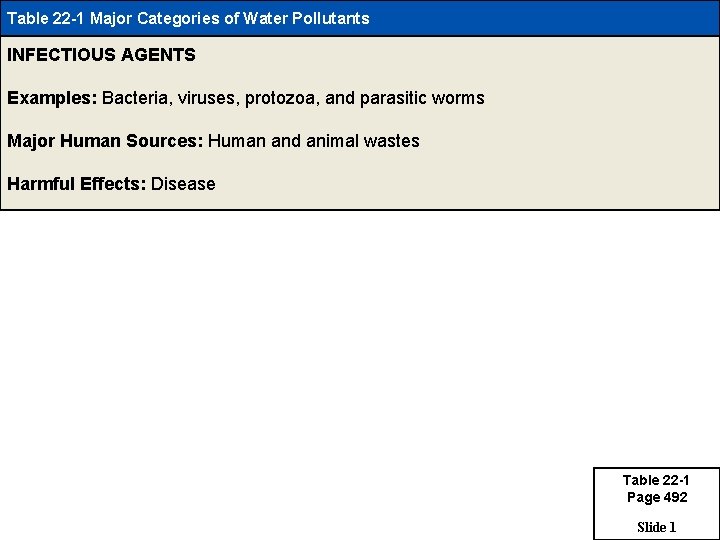
Table 22 -1 Major Categories of Water Pollutants INFECTIOUS AGENTS Examples: Bacteria, viruses, protozoa, and parasitic worms Major Human Sources: Human and animal wastes Harmful Effects: Disease Table 22 -1 Page 492 Slide 1
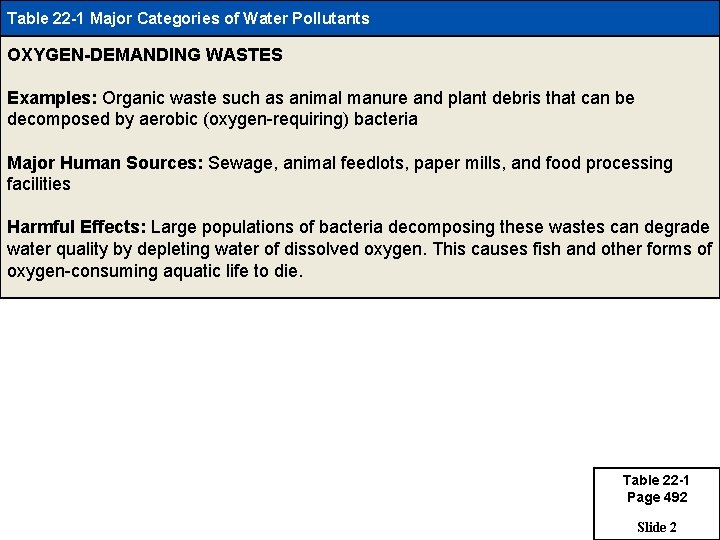
Table 22 -1 Major Categories of Water Pollutants OXYGEN-DEMANDING WASTES Examples: Organic waste such as animal manure and plant debris that can be decomposed by aerobic (oxygen-requiring) bacteria Major Human Sources: Sewage, animal feedlots, paper mills, and food processing facilities Harmful Effects: Large populations of bacteria decomposing these wastes can degrade water quality by depleting water of dissolved oxygen. This causes fish and other forms of oxygen-consuming aquatic life to die. Table 22 -1 Page 492 Slide 2

Table 22 -1 Major Categories of Water Pollutants INORGANIC CHEMICALS Examples: Water-soluble 1) acids, (2) compounds of toxic metals such as lead (Pb), arsenic (As), and selenium Se), and (3) salts such as sodium chloride (Na. Cl) in ocean water and fluorides (F–) found in some soils Major Human Sources: Surface runoff, industrial effluents, and household cleansers Harmful Effects: Can (1) make fresh water unusable for drinking or irrigation, (2) cause skin cancers and crippling spinal and neck damage (F–), (3) damage the nervous system, liver, and kidneys (Pb and As), (4) harm fish and other aquatic life, (5) lower crop yields, and (6) accelerate corrosion of metals exposed to such water. Table 22 -1 Page 492 Slide 3

Table 22 -1 Major Categories of Water Pollutants ORGANIC CHEMICALS Examples: Oil, gasoline, plastics, pesticides, cleaning solvents, detergents Major Human Sources: Industrial effluents, household cleansers, surface runoff from farms and yards Harmful Effects: Can (1) threaten human health by causing nervous system damage (some pesticides), reproductive disorders (some solvents), and some cancers (gasoline, oil, and some solvents) and (2) harm fish and wildlife. Table 22 -1 Page 492 Slide 4

Table 22 -1 Major Categories of Water Pollutants PLANT NUTRIENTS Examples: Water-soluble compounds containing nitrate (NO 3 –), phosphate (PO 43–), and ammonium (NH 4+) ions Major Human Sources: Sewage, manure, and runoff of agricultural and urban fertilizers Harmful Effects: Can cause excessive growth of algae and other aquatic plants, which die, decay, deplete water of dissolved oxygen, and kill fish. Drinking water with excessive levels of nitrates lowers the oxygen-carrying capacity of the blood and can kill unborn children and infants (“bluebaby syndrome”). Table 22 -1 Page 492 Slide 5

Table 22 -1 Major Categories of Water Pollutants SEDIMENT Examples: Soil, silt Major Human Sources: Land erosion Harmful Effects: Can (1) cloud water and reduce photosynthesis, (2) disrupt aquatic food webs, (3) carry pesticides, bacteria, and other harmful substances, (4) settle out and destroy feeding and spawning grounds of fish, and (5) clog and fill lakes, artificial reservoirs, stream channels, and harbors. Table 22 -1 Page 492 Slide 6

Table 22 -1 Major Categories of Water Pollutants RADIOACTIVE MATERIALS Examples: Radioactive isotopes of iodine, radon, uranium, cesium, and thorium Major Human Sources: Nuclear and coal-burning power plants, mining and processing of uranium and other ores, nuclear weapons production, natural sources Harmful Effects: Genetic mutations, miscarriages, birth defects, and certain cancers Table 22 -1 Page 492 Slide 7

Table 22 -1 Major Categories of Water Pollutants HEAT (THERMAL POLLUTION) Examples: Excessive heat Major Human Sources: Water cooling of electric power plants and some types of industrial plants. Almost half of all water withdrawn in the United States each year is for cooling electric power plants. Harmful Effects: Lowers dissolved oxygen levels and makes aquatic organisms more vulnerable to disease, parasites, and toxic chemicals. When a power plant first opens or shuts down for repair, fish and other organisms adapted to a particular temperature range can be killed by the abrupt change in water temperature—known as thermal shock. Table 22 -1 Page 492 Slide 8
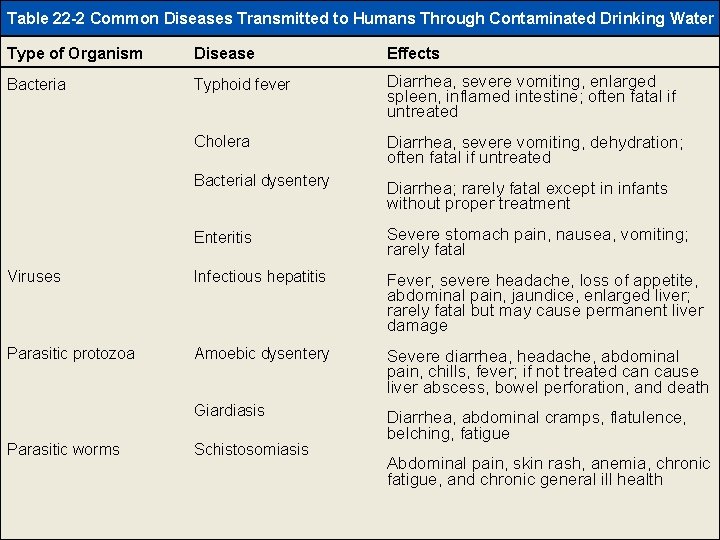
Table 22 -2 Common Diseases Transmitted to Humans Through Contaminated Drinking Water Type of Organism Disease Effects Bacteria Typhoid fever Diarrhea, severe vomiting, enlarged spleen, inflamed intestine; often fatal if untreated Cholera Diarrhea, severe vomiting, dehydration; often fatal if untreated Bacterial dysentery Diarrhea; rarely fatal except in infants without proper treatment Enteritis Severe stomach pain, nausea, vomiting; rarely fatal Viruses Infectious hepatitis Fever, severe headache, loss of appetite, abdominal pain, jaundice, enlarged liver; rarely fatal but may cause permanent liver damage Parasitic protozoa Amoebic dysentery Severe diarrhea, headache, abdominal pain, chills, fever; if not treated can cause liver abscess, bowel perforation, and death Giardiasis Diarrhea, abdominal cramps, flatulence, belching, fatigue Parasitic worms Schistosomiasis Abdominal pain, skin rash, anemia, chronic fatigue, and chronic general ill health Table 22 -2 Page 493 Slide 9
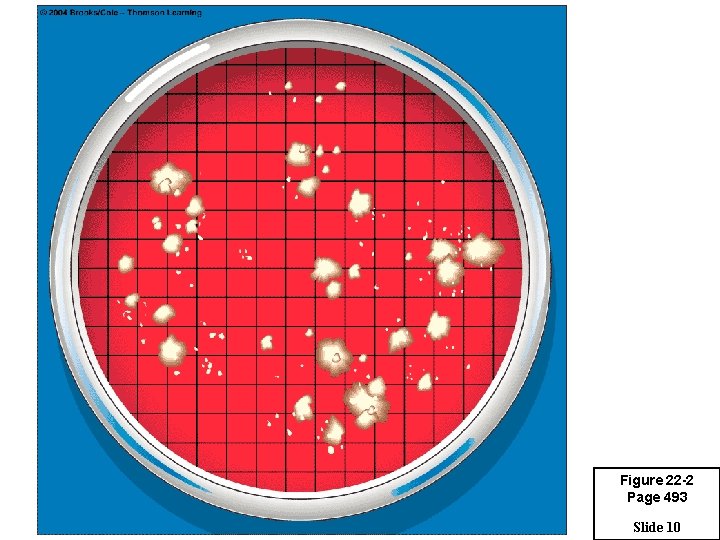
Figure 22 -2 Page 493 Slide 10
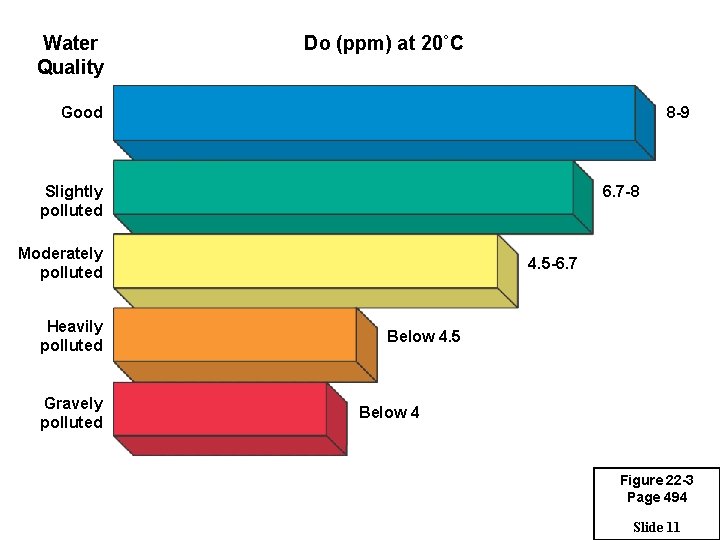
Water Quality Do (ppm) at 20˚C Good 8 -9 Slightly polluted 6. 7 -8 Moderately polluted Heavily polluted Gravely polluted 4. 5 -6. 7 Below 4. 5 Below 4 Figure 22 -3 Page 494 Slide 11
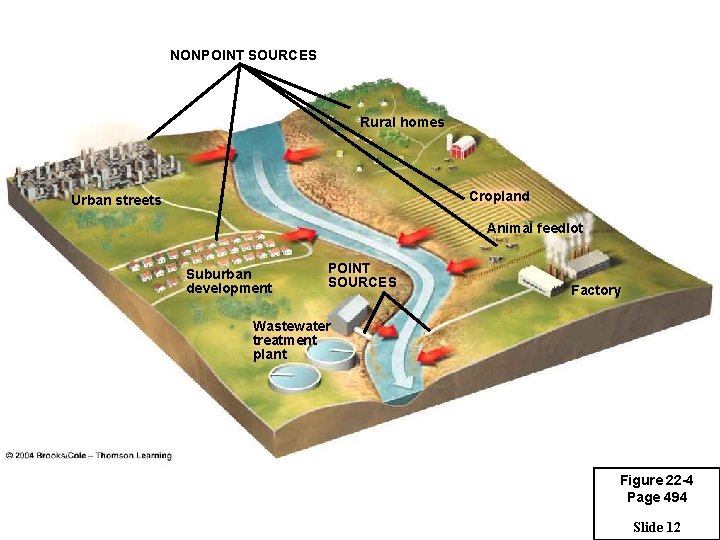
NONPOINT SOURCES Rural homes Cropland Urban streets Animal feedlot Suburban development POINT SOURCES Factory Wastewater treatment plant Figure 22 -4 Page 494 Slide 12
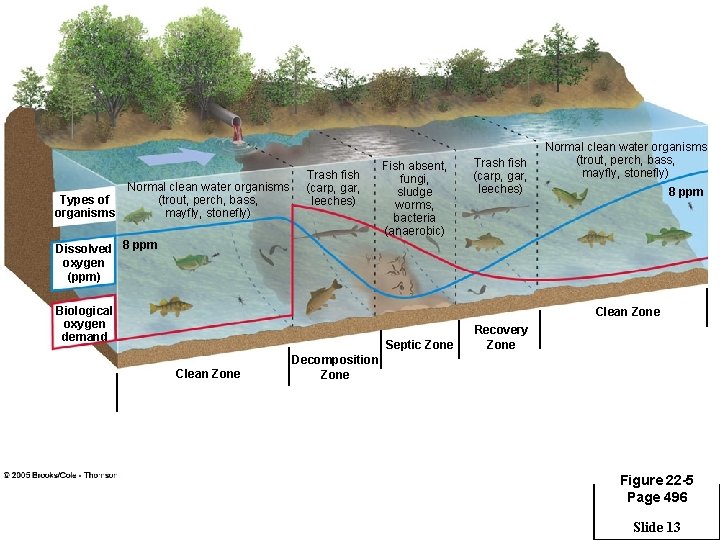
Types of organisms Normal clean water organisms (trout, perch, bass, mayfly, stonefly) Trash fish (carp, gar, leeches) Fish absent, fungi, sludge worms, bacteria (anaerobic) Trash fish (carp, gar, leeches) Normal clean water organisms (trout, perch, bass, mayfly, stonefly) 8 ppm Dissolved 8 ppm oxygen (ppm) Biological oxygen demand Clean Zone Septic Zone Clean Zone Recovery Zone Decomposition Zone Figure 22 -5 Page 496 Slide 13
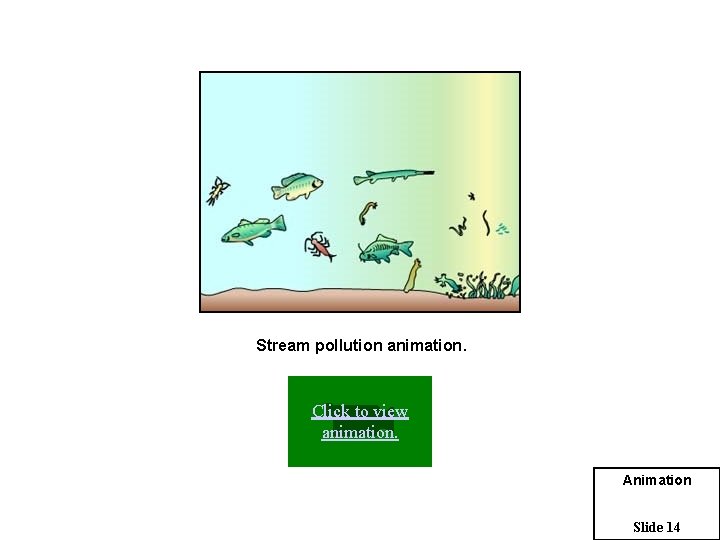
Stream pollution animation. Click to view animation. Animation Slide 14
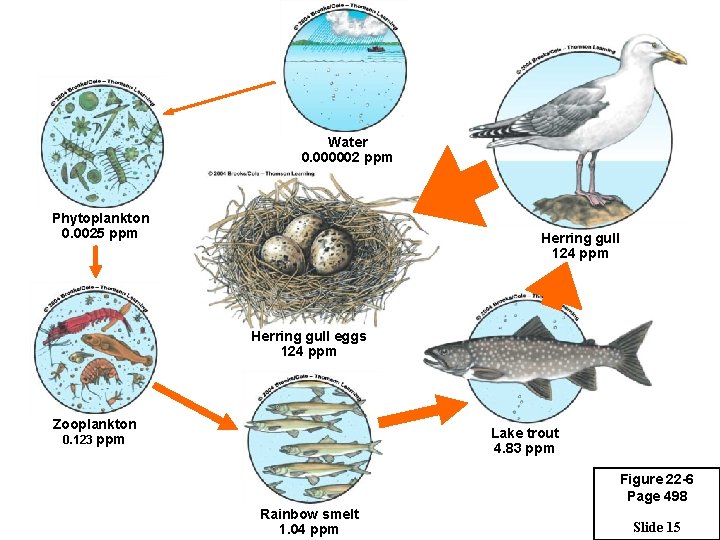
Water 0. 000002 ppm Phytoplankton 0. 0025 ppm Herring gull 124 ppm Herring gull eggs 124 ppm Zooplankton 0. 123 ppm Lake trout 4. 83 ppm Figure 22 -6 Page 498 Rainbow smelt 1. 04 ppm Slide 15
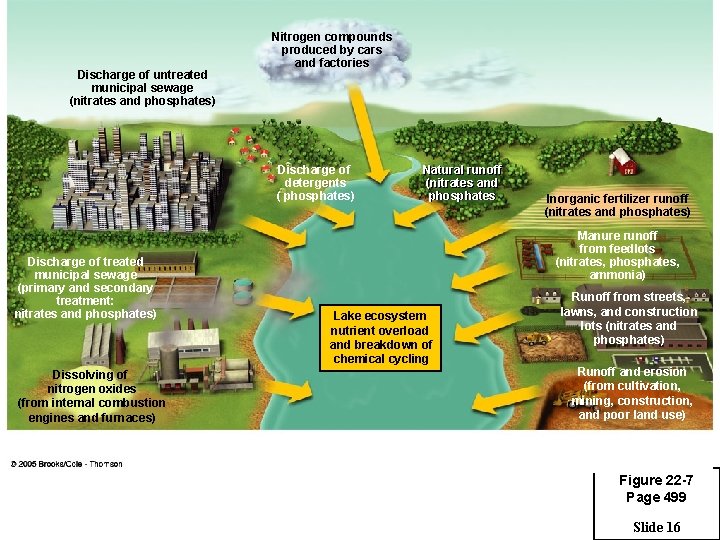
Discharge of untreated municipal sewage (nitrates and phosphates) Nitrogen compounds produced by cars and factories Discharge of detergents ( phosphates) Discharge of treated municipal sewage (primary and secondary treatment: nitrates and phosphates) Dissolving of nitrogen oxides (from internal combustion engines and furnaces) Natural runoff (nitrates and phosphates Inorganic fertilizer runoff (nitrates and phosphates) Manure runoff from feedlots (nitrates, phosphates, ammonia) Lake ecosystem nutrient overload and breakdown of chemical cycling Runoff from streets, lawns, and construction lots (nitrates and phosphates) Runoff and erosion (from cultivation, mining, construction, and poor land use) Figure 22 -7 Page 499 Slide 16
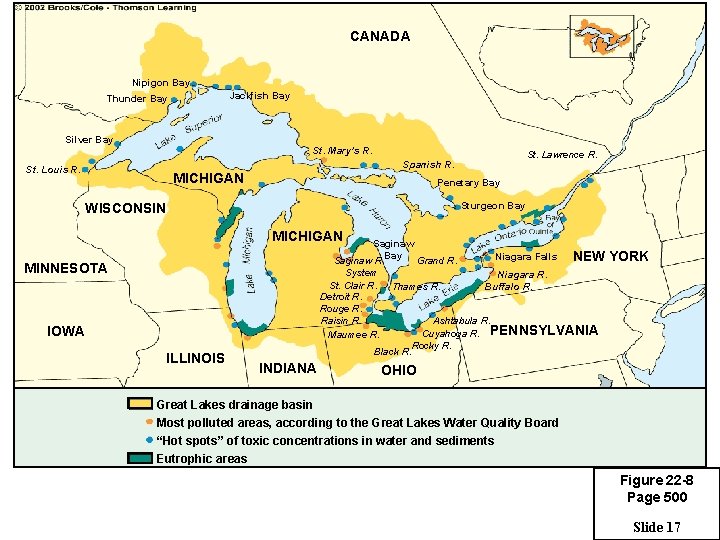
CANADA Nipigon Bay Jackfish Bay Thunder Bay Silver Bay St. Mary’s R. St. Lawrence R. Spanish R. St. Louis R. MICHIGAN Penetary Bay Sturgeon Bay WISCONSIN MICHIGAN Saginaw Niagara Falls NEW Saginaw R. Bay Grand R. System Niagara R. St. Clair R. Thames R. Buffalo R. Detroit R. Rouge R. Ashtabula R. Raisin R. Cuyahoga R. PENNSYLVANIA Maumee R. Rocky R. Black R. MINNESOTA IOWA ILLINOIS INDIANA YORK OHIO Great Lakes drainage basin Most polluted areas, according to the Great Lakes Water Quality Board “Hot spots” of toxic concentrations in water and sediments Eutrophic areas Figure 22 -8 Page 500 Slide 17
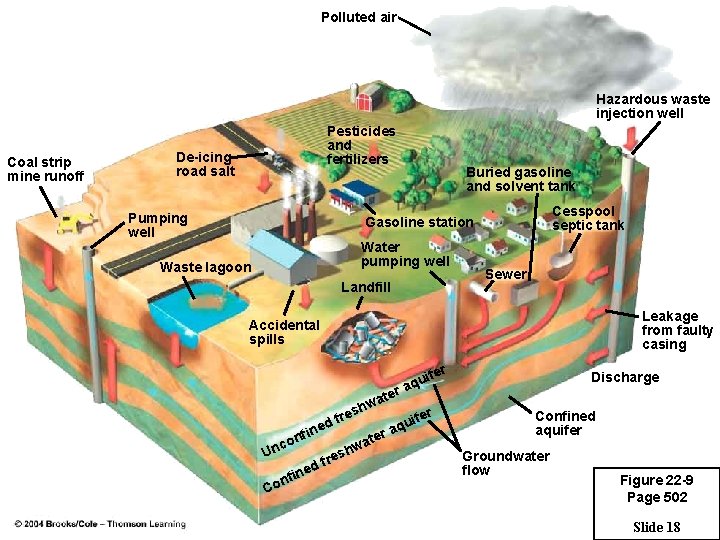
Polluted air Hazardous waste injection well Coal strip mine runoff Pesticides and fertilizers De-icing road salt Pumping well Buried gasoline and solvent tank Cesspool septic tank Gasoline station Water pumping well Waste lagoon Landfill Sewer Leakage from faulty casing Accidental spills ter a shw ifer u q ra re df e n i f n nco U df e n nfi Co ate hw res ifer u aq Discharge Confined aquifer Groundwater flow Figure 22 -9 Page 502 Slide 18
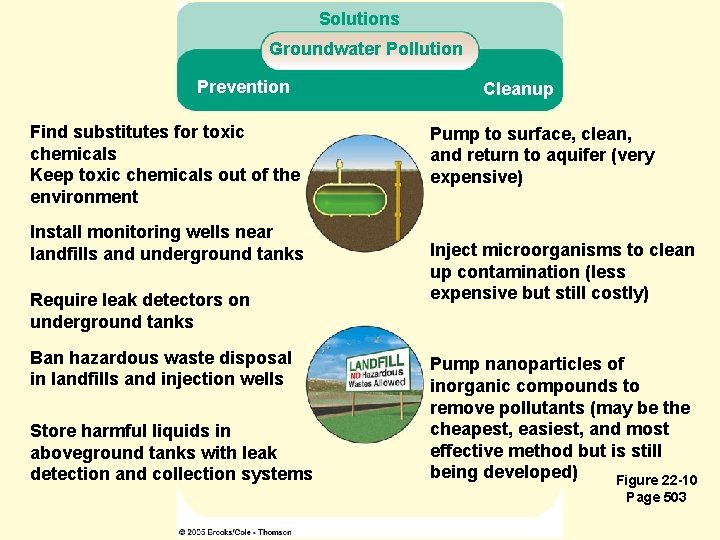
Solutions Groundwater Pollution Prevention Find substitutes for toxic chemicals Keep toxic chemicals out of the environment Install monitoring wells near landfills and underground tanks Require leak detectors on underground tanks Ban hazardous waste disposal in landfills and injection wells Store harmful liquids in aboveground tanks with leak detection and collection systems Cleanup Pump to surface, clean, and return to aquifer (very expensive) Inject microorganisms to clean up contamination (less expensive but still costly) Pump nanoparticles of inorganic compounds to remove pollutants (may be the cheapest, easiest, and most effective method but is still being developed) Figure 22 -10 Page 503 Slide 19
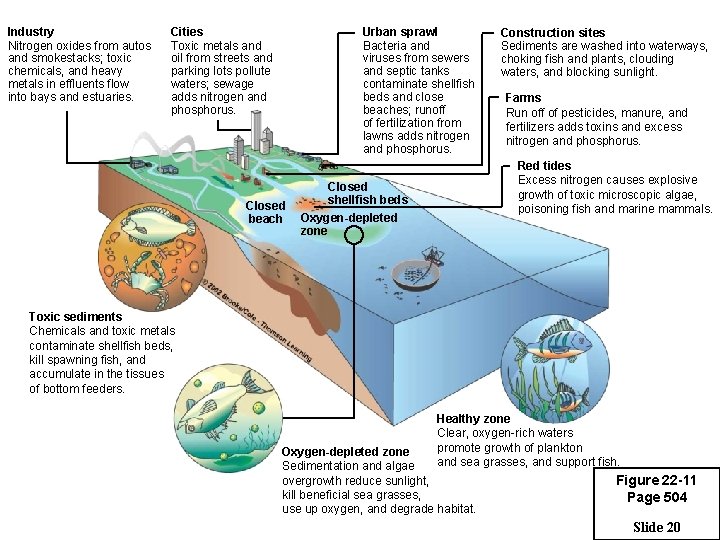
Industry Nitrogen oxides from autos and smokestacks; toxic chemicals, and heavy metals in effluents flow into bays and estuaries. Cities Toxic metals and oil from streets and parking lots pollute waters; sewage adds nitrogen and phosphorus. Urban sprawl Bacteria and viruses from sewers and septic tanks contaminate shellfish beds and close beaches; runoff of fertilization from lawns adds nitrogen and phosphorus. Closed beach Construction sites Sediments are washed into waterways, choking fish and plants, clouding waters, and blocking sunlight. Farms Run off of pesticides, manure, and fertilizers adds toxins and excess nitrogen and phosphorus. Red tides Excess nitrogen causes explosive growth of toxic microscopic algae, poisoning fish and marine mammals. Closed shellfish beds Oxygen-depleted zone Toxic sediments Chemicals and toxic metals contaminate shellfish beds, kill spawning fish, and accumulate in the tissues of bottom feeders. Healthy zone Clear, oxygen-rich waters promote growth of plankton and sea grasses, and support fish. Oxygen-depleted zone Sedimentation and algae overgrowth reduce sunlight, kill beneficial sea grasses, use up oxygen, and degrade habitat. Figure 22 -11 Page 504 Slide 20
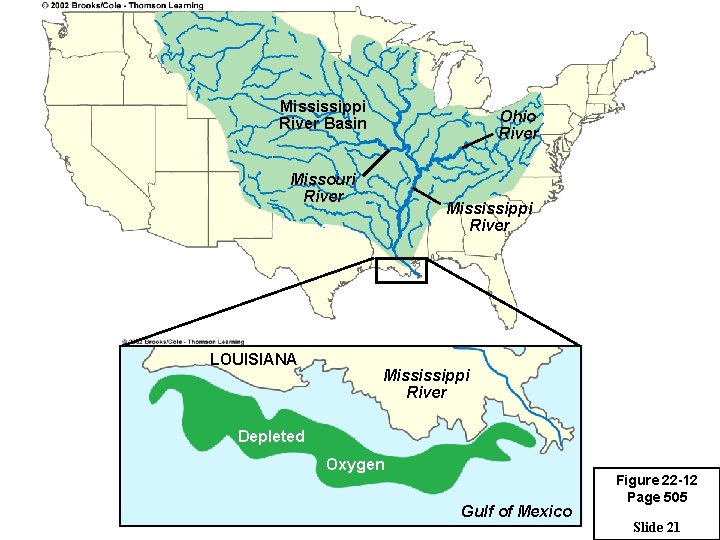
Mississippi River Basin Ohio River Missouri River LOUISIANA Mississippi River Depleted Oxygen Gulf of Mexico Figure 22 -12 Page 505 Slide 21
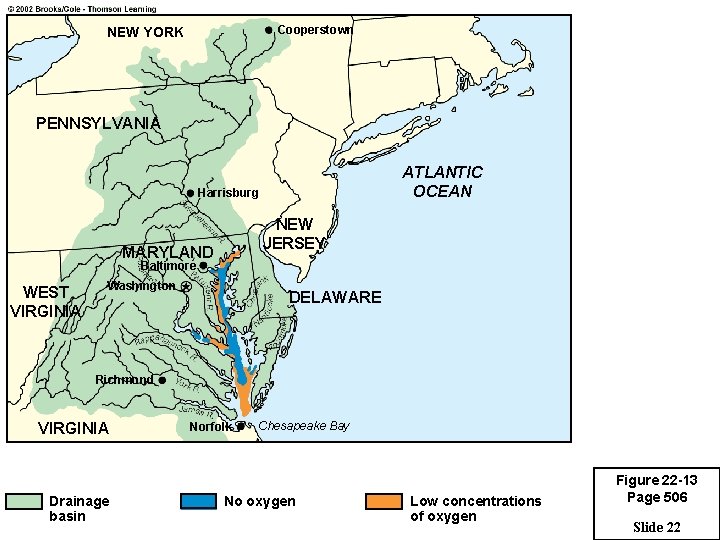
Cooperstown NEW YORK PENNSYLVANIA ATLANTIC OCEAN Harrisburg NEW JERSEY MARYLAND Baltimore WEST VIRGINIA Washington DELAWARE Richmond VIRGINIA Drainage basin Norfolk Chesapeake Bay No oxygen Low concentrations of oxygen Figure 22 -13 Page 506 Slide 22
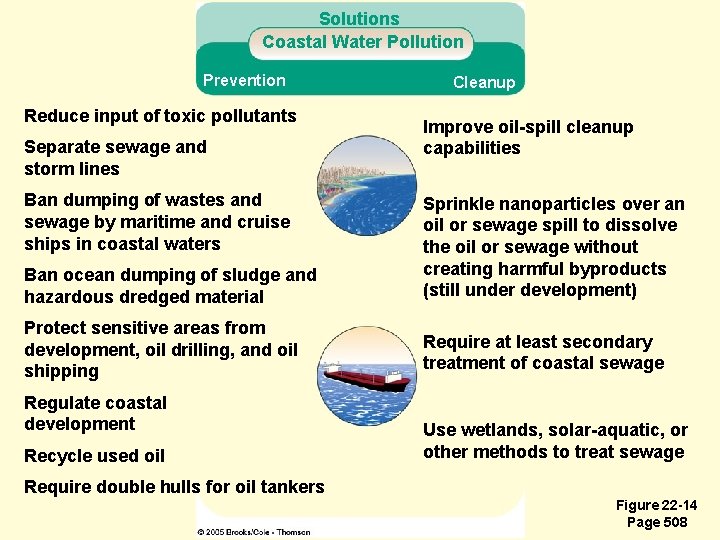
Solutions Coastal Water Pollution Prevention Reduce input of toxic pollutants Separate sewage and storm lines Ban dumping of wastes and sewage by maritime and cruise ships in coastal waters Cleanup Improve oil-spill cleanup capabilities Ban ocean dumping of sludge and hazardous dredged material Sprinkle nanoparticles over an oil or sewage spill to dissolve the oil or sewage without creating harmful byproducts (still under development) Protect sensitive areas from development, oil drilling, and oil shipping Require at least secondary treatment of coastal sewage Regulate coastal development Recycle used oil Use wetlands, solar-aquatic, or other methods to treat sewage Require double hulls for oil tankers Figure 22 -14 Page Slide 508 23
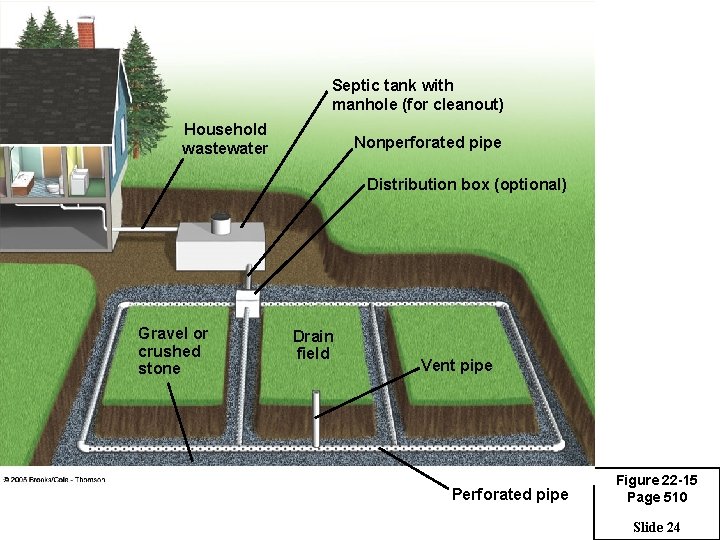
Septic tank with manhole (for cleanout) Household wastewater Nonperforated pipe Distribution box (optional) Gravel or crushed stone Drain field Vent pipe Perforated pipe Figure 22 -15 Page 510 Slide 24
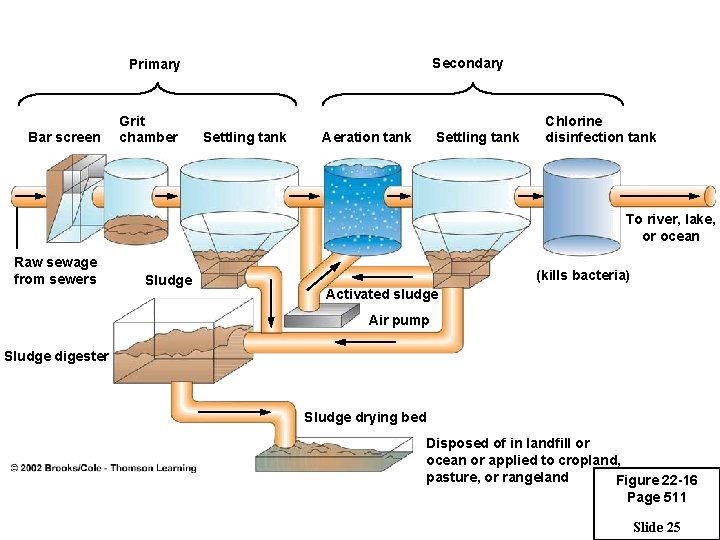
Secondary Primary Bar screen Grit chamber Settling tank Aeration tank Settling tank Chlorine disinfection tank To river, lake, or ocean Raw sewage from sewers Sludge (kills bacteria) Activated sludge Air pump Sludge digester Sludge drying bed Disposed of in landfill or ocean or applied to cropland, pasture, or rangeland Figure 22 -16 Page 511 Slide 25
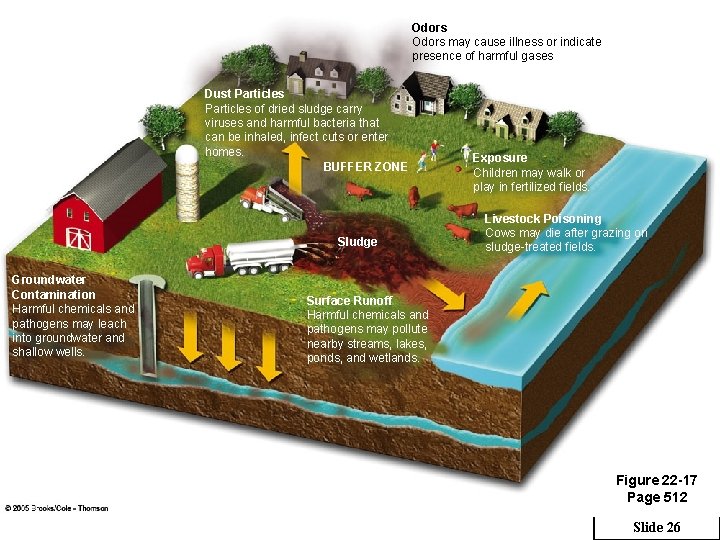
Odors may cause illness or indicate presence of harmful gases Dust Particles of dried sludge carry viruses and harmful bacteria that can be inhaled, infect cuts or enter homes. BUFFER ZONE Sludge Groundwater Contamination Harmful chemicals and pathogens may leach into groundwater and shallow wells. Exposure Children may walk or play in fertilized fields. Livestock Poisoning Cows may die after grazing on sludge-treated fields. Surface Runoff Harmful chemicals and pathogens may pollute nearby streams, lakes, ponds, and wetlands. Figure 22 -17 Page 512 Slide 26
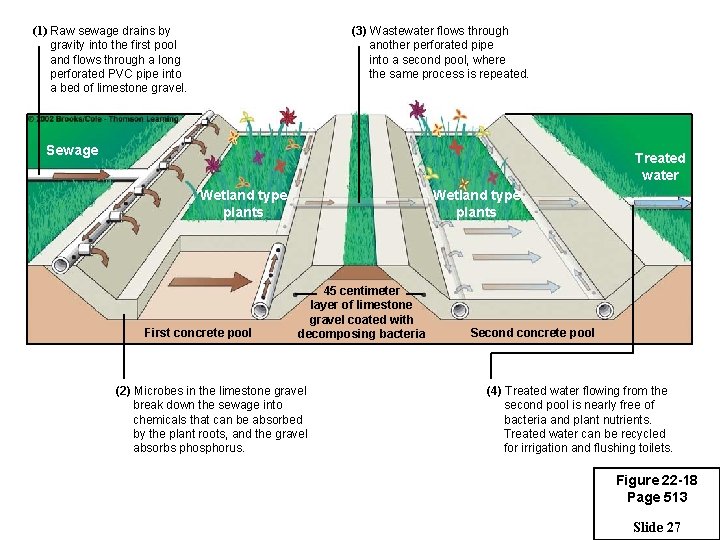
(1) Raw sewage drains by gravity into the first pool and flows through a long perforated PVC pipe into a bed of limestone gravel. (3) Wastewater flows through another perforated pipe into a second pool, where the same process is repeated. Sewage Treated water Wetland type plants First concrete pool Wetland type plants 45 centimeter layer of limestone gravel coated with decomposing bacteria (2) Microbes in the limestone gravel break down the sewage into chemicals that can be absorbed by the plant roots, and the gravel absorbs phosphorus. Second concrete pool (4) Treated water flowing from the second pool is nearly free of bacteria and plant nutrients. Treated water can be recycled for irrigation and flushing toilets. Figure 22 -18 Page 513 Slide 27
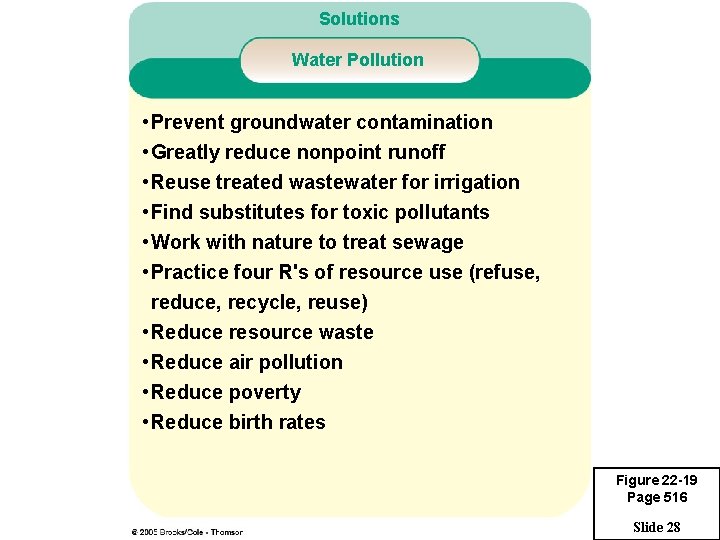
Solutions Water Pollution • Prevent groundwater contamination • Greatly reduce nonpoint runoff • Reuse treated wastewater for irrigation • Find substitutes for toxic pollutants • Work with nature to treat sewage • Practice four R's of resource use (refuse, reduce, recycle, reuse) • Reduce resource waste • Reduce air pollution • Reduce poverty • Reduce birth rates Figure 22 -19 Page 516 Slide 28
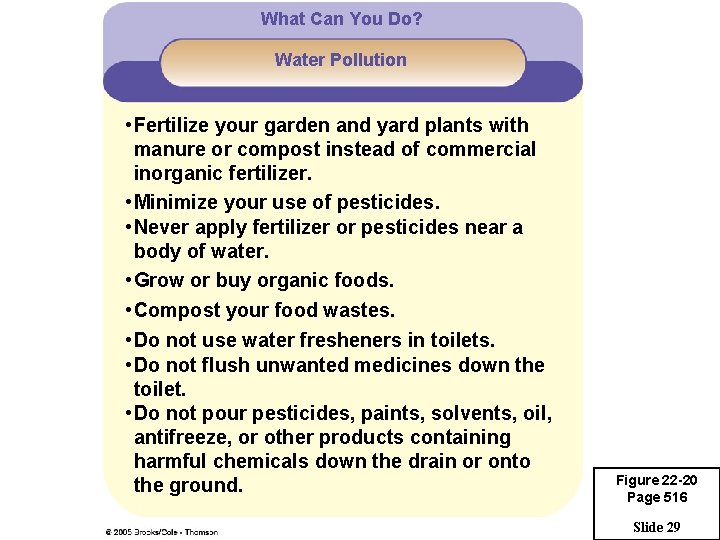
What Can You Do? Water Pollution • Fertilize your garden and yard plants with manure or compost instead of commercial inorganic fertilizer. • Minimize your use of pesticides. • Never apply fertilizer or pesticides near a body of water. • Grow or buy organic foods. • Compost your food wastes. • Do not use water fresheners in toilets. • Do not flush unwanted medicines down the toilet. • Do not pour pesticides, paints, solvents, oil, antifreeze, or other products containing harmful chemicals down the drain or onto the ground. Figure 22 -20 Page 516 Slide 29
- Slides: 29