
Table 2 A 1 WBGT Index Threshold Values
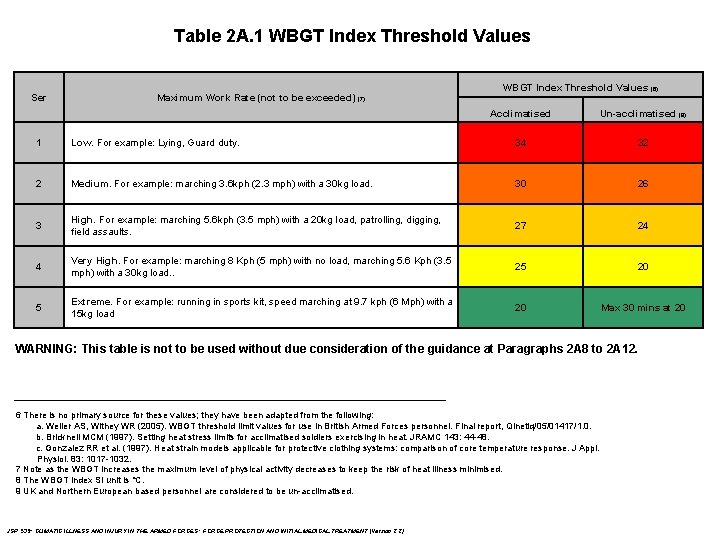
Table 2 A. 1 WBGT Index Threshold Values Ser Maximum Work Rate (not to be exceeded) (7) WBGT Index Threshold Values (6) Acclimatised Un-acclimatised (9) 1 Low. For example: Lying, Guard duty. 34 32 2 Medium. For example: marching 3. 6 kph (2. 3 mph) with a 30 kg load. 30 26 3 High. For example: marching 5. 6 kph (3. 5 mph) with a 20 kg load, patrolling, digging, field assaults. 27 24 4 Very High. For example: marching 8 Kph (5 mph) with no load, marching 5. 6 Kph (3. 5 mph) with a 30 kg load. . 25 20 5 Extreme. For example: running in sports kit, speed marching at 9. 7 kph (6 Mph) with a 15 kg load 20 Max 30 mins at 20 WARNING: This table is not to be used without due consideration of the guidance at Paragraphs 2 A 8 to 2 A 12. 6 There is no primary source for these values; they have been adapted from the following: a. Weller AS, Withey WR (2005). WBGT threshold limit values for use in British Armed Forces personnel. Final report, Qinetiq/05/01417/1. 0. b. Bricknell MCM (1997). Setting heat stress limits for acclimatised soldiers exercising in heat. JRAMC 143: 44 -48. c. Gonzalez RR et al. (1997). Heat strain models applicable for protective clothing systems: comparison of core temperature response. J Appl. Physiol. 83: 1017 -1032. 7 Note as the WBGT increases the maximum level of physical activity decreases to keep the risk of heat illness minimised. 8 The WBGT index SI unit is °C. 9 UK and Northern European based personnel are considered to be un-acclimatised. JSP 539: CLIMATIC ILLNESS AND INJURY IN THE ARMED FORCES: FORCE PROTECTION AND INITIAL MEDICAL TREATMENT (Version 2. 2)
- Slides: 1