
TAAT Technology Applications Assessment Team NAUTILUS X MultiMission
![Technology Applications Assessment Team Nested jacking cylinders for Transit Tunnel Soft-Berth mechanism [internal]: Micro-(g)](https://slidetodoc.com/presentation_image/b0b06eba24cc6a130667daa5e9c03eeb/image-21.jpg "Technology Applications Assessment Team Nested jacking cylinders for Transit Tunnel Soft-Berth mechanism [internal]: Micro-(g)")
- Slides: 34
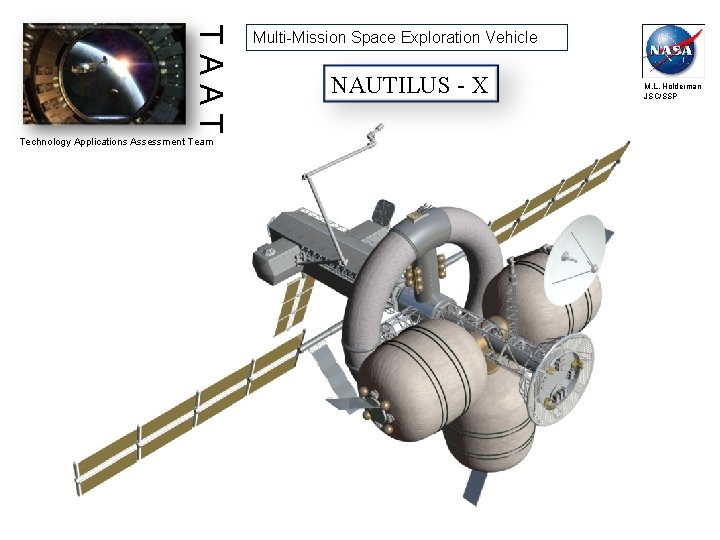
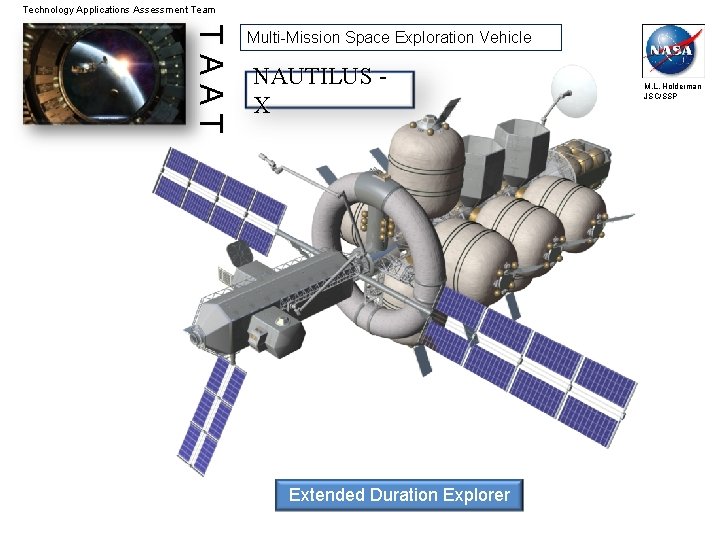
TAAT Technology Applications Assessment Team NAUTILUS - X Multi-Mission Space Exploration Vehicle Non – Atmospheric Universal Transport Intended for Lengthy United Space ----- X-ploration M. L. Holderman JSC/SSP
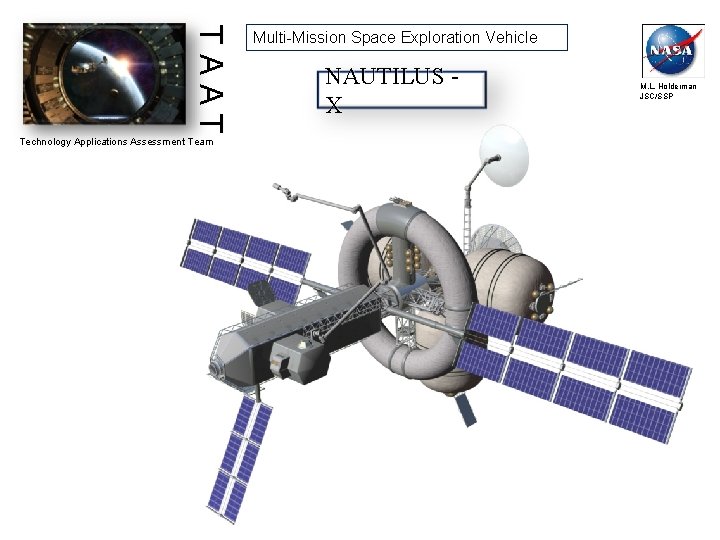
TAAT Technology Applications Assessment Team Multi-Mission Space Exploration Vehicle NAUTILUS X M. L. Holderman JSC/SSP
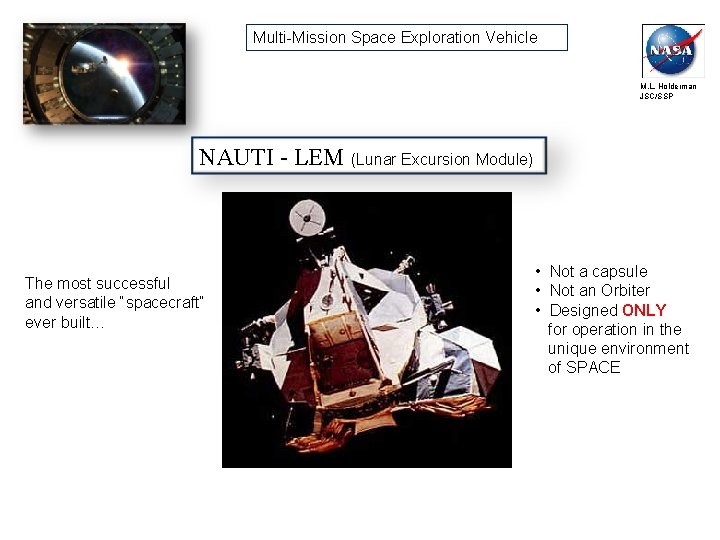
Multi-Mission Space Exploration Vehicle M. L. Holderman JSC/SSP NAUTI - LEM (Lunar Excursion Module) The most successful and versatile “spacecraft” ever built… • Not a capsule • Not an Orbiter • Designed ONLY for operation in the unique environment of SPACE
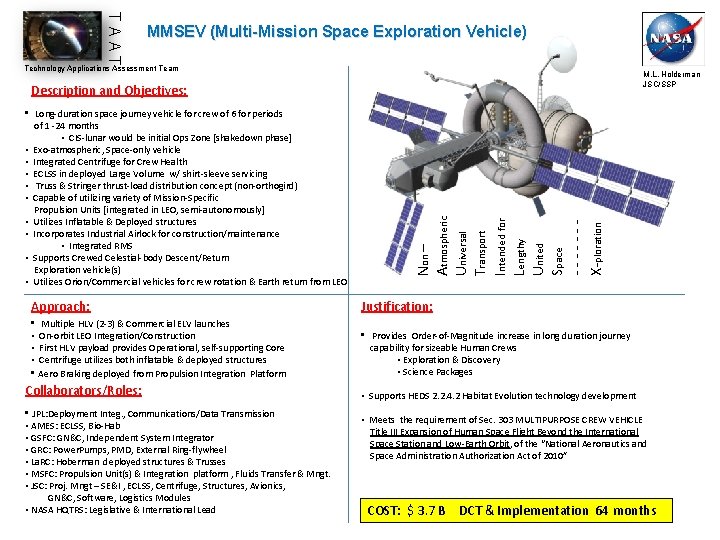
TAAT MMSEV (Multi-Mission Space Exploration Vehicle) Technology Applications Assessment Team M. L. Holderman JSC/SSP Description and Objectives: • • • Long-duration space journey vehicle for crew of 6 for periods of 1 -24 months • CIS-lunar would be initial Ops Zone [shakedown phase] Exo-atmospheric, Space-only vehicle Integrated Centrifuge for Crew Health ECLSS in deployed Large Volume w/ shirt-sleeve servicing Truss & Stringer thrust-load distribution concept (non-orthogird) Capable of utilizing variety of Mission-Specific Propulsion Units [integrated in LEO, semi-autonomously] Utilizes Inflatable & Deployed structures Incorporates Industrial Airlock for construction/maintenance • Integrated RMS Supports Crewed Celestial-body Descent/Return Exploration vehicle(s) Utilizes Orion/Commercial vehicles for crew rotation & Earth return from LEO Approach: • Multiple HLV (2 -3) & Commercial ELV launches • On-orbit LEO Integration/Construction • First HLV payload provides Operational, self-supporting Core • Centrifuge utilizes both inflatable & deployed structures • Aero Braking deployed from Propulsion Integration Platform Collaborators/Roles: • JPL: Deployment Integ. , Communications/Data Transmission • AMES: ECLSS, Bio-Hab • GSFC: GN&C, Independent System Integrator • GRC: Power. Pumps, PMD, External Ring-flywheel • La. RC: Hoberman deployed structures & Trusses • MSFC: Propulsion Unit(s) & Integration platform , Fluids Transfer & Mngt. • JSC: Proj. Mngt – SE&I , ECLSS, Centrifuge, Structures, Avionics, GN&C, Software, Logistics Modules • NASA HQTRS: Legislative & International Lead Non – Atmospheric Universal Transport Intended for Lengthy United Space ------X-ploration • Justification: • Provides Order-of-Magnitude increase in long duration journey capability for sizeable Human Crews • Exploration & Discovery • Science Packages • Supports HEDS 2. 2. 4. 2 Habitat Evolution technology development • Meets the requirement of Sec. 303 MULTIPURPOSE CREW VEHICLE Title III Expansion of Human Space Flight Beyond the International Space Station and Low-Earth Orbit, of the “National Aeronautics and Space Administration Authorization Act of 2010” COST: $ 3. 7 B DCT & Implementation 64 months
TAAT Technology Applications Assessment Team Multi-Mission Space Exploration Vehicle NAUTILUS - X M. L. Holderman JSC/SSP
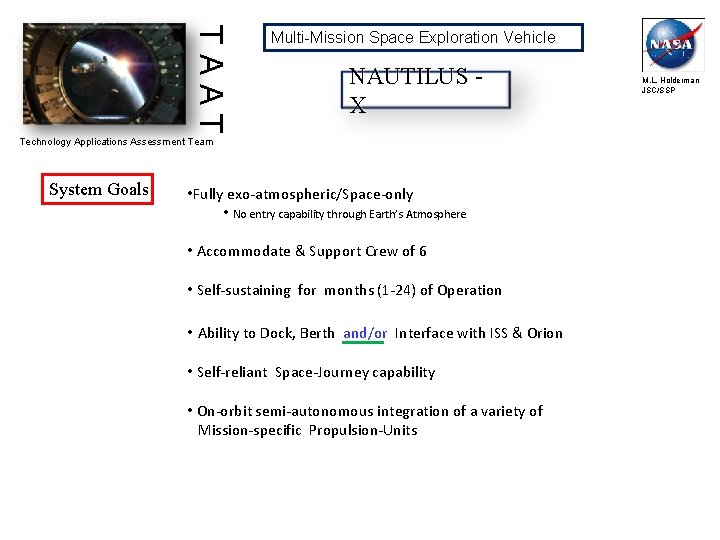
TAAT Multi-Mission Space Exploration Vehicle NAUTILUS X Technology Applications Assessment Team System Goals • Fully exo-atmospheric/Space-only • No entry capability through Earth’s Atmosphere • Accommodate & Support Crew of 6 • Self-sustaining for months (1 -24) of Operation • Ability to Dock, Berth and/or Interface with ISS & Orion • Self-reliant Space-Journey capability • On-orbit semi-autonomous integration of a variety of Mission-specific Propulsion-Units M. L. Holderman JSC/SSP
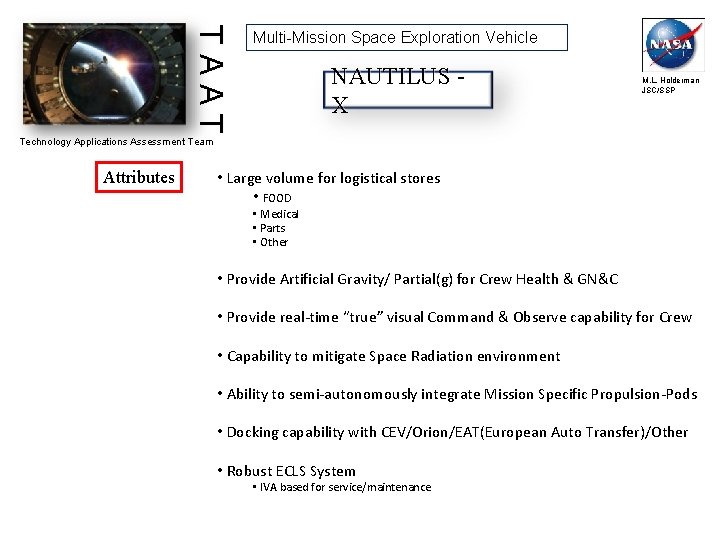
TAAT Multi-Mission Space Exploration Vehicle NAUTILUS X M. L. Holderman JSC/SSP Technology Applications Assessment Team Attributes • Large volume for logistical stores • FOOD • Medical • Parts • Other • Provide Artificial Gravity/ Partial(g) for Crew Health & GN&C • Provide real-time “true” visual Command & Observe capability for Crew • Capability to mitigate Space Radiation environment • Ability to semi-autonomously integrate Mission Specific Propulsion-Pods • Docking capability with CEV/Orion/EAT(European Auto Transfer)/Other • Robust ECLS System • IVA based for service/maintenance
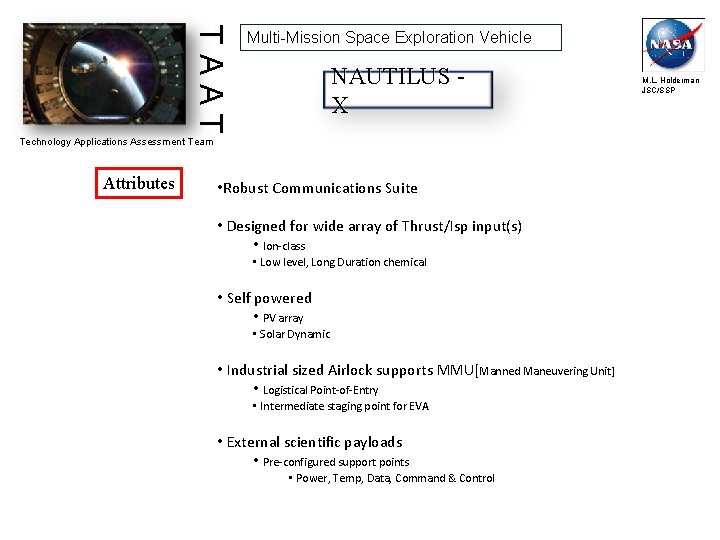
TAAT Multi-Mission Space Exploration Vehicle NAUTILUS X Technology Applications Assessment Team Attributes • Robust Communications Suite • Designed for wide array of Thrust/Isp input(s) • Ion-class • Low level, Long Duration chemical • Self powered • PV array • Solar Dynamic • Industrial sized Airlock supports MMU[Manned Maneuvering Unit] • Logistical Point-of-Entry • Intermediate staging point for EVA • External scientific payloads • Pre-configured support points • Power, Temp, Data, Command & Control M. L. Holderman JSC/SSP
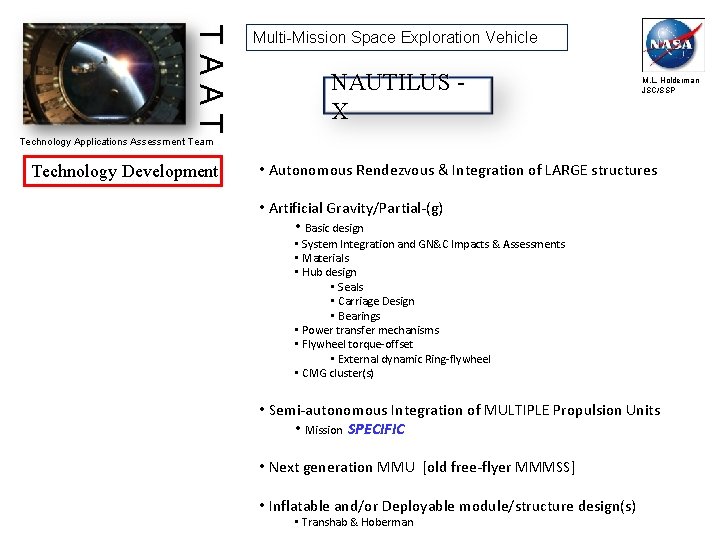
TAAT Multi-Mission Space Exploration Vehicle NAUTILUS X M. L. Holderman JSC/SSP Technology Applications Assessment Team Technology Development • Autonomous Rendezvous & Integration of LARGE structures • Artificial Gravity/Partial-(g) • Basic design • System Integration and GN&C Impacts & Assessments • Materials • Hub design • Seals • Carriage Design • Bearings • Power transfer mechanisms • Flywheel torque-offset • External dynamic Ring-flywheel • CMG cluster(s) • Semi-autonomous Integration of MULTIPLE Propulsion Units • Mission SPECIFIC • Next generation MMU [old free-flyer MMMSS] • Inflatable and/or Deployable module/structure design(s) • Transhab & Hoberman
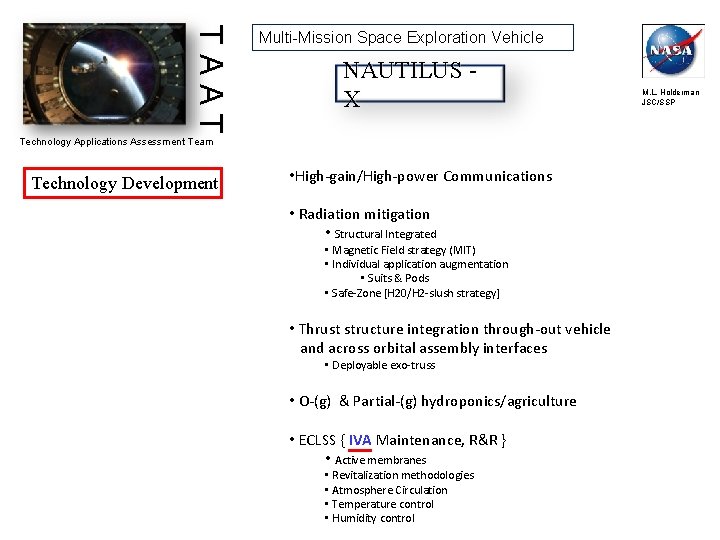
TAAT Multi-Mission Space Exploration Vehicle NAUTILUS X Technology Applications Assessment Team Technology Development • High-gain/High-power Communications • Radiation mitigation • Structural Integrated • Magnetic Field strategy (MIT) • Individual application augmentation • Suits & Pods • Safe-Zone [H 20/H 2 -slush strategy] • Thrust structure integration through-out vehicle and across orbital assembly interfaces • Deployable exo-truss • O-(g) & Partial-(g) hydroponics/agriculture • ECLSS { IVA Maintenance, R&R } • Active membranes • Revitalization methodologies • Atmosphere Circulation • Temperature control • Humidity control M. L. Holderman JSC/SSP
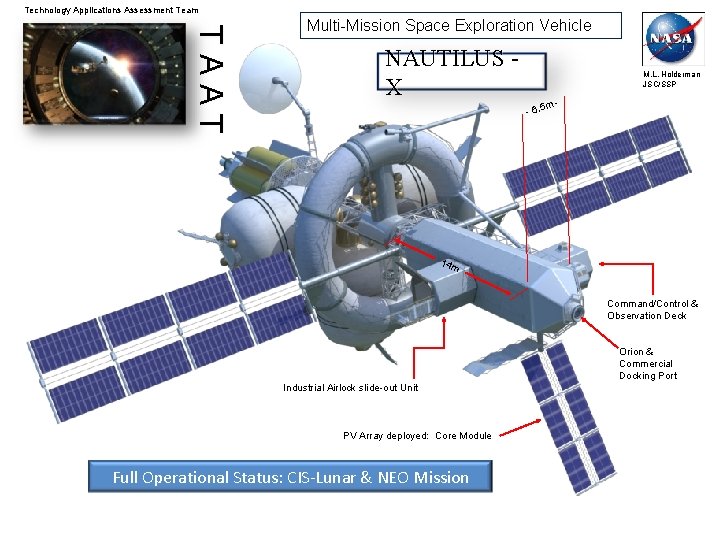
Technology Applications Assessment Team TAAT Multi-Mission Space Exploration Vehicle NAUTILUS X M. L. Holderman JSC/SSP m- - 6. 5 14 m Command/Control & Observation Deck Orion & Commercial Docking Port Industrial Airlock slide-out Unit PV Array deployed: Core Module Full Operational Status: CIS-Lunar & NEO Mission
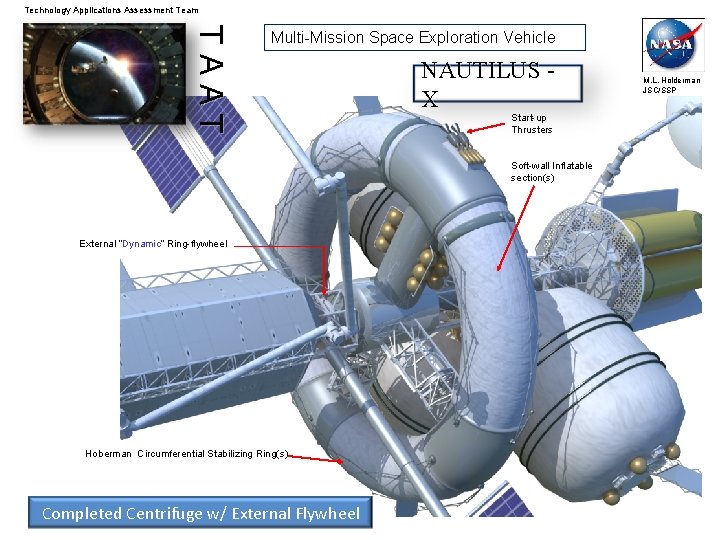
Technology Applications Assessment Team TAAT Multi-Mission Space Exploration Vehicle NAUTILUS X Start-up Thrusters Soft-wall Inflatable section(s) External “Dynamic” Ring-flywheel Hoberman Circumferential Stabilizing Ring(s) Completed Centrifuge w/ External Flywheel M. L. Holderman JSC/SSP
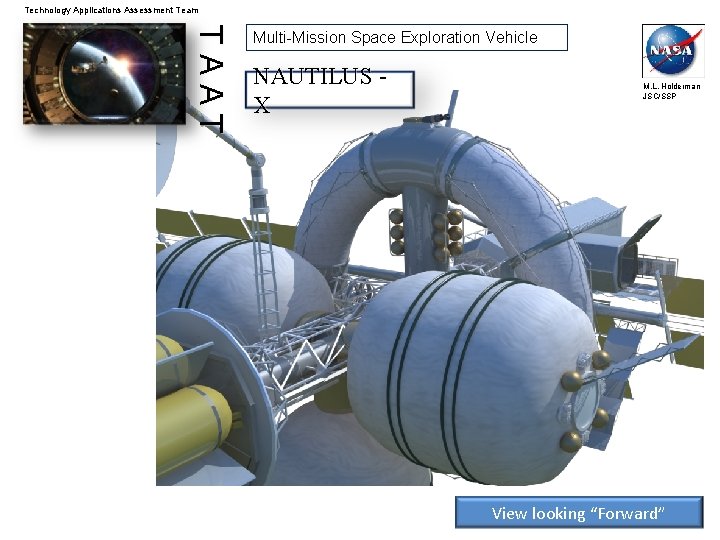
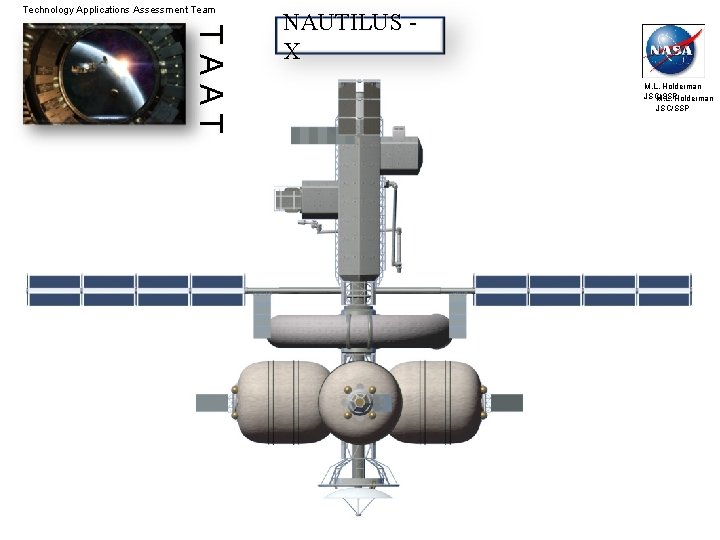
Technology Applications Assessment Team TAAT Multi-Mission Space Exploration Vehicle NAUTILUS X M. L. Holderman JSC/SSP View looking “Forward”
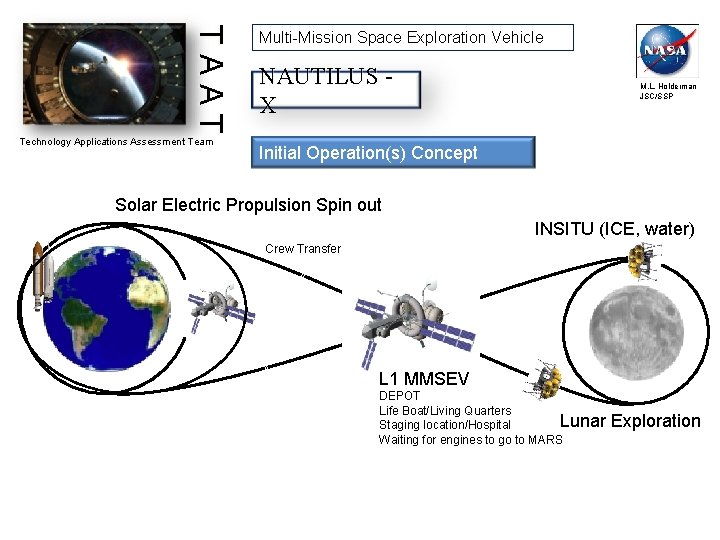
TAAT Technology Applications Assessment Team Multi-Mission Space Exploration Vehicle NAUTILUS X M. L. Holderman JSC/SSP Initial Operation(s) Concept Solar Electric Propulsion Spin out INSITU (ICE, water) Crew Transfer L 1 MMSEV DEPOT Life Boat/Living Quarters Lunar Staging location/Hospital Waiting for engines to go to MARS Exploration
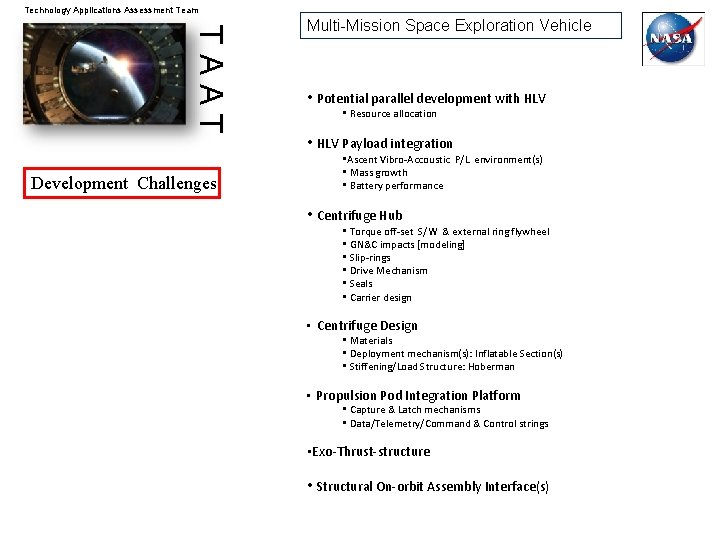
Technology Applications Assessment Team TAAT Multi-Mission Space Exploration Vehicle • Potential parallel development with HLV • Resource allocation • HLV Payload integration • Ascent Vibro-Accoustic P/L environment(s) • Mass growth • Battery performance Development Challenges • Centrifuge Hub • Torque off-set S/W & external ring flywheel • GN&C impacts [modeling] • Slip-rings • Drive Mechanism • Seals • Carrier design • Centrifuge Design • Materials • Deployment mechanism(s): Inflatable Section(s) • Stiffening/Load Structure: Hoberman • Propulsion Pod Integration Platform • Capture & Latch mechanisms • Data/Telemetry/Command & Control strings • Exo-Thrust-structure • Structural On-orbit Assembly Interface(s)
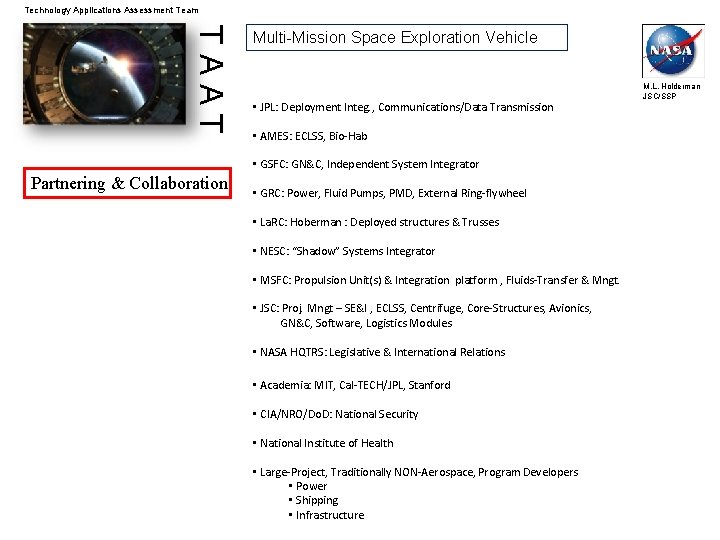
Technology Applications Assessment Team TAAT Multi-Mission Space Exploration Vehicle • JPL: Deployment Integ. , Communications/Data Transmission • AMES: ECLSS, Bio-Hab • GSFC: GN&C, Independent System Integrator Partnering & Collaboration • GRC: Power, Fluid Pumps, PMD, External Ring-flywheel • La. RC: Hoberman : Deployed structures & Trusses • NESC: “Shadow” Systems Integrator • MSFC: Propulsion Unit(s) & Integration platform , Fluids-Transfer & Mngt. • JSC: Proj. Mngt – SE&I , ECLSS, Centrifuge, Core-Structures, Avionics, GN&C, Software, Logistics Modules • NASA HQTRS: Legislative & International Relations • Academia: MIT, Cal-TECH/JPL, Stanford • CIA/NRO/Do. D: National Security • National Institute of Health • Large-Project, Traditionally NON-Aerospace, Program Developers • Power • Shipping • Infrastructure M. L. Holderman JSC/SSP
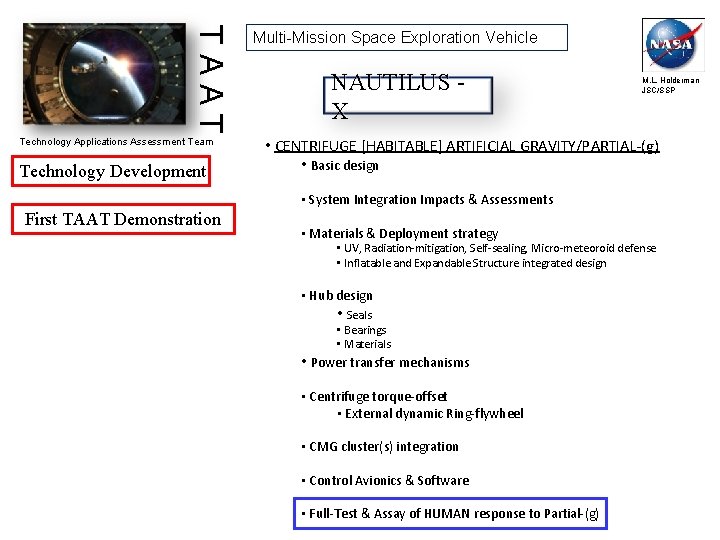
TAAT Technology Applications Assessment Team Technology Development Multi-Mission Space Exploration Vehicle NAUTILUS X M. L. Holderman JSC/SSP • CENTRIFUGE [HABITABLE] ARTIFICIAL GRAVITY/PARTIAL-(g) • Basic design • System Integration Impacts & Assessments First TAAT Demonstration • Materials & Deployment strategy • UV, Radiation-mitigation, Self-sealing, Micro-meteoroid defense • Inflatable and Expandable Structure integrated design • Hub design • Seals • Bearings • Materials • Power transfer mechanisms • Centrifuge torque-offset • External dynamic Ring-flywheel • CMG cluster(s) integration • Control Avionics & Software • Full-Test & Assay of HUMAN response to Partial-(g)
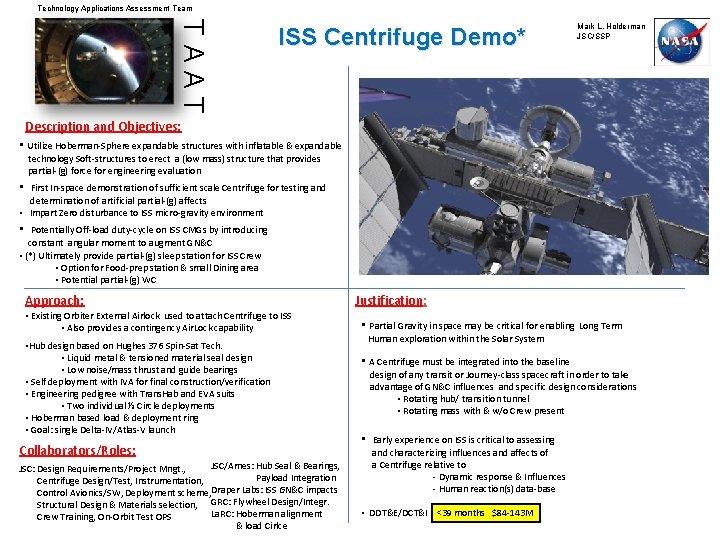
Technology Applications Assessment Team TAAT ISS Centrifuge Demo* Mark L. Holderman JSC/SSP Description and Objectives: • Utilize Hoberman-Sphere expandable structures with inflatable & expandable technology Soft-structures to erect a (low mass) structure that provides partial-(g) force for engineering evaluation • First In-space demonstration of sufficient scale Centrifuge for testing and determination of artificial partial-(g) affects • Impart Zero disturbance to ISS micro-gravity environment • Potentially Off-load duty-cycle on ISS CMGs by introducing constant angular moment to augment GN&C • (*) Ultimately provide partial-(g) sleep station for ISS Crew • Option for Food-prep station & small Dining area • Potential partial-(g) WC Approach: • Existing Orbiter External Airlock used to attach Centrifuge to ISS • Also provides a contingency Air. Lock capability • Hub design based on Hughes 376 Spin-Sat Tech. • Liquid metal & tensioned material seal design • Low noise/mass thrust and guide bearings • Self deployment with IVA for final construction/verification • Engineering pedigree with Trans. Hab and EVA suits • Two individual ½ Circle deployments • Hoberman based load & deployment ring • Goal: single Delta-IV/Atlas-V launch Collaborators/Roles: JSC/Ames: Hub Seal & Bearings, JSC: Design Requirements/Project Mngt. , Payload Integration Centrifuge Design/Test, Instrumentation, Control Avionics/SW, Deployment scheme, Draper Labs: ISS GN&C impacts Structural Design & Materials selection, GRC: Flywheel Design/Integr. La. RC: Hoberman alignment Crew Training, On-Orbit Test OPS & load Cirlce Justification: • Partial Gravity in space may be critical for enabling Long Term Human exploration within the Solar System • A Centrifuge must be integrated into the baseline design of any transit or Journey-class spacecraft in order to take advantage of GN&C influences and specific design considerations • Rotating hub/ transition tunnel • Rotating mass with & w/o Crew present • Early experience on ISS is critical to assessing and characterizing influences and affects of a Centrifuge relative to - Dynamic response & Influences - Human reaction(s) data-base • DDT&E/DCT&I <39 months $84 -143 M
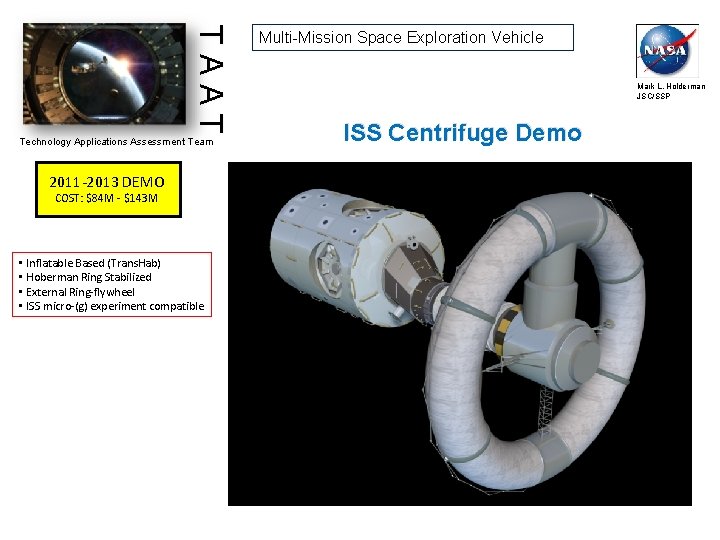
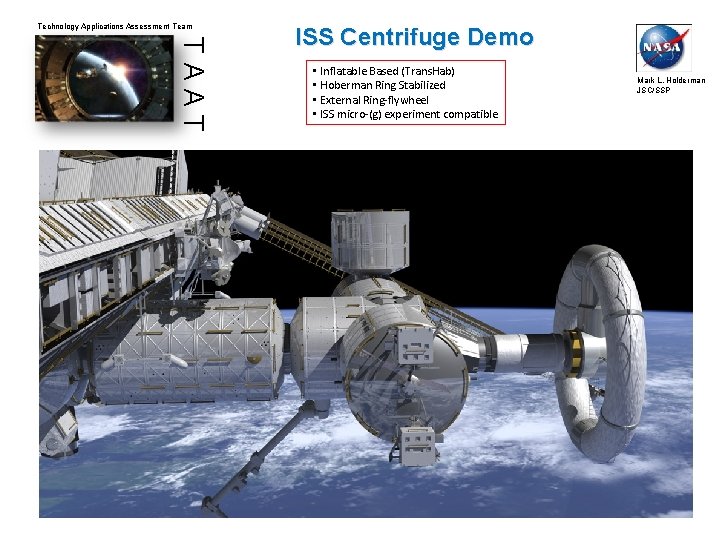
TAAT Technology Applications Assessment Team 2011 -2013 DEMO COST: $84 M - $143 M • Inflatable Based (Trans. Hab) • Hoberman Ring Stabilized • External Ring-flywheel • ISS micro-(g) experiment compatible Multi-Mission Space Exploration Vehicle Mark L. Holderman JSC/SSP ISS Centrifuge Demo
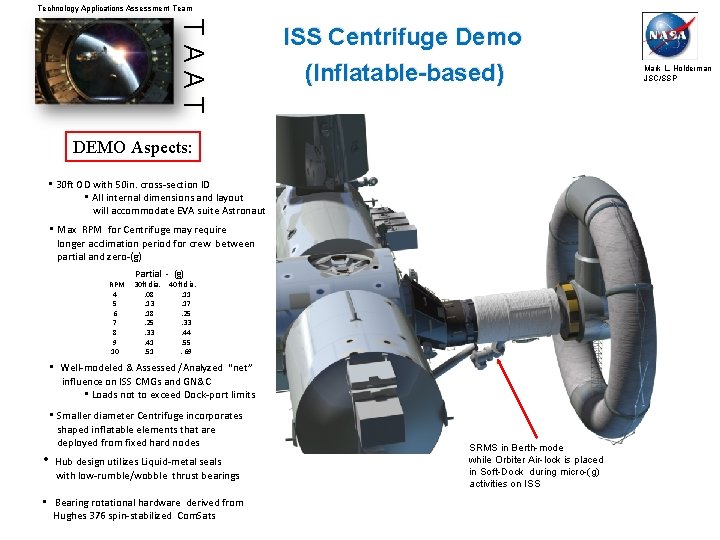
Technology Applications Assessment Team TAAT ISS Centrifuge Demo (Inflatable-based) DEMO Aspects: • 30 ft OD with 50 in. cross-section ID • All internal dimensions and layout will accommodate EVA suite Astronaut • Max RPM for Centrifuge may require longer acclimation period for crew between partial and zero-(g) RPM 4 5 6 7 8 9 10 • Partial - (g) 30 ft dia. . 08. 13. 18. 25. 33. 41. 51 40 ft dia. . 11. 17. 25. 33. 44. 55. 69 Well-modeled & Assessed /Analyzed “net” influence on ISS CMGs and GN&C • Loads not to exceed Dock-port limits • Smaller diameter Centrifuge incorporates shaped inflatable elements that are deployed from fixed hard nodes • Hub design utilizes Liquid-metal seals with low-rumble/wobble thrust bearings • Bearing rotational hardware derived from Hughes 376 spin-stabilized Com. Sats SRMS in Berth-mode while Orbiter Air-lock is placed in Soft-Dock during micro-(g) activities on ISS Mark L. Holderman JSC/SSP
Technology Applications Assessment Team Nested jacking cylinders for Transit Tunnel Soft-Berth mechanism [internal]: Micro-(g) ex-Orbiter External Air. Lock mitigation Mark L. Holderman JSC/SSP Hoberman Circular Deployment & Load outer ring Stabilizer Rings Dynamic external Ring-Flywheel Inner Jack-knife Stabilizer Astromast w/ Hard-node Internal Ballast Bladders http: //www. hoberman. com/portfolio/hobermanspherelsc. php? my. Num=10&mytext=Hoberman+Sphere+%28 New+Jersey%29&myrolloverte xt=%3 Cu%3 EHoberman+Sphere+%28 New+Jersey%29%3 C%2 Fu%3 E&category=& projectname=Hoberman+Sphere+%28 New+Jersey%29 Design, Construct, Test & Implement: DCT&I COST: $84 -143 M DCT & Implement <39 months * Test & Evaluation Centrifuge designed with capability to become Sleep Module for Crew TAAT ISS Centrifuge Demo* (Inflatable-based)
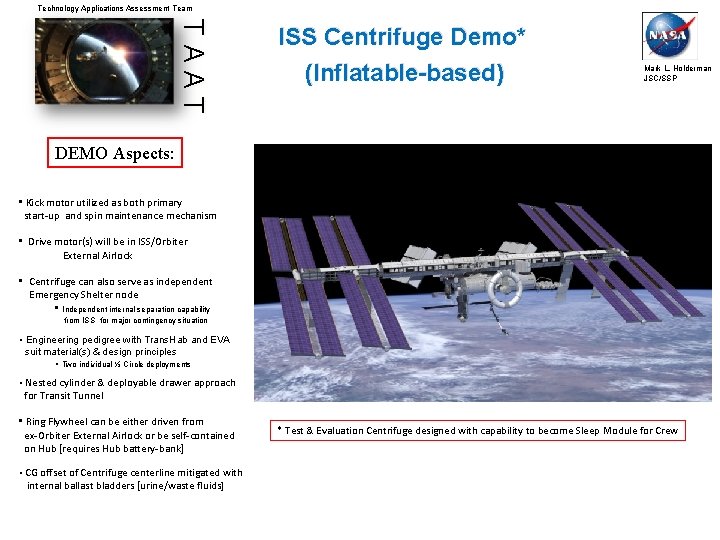
Technology Applications Assessment Team TAAT ISS Centrifuge Demo* (Inflatable-based) Mark L. Holderman JSC/SSP DEMO Aspects: • Kick motor utilized as both primary start-up and spin maintenance mechanism • Drive motor(s) will be in ISS/Orbiter External Airlock • Centrifuge can also serve as independent Emergency Shelter node • Independent internal separation capability from ISS for major contingency situation • Engineering pedigree with Trans. Hab and EVA suit material(s) & design principles • Two individual ½ Circle deployments • Nested cylinder & deployable drawer approach for Transit Tunnel • Ring Flywheel can be either driven from ex-Orbiter External Airlock or be self-contained on Hub [requires Hub battery-bank] • CG offset of Centrifuge centerline mitigated with internal ballast bladders [urine/waste fluids] * Test & Evaluation Centrifuge designed with capability to become Sleep Module for Crew
Technology Applications Assessment Team TAAT ISS Centrifuge Demo • Inflatable Based (Trans. Hab) • Hoberman Ring Stabilized • External Ring-flywheel • ISS micro-(g) experiment compatible Mark L. Holderman JSC/SSP
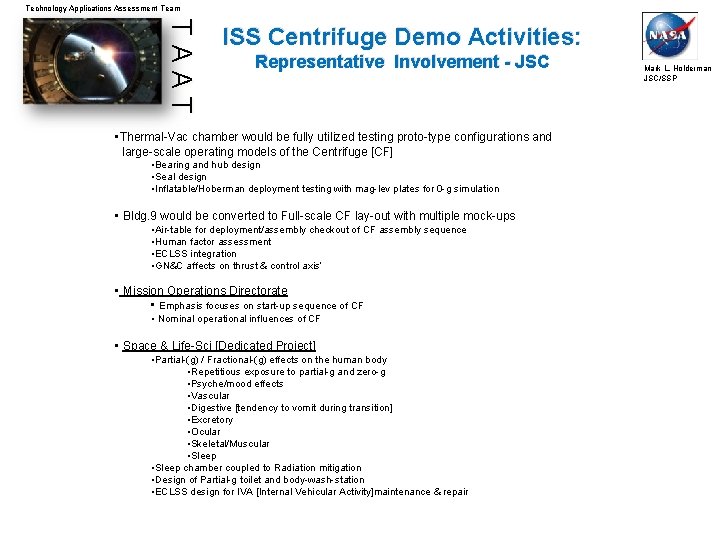
Technology Applications Assessment Team TAAT ISS Centrifuge Demo Activities: Representative Involvement - JSC • Thermal-Vac chamber would be fully utilized testing proto-type configurations and large-scale operating models of the Centrifuge [CF] • Bearing and hub design • Seal design • Inflatable/Hoberman deployment testing with mag-lev plates for 0 -g simulation • Bldg. 9 would be converted to Full-scale CF lay-out with multiple mock-ups • Air-table for deployment/assembly checkout of CF assembly sequence • Human factor assessment • ECLSS integration • GN&C affects on thrust & control axis’ • Mission Operations Directorate • Emphasis focuses on start-up sequence of CF • Nominal operational influences of CF • Space & Life-Sci [Dedicated Project] • Partial-(g) / Fractional-(g) effects on the human body • Repetitious exposure to partial-g and zero-g • Psyche/mood effects • Vascular • Digestive [tendency to vomit during transition] • Excretory • Ocular • Skeletal/Muscular • Sleep chamber coupled to Radiation mitigation • Design of Partial-g toilet and body-wash-station • ECLSS design for IVA [Internal Vehicular Activity]maintenance & repair Mark L. Holderman JSC/SSP
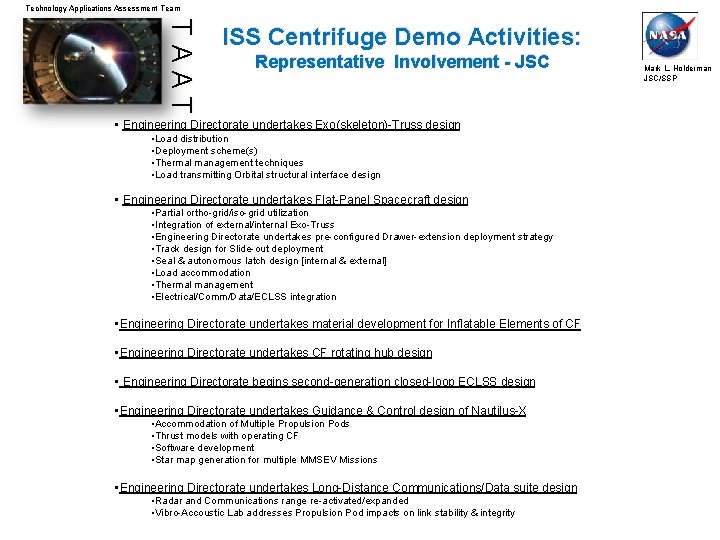
Technology Applications Assessment Team TAAT ISS Centrifuge Demo Activities: Representative Involvement - JSC • Engineering Directorate undertakes Exo(skeleton)-Truss design • Load distribution • Deployment scheme(s) • Thermal management techniques • Load transmitting Orbital structural interface design • Engineering Directorate undertakes Flat-Panel Spacecraft design • Partial ortho-grid/iso-grid utilization • Integration of external/internal Exo-Truss • Engineering Directorate undertakes pre-configured Drawer-extension deployment strategy • Track design for Slide-out deployment • Seal & autonomous latch design [internal & external] • Load accommodation • Thermal management • Electrical/Comm/Data/ECLSS integration • Engineering Directorate undertakes material development for Inflatable Elements of CF • Engineering Directorate undertakes CF rotating hub design • Engineering Directorate begins second-generation closed-loop ECLSS design • Engineering Directorate undertakes Guidance & Control design of Nautilus-X • Accommodation of Multiple Propulsion Pods • Thrust models with operating CF • Software development • Star map generation for multiple MMSEV Missions • Engineering Directorate undertakes Long-Distance Communications/Data suite design • Radar and Communications range re-activated/expanded • Vibro-Accoustic Lab addresses Propulsion Pod impacts on link stability & integrity Mark L. Holderman JSC/SSP
Technology Applications Assessment Team TAAT Back-Up Charts
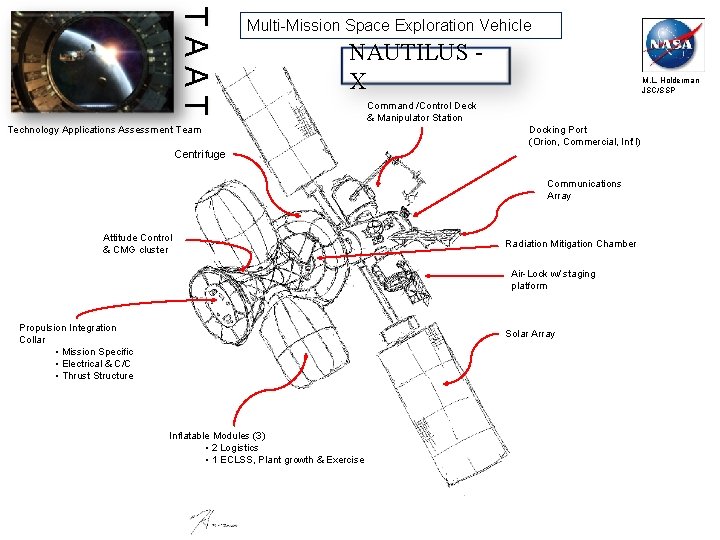
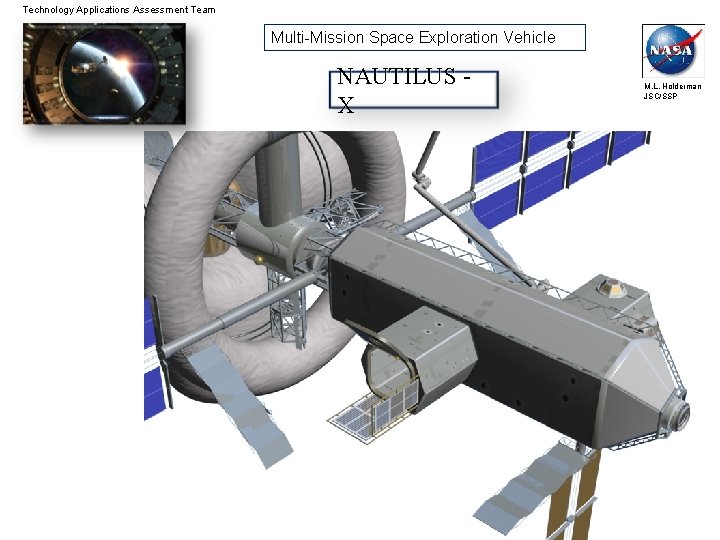
TAAT Multi-Mission Space Exploration Vehicle NAUTILUS X Technology Applications Assessment Team M. L. Holderman JSC/SSP Command /Control Deck & Manipulator Station Docking Port (Orion, Commercial, Int’l) Centrifuge Communications Array Attitude Control & CMG cluster Radiation Mitigation Chamber Air-Lock w/ staging platform Propulsion Integration Collar • Mission Specific • Electrical & C/C • Thrust Structure Solar Array Inflatable Modules (3) • 2 Logistics • 1 ECLSS, Plant growth & Exercise
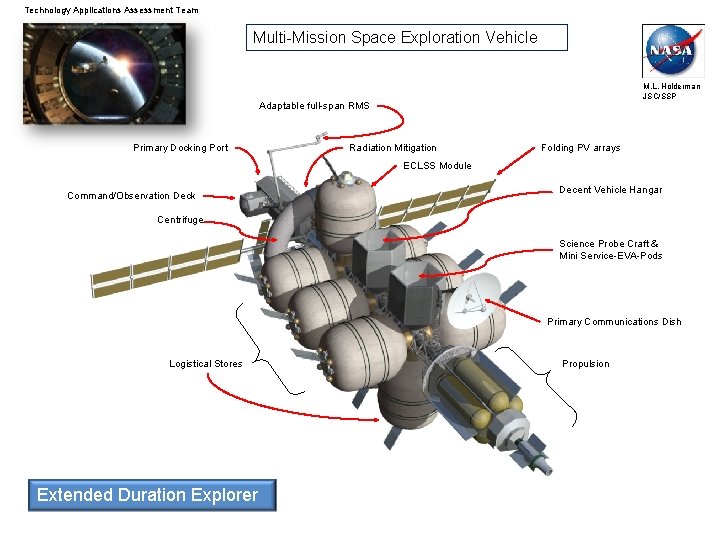
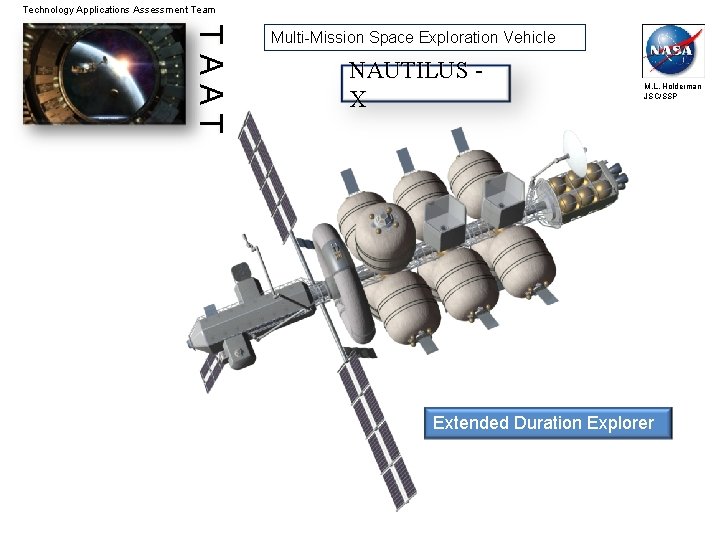
Technology Applications Assessment Team Multi-Mission Space Exploration Vehicle M. L. Holderman JSC/SSP Adaptable full-span RMS Primary Docking Port Radiation Mitigation Folding PV arrays ECLSS Module Command/Observation Deck Decent Vehicle Hangar Centrifuge Science Probe Craft & Mini Service-EVA-Pods Primary Communications Dish Logistical Stores Extended Duration Explorer Propulsion
Technology Applications Assessment Team TAAT Multi-Mission Space Exploration Vehicle NAUTILUS X Extended Duration Explorer M. L. Holderman JSC/SSP
Technology Applications Assessment Team TAAT Multi-Mission Space Exploration Vehicle NAUTILUS X M. L. Holderman JSC/SSP Extended Duration Explorer
Technology Applications Assessment Team Multi-Mission Space Exploration Vehicle NAUTILUS X M. L. Holderman JSC/SSP
Technology Applications Assessment Team TAAT NAUTILUS X M. L. Holderman JSC/SSP
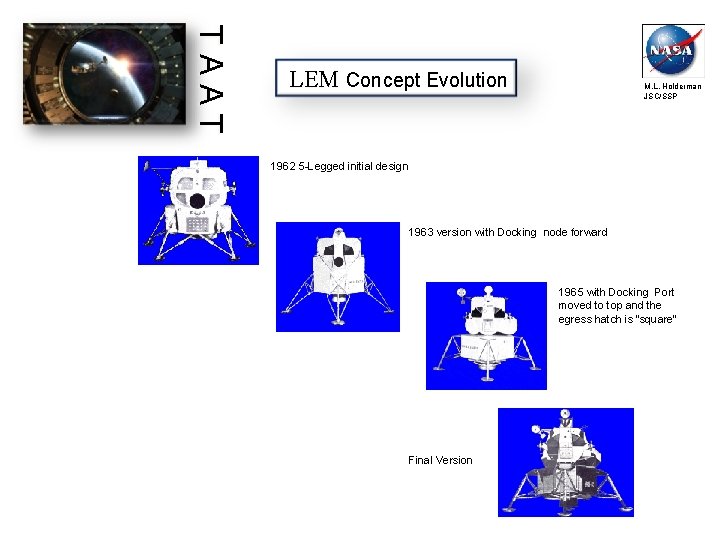
TAAT The Five legged 1962 model of then named Lunar Excursion Module LEM Concept Evolution M. L. Holderman JSC/SSP 1962 5 -Legged initial design 1963 version with Docking node forward 1965 with Docking Port moved to top and the egress hatch is “square” Final Version
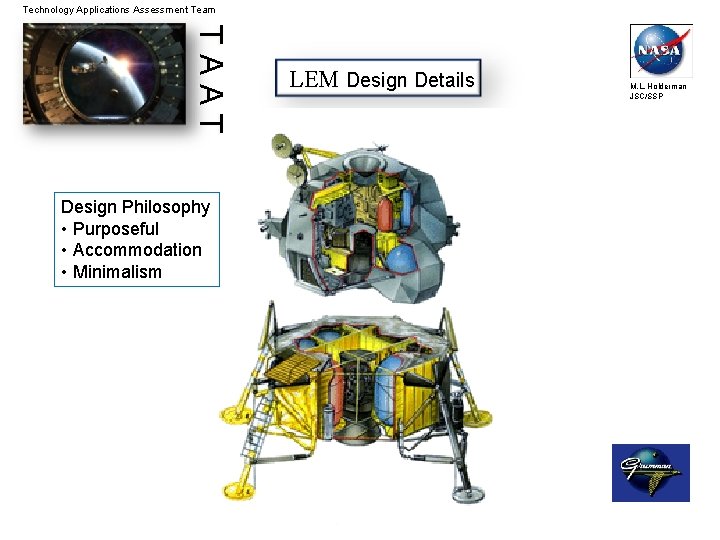
Technology Applications Assessment Team TAAT Design Philosophy • Purposeful • Accommodation • Minimalism LEM Design Details M. L. Holderman JSC/SSP