
TA to Mo LME Europe Aid137704DHSERTJ Quality education

![Presentation of results: Opinions about cooperation with IVET institutions Attitude toward IVET schools [ЗНАЧЕНИЕ],](https://slidetodoc.com/presentation_image_h/f5db5da70d701864053a8df07d011785/image-20.jpg "Presentation of results: Opinions about cooperation with IVET institutions Attitude toward IVET schools [ЗНАЧЕНИЕ],")


- Slides: 47
TA to Mo. LME Europe. Aid/137704/DH/SER/TJ Quality education support programme I Technical assistance to the Ministry of Labour, Migration and Employment of Population in the area of in-service teacher training for the initial technical, vocational education and training system LMR and TNA of employers workshop II Europe. Aid / 137704 / DH / SER / TJ / 6 -Lot 2 Dushanbe 10/07/2019 www. gopa. de
Welcome and opening remarks: • The overall objective of the Project • Purpose of the workshop Project funded by the EU 2
The overall objective of the project To contribute to the development of a modern education system, able to prepare informed and qualified citizens who are ready for the "world of work" and who can contribute to greater political stability, economic prosperity and social well-being in Tajikistan. Project funded by the EU 3
Goals of the workshop: Ø Presentation of results of LMR&TNA research, Ø Validation of LMR&TNA results, verifying findings, and drawing conclusions and recommendations for improvement of business – IVET system cooperation. Project funded by the EU 4
Expected results of the workshop: Validation of LMR&TNA results and draft of recommendations for improvement of relations of: • employers and IVET schools, • employers and Mo. LME and ALE, • employers` competences through trainings. Project funded by the EU 5
Rules of work - to be agreed: Ø Everybody should actively participate, Ø Opinions will be expressed freely and without hesitation, Ø Everybody's opinion will be respected – even if we disagree with it, disagreement will be expressed in decent way. Ø Contribution of everyone will be treated with respect and utmost attention, Ø All opinions will be carefully noted and used exclusively for the purposes of project realization. Ø Good manners will be respected (Discussions will be short and focused, there will be no interruption into someone`s speech, cell phones will be turned off…) Project funded by the EU 6
Goal 1: Presentation of results of LMR&TNA survey Project funded by the EU
The main goal of LMR & TNA survey was define the needs of employers for skilled labour force delivered by the IVET system and provide recommendations for the improvement of schoolbusiness cooperation. Project funded by the EU 8
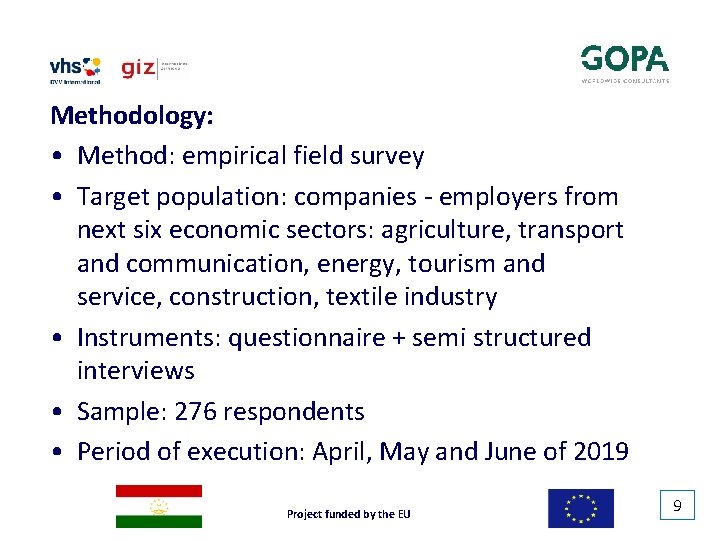
Methodology: • Method: empirical field survey • Target population: companies - employers from next six economic sectors: agriculture, transport and communication, energy, tourism and service, construction, textile industry • Instruments: questionnaire + semi structured interviews • Sample: 276 respondents • Period of execution: April, May and June of 2019 Project funded by the EU 9
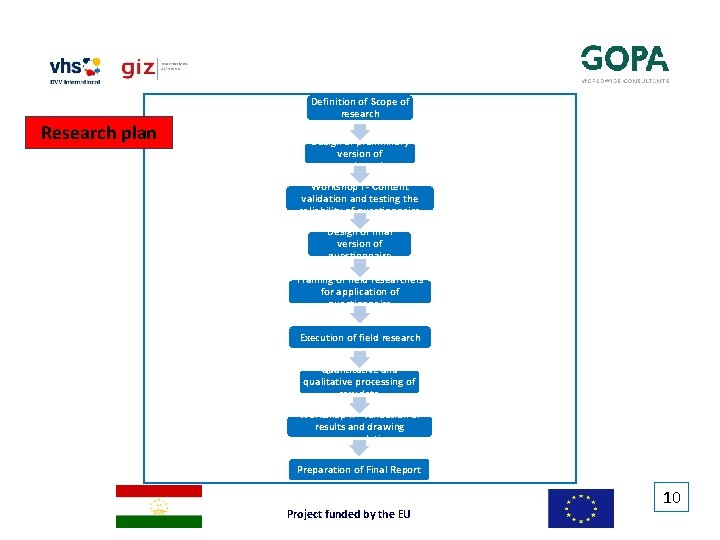
Definition of Scope of research Research plan Design of preliminary version of questionnaire Workshop I - Content validation and testing the reliability of questionnaire Design of final version of questionnaire Training of field researchers for application of questionnaire Execution of field research Quantitative and qualitative processing of raw data Workshop II - validation of results and drawing recomendations Preparation of Final Report Project funded by the EU 10
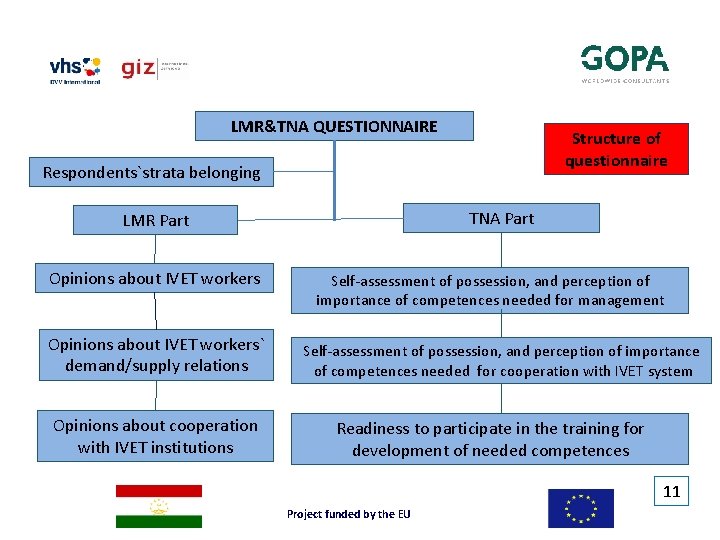
LMR&TNA QUESTIONNAIRE Structure of questionnaire Respondents`strata belonging TNA Part LMR Part Opinions about IVET workers` demand/supply relations Opinions about cooperation with IVET institutions Self-assessment of possession, and perception of importance of competences needed for management Self-assessment of possession, and perception of importance of competences needed for cooperation with IVET system Readiness to participate in the training for development of needed competences 11 Project funded by the EU
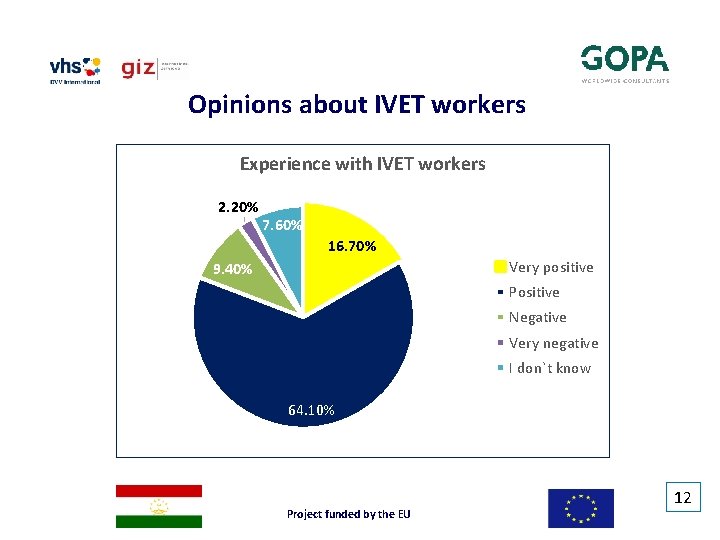
Opinions about IVET workers Experience with IVET workers 2. 20% 7. 60% 16. 70% Very positive 9. 40% Positive Negative Very negative I don`t know 64. 10% Project funded by the EU 12
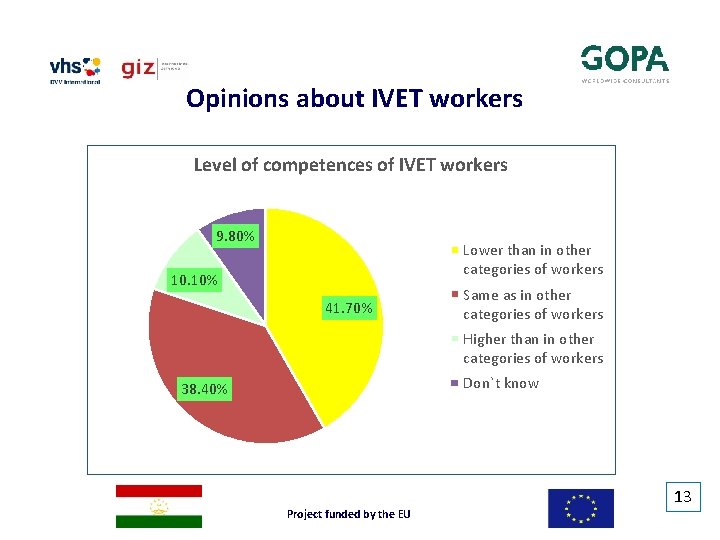
Opinions about IVET workers Level of competences of IVET workers 9. 80% Lower than in other categories of workers 10. 10% 41. 70% Same as in other categories of workers Higher than in other categories of workers Don`t know 38. 40% Project funded by the EU 13
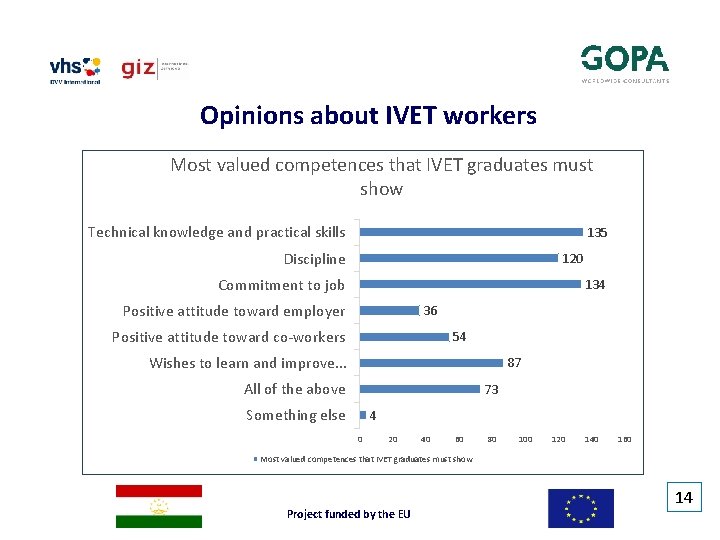
Opinions about IVET workers Most valued competences that IVET graduates must show Technical knowledge and practical skills 135 Discipline 120 Commitment to job 134 Positive attitude toward employer 36 Positive attitude toward co-workers 54 Wishes to learn and improve. . . 87 All of the above 73 Something else 4 0 20 40 60 80 100 120 140 160 Most valued competences that IVET graduates must show Project funded by the EU 14
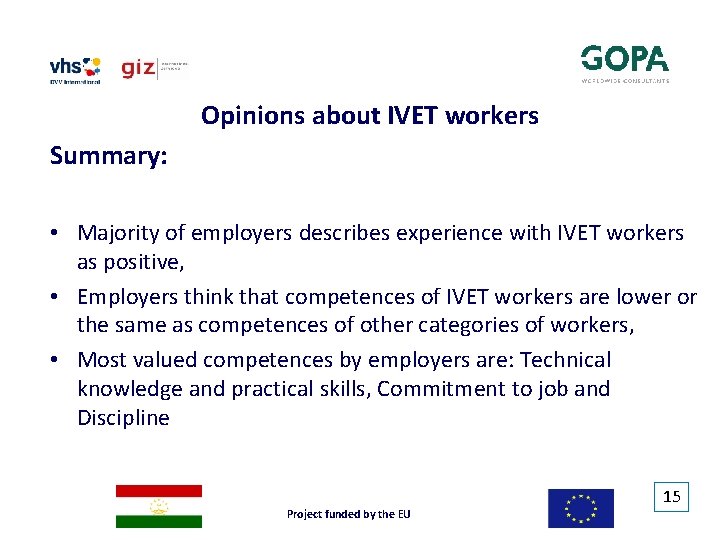
Opinions about IVET workers Summary: • Majority of employers describes experience with IVET workers as positive, • Employers think that competences of IVET workers are lower or the same as competences of other categories of workers, • Most valued competences by employers are: Technical knowledge and practical skills, Commitment to job and Discipline Project funded by the EU 15
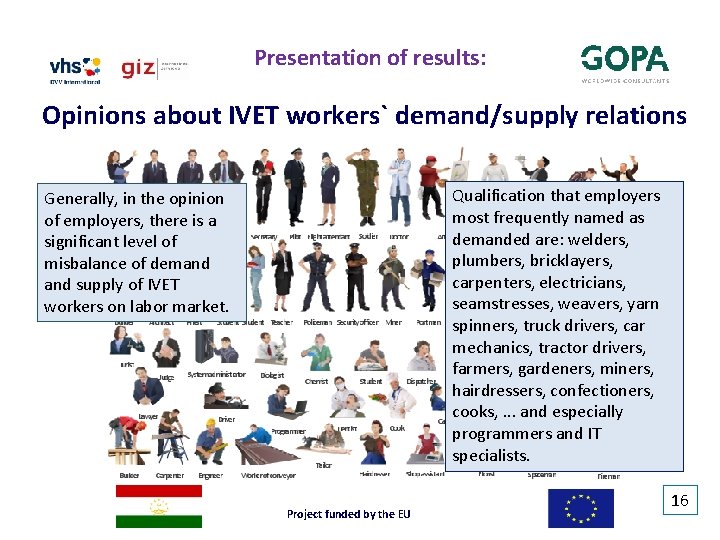
Presentation of results: Opinions about IVET workers` demand/supply relations Qualification that employers most frequently named as demanded are: welders, plumbers, bricklayers, carpenters, electricians, seamstresses, weavers, yarn spinners, truck drivers, car mechanics, tractor drivers, farmers, gardeners, miners, hairdressers, confectioners, cooks, . . . and especially programmers and IT specialists. Generally, in the opinion of employers, there is a significant level of misbalance of demand supply of IVET workers on labor market. Project funded by the EU 16
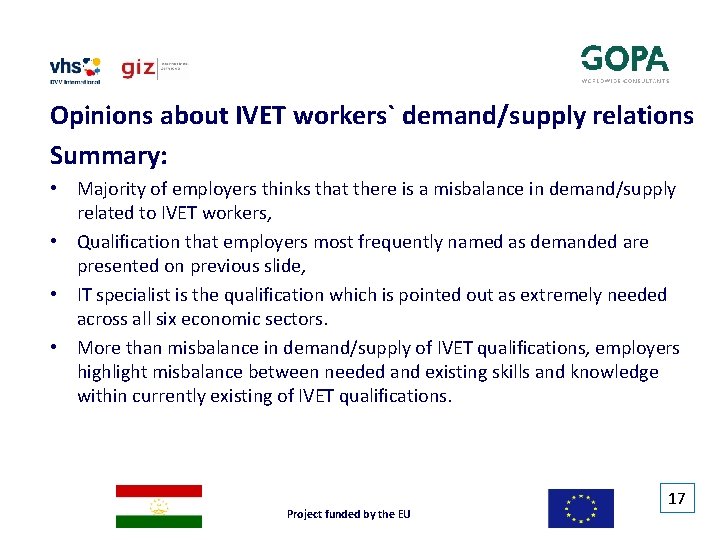
Opinions about IVET workers` demand/supply relations Summary: • Majority of employers thinks that there is a misbalance in demand/supply related to IVET workers, • Qualification that employers most frequently named as demanded are presented on previous slide, • IT specialist is the qualification which is pointed out as extremely needed across all six economic sectors. • More than misbalance in demand/supply of IVET qualifications, employers highlight misbalance between needed and existing skills and knowledge within currently existing of IVET qualifications. Project funded by the EU 17
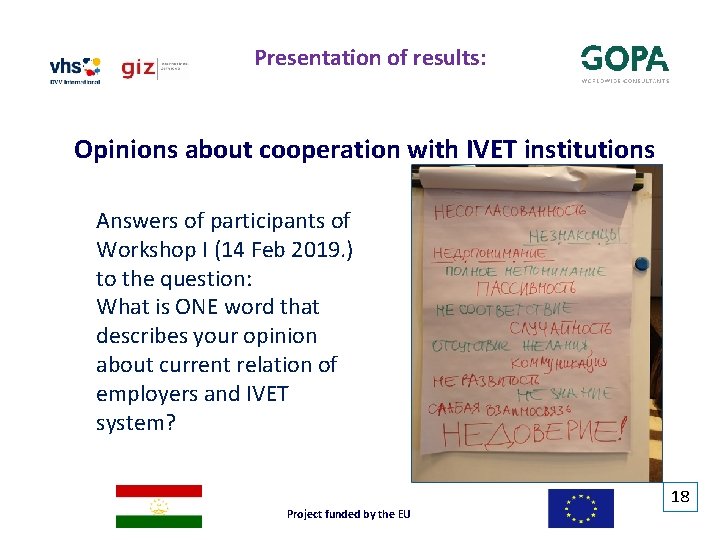
Presentation of results: Opinions about cooperation with IVET institutions Answers of participants of Workshop I (14 Feb 2019. ) to the question: What is ONE word that describes your opinion about current relation of employers and IVET system? Project funded by the EU 18
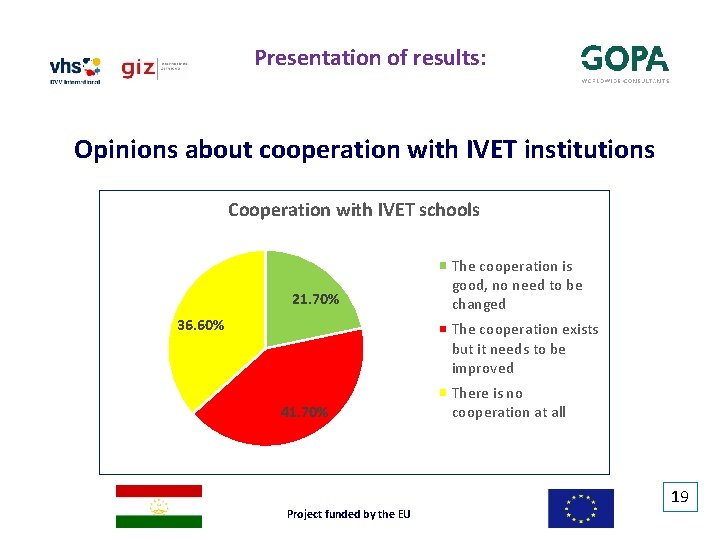
Presentation of results: Opinions about cooperation with IVET institutions Cooperation with IVET schools 21. 70% 36. 60% The cooperation is good, no need to be changed The cooperation exists but it needs to be improved 41. 70% Project funded by the EU There is no cooperation at all 19
Presentation of results: Opinions about cooperation with IVET institutions Attitude toward IVET schools [ЗНАЧЕНИЕ], Lyceums are doing very good job, there is no need for any change Lyceums are doing good, still there is the room for improvement [ЗНАЧЕНИЕ], Project funded by the EU Lyceums are not doing good, they have to improve their activities Don`t know 20
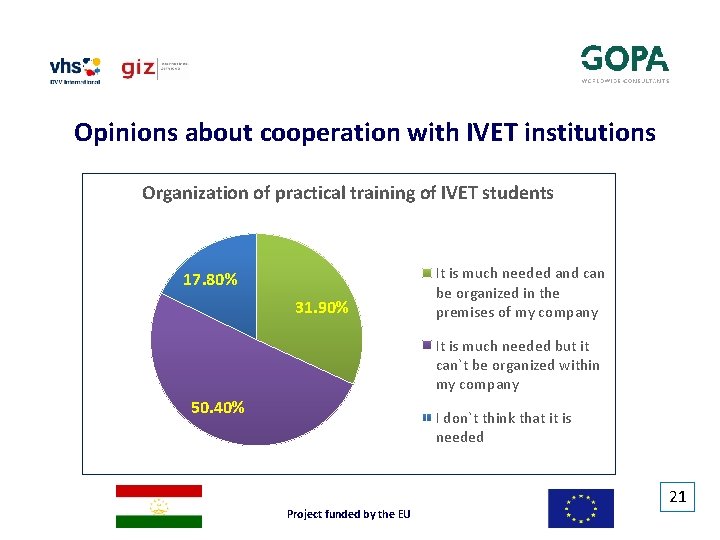
Opinions about cooperation with IVET institutions Organization of practical training of IVET students 17. 80% 31. 90% It is much needed and can be organized in the premises of my company It is much needed but it can`t be organized within my company 50. 40% I don`t think that it is needed Project funded by the EU 21
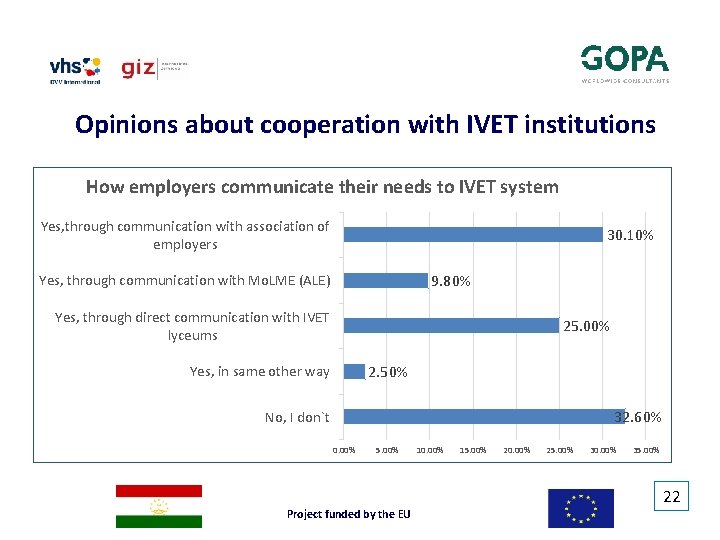
Opinions about cooperation with IVET institutions How employers communicate their needs to IVET system Yes, through communication with association of employers 30. 10% 9. 80% Yes, through communication with Mo. LME (ALE) Yes, through direct communication with IVET lyceums 25. 00% 2. 50% Yes, in same other way 32. 60% No, I don`t 0. 00% 5. 00% Project funded by the EU 10. 00% 15. 00% 20. 00% 25. 00% 30. 00% 35. 00% 22
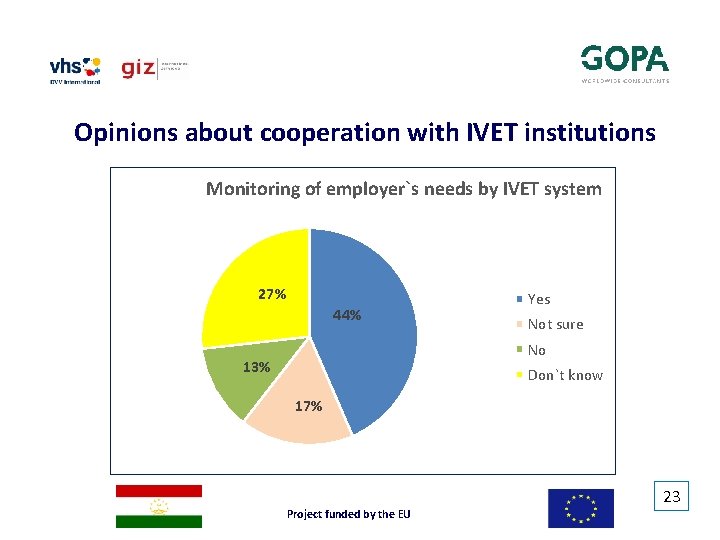
Opinions about cooperation with IVET institutions Monitoring of employer`s needs by IVET system 27% 44% Yes Not sure No 13% Don`t know 17% Project funded by the EU 23
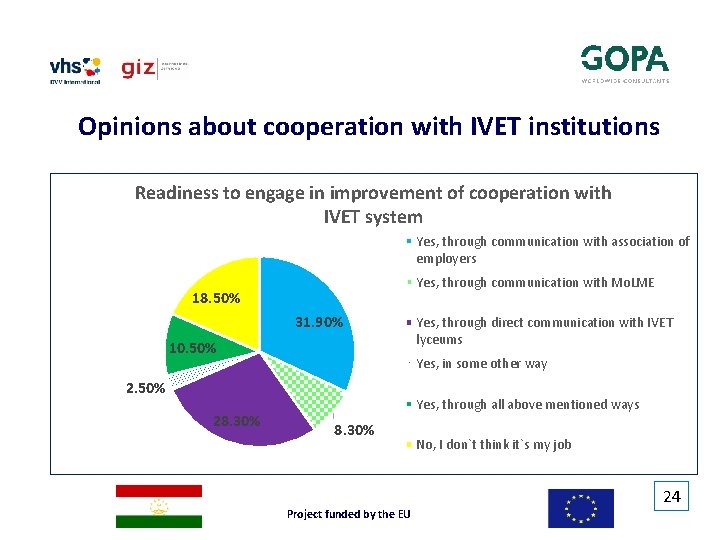
Opinions about cooperation with IVET institutions Readiness to engage in improvement of cooperation with IVET system Yes, through communication with association of employers Yes, through communication with Mo. LME 18. 50% 31. 90% 10. 50% Yes, in some other way 2. 50% 28. 30% Yes, through direct communication with IVET lyceums Yes, through all above mentioned ways 8. 30% Project funded by the EU No, I don`t think it`s my job 24
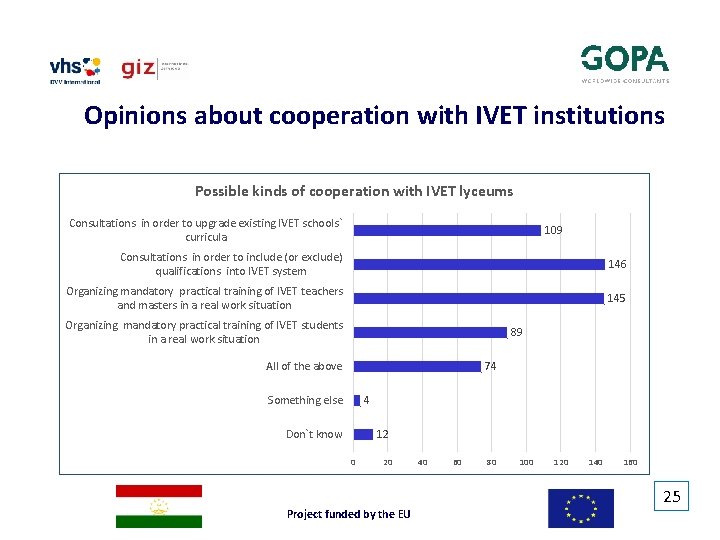
Opinions about cooperation with IVET institutions Possible kinds of cooperation with IVET lyceums Consultations in order to upgrade existing IVET schools` curricula 109 Consultations in order to include (or exclude) qualifications into IVET system 146 Organizing mandatory practical training of IVET teachers and masters in a real work situation 145 Organizing mandatory practical training of IVET students in a real work situation 89 All of the above 74 Something else 4 Don`t know 12 0 20 Project funded by the EU 40 60 80 100 120 140 160 25
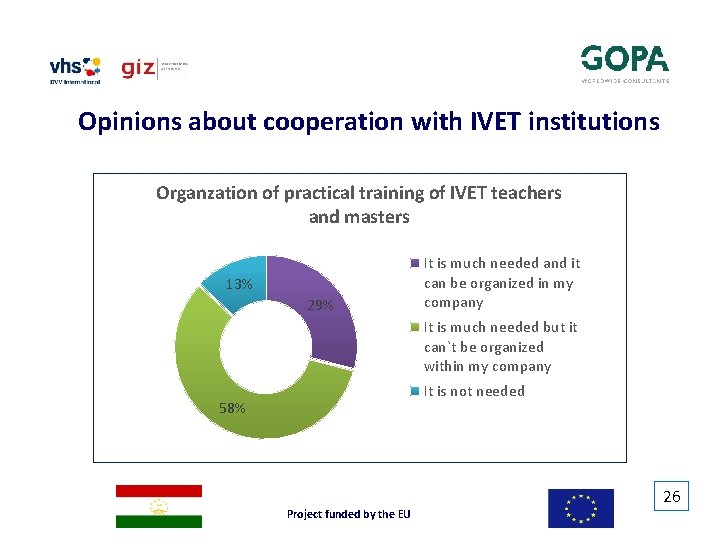
Opinions about cooperation with IVET institutions Organzation of practical training of IVET teachers and masters 13% 29% It is much needed and it can be organized in my company It is much needed but it can`t be organized within my company It is not needed 58% Project funded by the EU 26
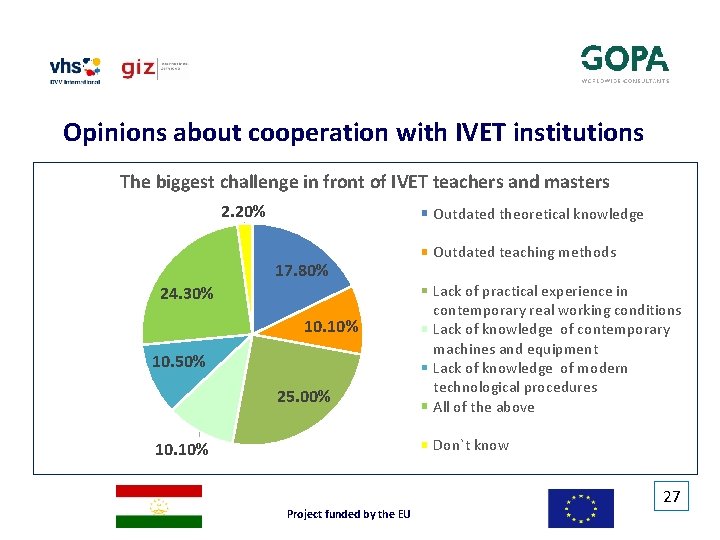
Opinions about cooperation with IVET institutions The biggest challenge in front of IVET teachers and masters 2. 20% Outdated theoretical knowledge 17. 80% 24. 30% 10. 10% 10. 50% 25. 00% Outdated teaching methods Lack of practical experience in contemporary real working conditions Lack of knowledge of contemporary machines and equipment Lack of knowledge of modern technological procedures All of the above Don`t know 10. 10% Project funded by the EU 27
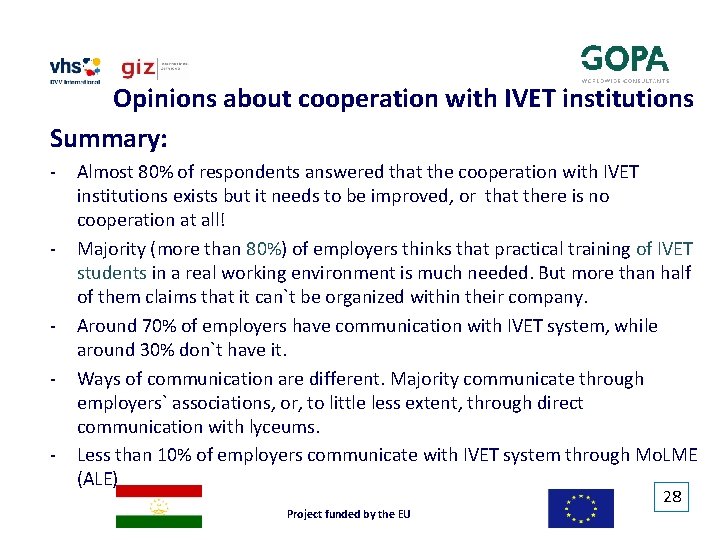
Opinions about cooperation with IVET institutions Summary: - - Almost 80% of respondents answered that the cooperation with IVET institutions exists but it needs to be improved, or that there is no cooperation at all! Majority (more than 80%) of employers thinks that practical training of IVET students in a real working environment is much needed. But more than half of them claims that it can`t be organized within their company. Around 70% of employers have communication with IVET system, while around 30% don`t have it. Ways of communication are different. Majority communicate through employers` associations, or, to little less extent, through direct communication with lyceums. Less than 10% of employers communicate with IVET system through Mo. LME (ALE) Project funded by the EU 28
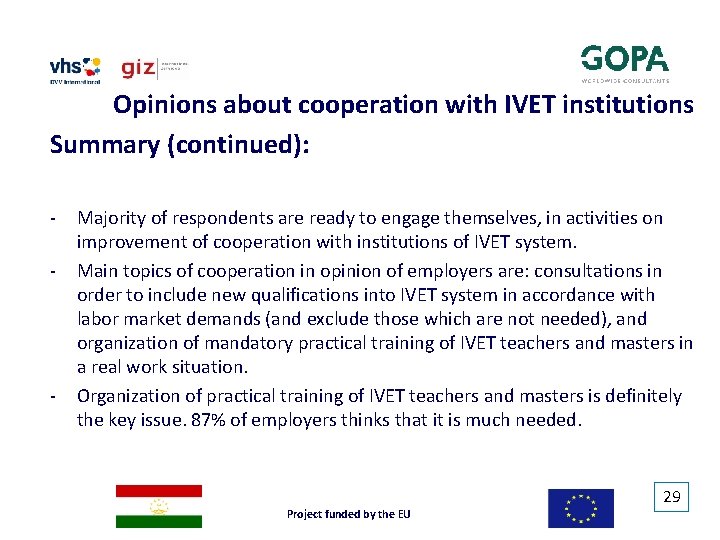
Opinions about cooperation with IVET institutions Summary (continued): - - Majority of respondents are ready to engage themselves, in activities on improvement of cooperation with institutions of IVET system. Main topics of cooperation in opinion of employers are: consultations in order to include new qualifications into IVET system in accordance with labor market demands (and exclude those which are not needed), and organization of mandatory practical training of IVET teachers and masters in a real work situation. Organization of practical training of IVET teachers and masters is definitely the key issue. 87% of employers thinks that it is much needed. Project funded by the EU 29
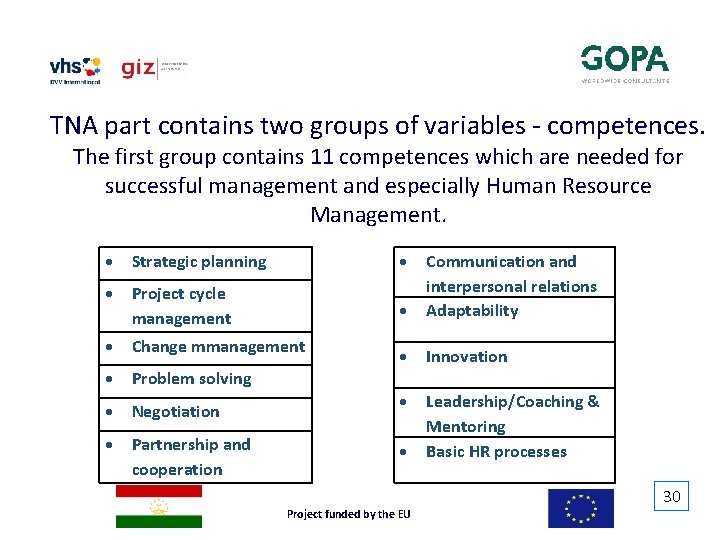
TNA part contains two groups of variables - competences. The first group contains 11 competences which are needed for successful management and especially Human Resource Management. Strategic planning Project cycle management Communication and interpersonal relations Adaptability Change mmanagement Innovation Problem solving Negotiation Partnership and cooperation Leadership/Coaching & Mentoring Basic HR processes Project funded by the EU 30
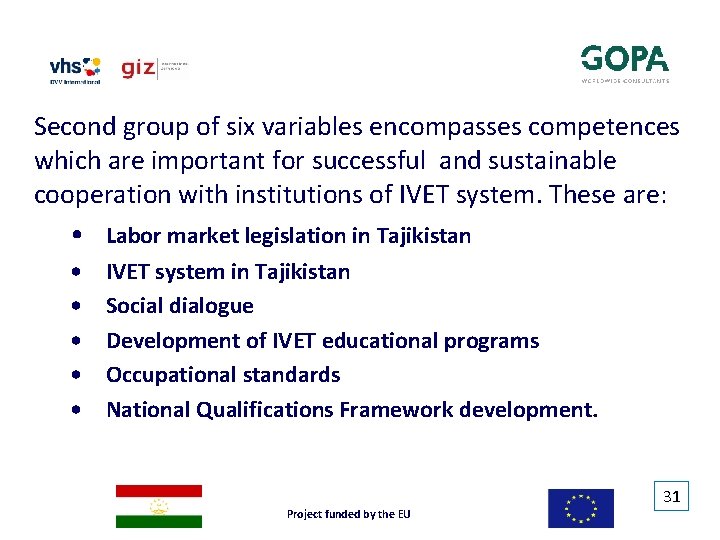
Second group of six variables encompasses competences which are important for successful and sustainable cooperation with institutions of IVET system. These are: • Labor market legislation in Tajikistan • • • IVET system in Tajikistan Social dialogue Development of IVET educational programs Occupational standards National Qualifications Framework development. Project funded by the EU 31
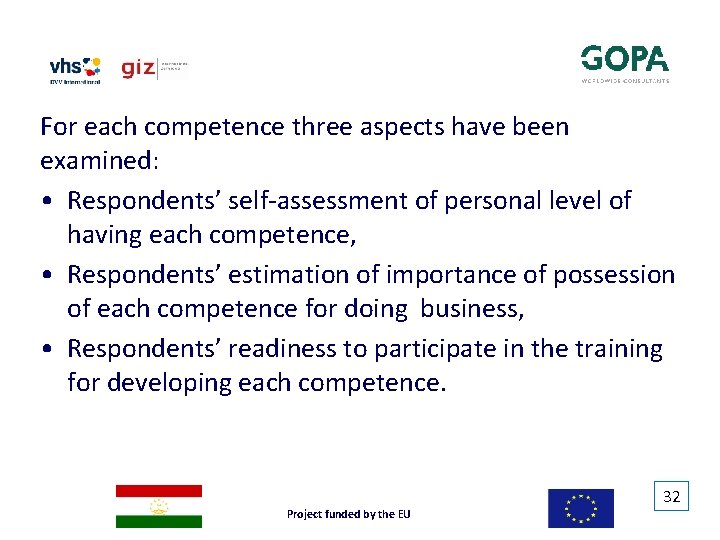
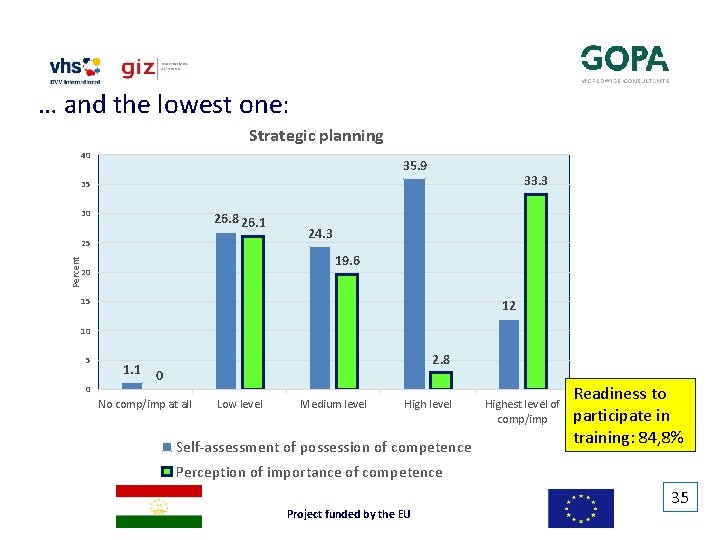
For each competence three aspects have been examined: • Respondents’ self-assessment of personal level of having each competence, • Respondents’ estimation of importance of possession of each competence for doing business, • Respondents’ readiness to participate in the training for developing each competence. Project funded by the EU 32
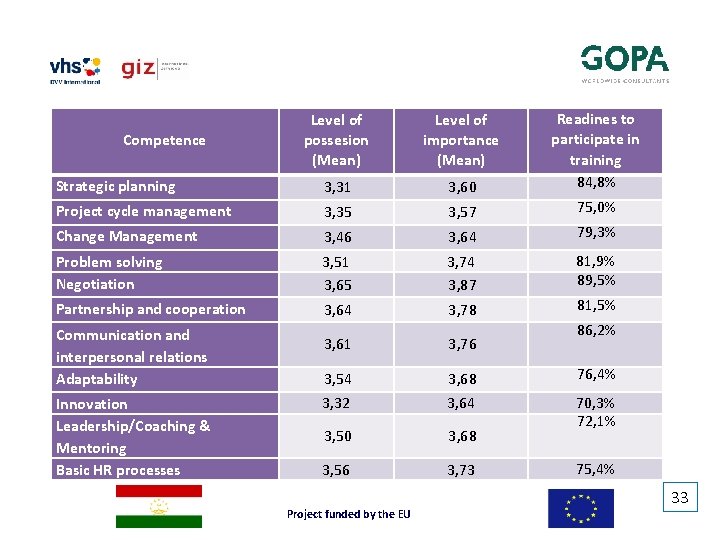
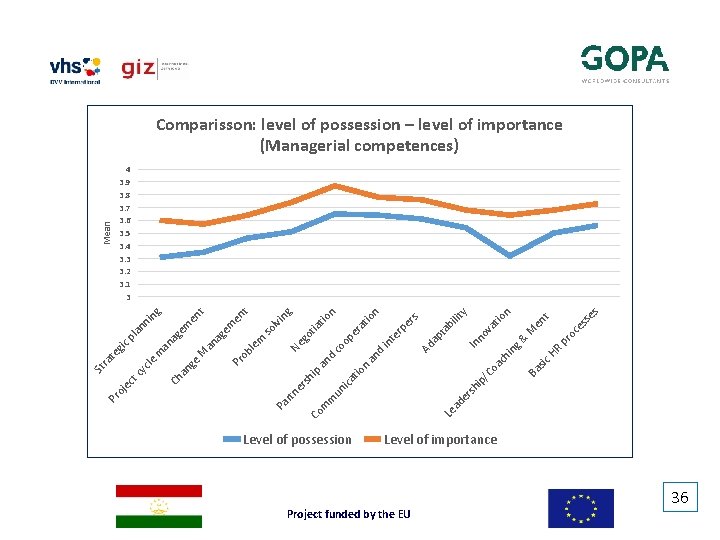
Level of possesion (Mean) Level of importance (Mean) Strategic planning 3, 31 3, 60 Readines to participate in training 84, 8% Project cycle management 3, 35 3, 57 75, 0% Change Management 3, 46 3, 64 79, 3% Problem solving Negotiation 3, 51 3, 65 3, 74 3, 87 81, 9% 89, 5% Partnership and cooperation 3, 64 3, 78 81, 5% Competence Communication and interpersonal relations Adaptability Innovation Leadership/Coaching & Mentoring Basic HR processes 86, 2% 3, 61 3, 76 3, 54 3, 68 76, 4% 3, 32 3, 64 3, 50 3, 68 70, 3% 72, 1% 3, 56 3, 73 Project funded by the EU 75, 4% 33
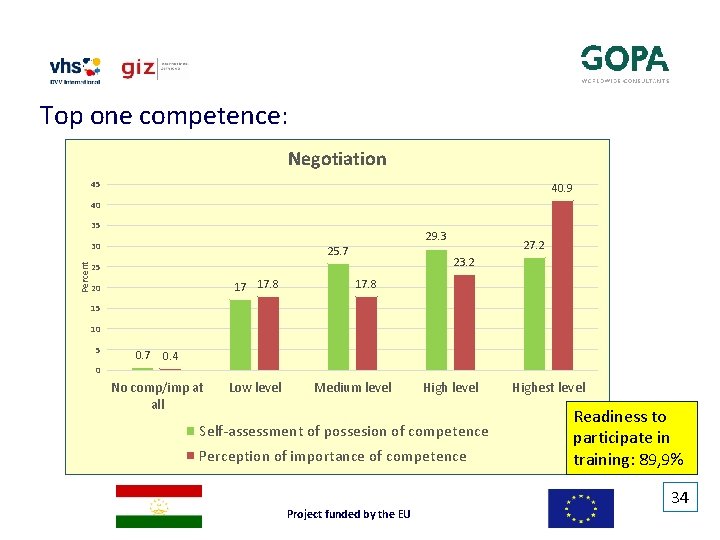
Top one competence: Negotiation 45 40. 9 40 35 29. 3 30 25. 7 23. 2 Percent 25 17 17. 8 20 27. 2 17. 8 15 10 5 0. 7 0. 4 0 No comp/imp at all Low level Medium level High level Self-assessment of possesion of competence Perception of importance of competence Project funded by the EU Highest level Readiness to participate in training: 89, 9% 34
… and the lowest one: Strategic planning 40 35. 9 33. 3 35 30 26. 8 26. 1 25 24. 3 Percent 19. 6 20 15 12 10 5 0 1. 1 2. 8 0 No comp/imp at all Low level Medium level High level Self-assessment of possession of competence Highest level of comp/imp Readiness to participate in training: 84, 8% Perception of importance of competence Project funded by the EU 35
Level of possession Project funded by the EU hi Le ad er s sic Ba HR . s es se oc pr t. . en M y tio n va no g& in ac h Co p/ In s. . . n lit bi ta ap Ad er te rp in n er at io op co ng tia tio lvi t t en em so go Ne d an n tio p sh i ica un m Co m er rtn Pa em ag M an em en ng ni an pl ag an m ob l Pr ge an Ch le ra te gic yc tc ec oj Pr St Mean Comparisson: level of possession – level of importance (Managerial competences) 4 3. 9 3. 8 3. 7 3. 6 3. 5 3. 4 3. 3 3. 2 3. 1 3 Level of importance 36
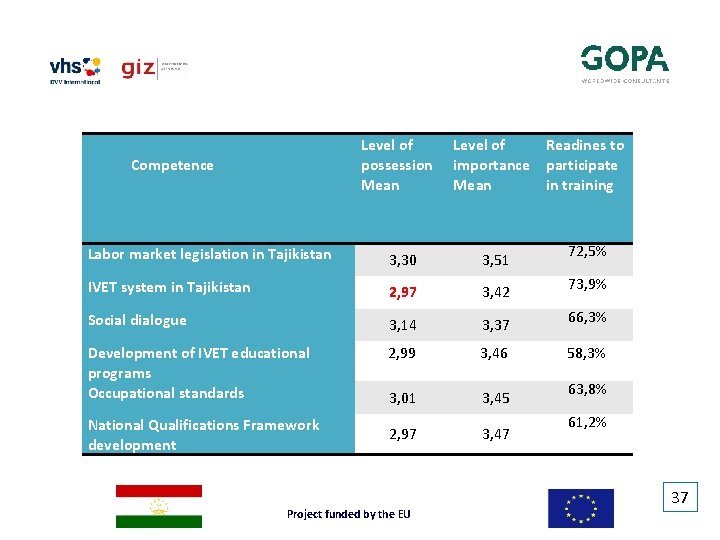
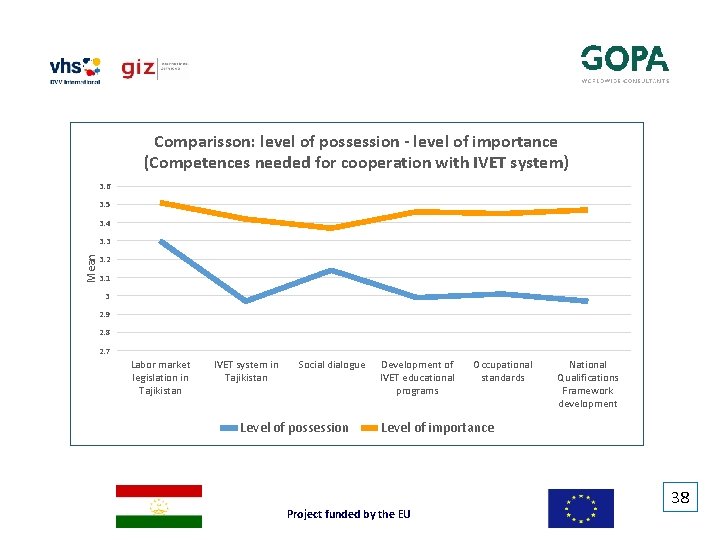
Competence Level of possession Mean Level of Readines to importance participate Mean in training Labor market legislation in Tajikistan 3, 30 3, 51 IVET system in Tajikistan 2, 97 3, 42 Social dialogue 3, 14 3, 37 Development of IVET educational programs Occupational standards 2, 99 3, 46 3, 01 3, 45 2, 97 3, 47 National Qualifications Framework development Project funded by the EU 72, 5% 73, 9% 66, 3% 58, 3% 63, 8% 61, 2% 37
Comparisson: level of possession - level of importance (Competences needed for cooperation with IVET system) 3. 6 3. 5 3. 4 Mean 3. 3 3. 2 3. 1 3 2. 9 2. 8 2. 7 Labor market legislation in Tajikistan IVET system in Tajikistan Social dialogue Level of possession Development of IVET educational programs Occupational standards National Qualifications Framework development Level of importance Project funded by the EU 38
TNA of employers Summary: • Employers are self-confident when assessing their own level of managerial competences. • Means are high, and pretty balanced. Differences are small, and not statistically significant. Average mean is 3, 50 , that it between medium and high level of competency. • Top three competences are: Negotiation, Partnership and cooperation, and Communication and interpersonal relations. On the other end, on the bottom are: Strategic planning, Innovation and Project cycle management. • Perception of importance of competences follows the estimation of possession • Level of possession of competences needed for cooperation with institutions of IVET system is significantly lower. Average mean is 3, 06. • The lowest (mean = 2, 97) is competence to cooperate with IVET system in Tajikistan • Readiness to participate to (all) trainings is extremely high. Project funded by the EU 39
Questions, clarifications, comments …. . Project funded by the EU 40
Coffee break. . . Project funded by the EU
Goal 2: Validation of LMR&TNA results, verifying findings, and drawing conclusions and recommendations for improvement of business – IVET system cooperation. Project funded by the EU 42
Key questions: Ø Relation of employers and IVET system Ø Relation of employers with Mo. LME, ALE Ø Training of employers Recommendations have to be adjusted to the Tajik conditions. That’s why your contribution is so important. Project funded by the EU 43
Presentation of recommendations: Ø Key employers' initiatives toward IVET system are… Ø Key employers' initiatives toward Mo. LME, (ALE) are… Ø Key initiatives toward training of employers are… Project funded by the EU 44
Evaluation of the workshop Project funded by the EU
Summarizing of results, closing remarks… Project funded by the EU
TA to Mo. LME Europe. Aid/137704/DH/SER/TJ Quality education support programme I РАХМАТ! ТАШАККУР! Thank you! www. gopa. de