
Ta RL Webinar Series Session 1 August 30
Ta. RL Webinar Series: Session 1 August 30, 2017
Teaching at the Right Level Pratham’s approach to solving a basic problem in elementary education in India JPAL-Pratham Webinar Series on Ta. RL August 30, 2017 Every child in school and learning well
PRATHAM’S TEACHING-AT-THE-RIGHT-LEVEL APPROACH CONTENTS 1. What is the problem? 2. Why do we have this problem? 3. What do the data tell us? 4. What is the solution? 5. What are the key elements of this approach? 6. What are the main teaching-learning activities? 7. How is the solution implemented? 8. How much does learning improve? In Learning Camps 9. How much does learning improve? In Govt. partnerships 10. What “works” to improve children’s learning? Lessons
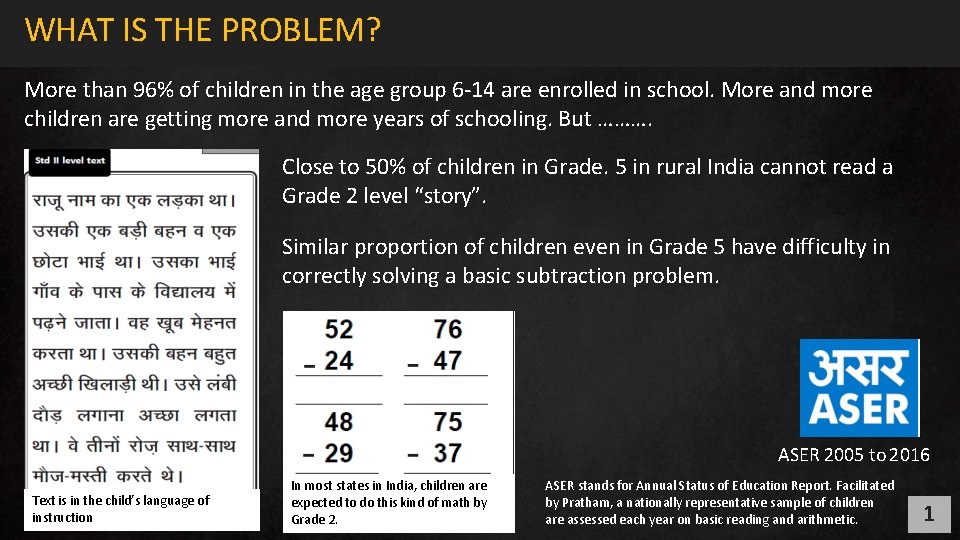
WHAT IS THE PROBLEM? More than 96% of children in the age group 6 -14 are enrolled in school. More and more children are getting more and more years of schooling. But ………. Close to 50% of children in Grade. 5 in rural India cannot read a Grade 2 level “story”. Similar proportion of children even in Grade 5 have difficulty in correctly solving a basic subtraction problem. ASER 2005 to 2016 Text is in the child’s language of instruction In most states in India, children are expected to do this kind of math by Grade 2. ASER stands for Annual Status of Education Report. Facilitated by Pratham, a nationally representative sample of children are assessed each year on basic reading and arithmetic. 1
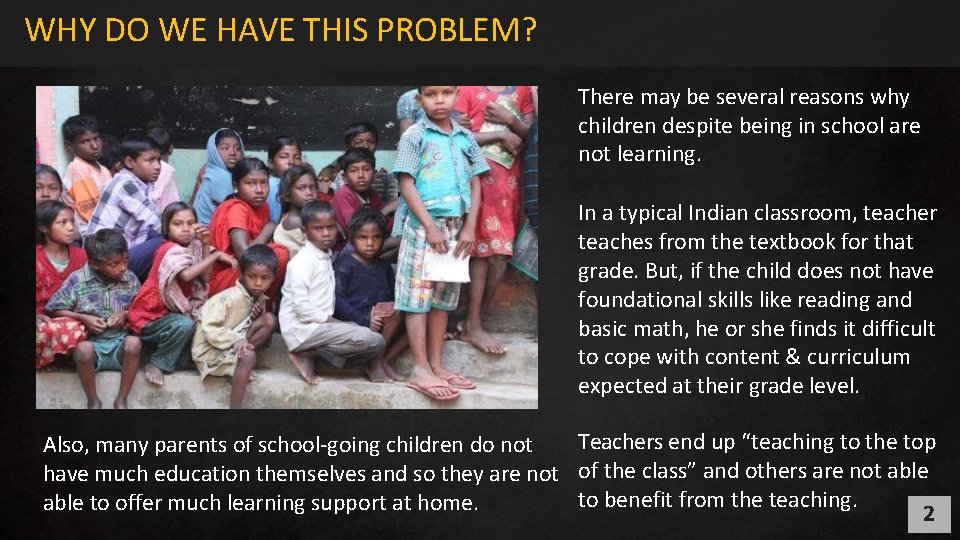
WHY DO WE HAVE THIS PROBLEM? There may be several reasons why children despite being in school are not learning. In a typical Indian classroom, teacher teaches from the textbook for that grade. But, if the child does not have foundational skills like reading and basic math, he or she finds it difficult to cope with content & curriculum expected at their grade level. Teachers end up “teaching to the top Also, many parents of school-going children do not have much education themselves and so they are not of the class” and others are not able to benefit from the teaching. able to offer much learning support at home. 2
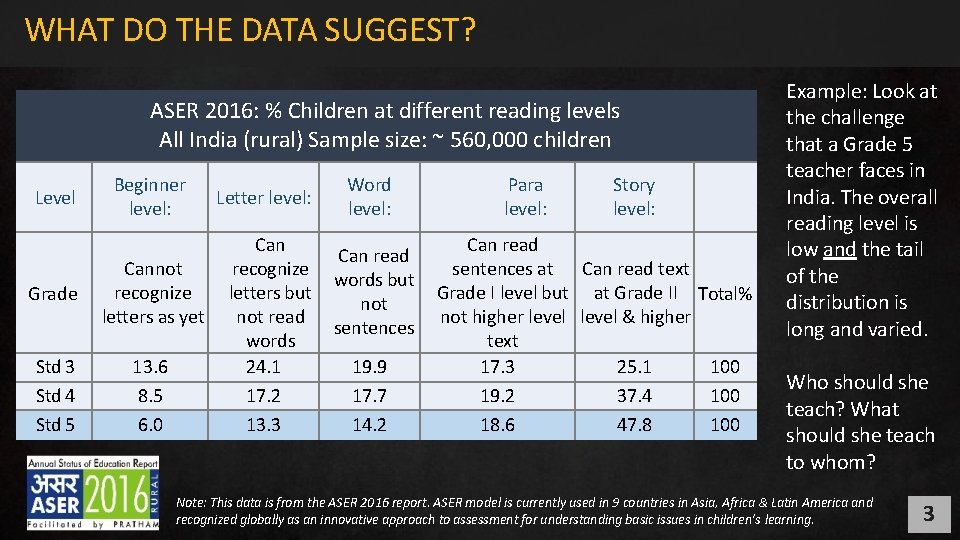
WHAT DO THE DATA SUGGEST? ASER 2016: % Children at different reading levels All India (rural) Sample size: ~ 560, 000 children Level Beginner level: Grade Cannot recognize letters as yet Std 3 Std 4 Std 5 13. 6 8. 5 6. 0 Letter level: Can recognize letters but not read words 24. 1 17. 2 13. 3 Word level: Can read words but not sentences 19. 9 17. 7 14. 2 Para level: Story level: Can read sentences at Can read text Grade I level but at Grade II not higher level & higher text 17. 3 25. 1 19. 2 37. 4 18. 6 47. 8 Total% 100 100 Example: Look at the challenge that a Grade 5 teacher faces in India. The overall reading level is low and the tail of the distribution is long and varied. Who should she teach? What should she teach to whom? Note: This data is from the ASER 2016 report. ASER model is currently used in 9 countries in Asia, Africa & Latin America and recognized globally as an innovative approach to assessment for understanding basic issues in children’s learning. 3
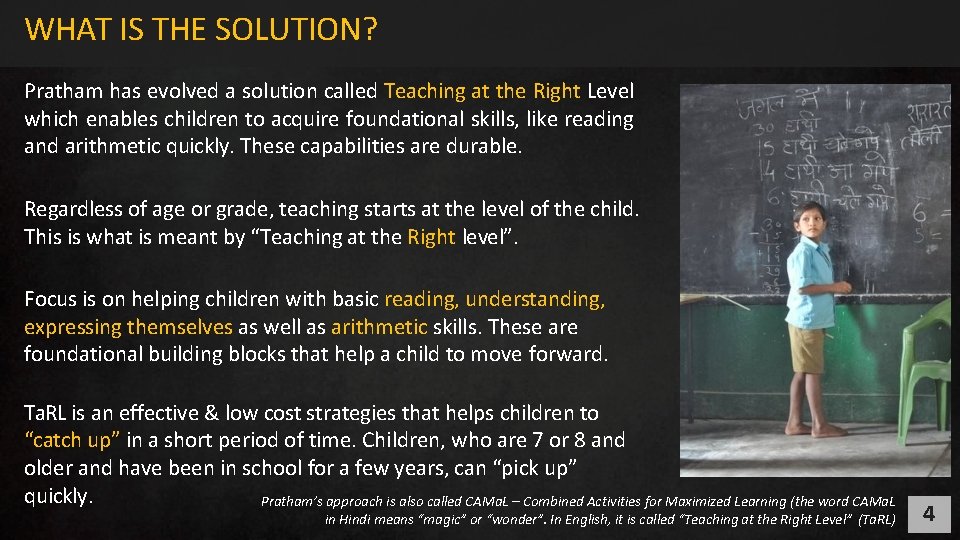
WHAT IS THE SOLUTION? Pratham has evolved a solution called Teaching at the Right Level which enables children to acquire foundational skills, like reading and arithmetic quickly. These capabilities are durable. Regardless of age or grade, teaching starts at the level of the child. This is what is meant by “Teaching at the Right level”. Focus is on helping children with basic reading, understanding, expressing themselves as well as arithmetic skills. These are foundational building blocks that help a child to move forward. Ta. RL is an effective & low cost strategies that helps children to “catch up” in a short period of time. Children, who are 7 or 8 and older and have been in school for a few years, can “pick up” quickly. Pratham’s approach is also called CAMa. L – Combined Activities for Maximized Learning (the word CAMa. L in Hindi means “magic” or “wonder”. In English, it is called “Teaching at the Right Level” (Ta. RL) 4

WHAT ARE THE KEY ELEMENTS OF THE APPROACH? 1. Simple one-on-one assessment done to group Grade 3, 4 and 5 children by level rather than by grade. Similar assessment used for tracking children’s progress, monitoring intervention. 4. 2. Children’s groups are made according to the basic assessment. Available teachers or instructors allocated to facilitate group activities and to guide children’s work. 3. For each group there a set of activities and materials appropriate for their level. Children learn in groups and also individually. Teachers or instructors do activities with groups. As children make progress they move into the next group. 5
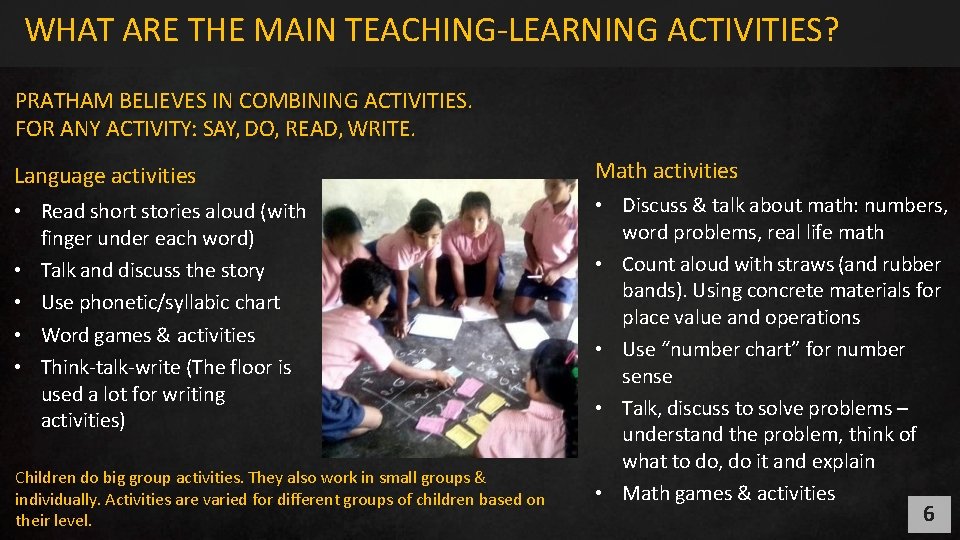
WHAT ARE THE MAIN TEACHING-LEARNING ACTIVITIES? PRATHAM BELIEVES IN COMBINING ACTIVITIES. FOR ANY ACTIVITY: SAY, DO, READ, WRITE. Language activities Math activities • Read short stories aloud (with finger under each word) • Talk and discuss the story • Use phonetic/syllabic chart • Word games & activities • Think-talk-write (The floor is used a lot for writing activities) • Discuss & talk about math: numbers, word problems, real life math • Count aloud with straws (and rubber bands). Using concrete materials for place value and operations • Use “number chart” for number sense • Talk, discuss to solve problems – understand the problem, think of what to do, do it and explain • Math games & activities Children do big group activities. They also work in small groups & individually. Activities are varied for different groups of children based on their level. 6
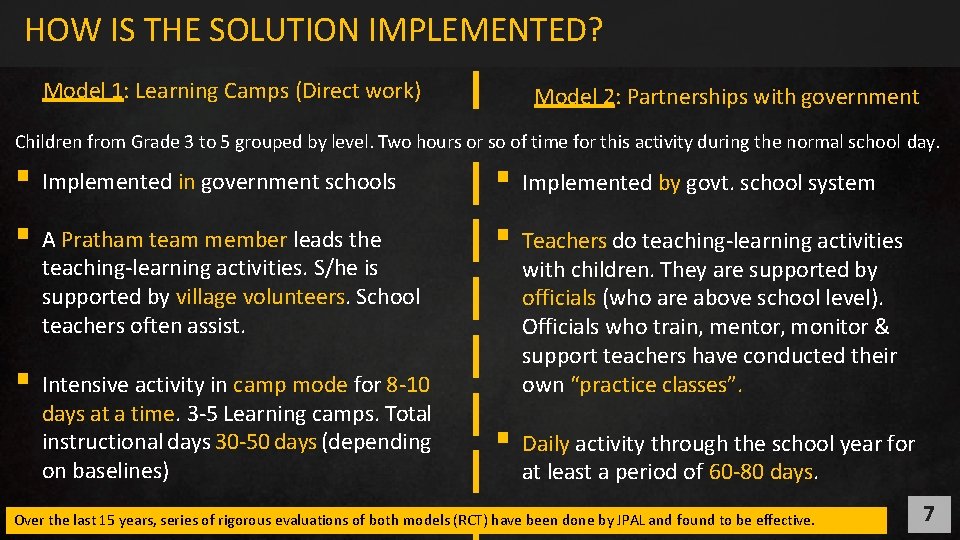
HOW IS THE SOLUTION IMPLEMENTED? Model 1: Learning Camps (Direct work) Model 2: Partnerships with government Children from Grade 3 to 5 grouped by level. Two hours or so of time for this activity during the normal school day. Implemented in government schools Implemented by govt. school system A Pratham team member leads the Teachers do teaching-learning activities. S/he is supported by village volunteers. School teachers often assist. Intensive activity in camp mode for 8 -10 days at a time. 3 -5 Learning camps. Total instructional days 30 -50 days (depending on baselines) with children. They are supported by officials (who are above school level). Officials who train, mentor, monitor & support teachers have conducted their own “practice classes”. Daily activity through the school year for at least a period of 60 -80 days. Over the last 15 years, series of rigorous evaluations of both models (RCT) have been done by JPAL and found to be effective. 7
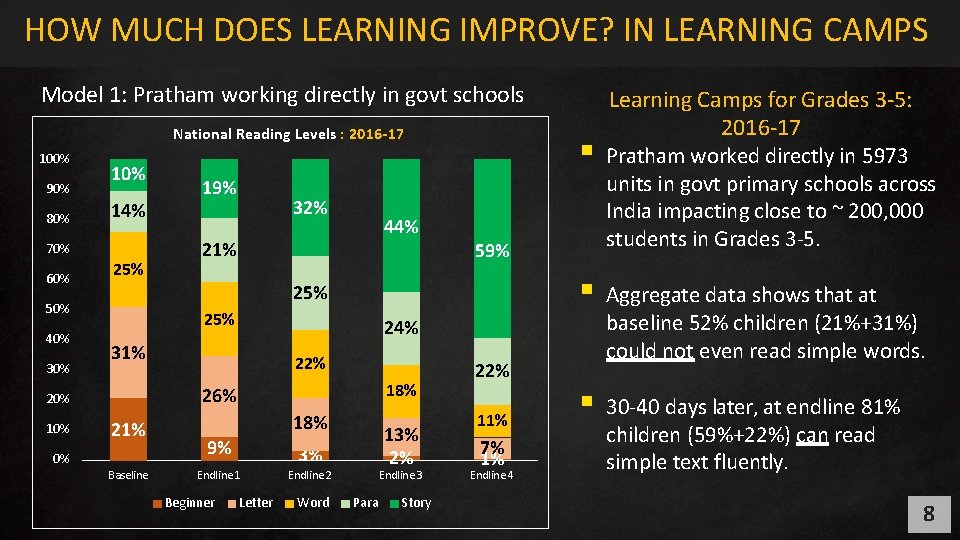
HOW MUCH DOES LEARNING IMPROVE? IN LEARNING CAMPS Model 1: Pratham working directly in govt schools National Reading Levels : 2016 -17 100% 90% 80% 14% 70% 60% 25% 50% 40% 32% 44% 21% 22% 18% 26% 0% Baseline 18% 9% 13% 2% 3% Endline 1 Beginner Aggregate data shows that at baseline 52% children (21%+31%) could not even read simple words. 30 -40 days later, at endline 81% children (59%+22%) can read simple text fluently. 24% 31% 21% 59% 25% 20% 19% Letter Endline 2 Word Endline 3 Para Story 22% 11% 7% 1% Endline 4 Learning Camps for Grades 3 -5: 2016 -17 Pratham worked directly in 5973 units in govt primary schools across India impacting close to ~ 200, 000 students in Grades 3 -5. 8
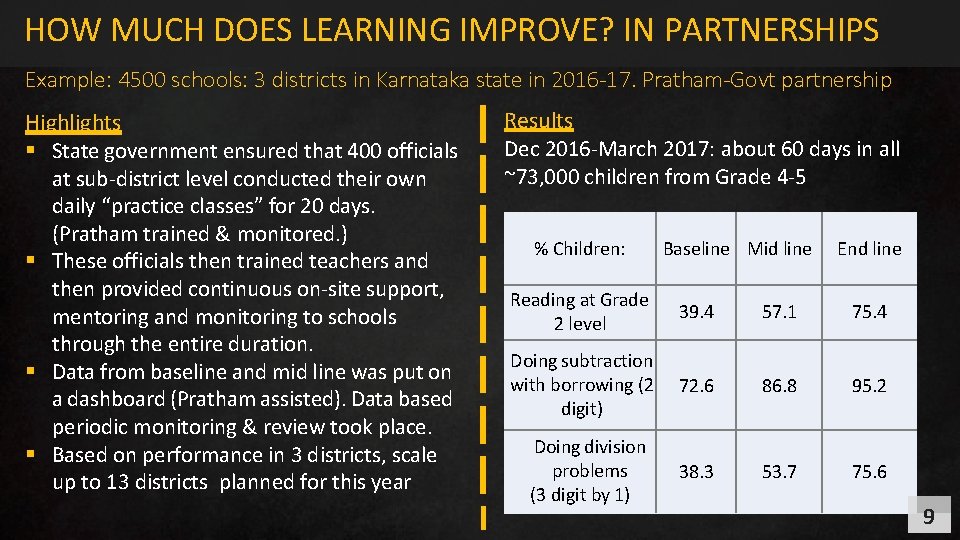
HOW MUCH DOES LEARNING IMPROVE? IN PARTNERSHIPS Example: 4500 schools: 3 districts in Karnataka state in 2016 -17. Pratham-Govt partnership Highlights State government ensured that 400 officials at sub-district level conducted their own daily “practice classes” for 20 days. (Pratham trained & monitored. ) These officials then trained teachers and then provided continuous on-site support, mentoring and monitoring to schools through the entire duration. Data from baseline and mid line was put on a dashboard (Pratham assisted). Data based periodic monitoring & review took place. Based on performance in 3 districts, scale up to 13 districts planned for this year Results Dec 2016 -March 2017: about 60 days in all ~73, 000 children from Grade 4 -5 % Children: Baseline Mid line End line Reading at Grade 2 level 39. 4 57. 1 75. 4 Doing subtraction with borrowing (2 digit) 72. 6 86. 8 95. 2 38. 3 53. 7 75. 6 Doing division problems (3 digit by 1) 9
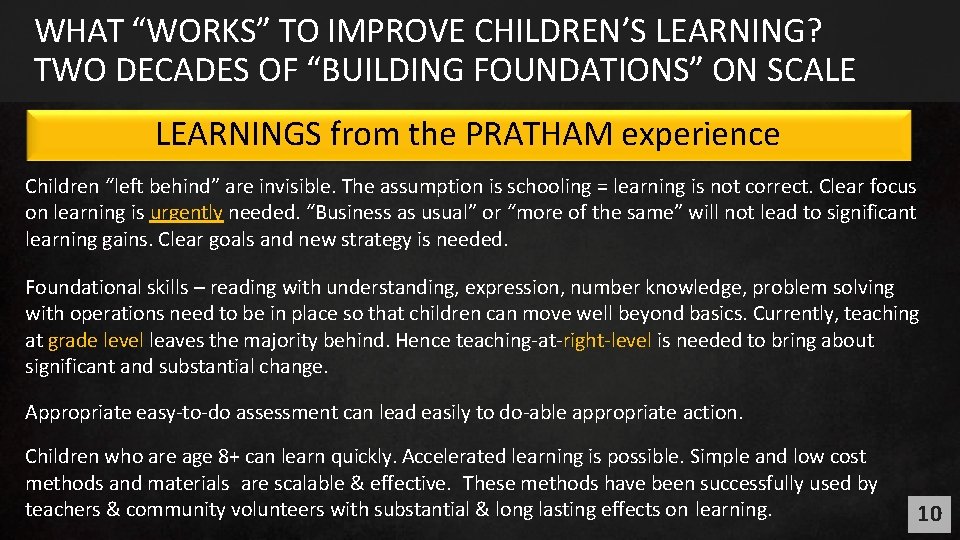
WHAT “WORKS” TO IMPROVE CHILDREN’S LEARNING? TWO DECADES OF “BUILDING FOUNDATIONS” ON SCALE LEARNINGS from the PRATHAM experience Children “left behind” are invisible. The assumption is schooling = learning is not correct. Clear focus on learning is urgently needed. “Business as usual” or “more of the same” will not lead to significant learning gains. Clear goals and new strategy is needed. Foundational skills – reading with understanding, expression, number knowledge, problem solving with operations need to be in place so that children can move well beyond basics. Currently, teaching at grade level leaves the majority behind. Hence teaching-at-right-level is needed to bring about significant and substantial change. Appropriate easy-to-do assessment can lead easily to do-able appropriate action. Children who are age 8+ can learn quickly. Accelerated learning is possible. Simple and low cost methods and materials are scalable & effective. These methods have been successfully used by teachers & community volunteers with substantial & long lasting effects on learning. 10
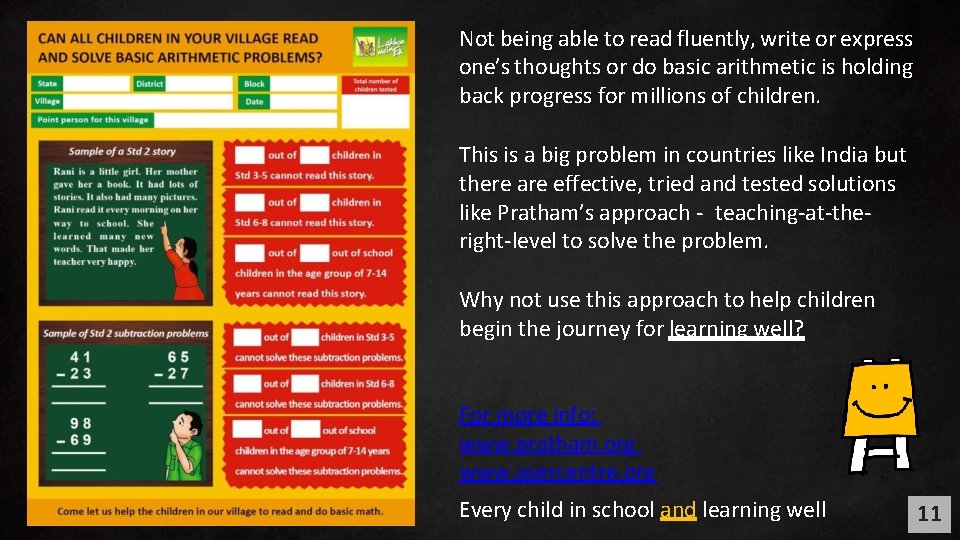
Not being able to read fluently, write or express one’s thoughts or do basic arithmetic is holding back progress for millions of children. This is a big problem in countries like India but there are effective, tried and tested solutions like Pratham’s approach - teaching-at-theright-level to solve the problem. Why not use this approach to help children begin the journey for learning well? For more info: www. pratham. org www. asercentre. org Every child in school and learning well 11
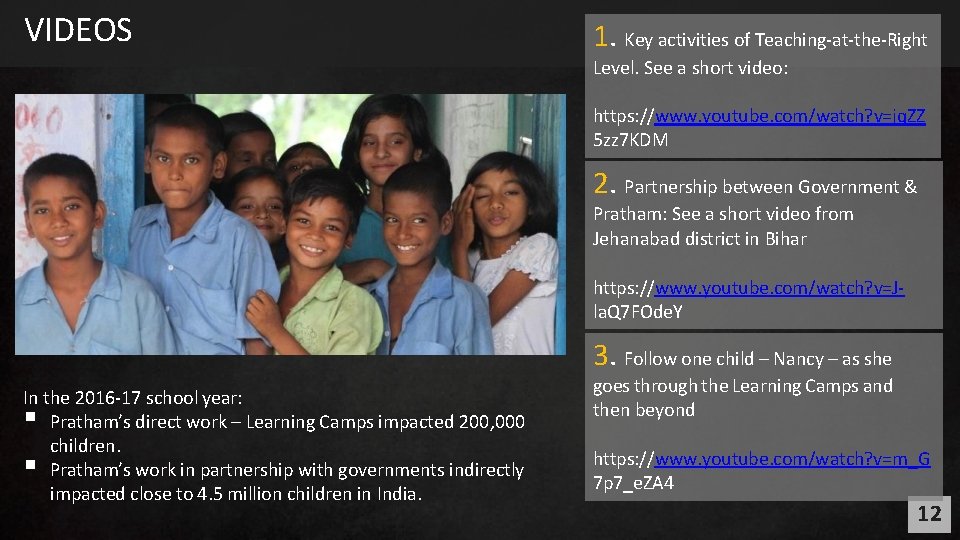
VIDEOS 1. Key activities of Teaching-at-the-Right Level. See a short video: https: //www. youtube. com/watch? v=jq. ZZ 5 zz 7 KDM 2. Partnership between Government & Pratham: See a short video from Jehanabad district in Bihar https: //www. youtube. com/watch? v=Jla. Q 7 FOde. Y 3. Follow one child – Nancy – as she In the 2016 -17 school year: Pratham’s direct work – Learning Camps impacted 200, 000 children. Pratham’s work in partnership with governments indirectly impacted close to 4. 5 million children in India. goes through the Learning Camps and then beyond https: //www. youtube. com/watch? v=m_G 7 p 7_e. ZA 4 12

Teaching at the Right Level Annie Duflo Executive Director Innovations for Poverty Action August 30, 2017
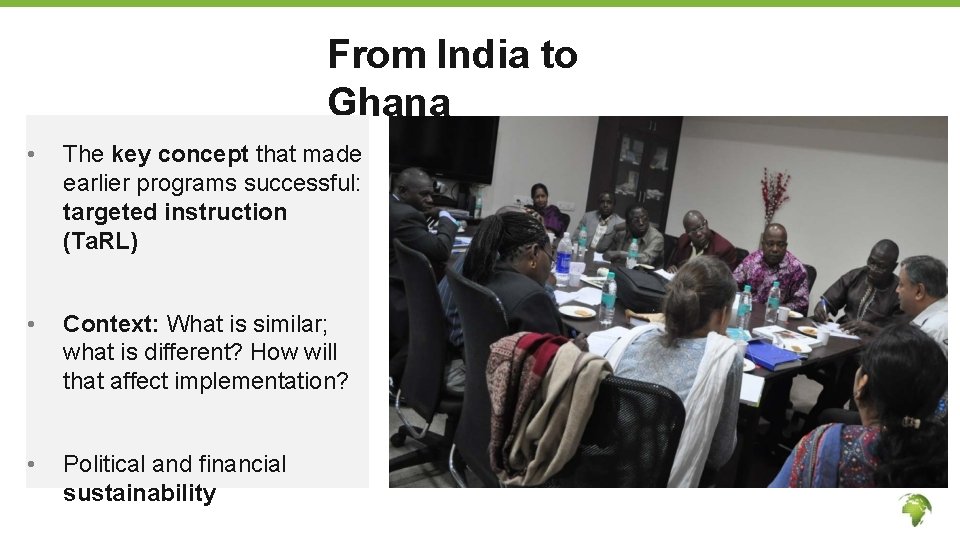
From India to Ghana • The key concept that made earlier programs successful: targeted instruction (Ta. RL) • Context: What is similar; what is different? How will that affect implementation? • Political and financial sustainability
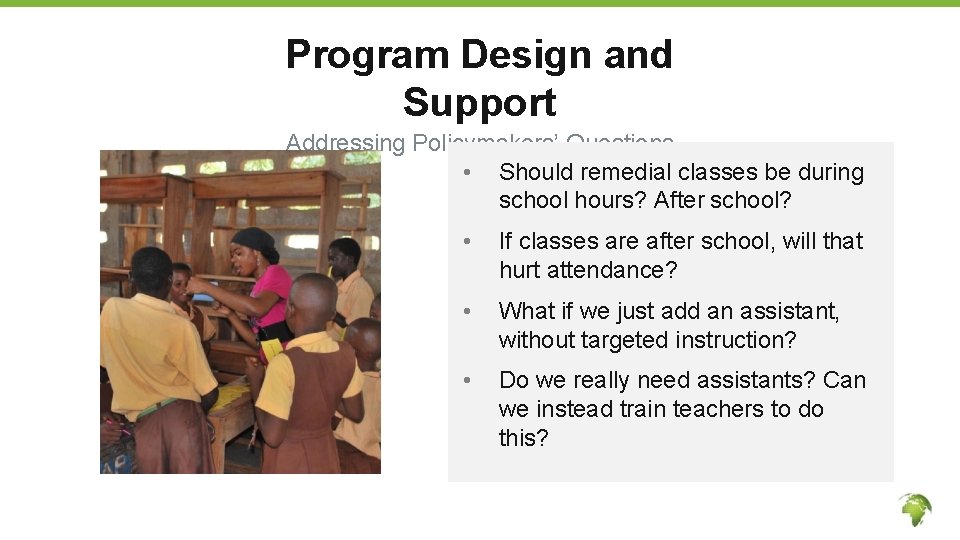
Program Design and Support Addressing Policymakers’ Questions • Should remedial classes be during school hours? After school? • If classes are after school, will that hurt attendance? • What if we just add an assistant, without targeted instruction? • Do we really need assistants? Can we instead train teachers to do this?
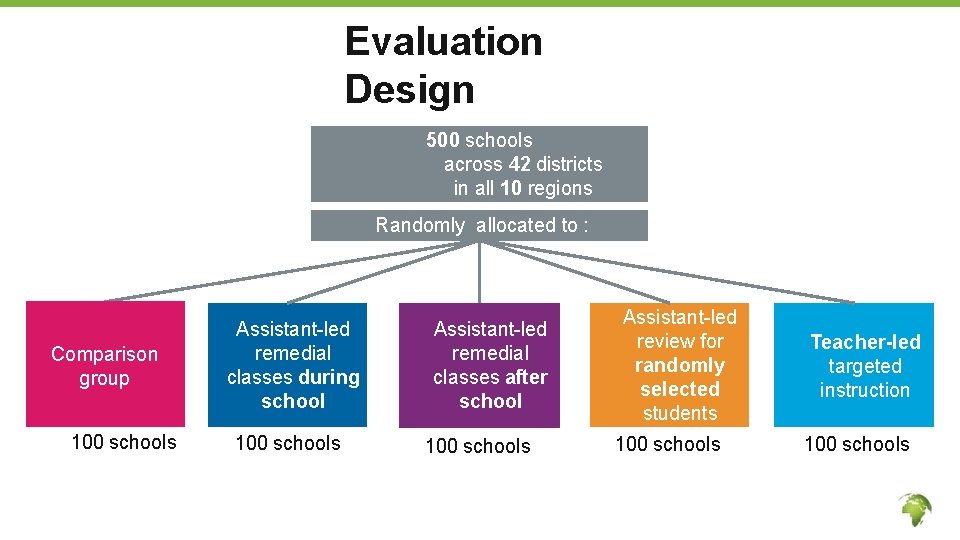
Evaluation Design 500 schools across 42 districts in all 10 regions Randomly allocated to : Comparison group 100 schools Assistant-led remedial classes during school 100 schools Assistant-led remedial classes after school 100 schools Assistant-led review for randomly selected students 100 schools Teacher-led targeted instruction 100 schools
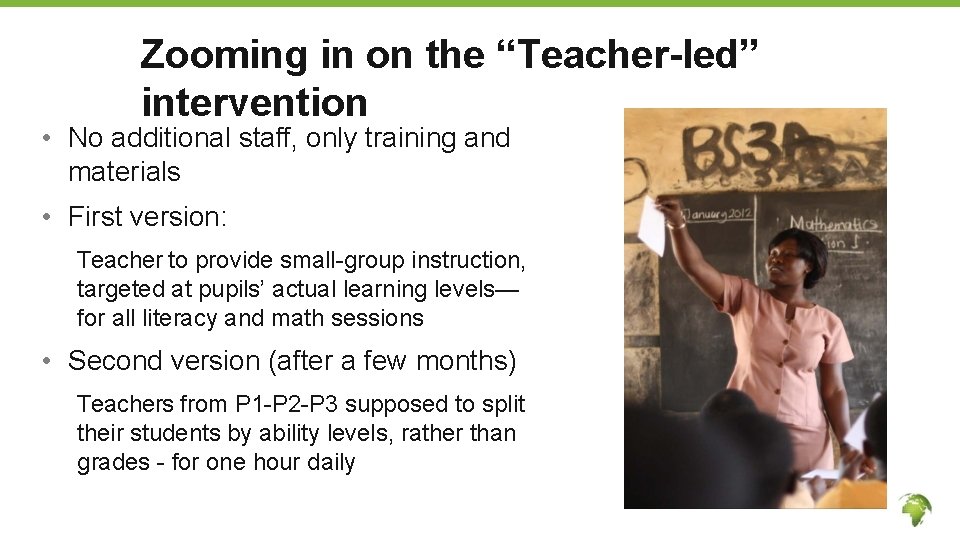
Zooming in on the “Teacher-led” intervention • No additional staff, only training and materials • First version: Teacher to provide small-group instruction, targeted at pupils’ actual learning levels— for all literacy and math sessions • Second version (after a few months) Teachers from P 1 -P 2 -P 3 supposed to split their students by ability levels, rather than grades - for one hour daily

Resul ts
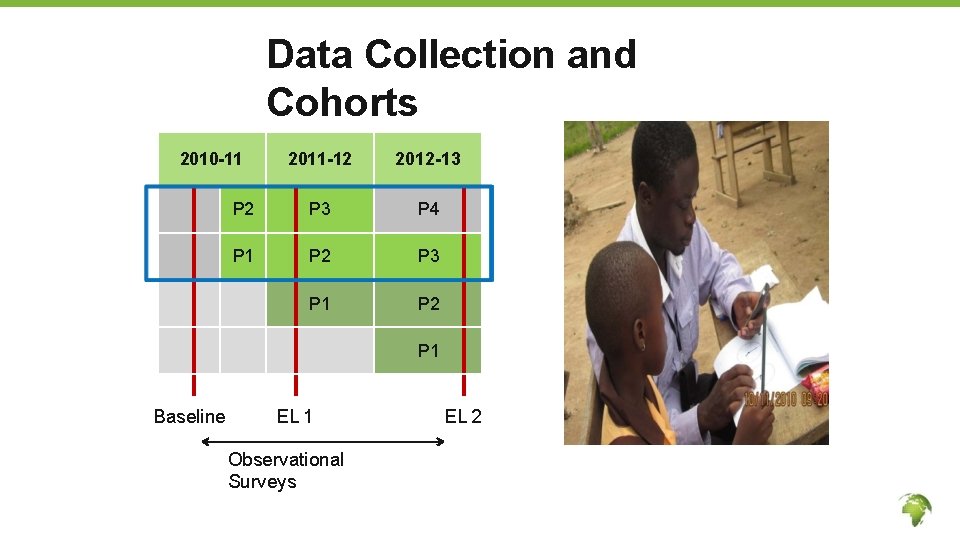
Data Collection and Cohorts 2010 -11 2011 -12 2012 -13 P 2 P 3 P 4 P 1 P 2 P 3 P 1 P 2 P 1 Baseline EL 1 Observational Surveys EL 2
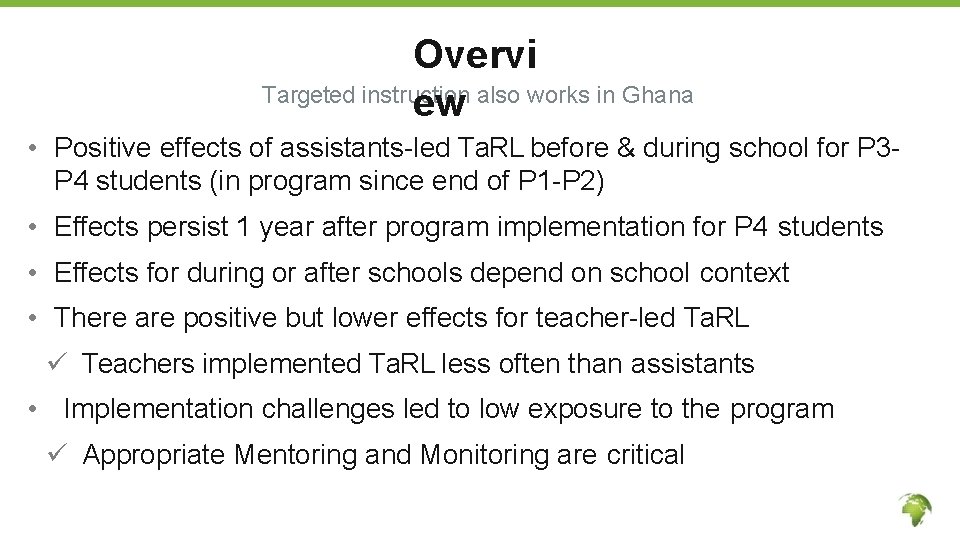
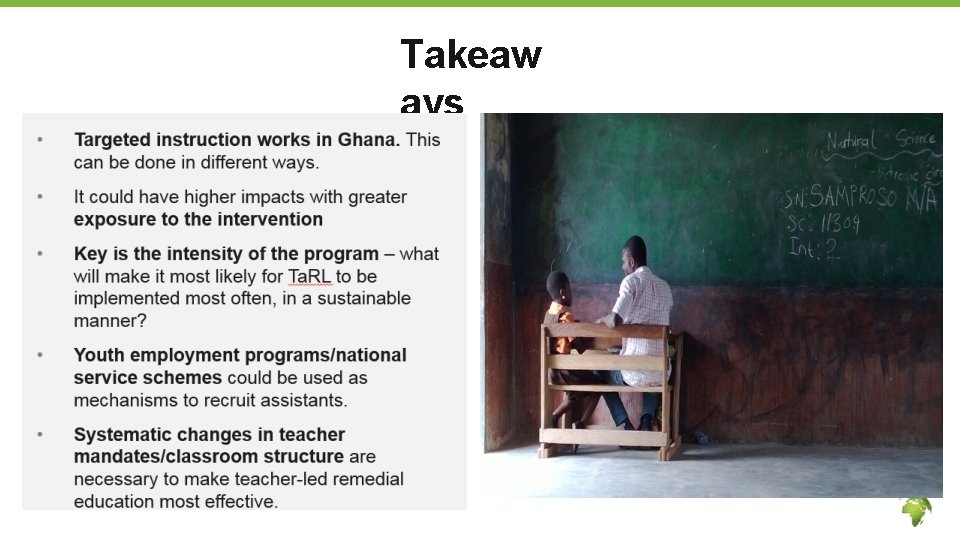
Overvi Targeted instruction also works in Ghana ew • Positive effects of assistants-led Ta. RL before & during school for P 3 P 4 students (in program since end of P 1 -P 2) • Effects persist 1 year after program implementation for P 4 students • Effects for during or after schools depend on school context • There are positive but lower effects for teacher-led Ta. RL Teachers implemented Ta. RL less often than assistants • Implementation challenges led to low exposure to the program Appropriate Mentoring and Monitoring are critical
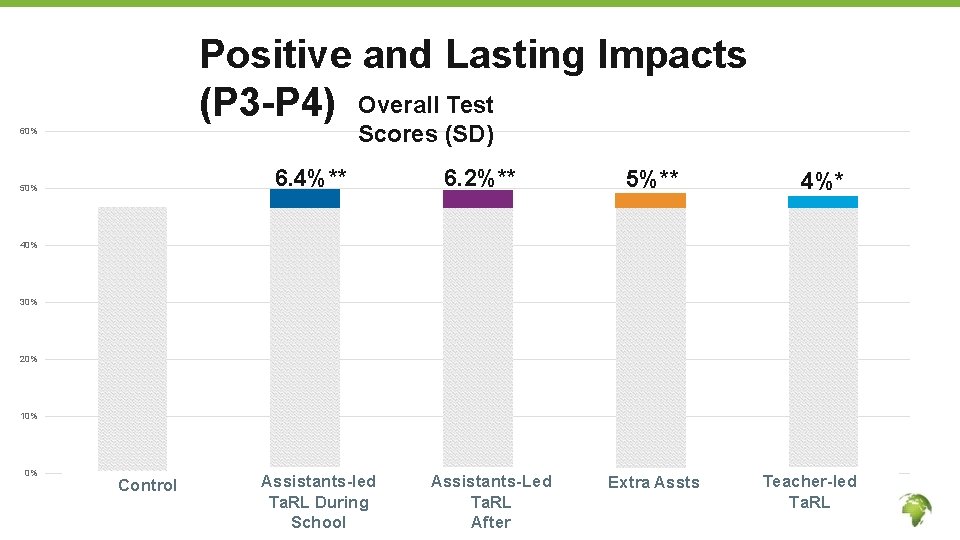
Positive and Lasting Impacts (P 3 -P 4) Overall Test Scores (SD) 60% 6. 4%** 50% 6. 2%** 5%** 4%* 40% 30% 20% 10% 0% Control Assistants-led Ta. RL During School Assistants-Led Ta. RL After Extra Assts Teacher-led Ta. RL
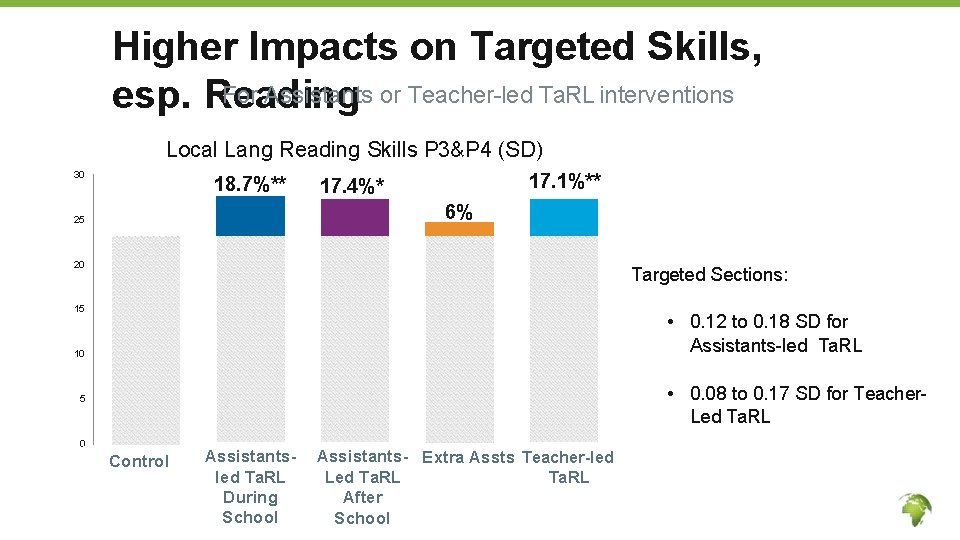
Higher Impacts on Targeted Skills, For Assistants or Teacher-led Ta. RL interventions esp. Reading Local Lang Reading Skills P 3&P 4 (SD) 30 18. 7%** 17. 1%** 17. 4%* 6% 25 20 Targeted Sections: 15 • 0. 12 to 0. 18 SD for Assistants-led Ta. RL 10 • 0. 08 to 0. 17 SD for Teacher. Led Ta. RL 5 0 Control Assistantsled Ta. RL During School Assistants- Extra Assts Teacher-led Ta. RL Led Ta. RL After School
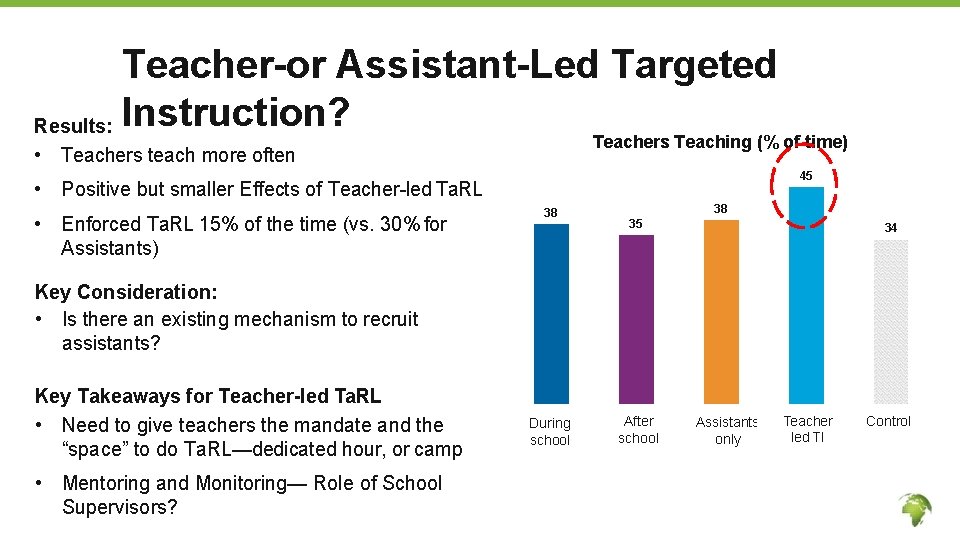
Teacher-or Assistant-Led Targeted Results: Instruction? Teachers Teaching (% of time) • Teachers teach more often 45 • Positive but smaller Effects of Teacher-led Ta. RL • Enforced Ta. RL 15% of the time (vs. 30% for Assistants) 38 38 35 34 Key Consideration: • Is there an existing mechanism to recruit assistants? Key Takeaways for Teacher-led Ta. RL • Need to give teachers the mandate and the “space” to do Ta. RL—dedicated hour, or camp • Mentoring and Monitoring— Role of School Supervisors? During school After school Assistants only Teacher led TI Control
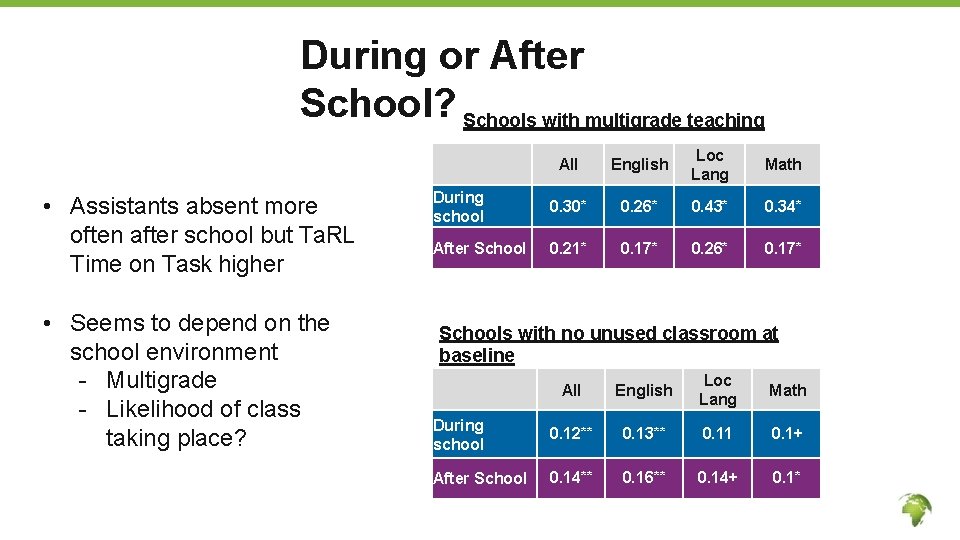
During or After School? Schools with multigrade teaching • Assistants absent more often after school but Ta. RL Time on Task higher • Seems to depend on the school environment - Multigrade - Likelihood of class taking place? All English Loc Lang Math During school 0. 30* 0. 26* 0. 43* 0. 34* After School 0. 21* 0. 17* 0. 26* 0. 17* Schools with no unused classroom at baseline All English Loc Lang Math During school 0. 12** 0. 13** 0. 11 0. 1+ After School 0. 14** 0. 16** 0. 14+ 0. 1*
Takeaw ays
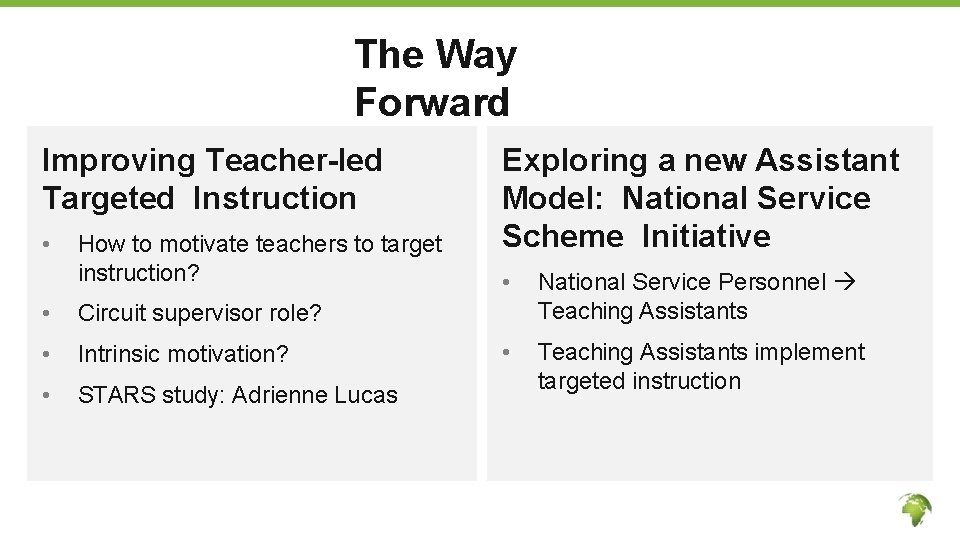
The Way Forward Improving Teacher-led Targeted Instruction • How to motivate teachers to target instruction? • Circuit supervisor role? • Intrinsic motivation? • STARS study: Adrienne Lucas Exploring a new Assistant Model: National Service Scheme Initiative • National Service Personnel Teaching Assistants • Teaching Assistants implement targeted instruction
Teaching at the Right Level: Evidence on Implementation Models John Floretta Associate Director of Policy
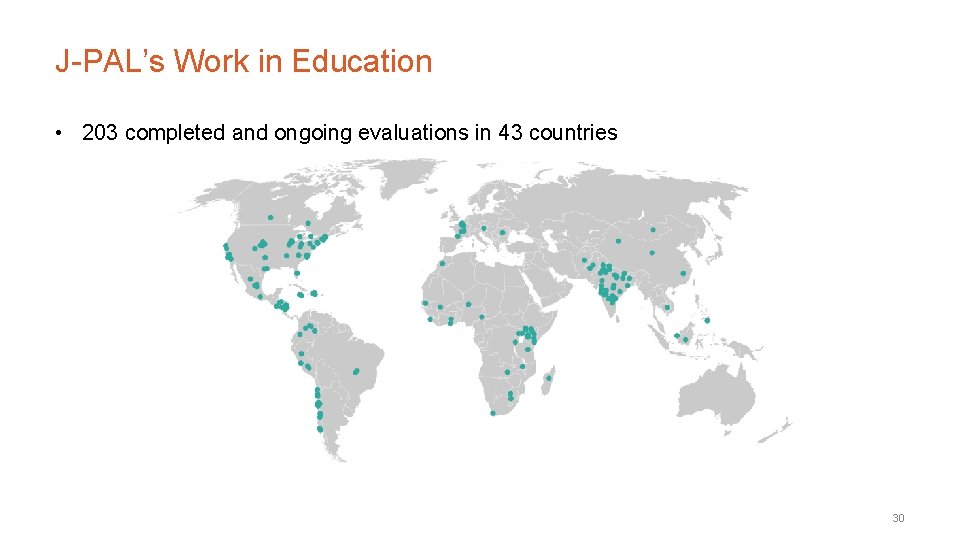
J-PAL’s Work in Education • 203 completed and ongoing evaluations in 43 countries 30
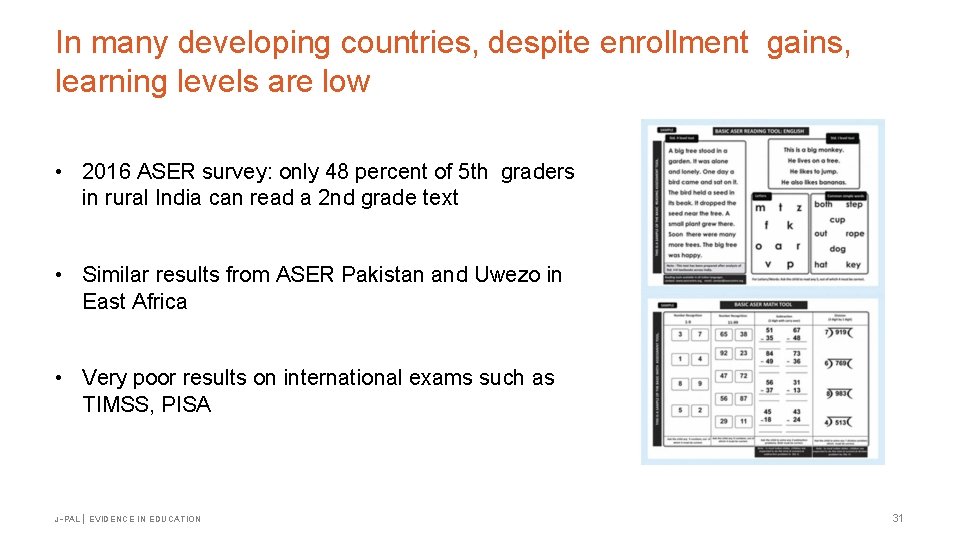
In many developing countries, despite enrollment gains, learning levels are low • 2016 ASER survey: only 48 percent of 5 th graders in rural India can read a 2 nd grade text • Similar results from ASER Pakistan and Uwezo in East Africa • Very poor results on international exams such as TIMSS, PISA J-PAL | EVIDENCE IN EDUCATION 31
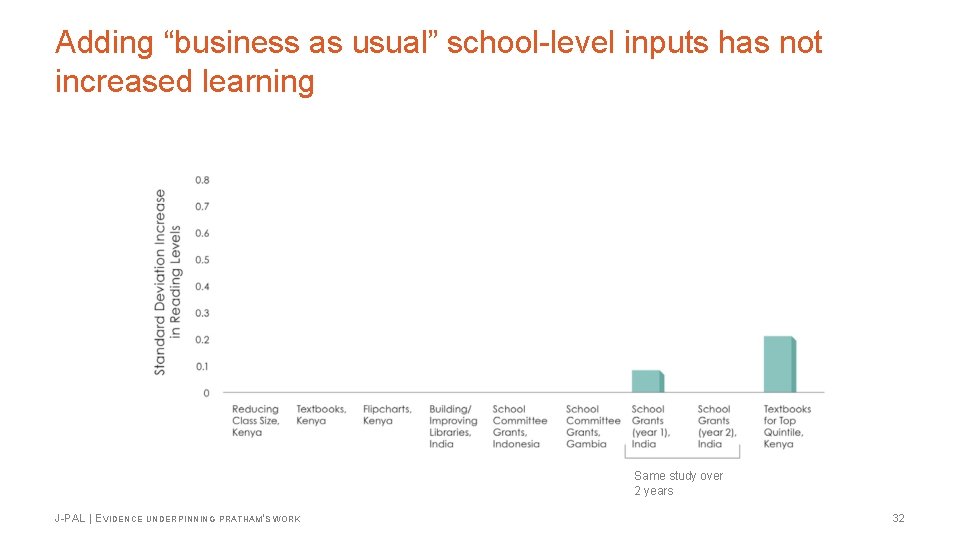
Adding “business as usual” school-level inputs has not increased learning Same study over 2 years J-PAL | E VIDENCE UNDERPINNING PRATHAM' S WORK 32
What are implications of the failure of additional inputs to improve learning? • Vast majority of education spending is on inputs such as teacher salaries, textbooks, teacher training • However, adding inputs is not sufficient to improve learning • Suggests there are other challenges in the classroom that need to be addressed: – Huge variation of learning levels in each grade, most students not at grade level – Overambitious, rigid curriculum – Teachers incentivized to complete curriculum, target instruction to highest performers J-PAL | E VIDENCE UNDERPINNING PRATHAM' S WORK 33
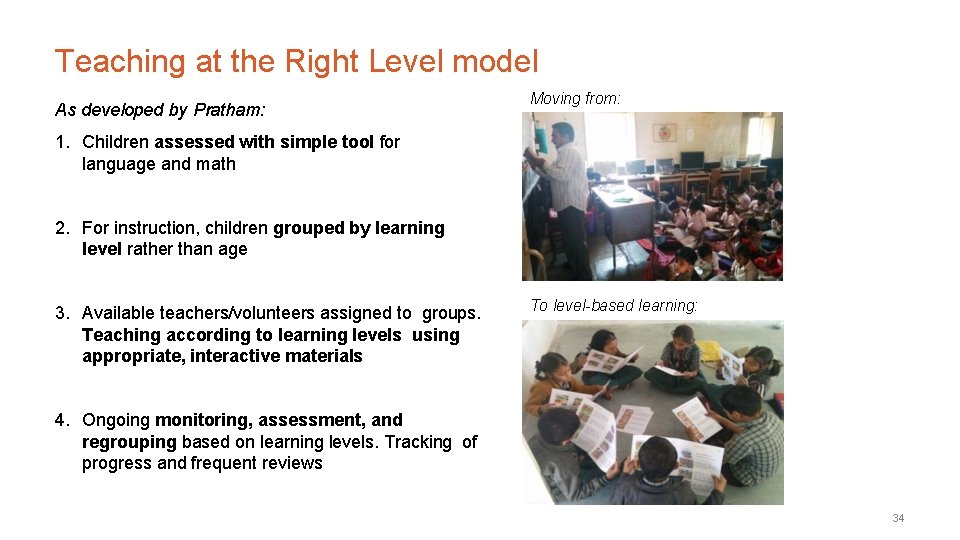
Teaching at the Right Level model As developed by Pratham: Moving from: 1. Children assessed with simple tool for language and math 2. For instruction, children grouped by learning level rather than age 3. Available teachers/volunteers assigned to groups. Teaching according to learning levels using appropriate, interactive materials To level-based learning: 4. Ongoing monitoring, assessment, and regrouping based on learning levels. Tracking of progress and frequent reviews 34
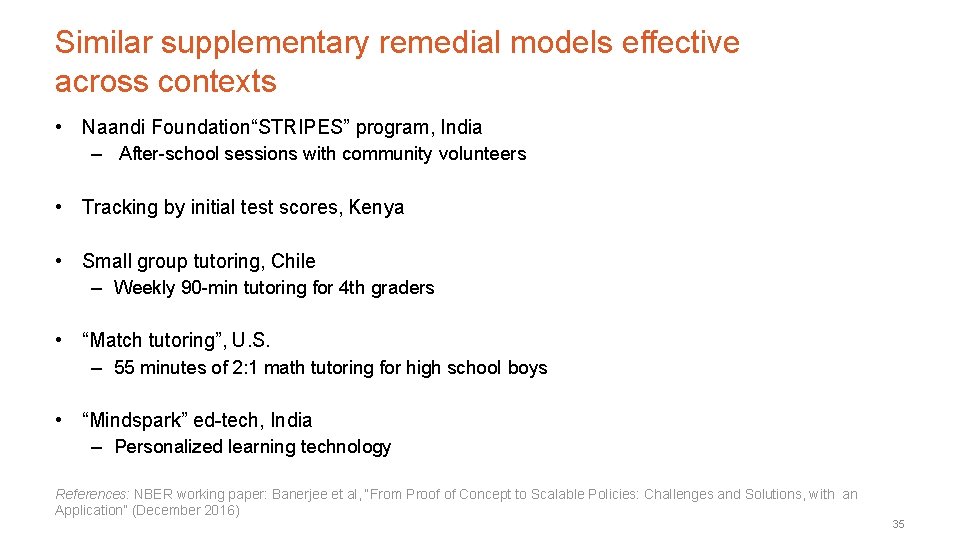
Similar supplementary remedial models effective across contexts • Naandi Foundation“STRIPES” program, India – After-school sessions with community volunteers • Tracking by initial test scores, Kenya • Small group tutoring, Chile – Weekly 90 -min tutoring for 4 th graders • “Match tutoring”, U. S. – 55 minutes of 2: 1 math tutoring for high school boys • “Mindspark” ed-tech, India – Personalized learning technology References: NBER working paper: Banerjee et al, “From Proof of Concept to Scalable Policies: Challenges and Solutions, with an Application” (December 2016) 35
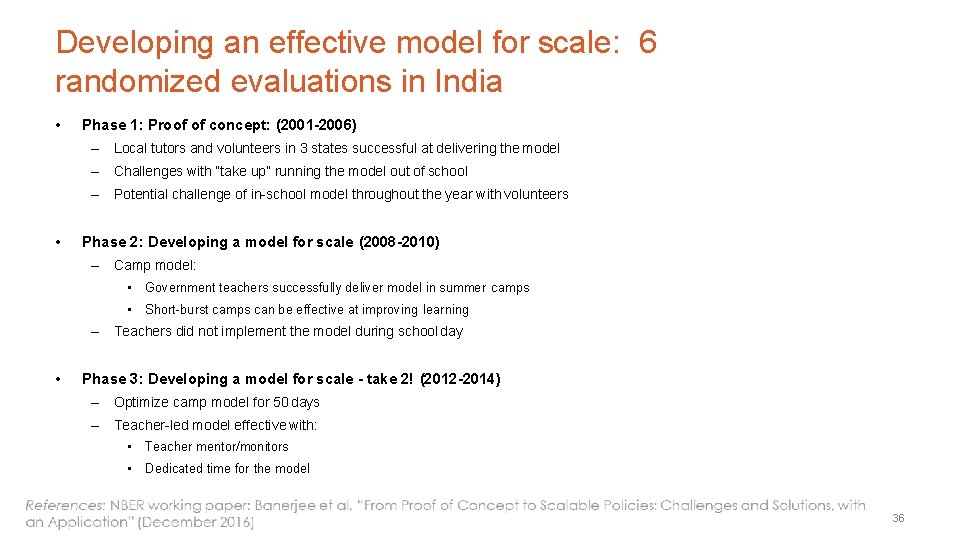
Developing an effective model for scale: 6 randomized evaluations in India • Phase 1: Proof of concept: (2001 -2006) – Local tutors and volunteers in 3 states successful at delivering the model – Challenges with “take up” running the model out of school – Potential challenge of in-school model throughout the year with volunteers • Phase 2: Developing a model for scale (2008 -2010) – Camp model: • Government teachers successfully deliver model in summer camps • Short-burst camps can be effective at improving learning – Teachers did not implement the model during school day • Phase 3: Developing a model for scale - take 2! (2012 -2014) – Optimize camp model for 50 days – Teacher-led model effective with: • Teacher mentor/monitors • Dedicated time for the model 36
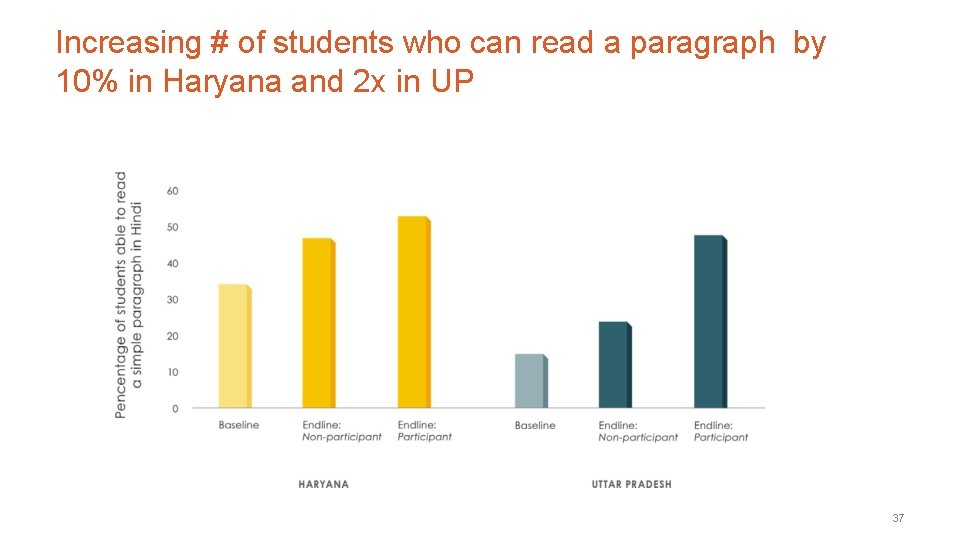
Increasing # of students who can read a paragraph by 10% in Haryana and 2 x in UP 37
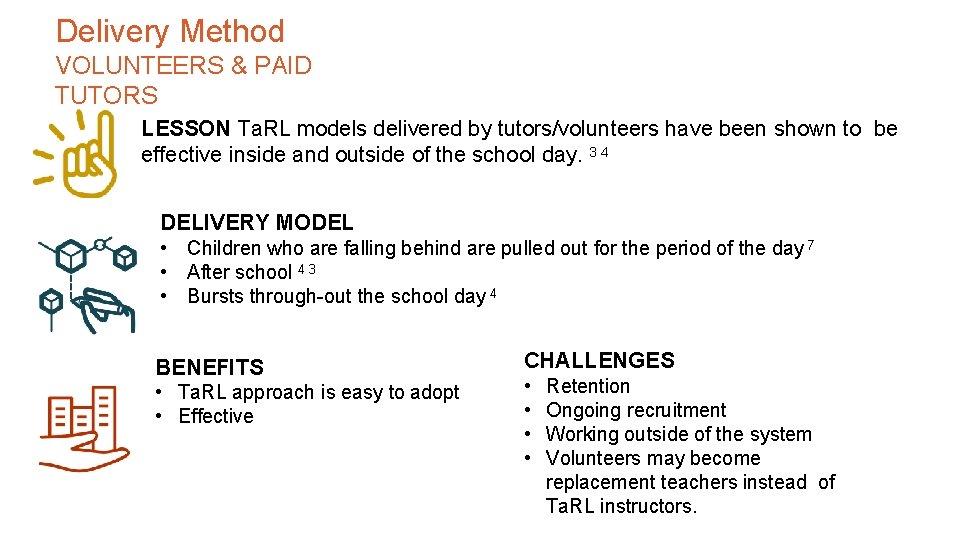
Delivery Method VOLUNTEERS & PAID TUTORS LESSON Ta. RL models delivered by tutors/volunteers have been shown to be effective inside and outside of the school day. 3 4 DELIVERY MODEL • Children who are falling behind are pulled out for the period of the day 7 • After school 4 3 • Bursts through-out the school day 4 BENEFITS • Ta. RL approach is easy to adopt • Effective CHALLENGES • • Retention Ongoing recruitment Working outside of the system Volunteers may become replacement teachers instead of Ta. RL instructors.
Delivery Method TEACHERS LESSON Teachers can effectively deliver Ta. RL programmes but they need a dedicated time for basic skills and a lot of mentoring and monitoring support. 4 • Material on its own does not work • Material and training on their own don’t work DELIVERY MODEL • Regroup children according to performance across grade levels for a period of the day • Holiday camps BENEFITS. • Working within government systems – beneficial for scale and sustainability. CHALLENGE • S It is easier for teachers to default into past teacher behavior • Government-led programmes are more susceptible to implementation break down.
Time of Instruction AFTER SCHOOL (holiday camps, time after school) 4 3 • Problems with attendance (23% attendance in summer camp in Bihar; 8% attended class in UP information campaign) • Additional hours • Need to think about incentives/additional pay DURING SCHOOL (an hour a day, bursts of time throughout the school year)4 • All children • Can be challenging to get government buy in 5 PULL OUT • More individualized attention for students falling behind • Reaches fewer children • Requires an additional resource
The Big Lessons 15 years of research on Ta. RL Information on learning outcomes alone unlikely to move people to act. 3 Targeting instruction to the level of the learner improves learning outcomes for reading and numeracy. 1 2 3 4 5 Ta. RL can be effectively implemented by volunteers, paid tutors and 1 2 3 45 teachers, but teachers require more support.
J-PAL Support of Teaching at the Right Level RESEARCH J-PAL affiliated researchers have conducted a series of randomized evaluations of Ta. RL programs. SHARE Policy teams share lessons from Ta. RL research through our website and through on-the-ground meetings with policymakers CATALYZE Regional policy teams support policymakers in designing and implementing evidence-based Ta. RL programmes.
Thank you

Appendix
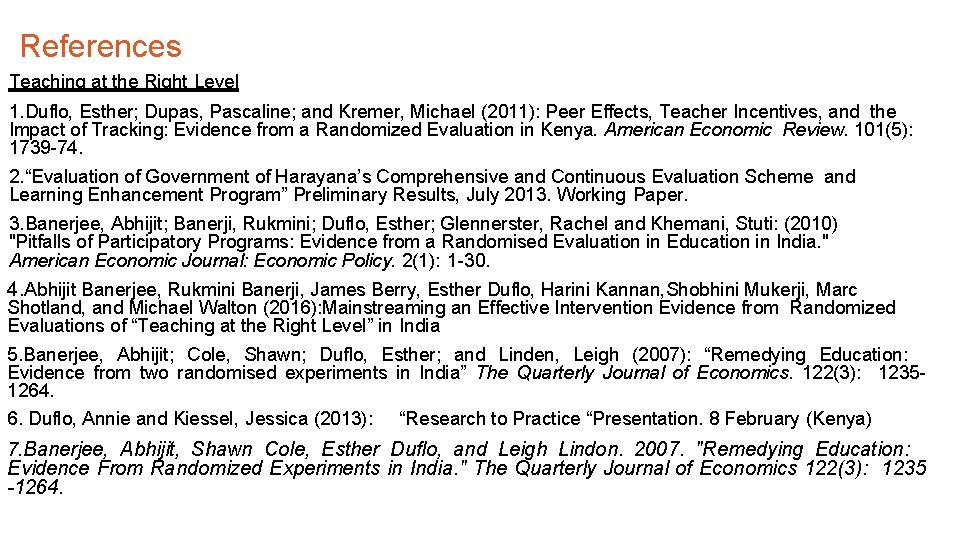
References Teaching at the Right Level 1. Duflo, Esther; Dupas, Pascaline; and Kremer, Michael (2011): Peer Effects, Teacher Incentives, and the Impact of Tracking: Evidence from a Randomized Evaluation in Kenya. American Economic Review. 101(5): 1739 -74. 2. “Evaluation of Government of Harayana’s Comprehensive and Continuous Evaluation Scheme and Learning Enhancement Program” Preliminary Results, July 2013. Working Paper. 3. Banerjee, Abhijit; Banerji, Rukmini; Duflo, Esther; Glennerster, Rachel and Khemani, Stuti: (2010) "Pitfalls of Participatory Programs: Evidence from a Randomised Evaluation in Education in India. " American Economic Journal: Economic Policy. 2(1): 1 -30. 4. Abhijit Banerjee, Rukmini Banerji, James Berry, Esther Duflo, Harini Kannan, Shobhini Mukerji, Marc Shotland, and Michael Walton (2016): Mainstreaming an Effective Intervention Evidence from Randomized Evaluations of “Teaching at the Right Level” in India 5. Banerjee, Abhijit; Cole, Shawn; Duflo, Esther; and Linden, Leigh (2007): “Remedying Education: Evidence from two randomised experiments in India” The Quarterly Journal of Economics. 122(3): 12351264. 6. Duflo, Annie and Kiessel, Jessica (2013): “Research to Practice “Presentation. 8 February (Kenya) 7. Banerjee, Abhijit, Shawn Cole, Esther Duflo, and Leigh Lindon. 2007. "Remedying Education: Evidence From Randomized Experiments in India. " The Quarterly Journal of Economics 122(3): 1235 -1264.
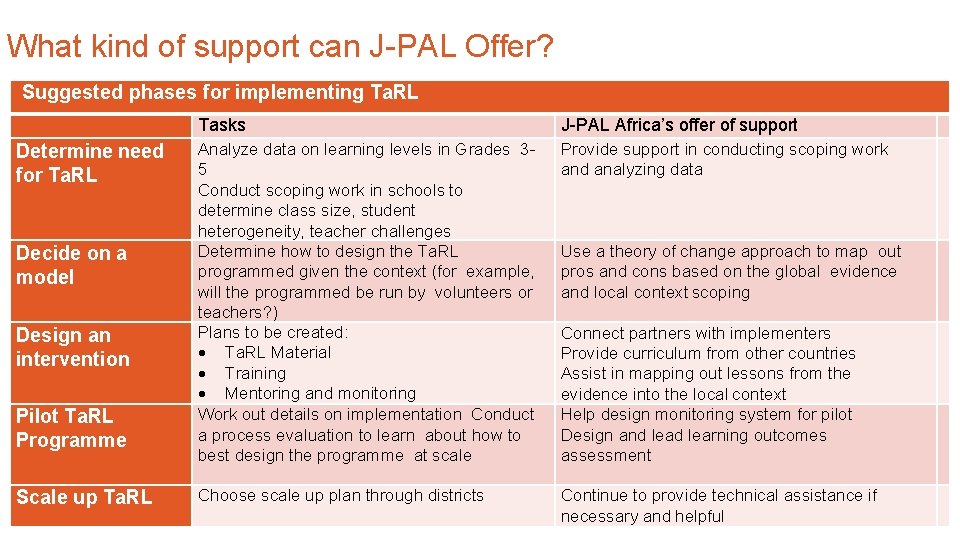
What kind of support can J-PAL Offer? Suggested phases for implementing Ta. RL Determine need for Ta. RL Decide on a model Design an intervention Pilot Ta. RL Programme Scale up Ta. RL Tasks J-PAL Africa’s offer of support Analyze data on learning levels in Grades 35 Conduct scoping work in schools to determine class size, student heterogeneity, teacher challenges Determine how to design the Ta. RL programmed given the context (for example, will the programmed be run by volunteers or teachers? ) Plans to be created: Ta. RL Material Training Mentoring and monitoring Work out details on implementation Conduct a process evaluation to learn about how to best design the programme at scale Provide support in conducting scoping work and analyzing data Choose scale up plan through districts Continue to provide technical assistance if necessary and helpful Use a theory of change approach to map out pros and cons based on the global evidence and local context scoping Connect partners with implementers Provide curriculum from other countries Assist in mapping out lessons from the evidence into the local context Help design monitoring system for pilot Design and learning outcomes assessment
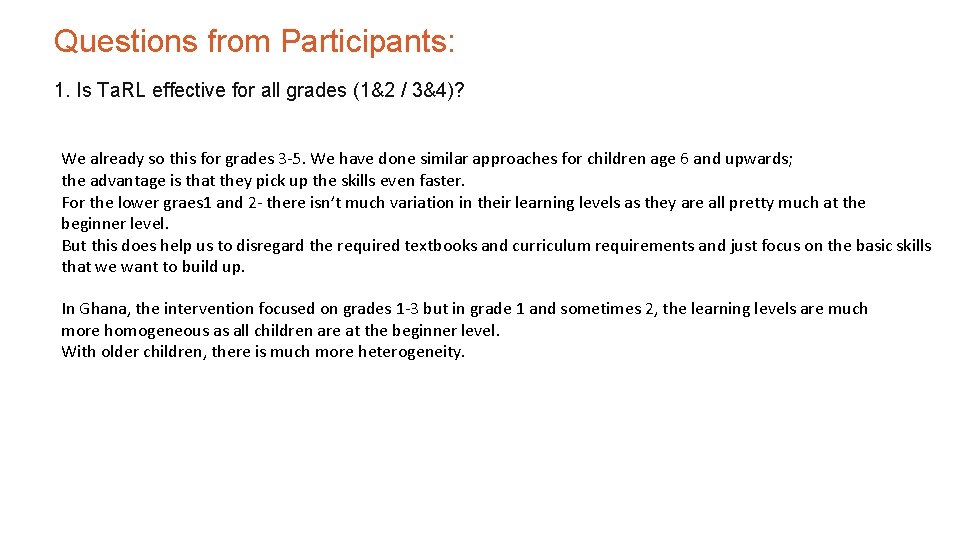
Questions from Participants: 1. Is Ta. RL effective for all grades (1&2 / 3&4)? We already so this for grades 3 -5. We have done similar approaches for children age 6 and upwards; the advantage is that they pick up the skills even faster. For the lower graes 1 and 2 - there isn’t much variation in their learning levels as they are all pretty much at the beginner level. But this does help us to disregard the required textbooks and curriculum requirements and just focus on the basic skills that we want to build up. In Ghana, the intervention focused on grades 1 -3 but in grade 1 and sometimes 2, the learning levels are much more homogeneous as all children are at the beginner level. With older children, there is much more heterogeneity.
2. What are the cost implications and which model is cost effective? The cost is relatively inexpensive. Where we have done cost effective analysis looking at learning gains as a ratio of the cost of the intervention, Ta. RL is one if the most cost effective ways to increase basic literacy and numeracy for any program that we have cost data for. The cost you will be looking at are, the cost of training, interactive material (developed and printed) and a monitoring system to ensure that the program is run well. In the volunteer model, there might be cost of stipends, transport etc - Relatively more costly but you often see larger gains in learning for the assistant –led learning camps. On the other hand, doing it within the school system –focusing on government teachers- and also on training mentors and monitors within the system – can be done at a fraction of the cost because you’re using existing resources – but any Learning gains are much lower. It depends heavily on context. In Ghana, the assistant version was more cost effective because the impact in learning gains Were higher and they were doing the instructions more often, but there was already a system that the government was Paying for that was leveraged to keep costs down.
3. After many years of experience and research, what are the outstanding big question that are critical to tapping into more impact? A big challenge remains the fact that this pervasive problem is so invisible. From our experience, the more you can do to Make this problem felt first-hand, the more urgent people seek a solution. People don’t realize how big this problem is and how much it is blocking education progress and a return on the investment that are being made. The biggest challenge is to make more people really fell the urgency of the problem at hand: You’re keeping children in school for 5 -8 years and if there’s no learning return, you’re sabotaging your efforts. Introducing innovations in the government system is quite challenging and the role of the school supervisors is really Important. More research and experimentation needs to be done with schools supervisors – what are sustainable ways to make them more effective mentors of teachers and monitors of learning gains. From the evidence-base, how do we integrate evidence into school systems? It could be good evidence from accurate Outcomes of learning levels and how do we use that to inform decision-making? That is not happening in so many places.
- Slides: 50