
T45 Stability Augmented Steering System The Goshawk Learns
T-45 Stability Augmented Steering System “The Goshawk Learns Some Basic Manners” 20 October 2005
T-45 Stability Augmented Steering System Ms. Christina Stack Project Engineer

Many thanks to… LCDR Allen Blocker, USN Lead Project Officer Mr. Jim Reinsberg Lead Boeing Engineer, Designer and Developer of SASS Mr. David Klyde Systems Technology, INC Mrs. Marge Draper-Donley NAVAIR
Chapter Overview • Background • Problem • Solution • Testing • Results • Lessons Learned
T-45 Background Info “In the beginning…”

T-45 Background Info …The Great Legislative Body declared, “Thou shalt take a foreign, land-based jet and remake it in thy naval image. ”

T-45 Background Info We needed just one or two minor changes…
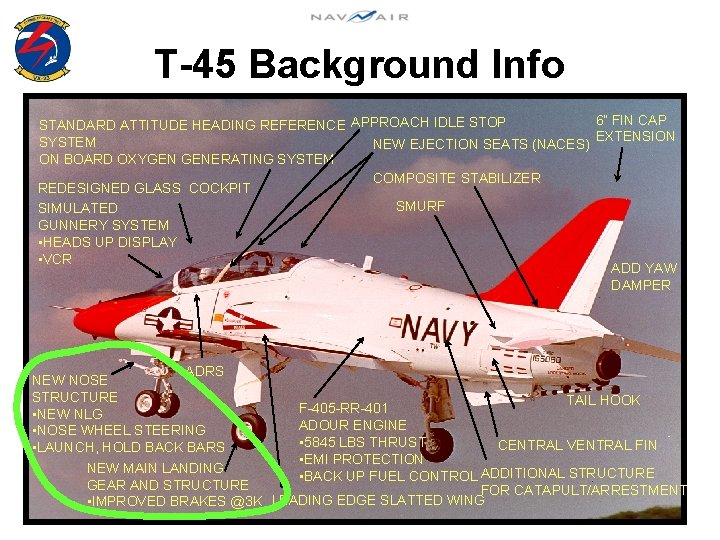
T-45 Background Info 6” FIN CAP STANDARD ATTITUDE HEADING REFERENCE APPROACH IDLE STOP EXTENSION SYSTEM NEW EJECTION SEATS (NACES) ON BOARD OXYGEN GENERATING SYSTEM COMPOSITE STABILIZER REDESIGNED GLASS COCKPIT SMURF SIMULATED GUNNERY SYSTEM • HEADS UP DISPLAY • VCR ADD YAW DAMPER ADRS NEW NOSE STRUCTURE TAIL HOOK F-405 -RR-401 • NEW NLG ADOUR ENGINE • NOSE WHEEL STEERING • 5845 LBS THRUST CENTRAL VENTRAL FIN • LAUNCH, HOLD BACK BARS • EMI PROTECTION NEW MAIN LANDING • BACK UP FUEL CONTROL ADDITIONAL STRUCTURE GEAR AND STRUCTURE FOR CATAPULT/ARRESTMENT • IMPROVED BRAKES @3 K LEADING EDGE SLATTED WING
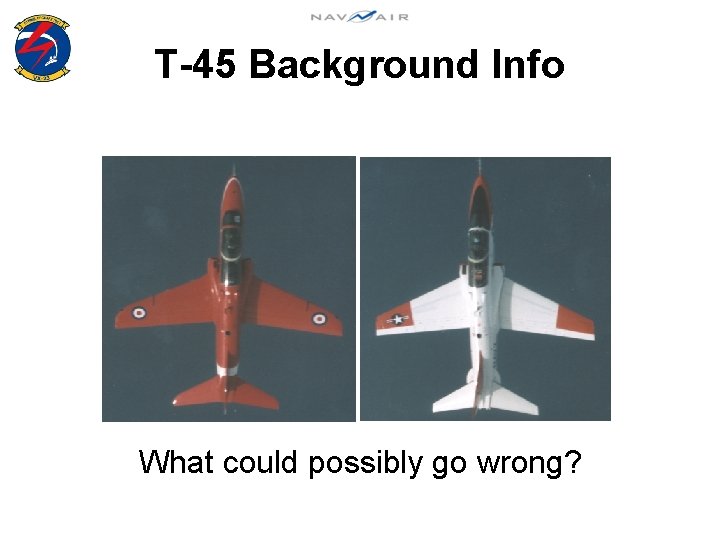
T-45 Background Info What could possibly go wrong?
Ground Handling History “The Saga of the T-45 All-Terrain Vehicle” P JEE
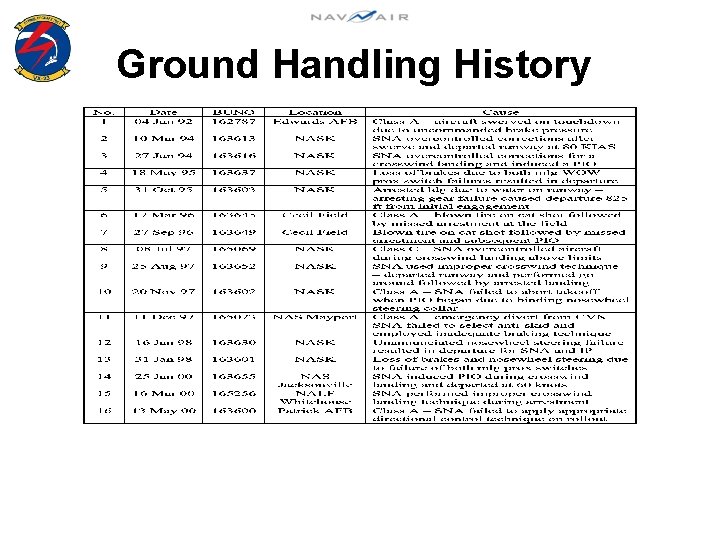
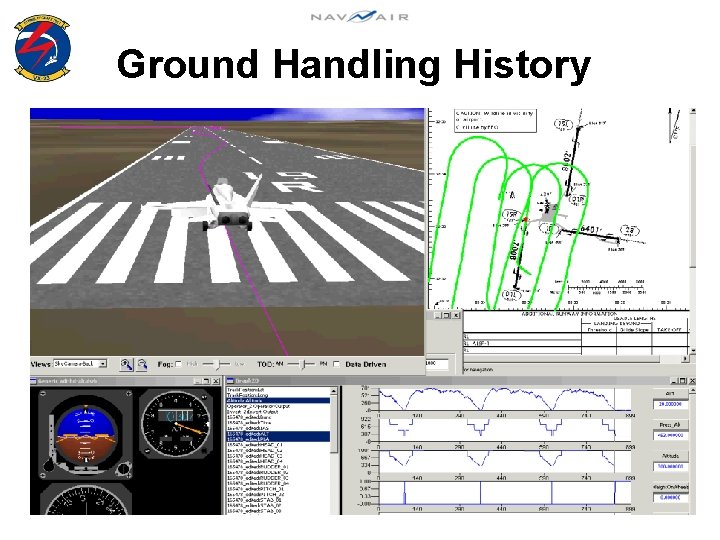
Ground Handling History – Aug 1992: Digital full time NWS incorporated. – May 1993: “Overly sensitive directional control characteristics during landing rollout. ” – Part IK This deficiency will persist until 2004.
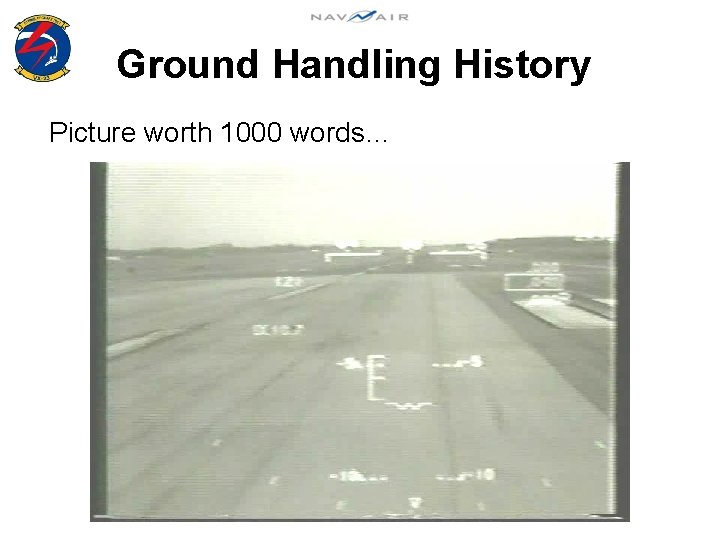
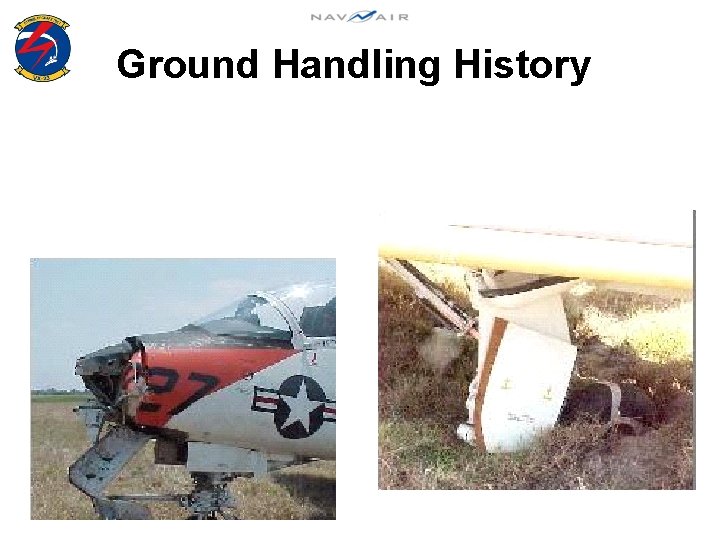
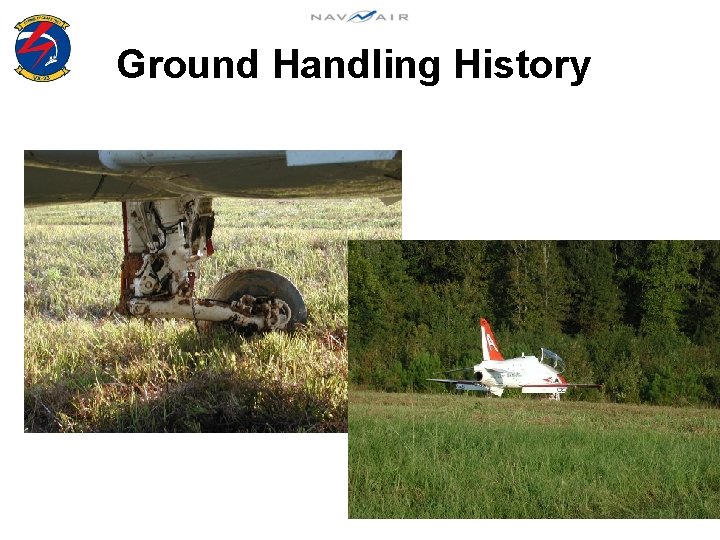
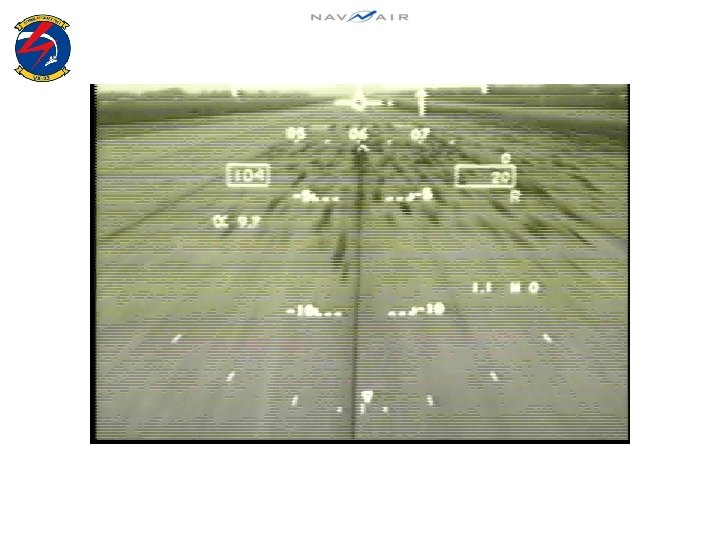
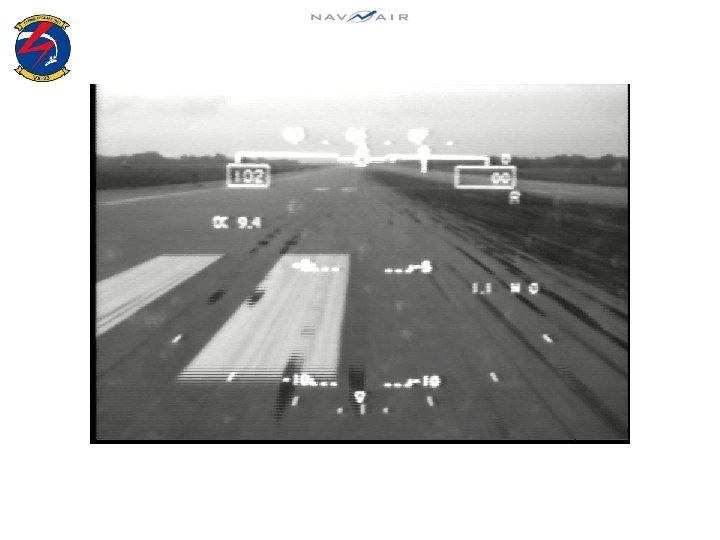
Ground Handling History Picture worth 1000 words…
Ground Handling History
Ground Handling History
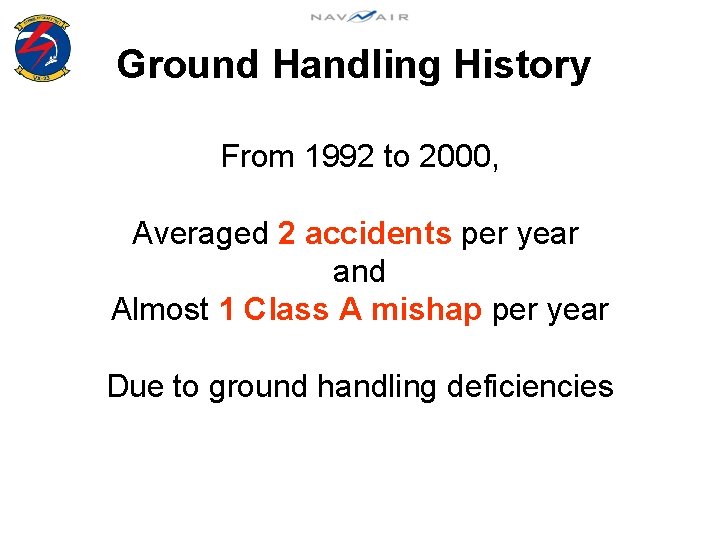
Ground Handling History From 1992 to 2000, Averaged 2 accidents per year and Almost 1 Class A mishap per year Due to ground handling deficiencies
Ground Handling History
Ground Handling History
Ground Handling History
Understanding the Problem “If only Dale Ernhardt, Jr. could fly”
Ground Handling History But, in 1998… Navy and Boeing seek help of Systems Technology, Inc (STI) and NASA Or “That Other Space Agency, ” depending on who you ask around Mojave, CA…
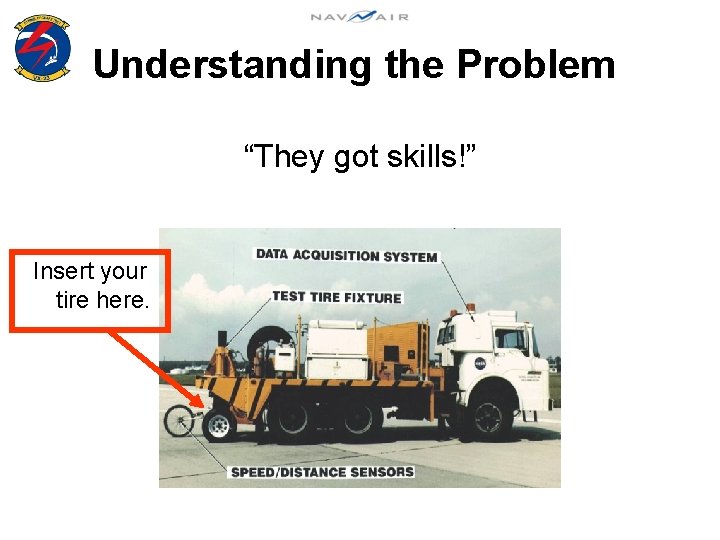
Understanding the Problem “They got skills!” Insert your tire here.
Understanding the Problem Results: • Tire models were in error; materials critical
Understanding the Problem Results: • Tire models were in error; materials critical Tires +
Understanding the Problem Results: • Tire models were in error; materials critical Tires + Landing gear mechanics and geometry +
Understanding the Problem Results: • Tire models were in error; materials critical Tires + Landing gear mechanics and geometry + Dynamic interactions =
Understanding the Problem Results: • Tire models were in error; materials critical Tires + Landing gear mechanics and geometry + Dynamic interactions = Aircraft response feels like an acceleration-command system and exhibits an “oversteer” condition
Understanding the Problem If you’re going to be in the ground handling business, you better get familiar with some terms and concepts: Cornering Stiffness Braking and Blown Tire Affects Hydroplaning Thermal Management Understeer Gradient
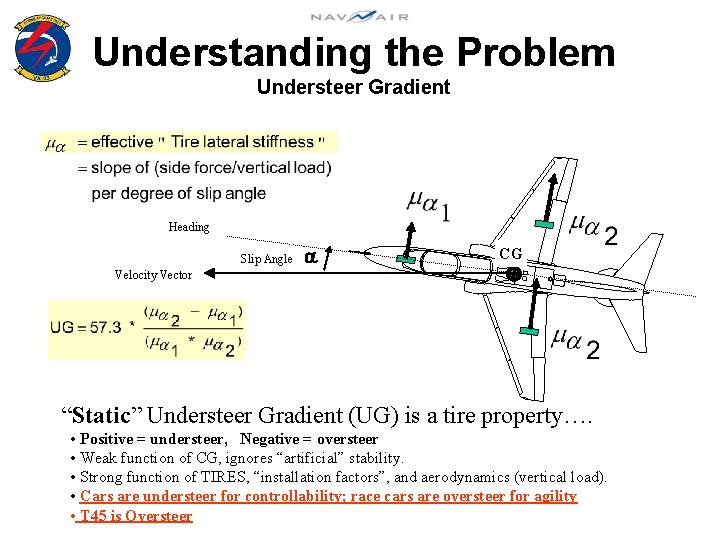
Understanding the Problem Understeer Gradient Heading Slip Angle a CG Velocity Vector “Static” Understeer Gradient (UG) is a tire property…. • Positive = understeer, Negative = oversteer • Weak function of CG, ignores “artificial” stability. • Strong function of TIRES, “installation factors”, and aerodynamics (vertical load). • Cars are understeer for controllability; race cars are oversteer for agility • T 45 is Oversteer
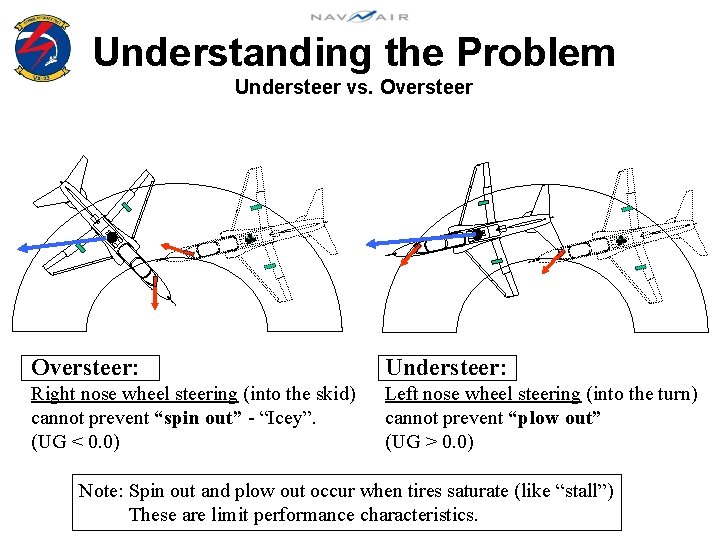
Understanding the Problem Understeer vs. Oversteer: Understeer: Right nose wheel steering (into the skid) cannot prevent “spin out” - “Icey”. (UG < 0. 0) Left nose wheel steering (into the turn) cannot prevent “plow out” (UG > 0. 0) Note: Spin out and plow out occur when tires saturate (like “stall”) These are limit performance characteristics.
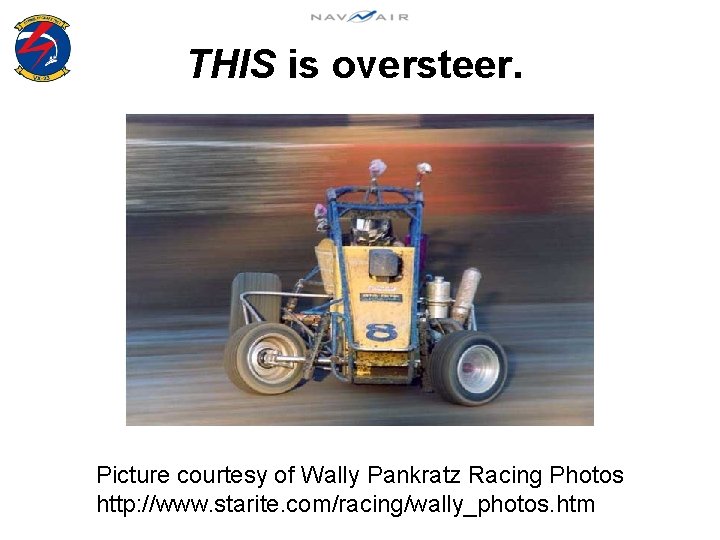
THIS is oversteer. Picture courtesy of Wally Pankratz Racing Photos http: //www. starite. com/racing/wally_photos. htm
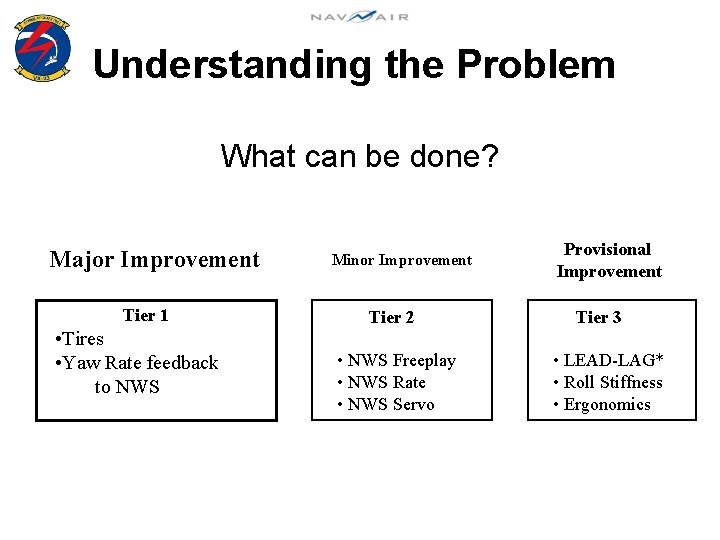
Understanding the Problem What can be done? Major Improvement Tier 1 • Tires • Yaw Rate feedback to NWS Minor Improvement Provisional Improvement Tier 2 Tier 3 • NWS Freeplay • NWS Rate • NWS Servo • LEAD-LAG* • Roll Stiffness • Ergonomics
The Solution The Stability Augmented Steering System Full-time yaw-rate feedback to the NWS.
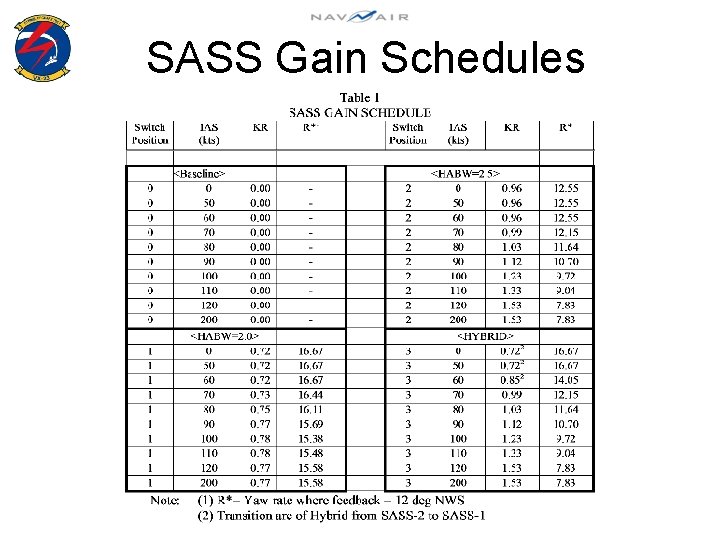
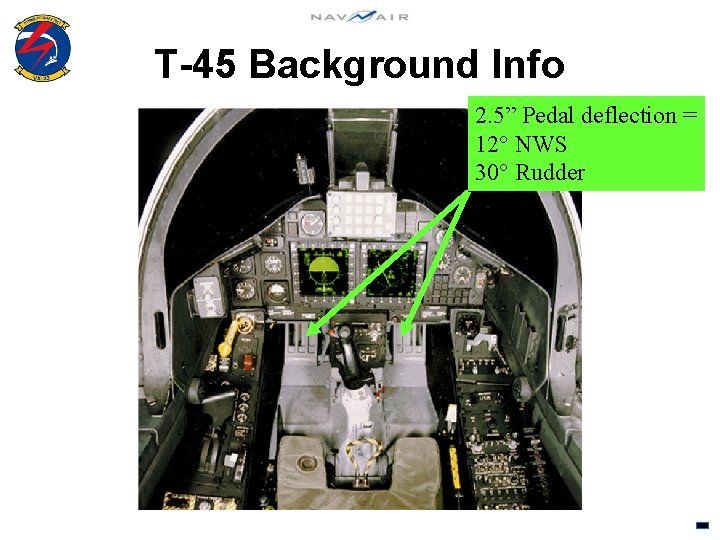
SASS • Attempts to nullify yaw rates using NWS based on set gains that vary with airspeed K = gain constant; R = yaw rate; δNWS = NWS commanded KR = δNWS • 4 pilot-selectable gains were used for flight test
SASS
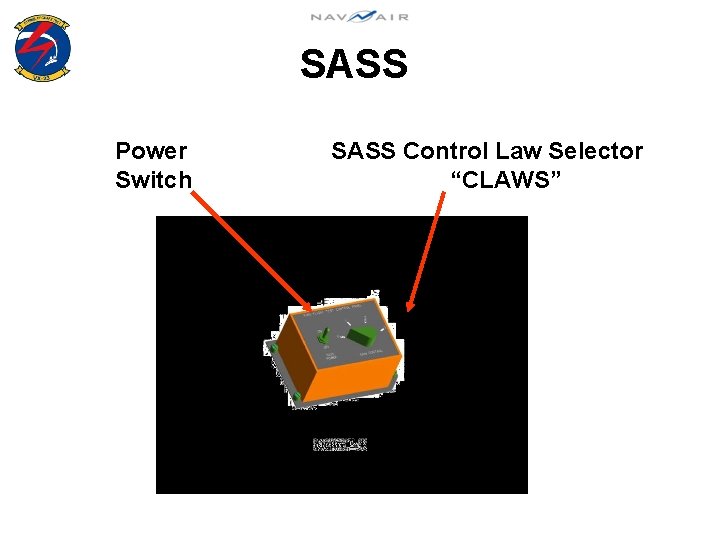
SASS Power Switch SASS Control Law Selector “CLAWS”
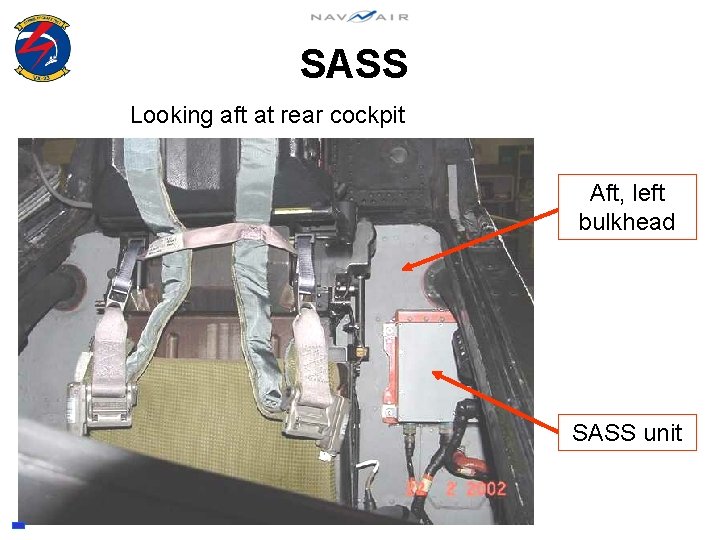
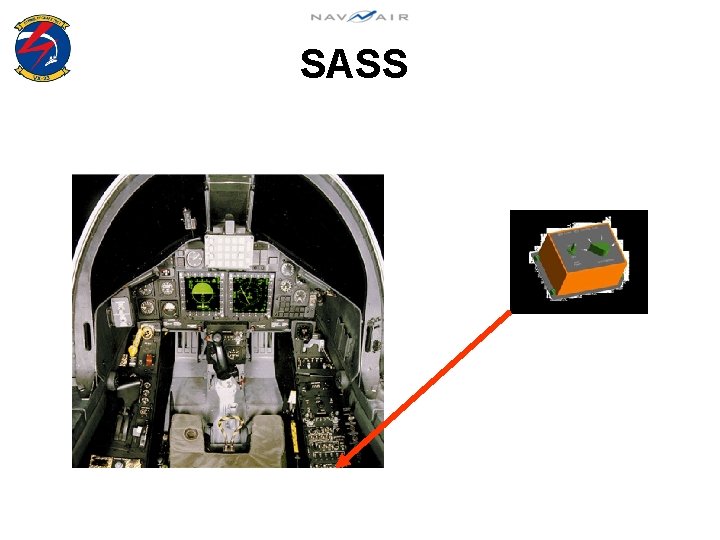
SASS Looking aft at rear cockpit Aft, left bulkhead SASS unit
New Metrics “Teaching an old dog new tricks”
New Metrics • Heading Angle Bandwidth (HABW) – Based on longitudinal flying qualities specifications • Runway Offset Capture and Hold (ROCH) – Traditional FQ parameter capture and tracking task • ROCH with Braking (ROCHB) – Increases difficulty of ROCH and more operationally representative
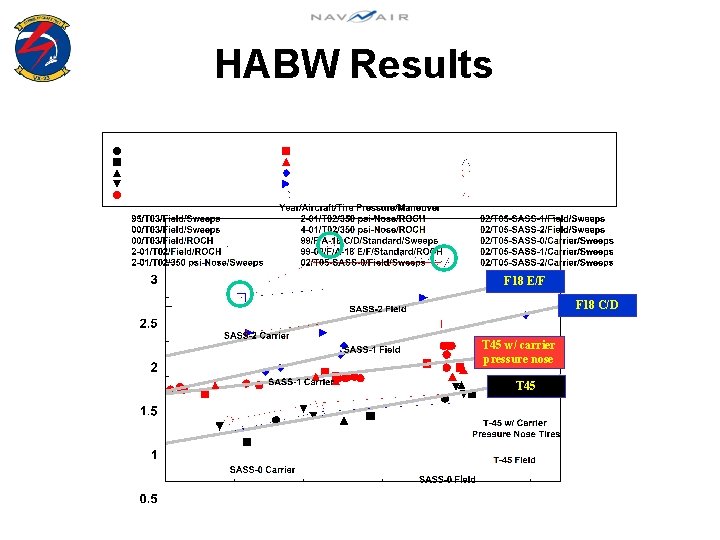
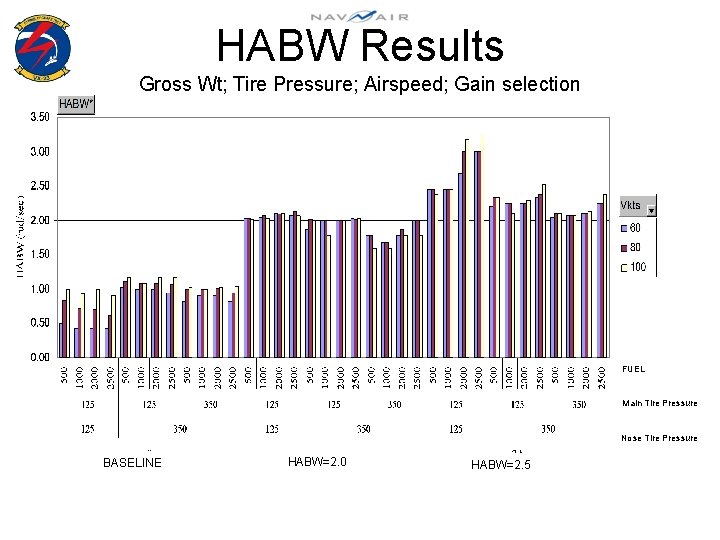
New Metrics • HABW – Defined as highest frequency at which you have less than 45° phase lag between rudder input and aircraft yaw response – Measured using rudder pedal frequency sweeps at discrete groundspeeds, described in rad/sec. – Demonstrates a pseudo-track of understeer gradient and PIO ratings Key: Wider is better!
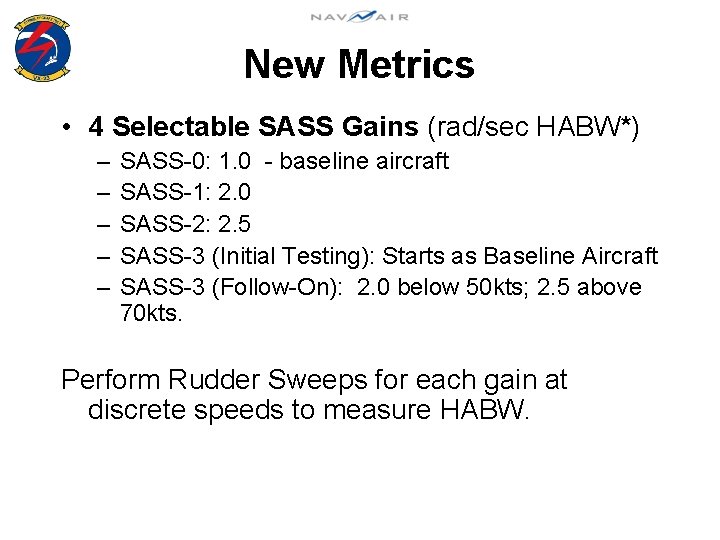
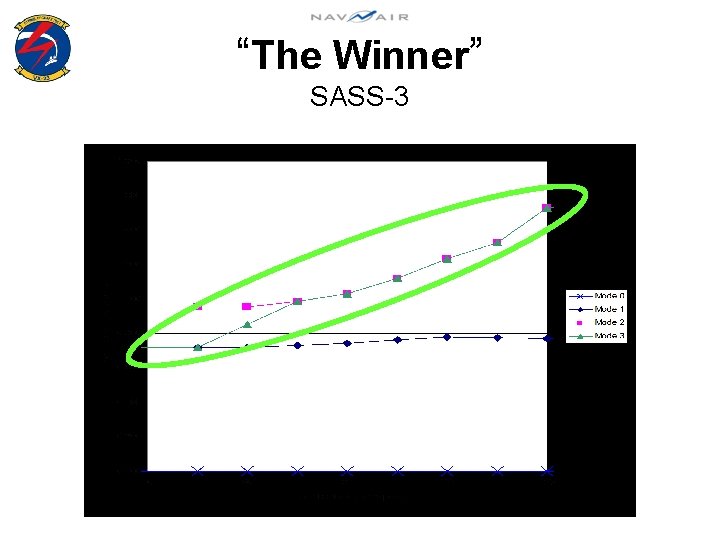
New Metrics • 4 Selectable SASS Gains (rad/sec HABW*) – – – SASS-0: 1. 0 - baseline aircraft SASS-1: 2. 0 SASS-2: 2. 5 SASS-3 (Initial Testing): Starts as Baseline Aircraft SASS-3 (Follow-On): 2. 0 below 50 kts; 2. 5 above 70 kts. Perform Rudder Sweeps for each gain at discrete speeds to measure HABW.
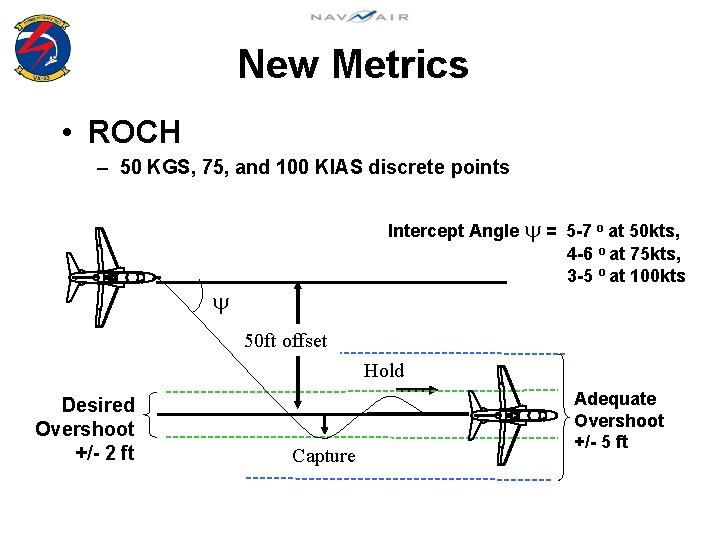
New Metrics • ROCH – 50 KGS, 75, and 100 KIAS discrete points Intercept Angle = 5 -7 o at 50 kts, 4 -6 o at 75 kts, 3 -5 o at 100 kts 50 ft offset Hold Desired Overshoot +/- 2 ft Capture Adequate Overshoot +/- 5 ft
New Metrics
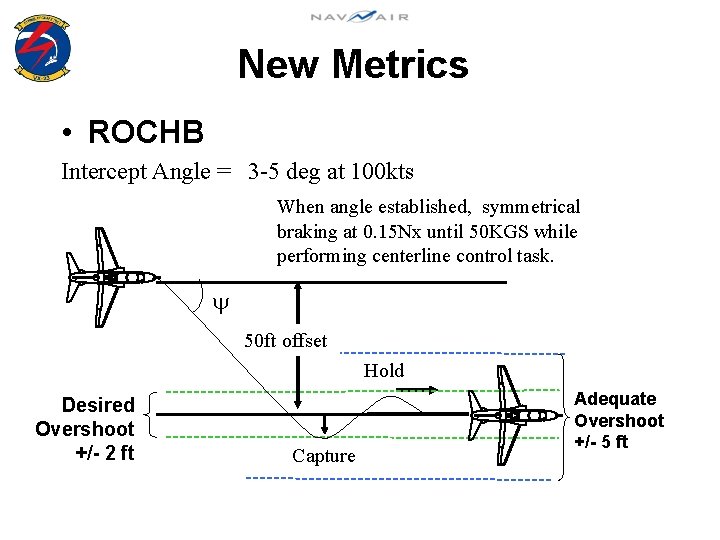
New Metrics • ROCHB Intercept Angle = 3 -5 deg at 100 kts When angle established, symmetrical braking at 0. 15 Nx until 50 KGS while performing centerline control task. 50 ft offset Hold Desired Overshoot +/- 2 ft Capture Adequate Overshoot +/- 5 ft
Test Planning “Are you sure this isn’t dangerous? ”
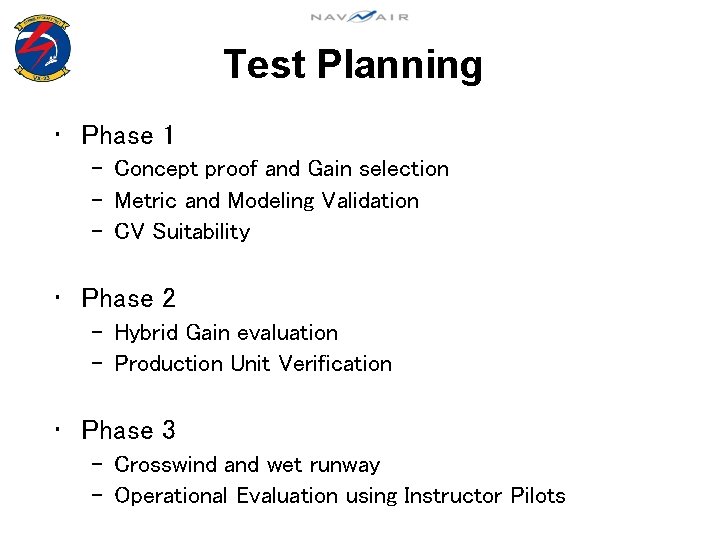
Test Planning • Phase 1 – Concept proof and Gain selection – Metric and Modeling Validation – CV Suitability • Phase 2 – Hybrid Gain evaluation – Production Unit Verification • Phase 3 – Crosswind and wet runway – Operational Evaluation using Instructor Pilots
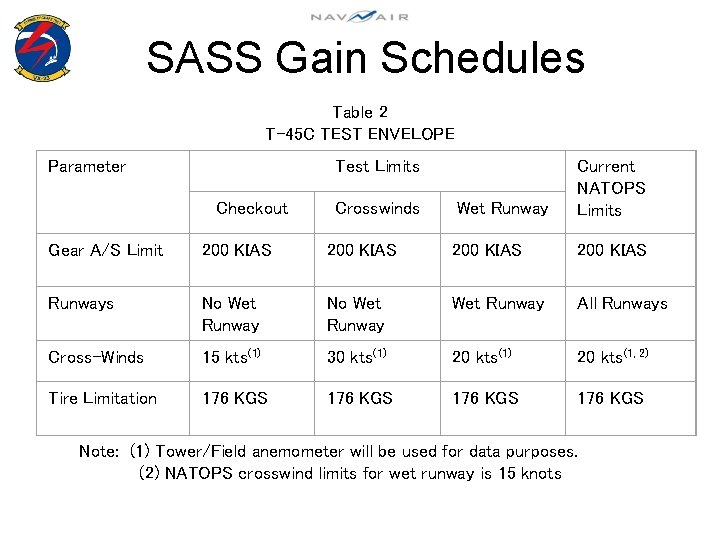
Test Planning • Crosswind and Wet Runway Tasks – Centerline Maintenance – Upwind / Downwind Captures – Max braking test points.
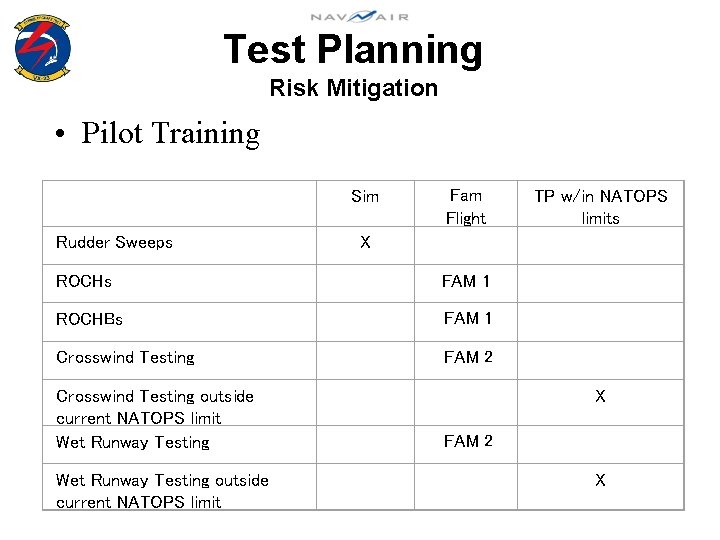
Test Planning Risk Mitigation • Pilot Training Rudder Sweeps X Fam Flight ROCHs FAM 1 ROCHBs FAM 1 Crosswind Testing FAM 2 Crosswind Testing outside current NATOPS limit Wet Runway Testing X FAM 2 Wet Runway Testing outside current NATOPS limit X Sim TP w/in NATOPS limits
Test Planning Risk Mitigation • Build-up – Increasing vs. Decreasing Airspeed • Worst control region from 60 -80 knots • 50 knot points during high-speed taxi • 75 and 100 knot points during roll-and-go – Maneuvers Normal “navigational” inputs Rudder Sweeps ROCHs ROCHBs Operational Evaluations
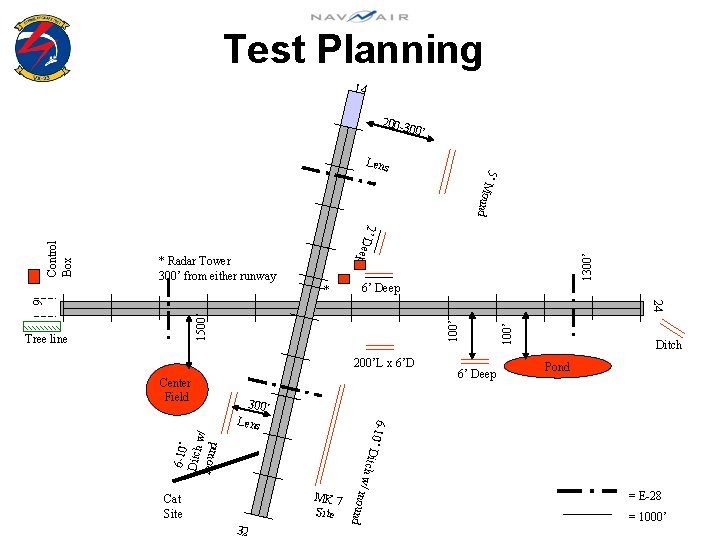
Test Planning Risk Mitigation • Runway Excursions (End vs. Side) – KIO Distance Criteria established • Off the End – 50 knots to rotation then back to stop – Verbal “KIO” call over radio at marker • Nominal roll-and-go at each speed prior to test points for testable runway familiarization • Off the Side – 30 deg hazard pattern – Based on runway surveys
Test Planning 14 200 -3 00’ p * Radar Tower 300’ from either runway 1300’ 2’ De e Control Box und 5’ Mo Lens * 6’ Deep 200’L x 6’D Ditch Pond 300’ 6 -10 Lens 32 nd MK 7 Site Cat Site / mou ’ Ditc h w 6 -10’ Ditch w/ moun d Center Field 6’ Deep 100’ 1500’ 24 6 Tree line = E-28 = 1000’
Test Planning Risk Mitigation • Thermal Management (Hot Brakes) – Brake vs. Tire Design • Fuse plug designed to melt at 350° F to prevent explosive pressure release. – Thermal profile • Transfers from brakes to tires and axle • Approximately 20 min to max temp – KIO Temperature Criteria • 150° F with axle temp instrumentation • 120° F using handheld pyrometers
Test Planning Risk Mitigation • Thermal Management (Hot Brakes) – Test Point management • High-speed taxi vs. roll-and-go – Brake cooling • “Penalty laps” • Cooling fans • Personnel safety issues
Test Planning Risk Mitigation • Tire Health Monitoring – Tread Wear Inspections • 10 passes • Max Brake test points
Results and Conclusions “And the winner is…”
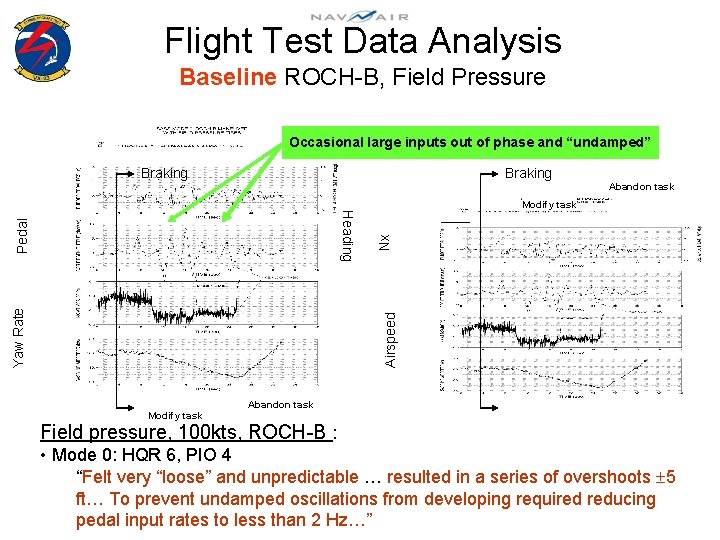
Flight Test Data Analysis Baseline ROCH-B, Field Pressure Occasional large inputs out of phase and “undamped” Braking Abandon task Airspeed Yaw Rate Pedal Heading Nx Modify task Abandon task Field pressure, 100 kts, ROCH-B : • Mode 0: HQR 6, PIO 4 “Felt very “loose” and unpredictable … resulted in a series of overshoots 5 ft… To prevent undamped oscillations from developing required reducing pedal input rates to less than 2 Hz…”
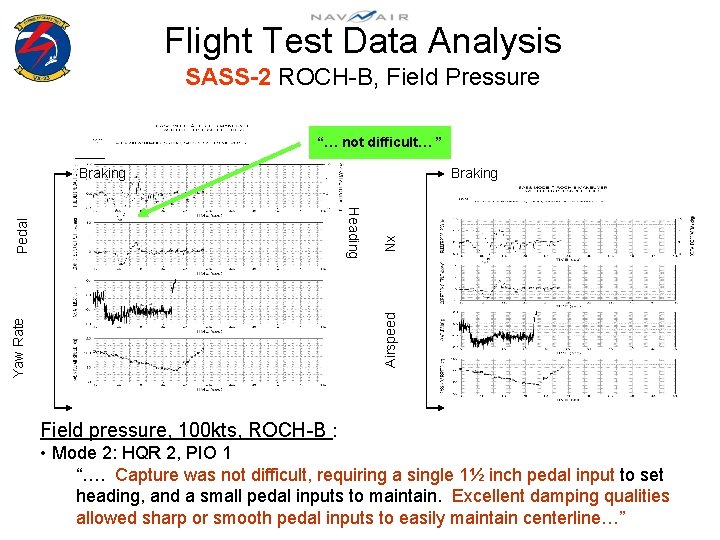
Flight Test Data Analysis SASS-2 ROCH-B, Field Pressure “… not difficult… ” Braking Yaw Rate Airspeed Pedal Heading Nx Braking Field pressure, 100 kts, ROCH-B : • Mode 2: HQR 2, PIO 1 “…. Capture was not difficult, requiring a single 1½ inch pedal input to set heading, and a small pedal inputs to maintain. Excellent damping qualities allowed sharp or smooth pedal inputs to easily maintain centerline…”
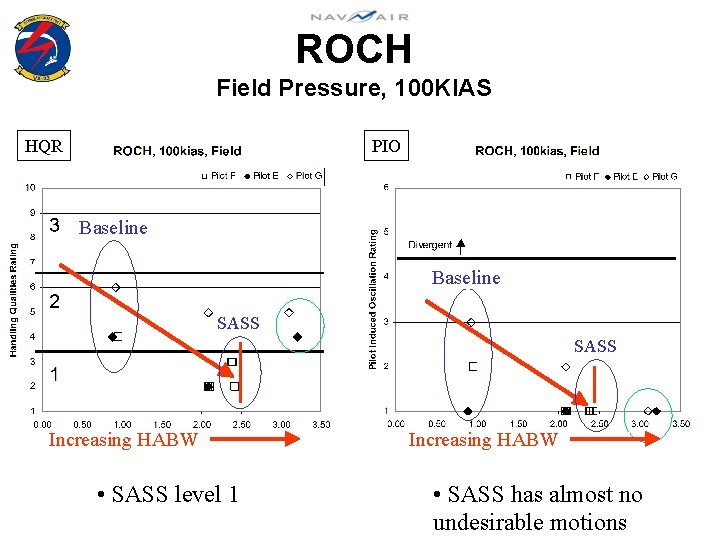
ROCH Field Pressure, 100 KIAS HQR PIO Baseline SASS Increasing HABW • SASS level 1 Increasing HABW • SASS has almost no undesirable motions
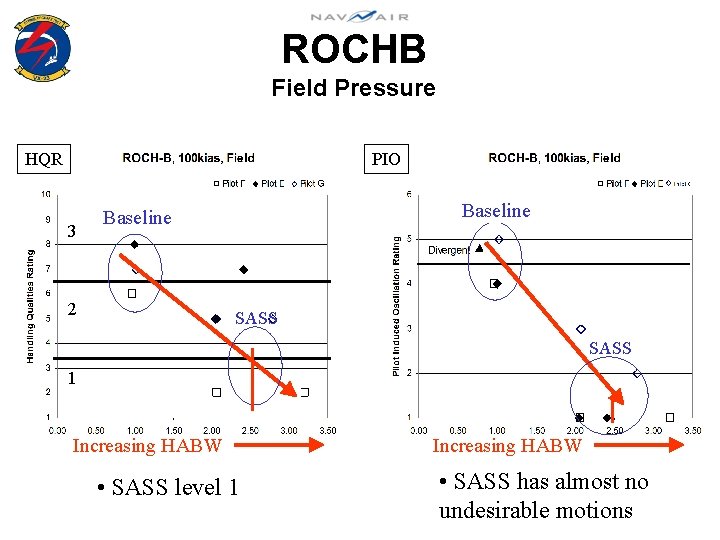
ROCHB Field Pressure HQR PIO 3 Baseline 2 SASS 1 Increasing HABW • SASS level 1 Increasing HABW • SASS has almost no undesirable motions
HABW Results F 18 E/F F 18 C/D T 45 w/ carrier pressure nose T 45
“The Winner” SASS-3
Conclusions: The Good • SASS is a definite improvement over the baseline airplane – “No SASS is Silly” • Ground handling issues are no longer crosswind limiting factor for the aircraft.
Conclusions: The Bad • SASS not designed to counter ground handling problems encountered as a result of blown tires.
Conclusions: The Ugly • Students still need to be good pilots: – Instructors will still be able to see incorrect student inputs, however… – Incorrect student inputs will be tempered by SASS
Lessons-Learned “If I only knew then what I know now…”
Reminder “Off the Shelf” is not necessarily “Off the Shelf” • Over 15 years later, we are still making improvements to an off the shelf system. • This small sub-system still had growing pains during the installation.
It’s Great! Lets Release It? • Still need full checkouts: – System Faults due to installation when used from aft cockpit – Need to capture aft cockpit comments as well as forward cockpit comments
GH Metrics • Stability Factor/Understeer Gradient – steady state parameter that defines oversteer/understeer tendencies of a given configuration (not easily applied to augmented configurations) • Heading Attitude Bandwidth – controlled element frequency domain parameters that define ability of the pilot to attain stable, closedloop control • Overshoot Ratio – time domain measure that defines of the amount of attitude overshoot generated from a step input • Capture Time – time domain measure that defines the time required to capture an attitude within a given tolerance • Pilot-Vehicle System Parameters – Frequency domain measures that characterize the closed-loop pilot-vehicle response
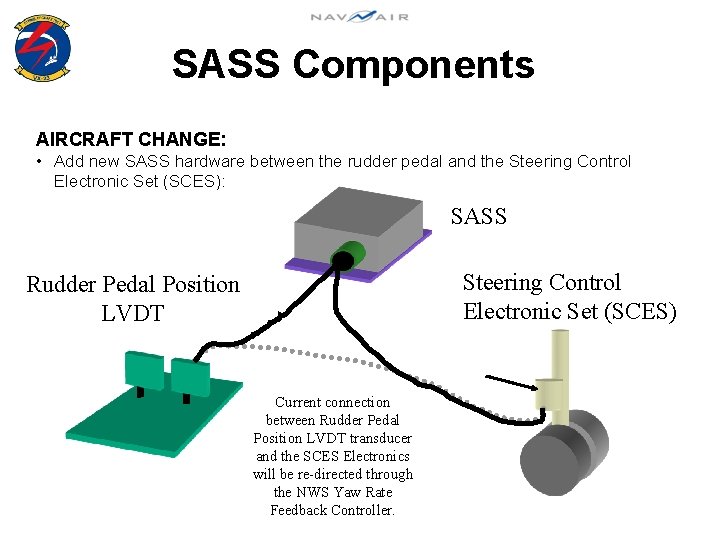
SASS Components AIRCRAFT CHANGE: • Add new SASS hardware between the rudder pedal and the Steering Control Electronic Set (SCES): SASS Steering Control Electronic Set (SCES) Rudder Pedal Position LVDT Current connection between Rudder Pedal Position LVDT transducer and the SCES Electronics will be re-directed through the NWS Yaw Rate Feedback Controller.
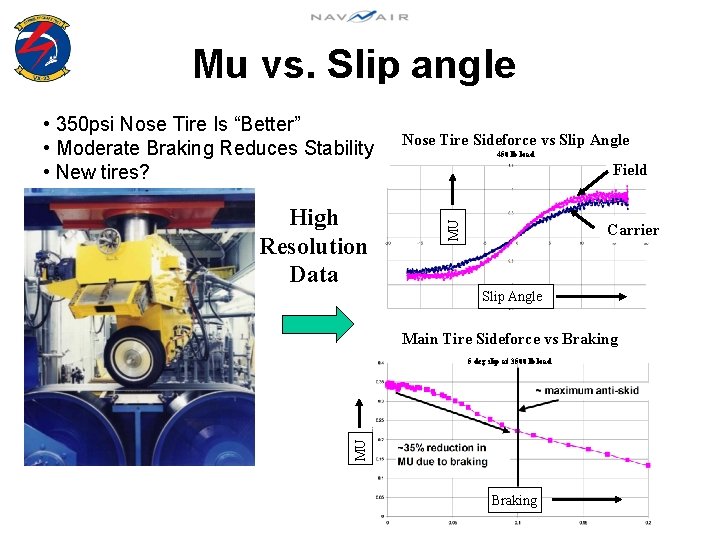
Mu vs. Slip angle High Resolution Data Nose Tire Sideforce vs Slip Angle 450 lb load Field MU • 350 psi Nose Tire Is “Better” • Moderate Braking Reduces Stability • New tires? Carrier Slip Angle Main Tire Sideforce vs Braking MU 5 deg slip at 3500 lb load Braking
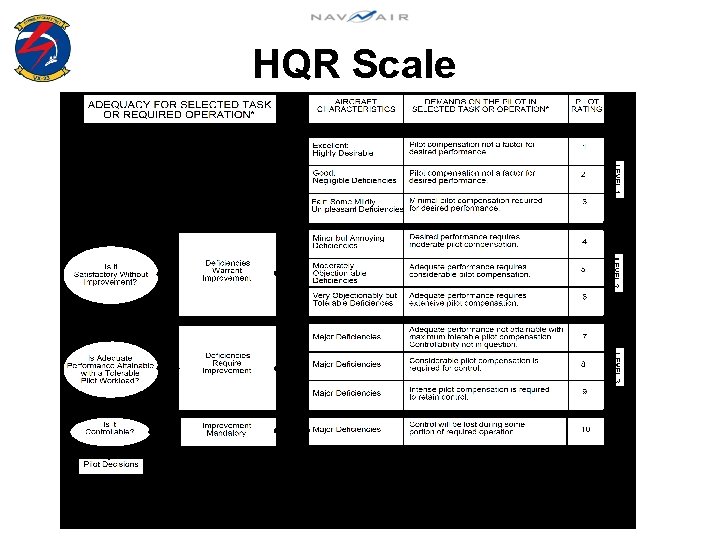
HQR Scale
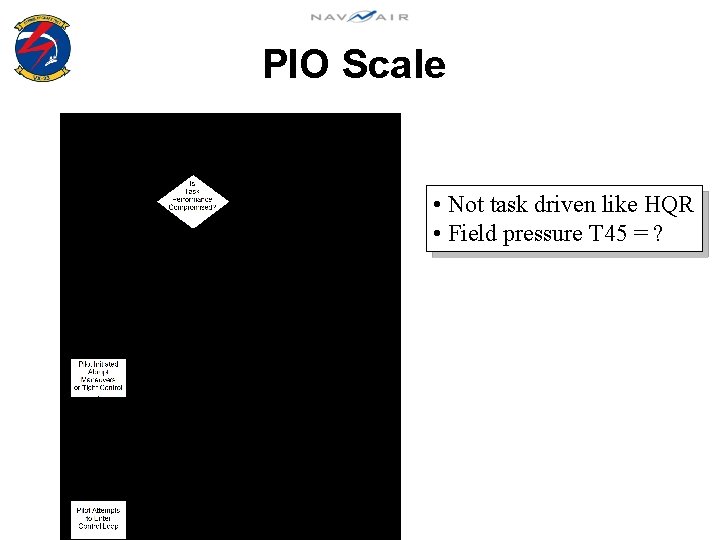
PIO Scale • Not task driven like HQR • Field pressure T 45 = ?
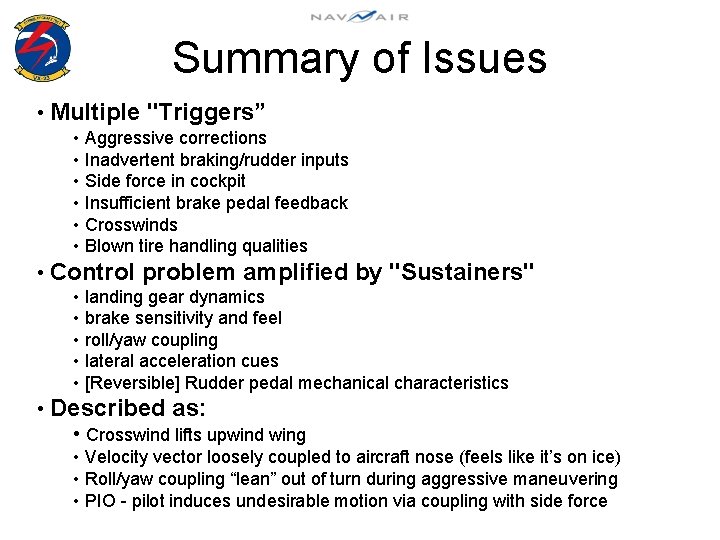
Summary of Issues • Multiple "Triggers” • Aggressive corrections • Inadvertent braking/rudder inputs • Side force in cockpit • Insufficient brake pedal feedback • Crosswinds • Blown tire handling qualities • Control problem amplified by "Sustainers" • landing gear dynamics • brake sensitivity and feel • roll/yaw coupling • lateral acceleration cues • [Reversible] Rudder pedal mechanical characteristics • Described as: • Crosswind lifts upwind wing • Velocity vector loosely coupled to aircraft nose (feels like it’s on ice) • Roll/yaw coupling “lean” out of turn during aggressive maneuvering • PIO - pilot induces undesirable motion via coupling with side force

Understeer gradient Understeer Gradient Ford Thunderbird Understeer Neutral steer T 45 Oversteer Main tire cornering power Nose ti g po n i r e n r o re c wer
HABW Results Gross Wt; Tire Pressure; Airspeed; Gain selection FUEL Main Tire Pressure Nose Tire Pressure BASELINE HABW=2. 0 HABW=2. 5
SASS Gain Schedules
SASS Gain Schedules Table 2 T-45 C TEST ENVELOPE Test Limits Parameter Checkout Crosswinds Wet Runway Current NATOPS Limits Gear A/S Limit 200 KIAS Runways No Wet Runway All Runways Cross-Winds 15 kts(1) 30 kts(1) 20 kts(1, 2) Tire Limitation 176 KGS Note: (1) Tower/Field anemometer will be used for data purposes. (2) NATOPS crosswind limits for wet runway is 15 knots
T-45 Background Info 2. 5” Pedal deflection = 12° NWS 30° Rudder
- Slides: 80