
T1070 CHEMICAL SEGREGATION This work has been produced
T-1070 CHEMICAL SEGREGATION This work has been produced by DGL (Aust) Pty Ltd This Learner’s Tool is about the skills and knowledge required for Segregating Chemicals DGL (Aust) facilities.
DGL (AUST) Pty Ltd What is Segregation Definition of Segregation To keep separated / Isolated by a distance. Segregation device” means a device for segregating dangerous goods from incompatible goods, that: Complies with the requirements in relation to devices used to segregate those goods set out in the “Specification for Segregation Devices” (Supplement 2); or (b) Is approved by a Competent Authority as a segregation device for use in segregating the goods 9/12/2021 Dangerous Goods Logistics 2
DGL (AUST) Pty Ltd INCOMPATIBLE SUBSTANCES Incompatible Substances: l Substances that have the ability to react or combine with one another in a way that: • • • increases the hazard of an individual substance that could cause deterioration of any of those substances and increase the hazards they present could increase the hazards in the event of fire. 9/12/2021 Dangerous Goods Logistics 3
DGL (AUST) Pty Ltd REACTION OF INCOMPATIBLE SUBSTANCES l Substances can react with one another in a manner that can create a hazard to people due to the reaction: • • • being violent producing an explosion producing a potentially explosive combination of products producing fire or rapid evolution of heat producing toxic vapour or toxic gas. 9/12/2021 Dangerous Goods Logistics 4
DGL (AUST) Pty Ltd SEGREGATION OF INCOMPATIBLE SUBSTANCES l Keeping incompatible substances segregated (or separated) ensures the safety of all persons. Required segregation distances are different for different types of incompatible substances. l ALWAYS comply with the type of DG allowed to be stored in a particular area BEFORE YOU APPLY the Storage Segregation Chart (T-220) to determine segregation needs. l DGL use a Storage Segregation Chart (T-220) and Oxidising Agents Segregation Chart (T-200) to assist operators in identifying incompatible substances and minimum required distances they are to be stored away from each other. 9/12/2021 Dangerous Goods Logistics 5
DGL (AUST) Pty Ltd SUBSIDIARY RISKS & SEGREGATION l If a packaged dangerous good has a Subsidiary Risk, greater care is required as to where it can be stored on site. Refer to your Supervisor for support in determining best location for the product. l If the Segregation Charts are not clear refer to your Supervisor for assistance. 9/12/2021 Dangerous Goods Logistics 6
DGL (AUST) Pty Ltd ACIDS AND BASES l Some DG Class 8 substances are incompatible with one other. l DG Class 8 ACIDS are incompatible with DG Class 8 ALKALIS (or BASES). l Bunding ensures incompatible substances are not kept in the same compound, or in compounds that share a common drainage system. 9/12/2021 Dangerous Goods Logistics 7
DGL (AUST) Pty Ltd ACIDS AND BASES l If a Class 8 substance cannot be stored in the dedicated store area for that class and substance type (acid or alkali), greater attention is required when placing the substance in an alternate storage location. l The same principles of substance type (acid and alkali) segregation still need to be followed, as well as segregation distance from other class types of dangerous goods (eg. Class 4). 9/12/2021 Dangerous Goods Logistics 8
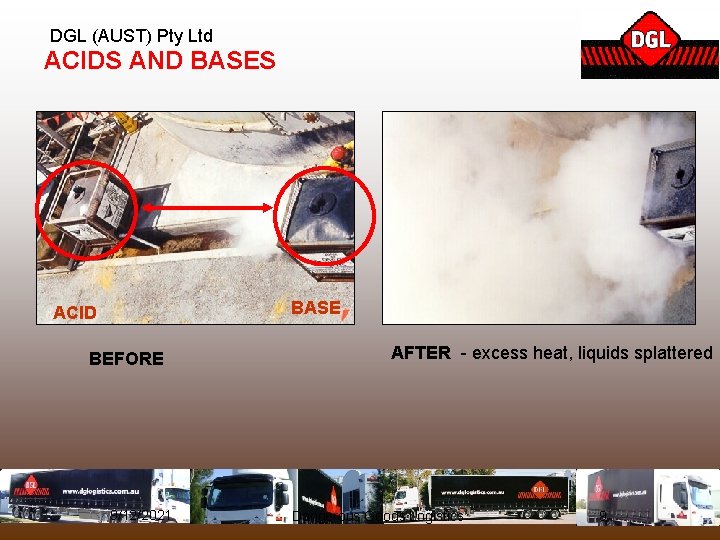
DGL (AUST) Pty Ltd ACIDS AND BASES BASE ACID BEFORE 9/12/2021 AFTER - excess heat, liquids splattered Dangerous Goods Logistics 9
DGL (AUST) Pty Ltd DAMAGED/ QUARANTINED STOCK l Contained damage and/or quarantined products should be stored in a ‘Damaged/Quarantine Bin’ located within the stock’s normal storage store. (For example; damaged class 4. 2 product is contained in a recovery bag and stored in the Damaged/Quarantine Bin located within that Store. l Every product in the Damaged/ Quarantine Bin must be compatible. Separate bins must be set up for incompatible damaged/quarantined stock. 9/12/2021 Dangerous Goods Logistics 10
DGL (AUST) Pty Ltd DAMAGED/ QUARANTINED STOCK l This approach minimizes the risk of chemical reaction. When packaging is compromised, we have greater risk of chemical reaction so it makes good sense to treat segregation of damages/quarantined product with the same if not more care than non damaged product. Placing all classes of damages in a ‘damage product store’ is high risk. l Further, this approach ensure compliance with fire protection equipment requirements. For example, taking Class 3 damaged product out of the normal fire protection equipped store, and placing this product in a ‘damage product store’ would dramatically increase fire risks on site 9/12/2021 Dangerous Goods Logistics 11
DGL (AUST) Pty Ltd DAMAGED/ QUARANTINED STOCK l Some sites have ‘Waste Bins’ used for disposal of damaged product. ONLY COMPATIBLE MATERIALS ARE TO BE PLACED IN THESE WASTE BINS. This may require the maintenance of a register to indicate exactly what product has gone into a bin to ensure non-compatible materials are never mixed. 9/12/2021 Dangerous Goods Logistics 12
DGL (AUST) Pty Ltd WHAT’S THE DIFFERENCE BETWEEN COMBUSTIBLE MATERIALS AND CLASS 3 FLAMMABLE LIQUIDS? Class 3 DG have flashpoints between -0 to 60ºC and their flashpoint is lower than their boiling point. l Combustible products have flashpoints above 60ºC and not like class 3 DG, their flashpoint is lower than their boiling point. - C 1: has flashpoint between 61ºC to 150ºC - C 2: has flashpoint above 150ºC - CS: A solid that has a flashpoint/ will burn. l What’s a flash point? The lowest temperature at which the vapour of a test portion will ignite when a test flame is applied. 9/12/2021 Dangerous Goods Logistics 13
DGL (AUST) Pty Ltd WHAT’S THE DIFFERENCE BETWEEN COMBUSTIBLE MATERIALS AND CLASS 3 FLAMMABLE LIQUIDS? l Even though combustible products are not Class 3 DG, we still need to ensure we control and minimise the fire risks of storing combustibles with or near other Dangerous Goods. l The safest approach is to treat C 1 as Class 3 DG for storage purposes (i. e store in the same area as Class 3 DG). l C 2 and CS need to be segregated from other Dangerous Goods as per the Storage Segregation Chart (T-220). Generally, these products should not go into storage facilities where 5. 1 and 5. 2 products are present. Generally, these products need to be segregated by 3 m from class 2 s, 4. 3 s and 6. 1 s. 9/12/2021 Dangerous Goods Logistics 14
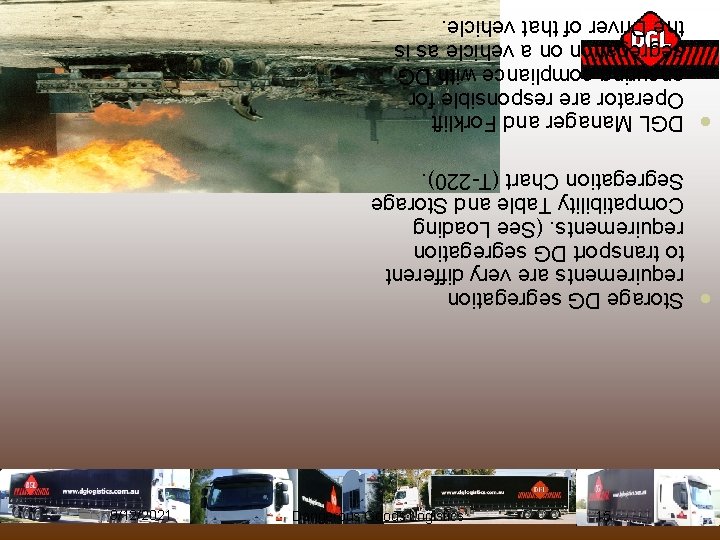
Dangerous Goods Logistics 15 DGL Manager and Forklift Operator are responsible for ensuring compliance with DG segregation on a vehicle as is the Driver of that vehicle. l Storage DG segregation requirements are very different to transport DG segregation requirements. (See Loading Compatibility Table and Storage Segregation Chart (T-220). l 9/12/2021 SEGREGATION – STORAGE VS. TRANSPORT DGL (AUST) Pty Ltd
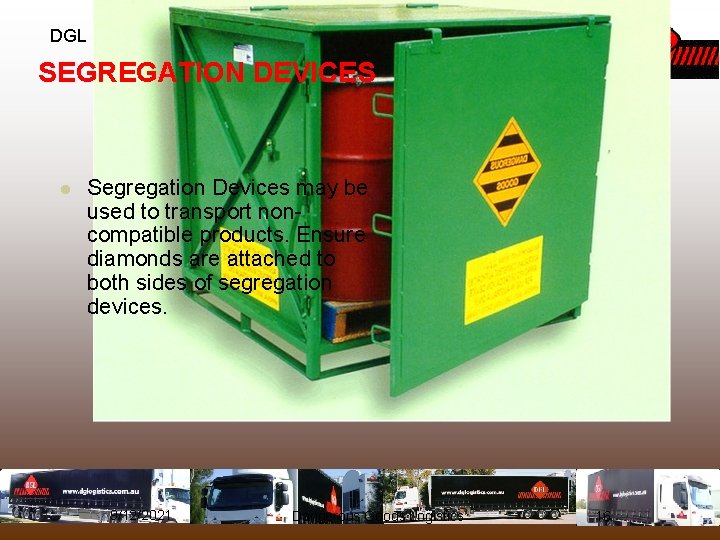
DGL (AUST) Pty Ltd SEGREGATION DEVICES l Segregation Devices may be used to transport noncompatible products. Ensure diamonds are attached to both sides of segregation devices. 9/12/2021 Dangerous Goods Logistics 16
DGL (AUST) Pty Ltd Test your knowledge • Through the following slides you will be asked an number of questions to show that you have understood the content of this learning tool • Please record your answer on the training form F-260. • You will be required to submit the answers to the DGL HSEQ unit 9/12/2021 17
DGL (AUST) Pty Ltd Question 1 l Substances that have the ability to react or combine with one another in a way that: a) increases the hazard of an individual substance b) that could cause deterioration of any of those substances and increase the hazards they present c) could increase the hazards in the event of fire. d) All of the above 9/12/2021 Dangerous Goods Logistics 18
DGL (AUST) Pty Ltd Question 2 • Do division 3 dangerous goods have flashpoints between -0 to 60ºC and their flashpoint is lower than their boiling point • a)yes b)no • 9/12/2021 Dangerous Goods Logistics 19
DGL (AUST) Pty Ltd Question 3 • Do C 1 liquids have a flashpoint between 61ºC to 150ºC • • • a)yes b)no 9/12/2021 Dangerous Goods Logistics 20
DGL (AUST) Pty Ltd Question 4 l What’s a flash point? a) The lowest temperature at which the vapour of a test portion will ignite when a test flame is applied. b) The lowest temperature at which the vapour of a test portion will boil when a test applied. c) all of the above 9/12/2021 Dangerous Goods Logistics 21
DGL (AUST) Pty Ltd Question 5 What is best to ensure incompatible substances are do not react with incompatible products • • a) bunding b) distance 9/12/2021 Dangerous Goods Logistics 22
DGL (AUST) Pty Ltd Additional information • 9/12/2021 Dangerous Goods Logistics 23
- Slides: 23