
T V Message Board Vol 9 Hot Oil
T. V. Message Board Vol. 9 Hot Oil 2011 Running Time 9 minutes 24 seconds
First, a few reminders… When loading at bulk facilities you must follow their loading procedures. You must have Site Specific Training for the facilities you will be loading from. As with anything that you do at WBI if you are not comfortable or not sure of proper safety or company procedures it is your responsibility to ask!
There a few very important things to know about hot oil and to always remember. If the material previously in the tanker was not hot oil, (e. g. emulsion): • Do Not Load. The potential to create an explosion or severe reaction will be greatly increased, most likely if the trailer has no placard, it last contained emulsion. • If any water is present in the tanker, it will flash into steam as the hot asphalt comes into contact with it. When water converts from a liquid to a gaseous state, it expands 1700 times in volume. This will result in a foaming action, which can become violent depending on the amount of water involved. Overflow of the tanker is possible even if the flow of product is stopped quickly.
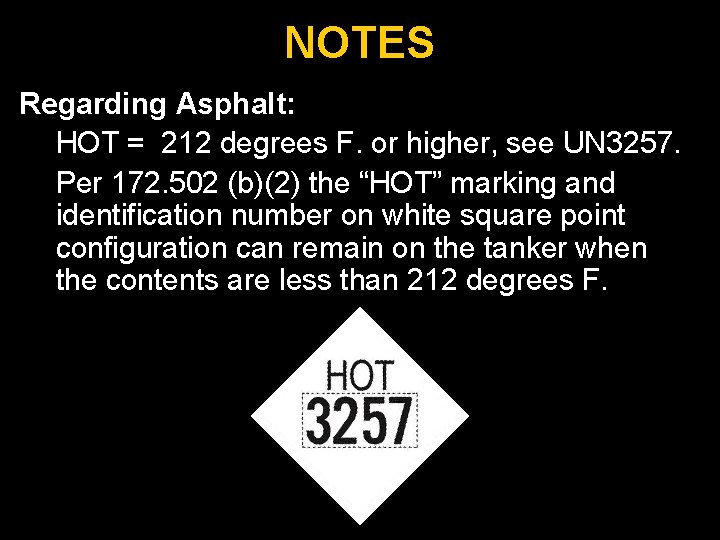
NOTES Regarding Asphalt: HOT = 212 degrees F. or higher, see UN 3257. Per 172. 502 (b)(2) the “HOT” marking and identification number on white square point configuration can remain on the tanker when the contents are less than 212 degrees F.
NOTES Railroad Crossings & Asphalt Loads: You must stop at rail crossings when the tanker is loaded with hot asphalt. Per 392. 10 (a)(4) the load is hazardous when HOT. (HOT = 212 degrees F or higher, see UN 3257) You do not have to stop when empty since the tanker is non-hazardous at that time.
Hot Oil Safety Gear Policy Gear required when loading or unloading hot oil: · Coveralls · Flint Hills requires aluminized coat (provided by them) · Safety Glasses and Hard Hat at all times · Regular glasses do not replace safety glasses · We have two styles of safety glasses, those that fit over eye glasses and regular type. · Face Shield in down position when loading or actively hooking or unhooking hoses. · At other times face shield may be up but safety glasses and hard hat must be on.
Hot Oil Safety Gear Policy · Leather Work boots · Gloves (need to be big enough to come off quickly if needed) · Flint Hills requires aluminized gloves · These are WBI’s minimums for safety gear, if our customers require more YOU MUST use it.
Hot Oil Spill Guidelines • Contact the nearest WBI office to report the spill 24 hours a day. • Keep all unnecessary people away. • All spills at customer locations must first be reported to the on site plant operator. • The MSDS contains important information regarding spills. It is the driver’s responsibility to read them.
General Loading for Hot Oil Guidelines: • Good communication is essential; do not take anything for granted. • When taring in, verify your tare weight to ensure there is no retain. • After opening dome lid, inspect the inside of the compartment for moisture or retain from the last load. • Never load a tanker if water is present inside the tanker.
General Loading for Hot Oil Precautions: • If trailer is suspected to have moisture inside, you must contact your dispatcher before proceeding to load. • The loading arm must be held firmly in place by chain, bungee, or similar device to ensure it is locked in place.
General Loading for Hot Oil Precautions Cont… • The driver must stay well back of the manhole to avoid splashes of the very hot asphalt, which can cause severe burns and inhalation of vapors. • PPE must be worn prior to beginning loading.
General Loading for Hot Oil Before Leaving the Terminal Checklist: q q q Do you have the right tanker? What was the last product hauled in the tanker? You must check this BEFORE you leave the yard. Check to make sure unloading valve was closed from previous trip. Be especially cautious of water in the tanker, which may cause loading problems. Are you loading by inches on a stick, gallons or pounds of product? Do you have correct numbers to load? Do you have your safety gear?
General Loading for Hot Oil Loading Checklist q q q Do you know where the emergency water barrel system is located at that facility? Is it full and in working order? Do you know how to use it? Listen for and watch for moisture in the tank. (Especially after it has rained or snowed, where a dome lid might have been left open. ) When finished, make sure the dome lid is closed and secured. When pulling loading spout of compartment, attach spill bucket without spilling retain in spout on tanker side or in crows nest. Make sure walkway is raised and secured in the full upright position.
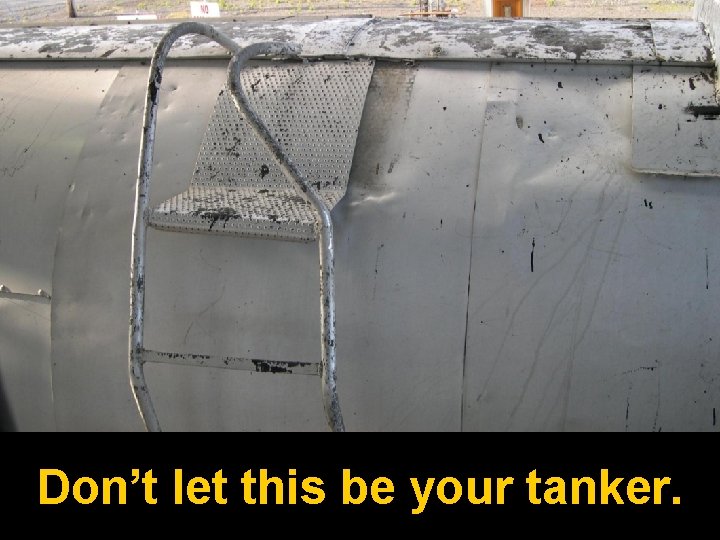
Don’t let this be your tanker.
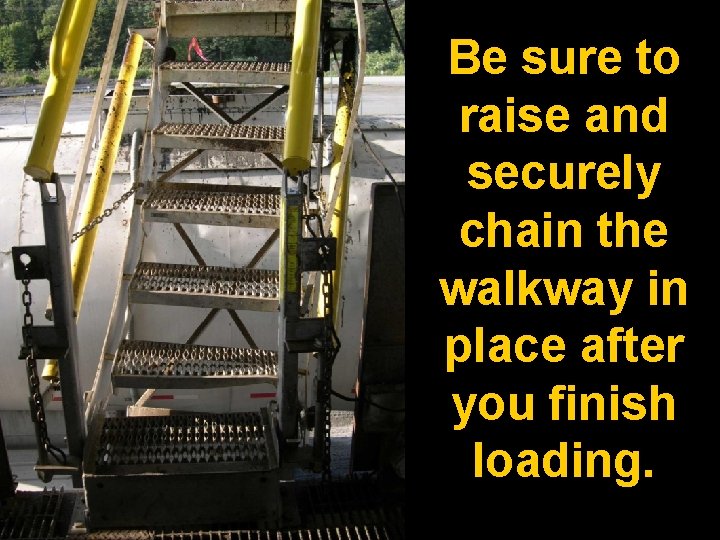
Be sure to raise and securely chain the walkway in place after you finish loading.

General Unloading for Hot Oil Guidelines: • • • Good communication is essential; do not take anything for granted. Only one person should actively hook/unhook lines. Assisting personnel will act as safety backup. When arriving at the destination communicate with their yard man. Always insure that there is a water barrel at the destination and it is full of water. Also check to make sure that the control valve is functioning properly (Check for rust). At the end of the season you can remind the plant operators that it needs to be drained so that it will not freeze and crack the barrel. Never unload or unhook a hose alone. If a spill occurs you may need immediate assistance.
General Unloading for Hot Oil • Never unhook a hose from a tanker without the pump running- ensure that you, the driver, can hear suction as you open the cam locks. You the driver are responsible for unhooking the hoses and closing the tanker valves. If you are at a facility where they unhook the hoses, you are required to be immediately present and ready to assist in any way. • While unloading, confirm with the plant operator which storage tank the product is going into and that it will hold your entire load. • Also ensure that the pump is running in the correct direction. If the pump has a "reverse" communicate with the operator the importance of ensuring the pump is going the right direction.
General Unloading for Hot Oil Precautions: • Use extreme caution when removing caps or plugs from manifolds or hoses that have been heated because of pressure buildup. • Always stand to one side, never directly in front of the product line when removing plugs or dust covers. • Drivers must use hard hats with face shields, goggles, and gloves whenever they open hatches or dome covers and outlet caps.
General Unloading for Hot Oil Precautions Cont… • Always assume that when you are disconnecting from the tanker that the hose is full and or under pressure. Every cam lock no matter the product should be treated like a firearm, always loaded. • When unloading rubberized asphalt, leave rear discharge trailers with the nose low to avoid plugging the outlet when the product cools and solidifies. • When you start unloading, if you determine the discharge hose is plugged, get assistance from the plant operator to heat the line to find the plug. During this process if you decide to unhook the discharge line, make sure pump is still running and tanker valves are closed.
General Unloading for Hot Oil Precautions Cont… • Stand upwind to one side to avoid any possible injury from splash and avoid breathing vapors when opening hatch covers. • It is the driver’s responsibility to run the torch unless the unloading facility instructs that they will do it. Concentrate the flame on the manifold and valve – keep away from tanker skin, air and electrical lines. • Some unloading facilities have rubber discharge hoses and some have steel braided hoses. Be careful when heating a rubber hose – you can damage it with too much heating when trying to find a turd.
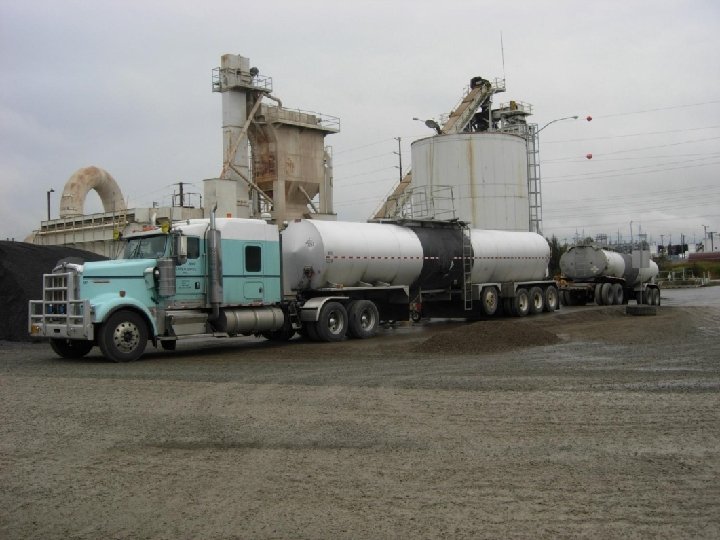
General Unloading for Hot Oil Unloading Checklist: q q Do you have your safety gear on? Hard hat with face shield, heat resistant gloves, safety glasses, leather boots and coveralls are required when hooking or unhooking lines? Are you situated on a level off-loading pad? Do you know where the water barrel is and does it have water in it? Is the valve for the emergency water barrel system in good working condition? Do you know how to use the emergency water barrel system?
General Unloading for Hot Oil Unloading Checklist Cont… q q Do you have an understanding of the procedures at that asphalt plant? Do you know the pump direction? Have you talked about the plant procedures with the ground help (yard man)? Do you and the yard man have an understanding of procedures for hooking up and off-loading? Do you have asphalt flowing in the correct direction? Check storage tank, for exiting fumes, if necessary. Make sure you monitor storage tank so it does not overfill if it is our responsibility (clarify with yard man).
General Unloading for Hot Oil Unloading Checklist Cont… q Ensure the tanker is empty of product and dome lid closed when off-loading is finished. q When tanker is empty and hose is to be disconnected, make sure the offload valve is closed, pump still running, and listen for sucking sound when disconnecting. q Is diesel used in off-loading hoses when off-loading is completed? Flush the hoses if there is not another truck in line behind you.
- Slides: 27