
T S Eliots The Waste Land ALESSANDRO SERPIERI



- Slides: 7
“T. S. Eliot’s The Waste Land” ALESSANDRO SERPIERI
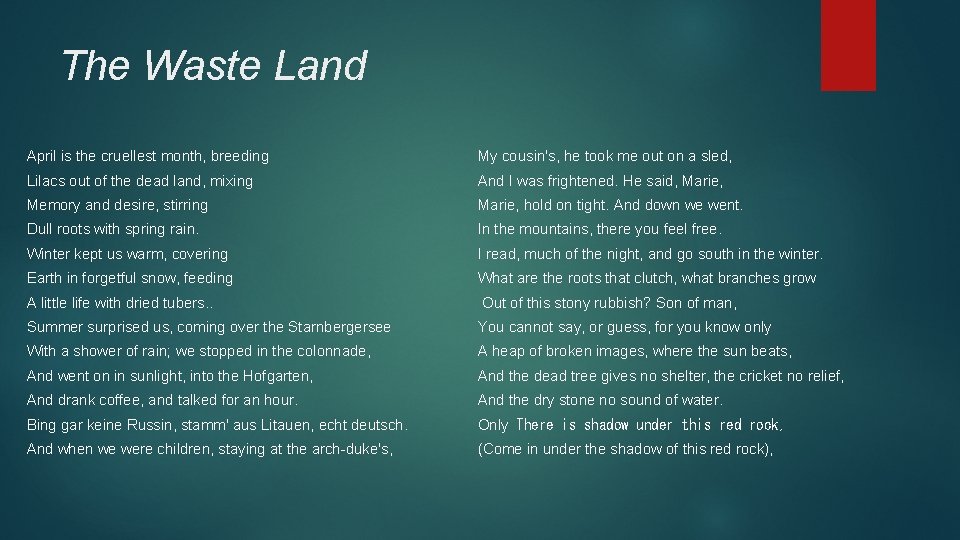
The Waste Land April is the cruellest month, breeding My cousin's, he took me out on a sled, Lilacs out of the dead land, mixing And I was frightened. He said, Marie, Memory and desire, stirring Marie, hold on tight. And down we went. Dull roots with spring rain. In the mountains, there you feel free. Winter kept us warm, covering I read, much of the night, and go south in the winter. Earth in forgetful snow, feeding What are the roots that clutch, what branches grow A little life with dried tubers. . Out of this stony rubbish? Son of man, Summer surprised us, coming over the Starnbergersee You cannot say, or guess, for you know only With a shower of rain; we stopped in the colonnade, A heap of broken images, where the sun beats, And went on in sunlight, into the Hofgarten, And the dead tree gives no shelter, the cricket no relief, And drank coffee, and talked for an hour. And the dry stone no sound of water. Bing gar keine Russin, stamm' aus Litauen, echt deutsch. Only There is shadow under this red rock, And when we were children, staying at the arch-duke's, (Come in under the shadow of this red rock),
Critical analysis by Alessandro Serpieri Eliot composed “the waste land” in 1921. At that time he had already written many poems. In his first poem “Prufrock and Other Observations”, there were many lacks of logic transitions and the combination between meter blocks and significant was given through parallelisms and inter-testual quotations: Eliot shows his way to organize the structure. There isn’t any relation between causes and effects, characters and environment fall apart. The structure is not coherent: the speaking voice tells about the character and time in a fragmentary way. The way the poet composes the poem is neither sequential, nor monological but it is relational and dialogical (more characters are speaking to each other).
Mythic method Elliot, Pound and Joyce are aware of how literary methods work. They are interested in putting into a relationship subject-object, present-past, realtymyth, text-text. The “mythic method” came out from these relationships and it was first defined by Eliot in Joyce’s “Ulysses” review: “In using the myth, in manipulating a continuous parallel between contemporaneity and antiquity, Mr. Joyce is pursuing a method which others must pursue after him. They will not be imitators, any more than the scientist who uses the discoveries of an Einstein in pursuing his own, independent, further investigations. It is simply a way of controlling, of ordering, of giving a shape and a significance to the immense panorama of futility and anarchy which is contemporary history. It is a method already adumbrated by Mr. Yeats, and of the need for which I believe Mr. Yeats to have been the first contemporary to be conscious. It is a method for which the horoscope is auspicious. ” The “mythic method” has been firstly used by W. B. Yates, who recognized his essentiality.
The “mythic method” substituted the narrative method; it was used in Eliot’s first works and it is able o express something that cannot be expressed in the traditional way. Indeed, the poet could compare each psychological and emotional scheme on mythic, literary and anthropological bases. As a result, the way sonnet used to be written and considered all over the world had changed. In his essay, Eliot wants to understand why a literary work might be considered “new” and “original”. In Eliot’s mind, people think a original literary work is completely different from the traditional ones, but people are wrong. Indeed, The more a literary work is “original”, the more western literary tradition is inside his DNA. In few words, if you want to write something “original”, you must study traditional works. Modern texts are built assimilating and destroying other poetical texts. These texts are “alter-junctions”. Non— conjunctions that are inside of an independent syntax are substituted by alterjunctions and each element alludes to/parodies previous texts.
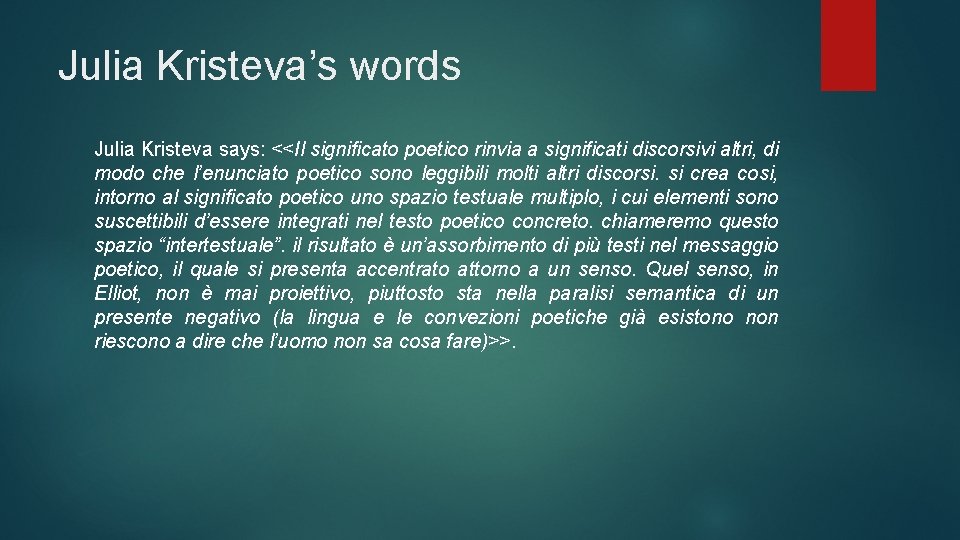
Julia Kristeva’s words Julia Kristeva says: <<Il significato poetico rinvia a significati discorsivi altri, di modo che l’enunciato poetico sono leggibili molti altri discorsi. si crea cosi, intorno al significato poetico uno spazio testuale multiplo, i cui elementi sono suscettibili d’essere integrati nel testo poetico concreto. chiameremo questo spazio “intertestuale”. il risultato è un’assorbimento di più testi nel messaggio poetico, il quale si presenta accentrato attorno a un senso. Quel senso, in Elliot, non è mai proiettivo, piuttosto sta nella paralisi semantica di un presente negativo (la lingua e le convezioni poetiche già esistono non riescono a dire che l’uomo non sa cosa fare)>>.
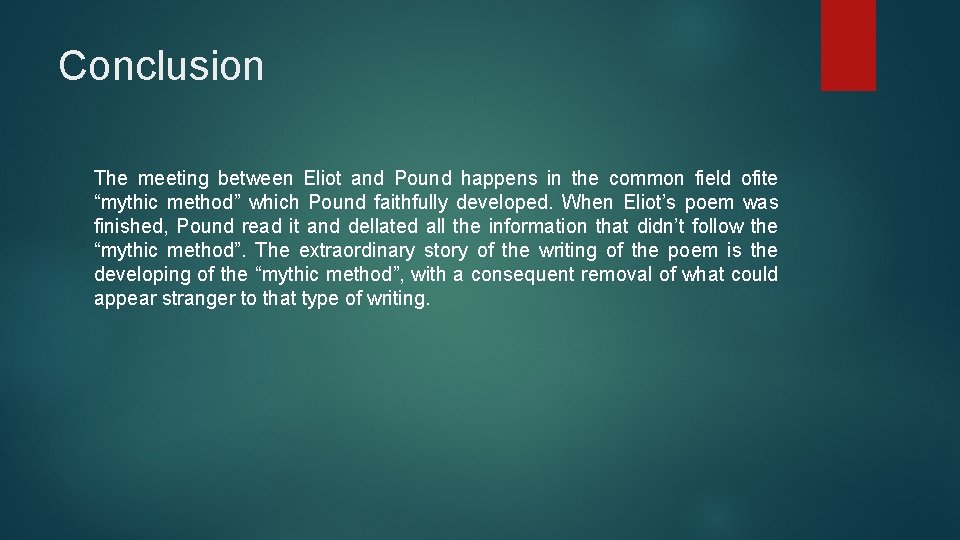
Conclusion The meeting between Eliot and Pound happens in the common field ofite “mythic method” which Pound faithfully developed. When Eliot’s poem was finished, Pound read it and dellated all the information that didn’t follow the “mythic method”. The extraordinary story of the writing of the poem is the developing of the “mythic method”, with a consequent removal of what could appear stranger to that type of writing.