
T F Edgar Department of Chemical Engineering The

- Slides: 22
T. F. Edgar Department of Chemical Engineering The University of Texas Austin, Texas 78712 February 19 -20, 2001 Austin, Texas
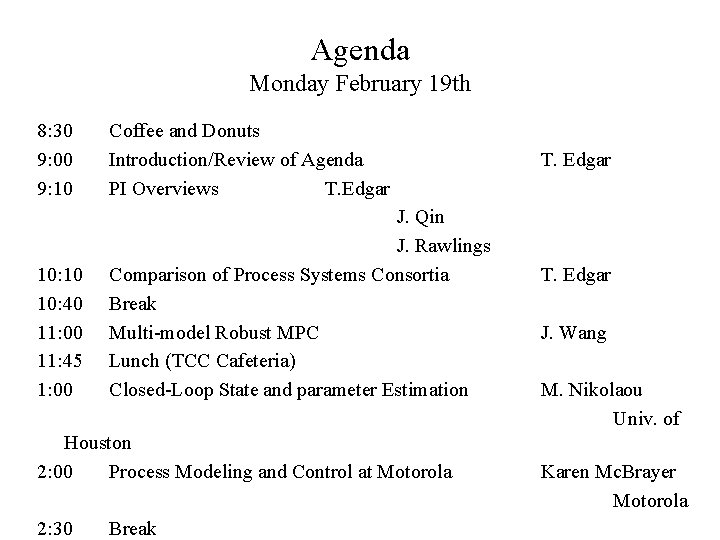
Agenda Monday February 19 th 8: 30 9: 00 9: 10 Coffee and Donuts Introduction/Review of Agenda PI Overviews T. Edgar 10: 10 10: 40 11: 00 11: 45 1: 00 J. Qin J. Rawlings Comparison of Process Systems Consortia Break Multi-model Robust MPC Lunch (TCC Cafeteria) Closed-Loop State and parameter Estimation Houston 2: 00 Process Modeling and Control at Motorola 2: 30 Break T. Edgar J. Wang M. Nikolaou Univ. of Karen Mc. Brayer Motorola
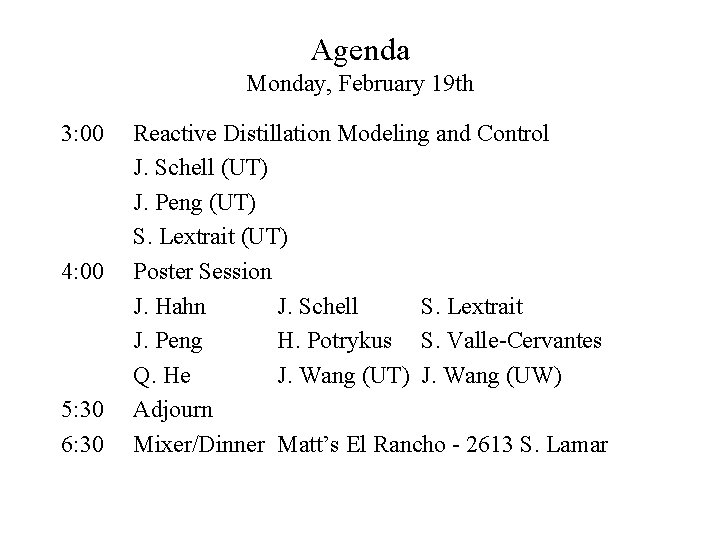
Agenda Monday, February 19 th 3: 00 4: 00 5: 30 6: 30 Reactive Distillation Modeling and Control J. Schell (UT) J. Peng (UT) S. Lextrait (UT) Poster Session J. Hahn J. Schell S. Lextrait J. Peng H. Potrykus S. Valle-Cervantes Q. He J. Wang (UT) J. Wang (UW) Adjourn Mixer/Dinner Matt’s El Rancho - 2613 S. Lamar
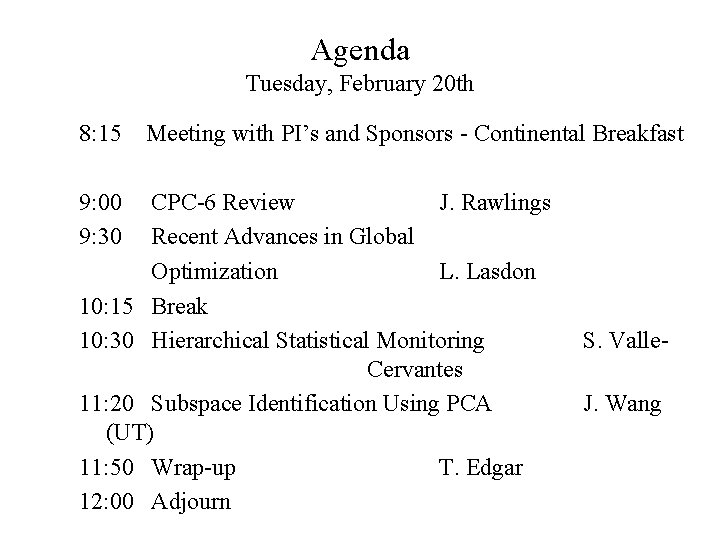
Agenda Tuesday, February 20 th 8: 15 Meeting with PI’s and Sponsors - Continental Breakfast 9: 00 9: 30 CPC-6 Review J. Rawlings Recent Advances in Global Optimization L. Lasdon 10: 15 Break 10: 30 Hierarchical Statistical Monitoring Cervantes 11: 20 Subspace Identification Using PCA (UT) 11: 50 Wrap-up T. Edgar 12: 00 Adjourn S. Valle. J. Wang
TWMCC - Multiple Projects Company AMD Aspentech Condea-Vista Du. Pont Equilon Exxon/Mobil Fisher-Rosemount KLA-Tencor Motorola JBR √ √ TFE √√ √ √ JQ √√ √ √
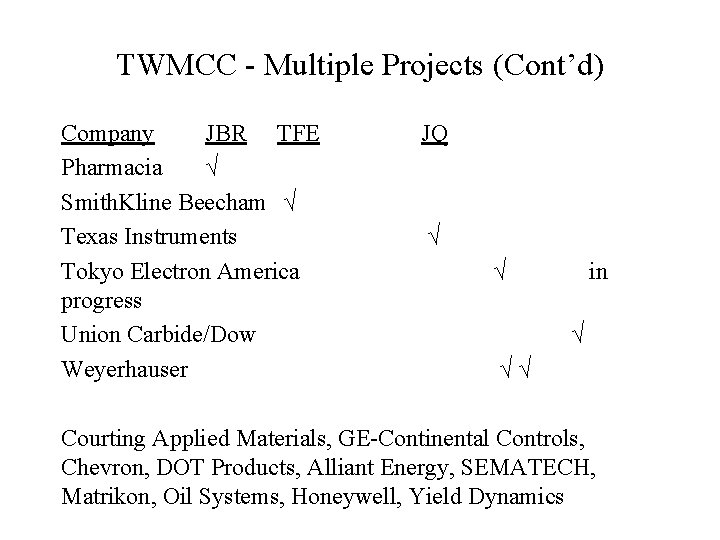
TWMCC - Multiple Projects (Cont’d) Company JBR TFE Pharmacia √ Smith. Kline Beecham √ Texas Instruments Tokyo Electron America progress Union Carbide/Dow Weyerhauser JQ √ √ in √ √√ Courting Applied Materials, GE-Continental Controls, Chevron, DOT Products, Alliant Energy, SEMATECH, Matrikon, Oil Systems, Honeywell, Yield Dynamics
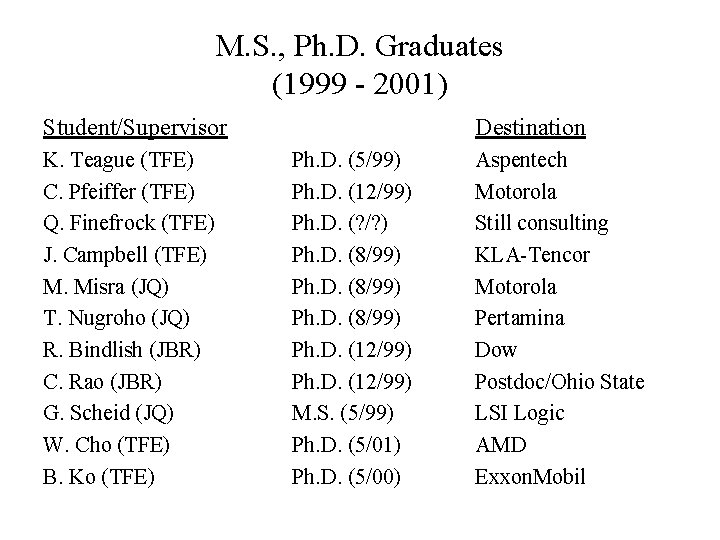
M. S. , Ph. D. Graduates (1999 - 2001) Student/Supervisor K. Teague (TFE) C. Pfeiffer (TFE) Q. Finefrock (TFE) J. Campbell (TFE) M. Misra (JQ) T. Nugroho (JQ) R. Bindlish (JBR) C. Rao (JBR) G. Scheid (JQ) W. Cho (TFE) B. Ko (TFE) Destination Ph. D. (5/99) Ph. D. (12/99) Ph. D. (? /? ) Ph. D. (8/99) Ph. D. (12/99) M. S. (5/99) Ph. D. (5/01) Ph. D. (5/00) Aspentech Motorola Still consulting KLA-Tencor Motorola Pertamina Dow Postdoc/Ohio State LSI Logic AMD Exxon. Mobil
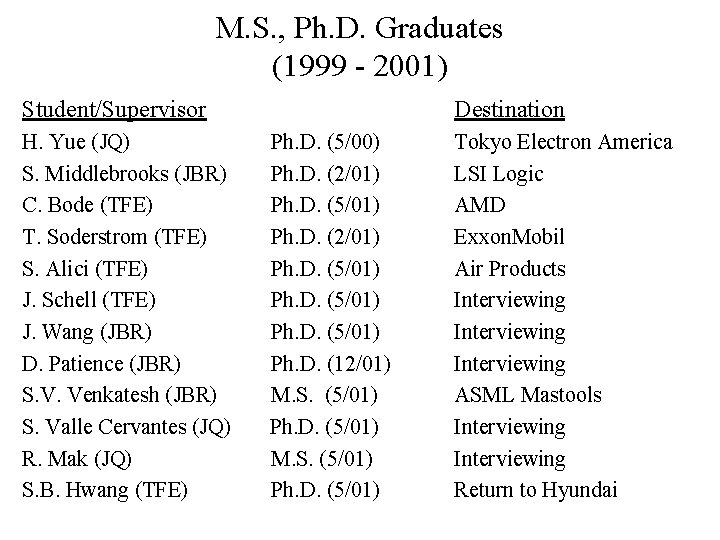
M. S. , Ph. D. Graduates (1999 - 2001) Student/Supervisor H. Yue (JQ) S. Middlebrooks (JBR) C. Bode (TFE) T. Soderstrom (TFE) S. Alici (TFE) J. Schell (TFE) J. Wang (JBR) D. Patience (JBR) S. V. Venkatesh (JBR) S. Valle Cervantes (JQ) R. Mak (JQ) S. B. Hwang (TFE) Destination Ph. D. (5/00) Ph. D. (2/01) Ph. D. (5/01) Ph. D. (12/01) M. S. (5/01) Ph. D. (5/01) Tokyo Electron America LSI Logic AMD Exxon. Mobil Air Products Interviewing ASML Mastools Interviewing Return to Hyundai
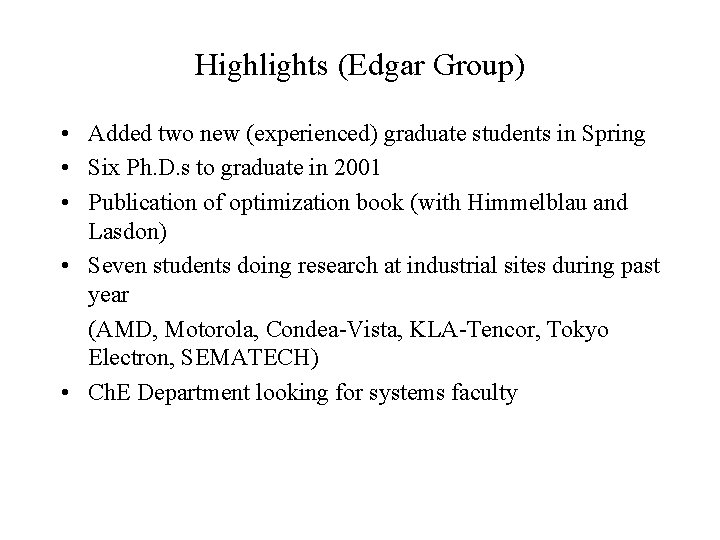
Highlights (Edgar Group) • Added two new (experienced) graduate students in Spring • Six Ph. D. s to graduate in 2001 • Publication of optimization book (with Himmelblau and Lasdon) • Seven students doing research at industrial sites during past year (AMD, Motorola, Condea-Vista, KLA-Tencor, Tokyo Electron, SEMATECH) • Ch. E Department looking for systems faculty
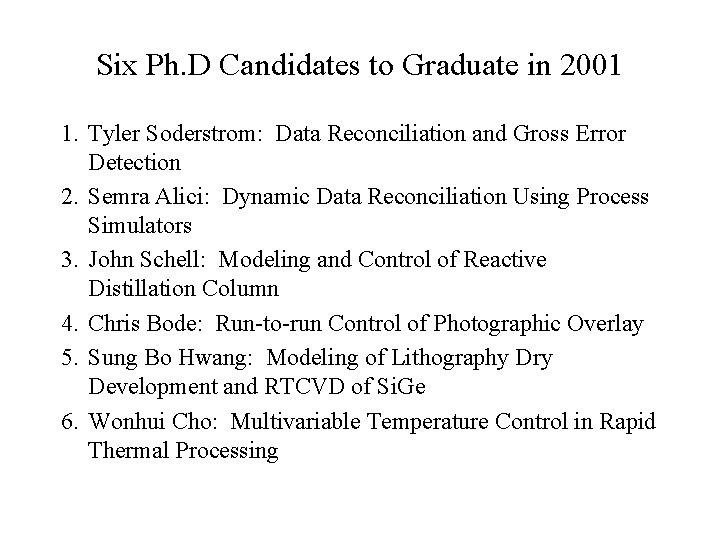
Six Ph. D Candidates to Graduate in 2001 1. Tyler Soderstrom: Data Reconciliation and Gross Error Detection 2. Semra Alici: Dynamic Data Reconciliation Using Process Simulators 3. John Schell: Modeling and Control of Reactive Distillation Column 4. Chris Bode: Run-to-run Control of Photographic Overlay 5. Sung Bo Hwang: Modeling of Lithography Dry Development and RTCVD of Si. Ge 6. Wonhui Cho: Multivariable Temperature Control in Rapid Thermal Processing
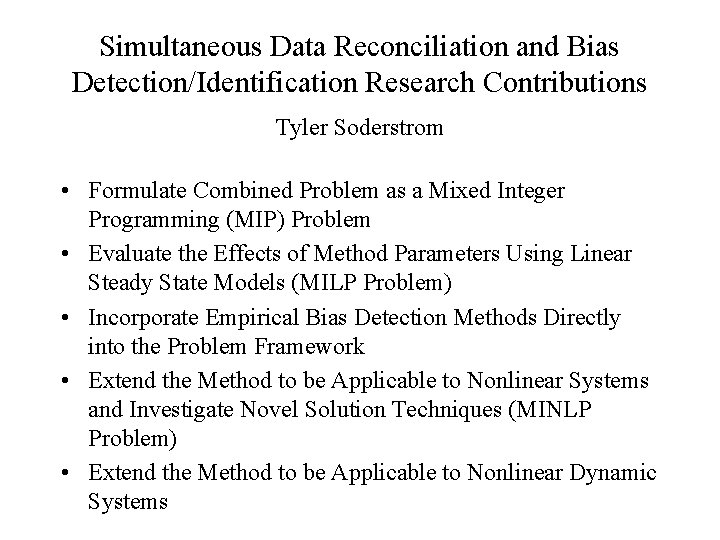
Simultaneous Data Reconciliation and Bias Detection/Identification Research Contributions Tyler Soderstrom • Formulate Combined Problem as a Mixed Integer Programming (MIP) Problem • Evaluate the Effects of Method Parameters Using Linear Steady State Models (MILP Problem) • Incorporate Empirical Bias Detection Methods Directly into the Problem Framework • Extend the Method to be Applicable to Nonlinear Systems and Investigate Novel Solution Techniques (MINLP Problem) • Extend the Method to be Applicable to Nonlinear Dynamic Systems
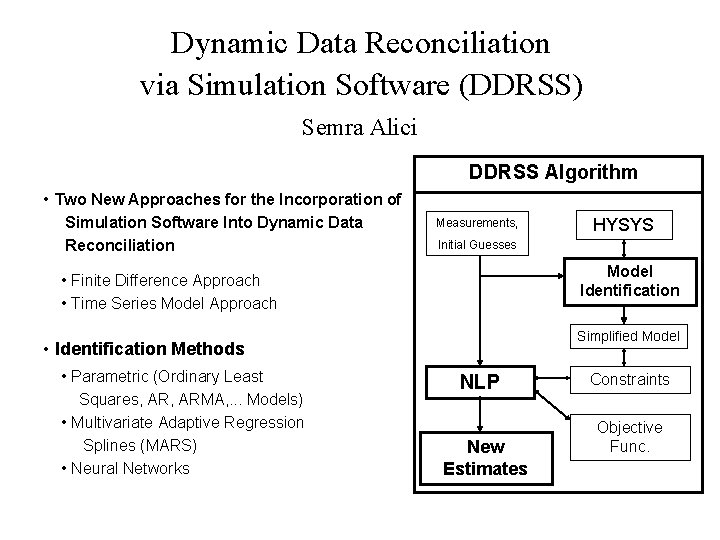
Dynamic Data Reconciliation via Simulation Software (DDRSS) Semra Alici DDRSS Algorithm • Two New Approaches for the Incorporation of Simulation Software Into Dynamic Data Reconciliation Measurements, Initial Guesses Model Identification • Finite Difference Approach • Time Series Model Approach Simplified Model • Identification Methods • Parametric (Ordinary Least Squares, ARMA, . . . Models) • Multivariate Adaptive Regression Splines (MARS) • Neural Networks HYSYS NLP New Estimates Constraints Objective Func.
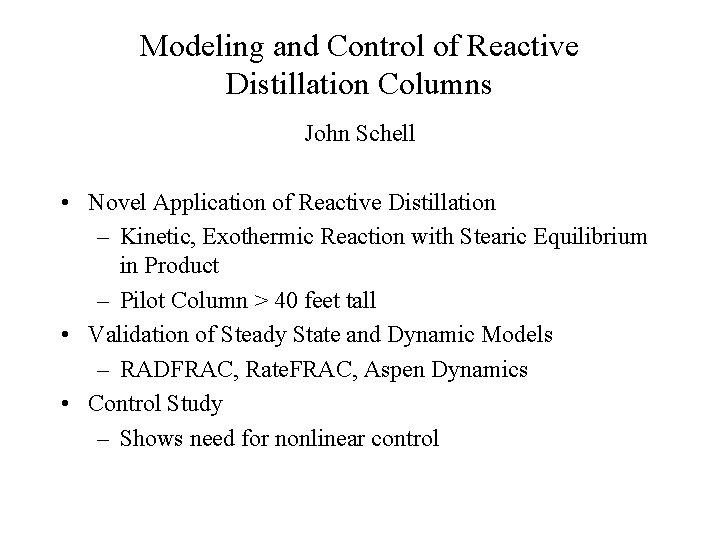
Modeling and Control of Reactive Distillation Columns John Schell • Novel Application of Reactive Distillation – Kinetic, Exothermic Reaction with Stearic Equilibrium in Product – Pilot Column > 40 feet tall • Validation of Steady State and Dynamic Models – RADFRAC, Rate. FRAC, Aspen Dynamics • Control Study – Shows need for nonlinear control
Run-to-run Control of Lithography Overlay and Poly Gate Linewidth • • Christopher A. Bode Compiled a set of known disturbances to the process responsible for overlay and linewidth performance, and completed an analysis of variance to identify the significant disturbances. Identified an strategy for the control of these significant disturbances based upon control thread methodology. Developed a run-to run Model Predictive Control (MPC) method for each controlled variable. Deployed above to high-volume semiconductor manufacturing, realizing a 40% improvement in process capability (Cpk) for overlay and a 44% improvement in gate linewidth Cpk.
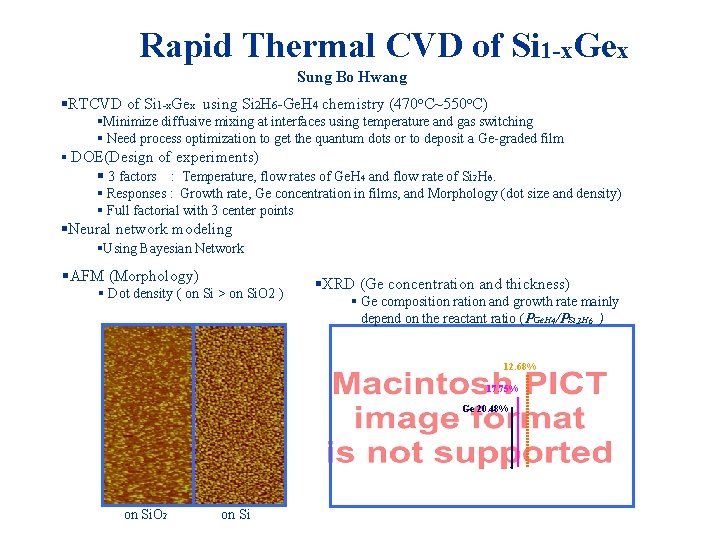
Rapid Thermal CVD of Si 1 -x. Gex Sung Bo Hwang §RTCVD of Si 1 -x. Gex using Si 2 H 6 -Ge. H 4 chemistry (470 o. C~550 o. C) §Minimize diffusive mixing at interfaces using temperature and gas switching § Need process optimization to get the quantum dots or to deposit a Ge-graded film § DOE(Design of experiments) § 3 factors : Temperature, flow rates of Ge. H 4 and flow rate of Si 2 H 6. § Responses : Growth rate, Ge concentration in films, and Morphology (dot size and density) § Full factorial with 3 center points §Neural network modeling §Using Bayesian Network §AFM (Morphology) § Dot density ( on Si > on Si. O 2 ) §XRD (Ge concentration and thickness) § Ge composition ration and growth rate mainly depend on the reactant ratio (PGe. H 4/PSi 2 H 6 ) 12. 68% 17. 75% Ge 20. 48% on Si. O 2 on Si
Modeling and Control of Rapid Thermal Processor Wonhui Cho • Multi input/output wafer heat transport dynamic model based on finite difference method (FDM) and view factor analysis • Closed loop parameter identification • Nonlinear MIMO (3 X 3) Iterative Control application to temperature uniformity control • Development of Windows NT-VME based real-time control system
Reactive Distillation Project Goals (J. Schell, S. Lextrait, J. Peng) • Operate columns – Alkylation (Condea Vista) – Etherification (TAME chemistry) • Validate existing reactive distillation simulators – Aspen’s RADFRAC (equilibrium stage) – Aspen’s Rate. FRAC (mass transfer rate) – Aspen Custom Modeler • Develop fundamental nonlinear models for comparison • Future funding by Aspentech, GOALI proposal to NSF
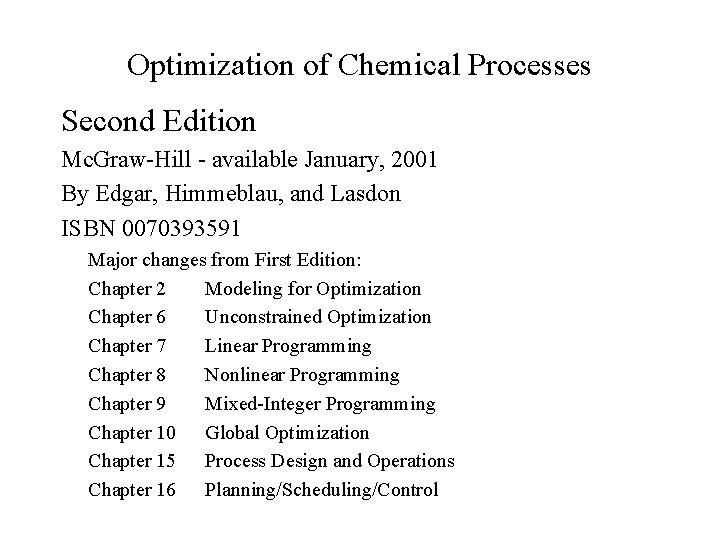
Optimization of Chemical Processes Second Edition Mc. Graw-Hill - available January, 2001 By Edgar, Himmeblau, and Lasdon ISBN 0070393591 Major changes from First Edition: Chapter 2 Modeling for Optimization Chapter 6 Unconstrained Optimization Chapter 7 Linear Programming Chapter 8 Nonlinear Programming Chapter 9 Mixed-Integer Programming Chapter 10 Global Optimization Chapter 15 Process Design and Operations Chapter 16 Planning/Scheduling/Control
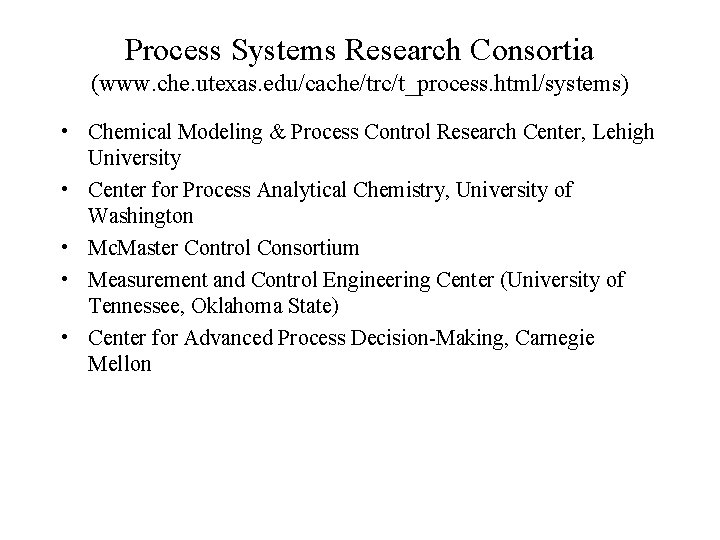
Process Systems Research Consortia (www. che. utexas. edu/cache/trc/t_process. html/systems) • Chemical Modeling & Process Control Research Center, Lehigh University • Center for Process Analytical Chemistry, University of Washington • Mc. Master Control Consortium • Measurement and Control Engineering Center (University of Tennessee, Oklahoma State) • Center for Advanced Process Decision-Making, Carnegie Mellon
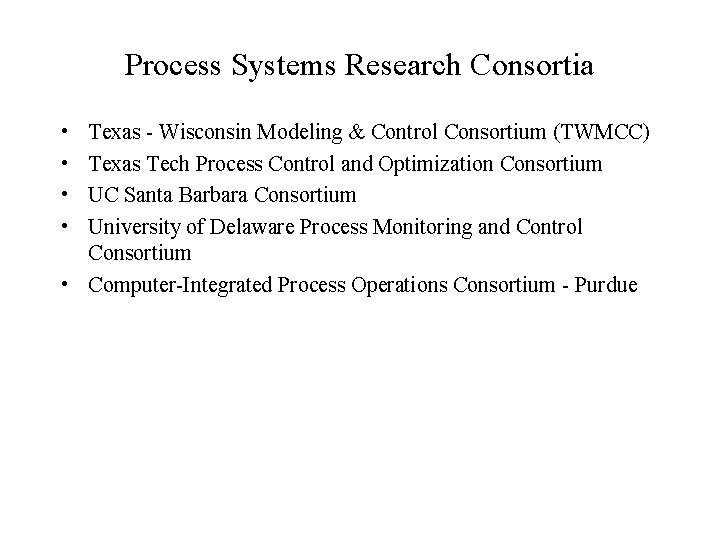
Process Systems Research Consortia • • Texas - Wisconsin Modeling & Control Consortium (TWMCC) Texas Tech Process Control and Optimization Consortium UC Santa Barbara Consortium University of Delaware Process Monitoring and Control Consortium • Computer-Integrated Process Operations Consortium - Purdue
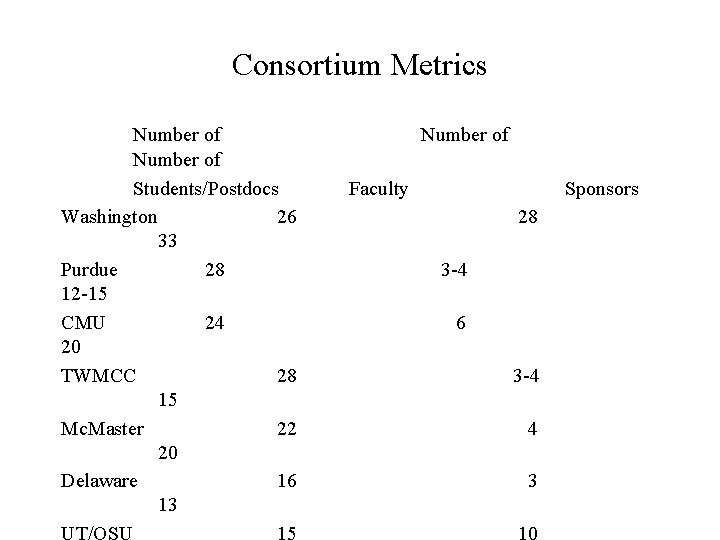
Consortium Metrics Number of Students/Postdocs Washington 26 33 Purdue 28 12 -15 CMU 24 20 TWMCC 28 15 Mc. Master 22 20 Delaware 16 13 Number of Faculty Sponsors 28 3 -4 6 3 -4 4 3
General Observations • Several operate with formal consortium agreement, previous or current government agency funding (UW, CMU, Lehigh, UT/OSU) • Two are mostly focused on analytical measurements and chemistry faculty (UW, UT/OSU) • Most use agency funds to supplement industrial contributions (UCSB, Delaware, Purdue, Lehigh, Mc. Master, CMU, TWMCC) • Some allow special membership for vendors or for hardware/software donations in lieu of cash (Delaware, UCSB) • Company fees typically range from $12, 000 (Mc. Master-in $US) to $35, 000 (UW); UCSB (Single prof) = $5000 • Most consortia meet twice per year